Ganadores y perdedores semanales del mercado de criptomonedas – TAO, CC, DOT, WLD

ambcryptoОпубліковано о 2026-03-29Востаннє оновлено о 2026-03-29

Анотація

Los principales ganadores semanales en el mercado de criptomonedas fueron TAO, con una subida del 44,7% tras romper su estructura alcista, y Memecore, que lideró el sector memecoin con un alza del 33%. Canton también destacó con una rápida apreciación del 13,47%. Otros como DeXe, FET y Chiliz registraron ganancias significativas impulsadas por narrativas de IA y expectativas de tokens deportivos. Entre los perdedores, Polkadot (DOT) cayó hasta soportes de febrero, perdiendo el nivel de $1.40, mientras que Aave extendió su tendencia bajista con una caída del 10,7%. NEAR Protocol retrocedió un 9,7%, y tokens de IA como Internet Computer (ICP) y Worldcoin (WLD) también tuvieron desempeños débiles. Bitcoin cerró la semana con una caída del 3%, defendiendo temporalmente los $65.6k, aunque la incertidumbre geopolítica y macroeconómica mantiene la volatilidad elevada en el mercado.

Bitcoin [BTC] registró una caída adicional del 3% durante la última semana, después de haber disminuido un 3,8% la semana anterior. La capitalización de mercado de las altcoins se redujo en un 1,52%, lo que significa que Bitcoin ha registrado más pérdidas que el mercado de altcoins en conjunto.

Sin embargo, muchos de los 50 principales activos cripto por capitalización de mercado estaban en rojo debido a la corrección de Bitcoin y al miedo generalizado en el mercado. Algunos tokens seleccionados superaron ampliamente al mercado.

Echemos un vistazo más de cerca a estos outperformers y sus contrapartes bajistas.

Ganadores semanales

TAO a la cabeza de las altcoins alcistas una vez más
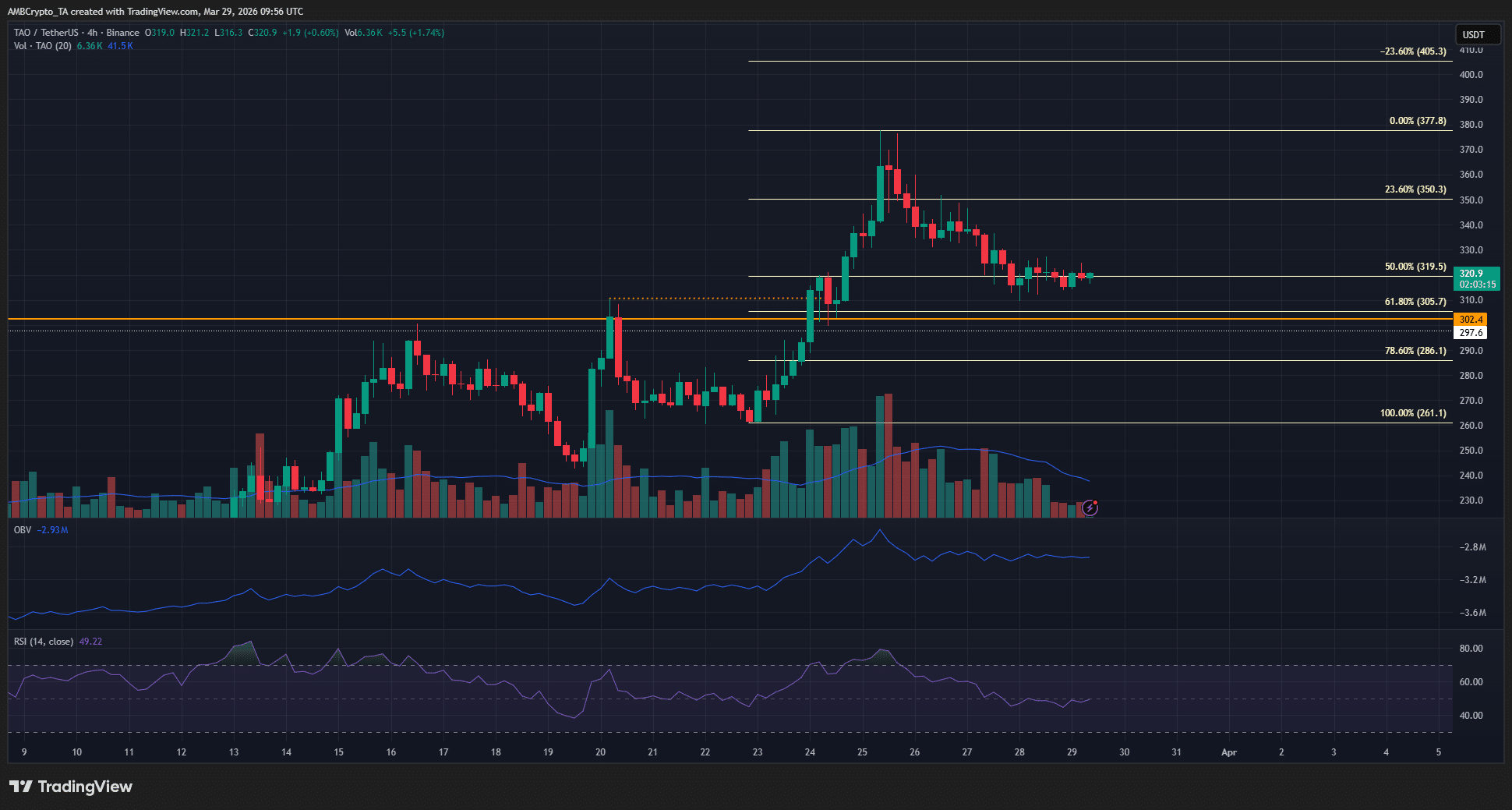
Fuente: TAO/USDT en TradingView

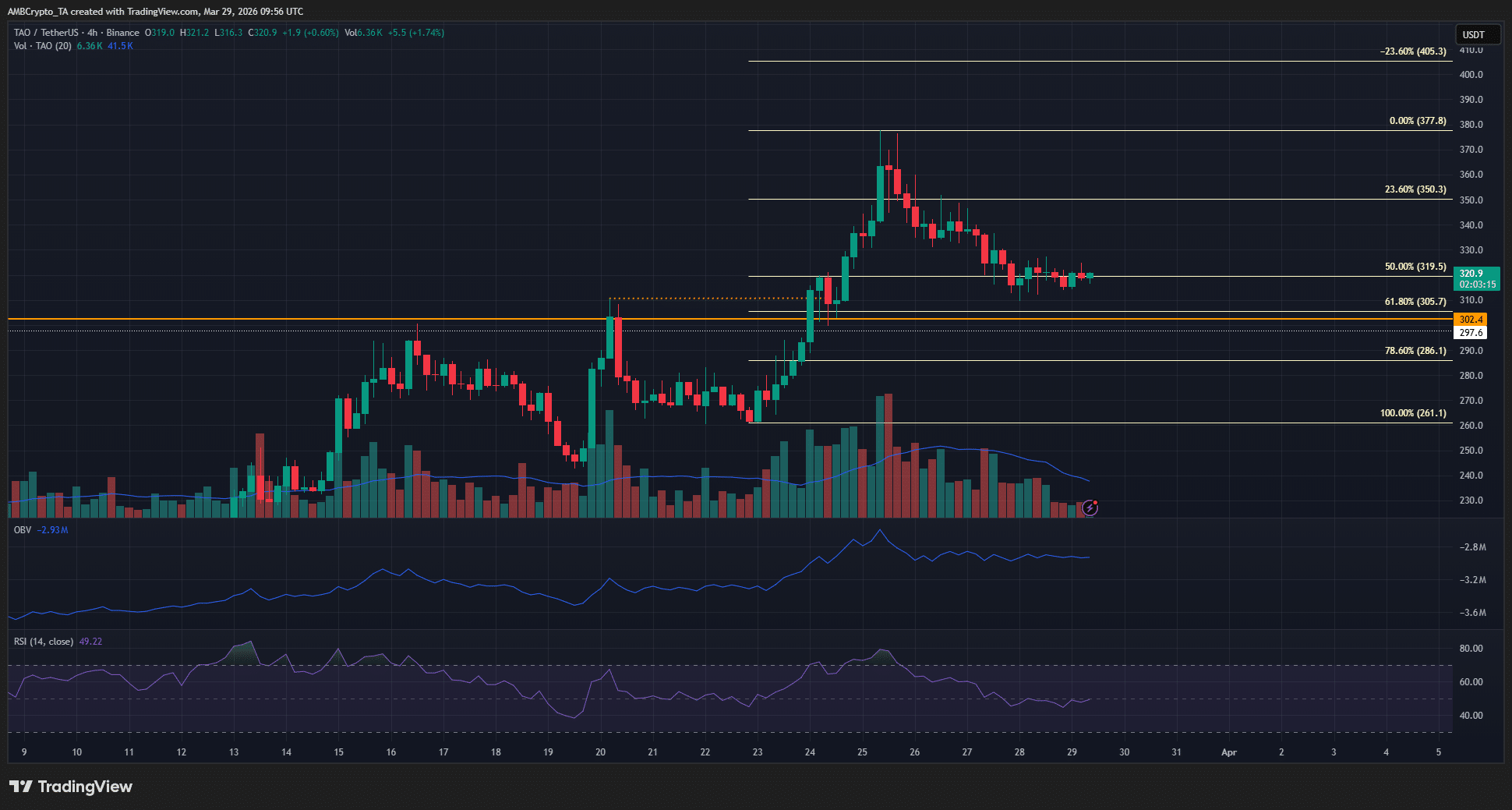
El movimiento por encima de $302 a principios de marzo rompió la estructura de 1 día de manera alcista. La semana pasada, se superó un máximo local en $310,6 (naranja punteado), mostrando una ruptura de estructura alcista. En otras palabras, Bittensor experimentó una estructura de precios alcista en múltiples marcos de tiempo.

El rally de la semana pasada fue desde $261,1 hasta $377,8, un movimiento del 44,7% en su cenit. Desde entonces, ha retrocedido al nivel del 50%. Hacia el sur, los niveles de $286 y $305 son zonas clave de retroceso a tener en cuenta.

Mientras el precio se mantenga por encima de $261, las posibilidades alcistas de TAO siguen siendo fuertes.

Memecore eclipsa a los principales memecoins con un movimiento del 33%

Los datos de Glassnode mostraron que el sector de los memecoins ha sido uno de los más destacados durante la última semana. Subió un 5,8%, mientras que Bitcoin y Ethereum [ETH] cayeron un 3,5% y un 5%, respectivamente.

Los fuertes avances de Memecore probablemente impulsaron la capitalización de mercado general de los memecoins. Otro meme, siren [SIREN], también contribuyó.

Otros memes populares como Dogecoin [DOGE], Shiba Inu [SHIB] y Pepe [PEPE] se movieron menos del 0,5% cada uno.

Canton se dispara a máximos locales después de estar en modo de retroceso en marzo

Canton fue un ganador semanal sorpresa. Se disparó un 13,47% en 12 horas el sábado 28 de marzo. La estructura de precios de marco temporal superior era alcista, pero CC ha estado retrocediendo desde $0,19 hasta $0,14 desde la primera semana de febrero.

A finales de febrero, experimentó un rally que desafió el máximo local en $0,175, con un aumento de casi un 9% en un día, antes de que continuara el retroceso. Un escenario similar podría repetirse una vez más.

Otros ganadores notables

DeXe [DEXE] y Artificial Superintelligence Alliance [FET] subieron un 18,5% y un 11,8% durante la semana. Chiliz se disparó un 11,9% debido a la especulación sobre una mayor actividad de fan tokens para la próxima Copa Mundial de la FIFA 2026.

Midnight [NIGHT] subió casi un 9% pero continuó luchando dentro de una tendencia bajista, después de enfrentar un rechazo en $0,065 a principios de marzo. Ondo [ONDO] también se disparó un 8,4% ya que los flujos de RWA reforzaron su narrativa.

Perdedores semanales

Polkadot se hunde de nuevo al soporte de febrero
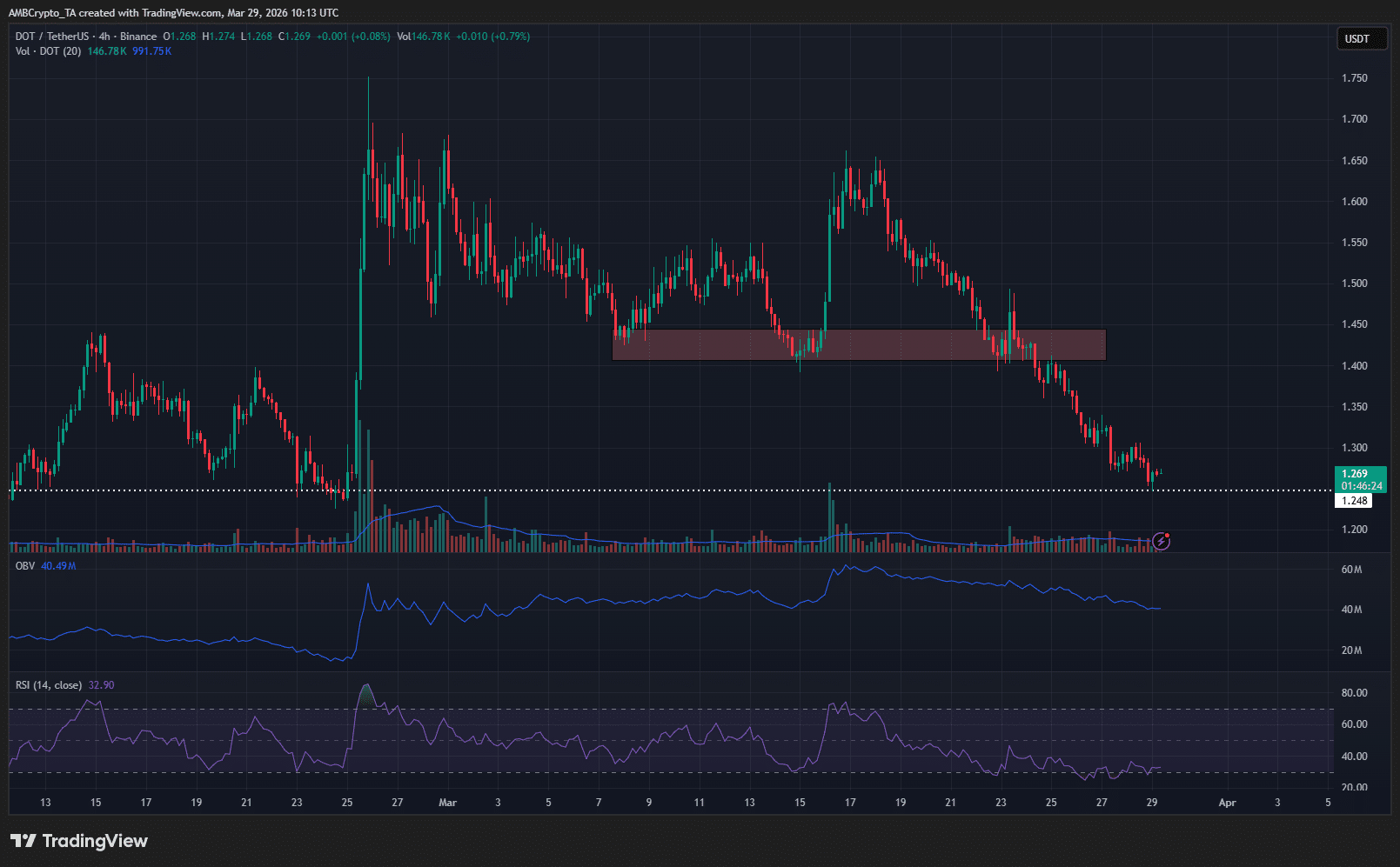
Fuente: DOT/USDT en TradingView

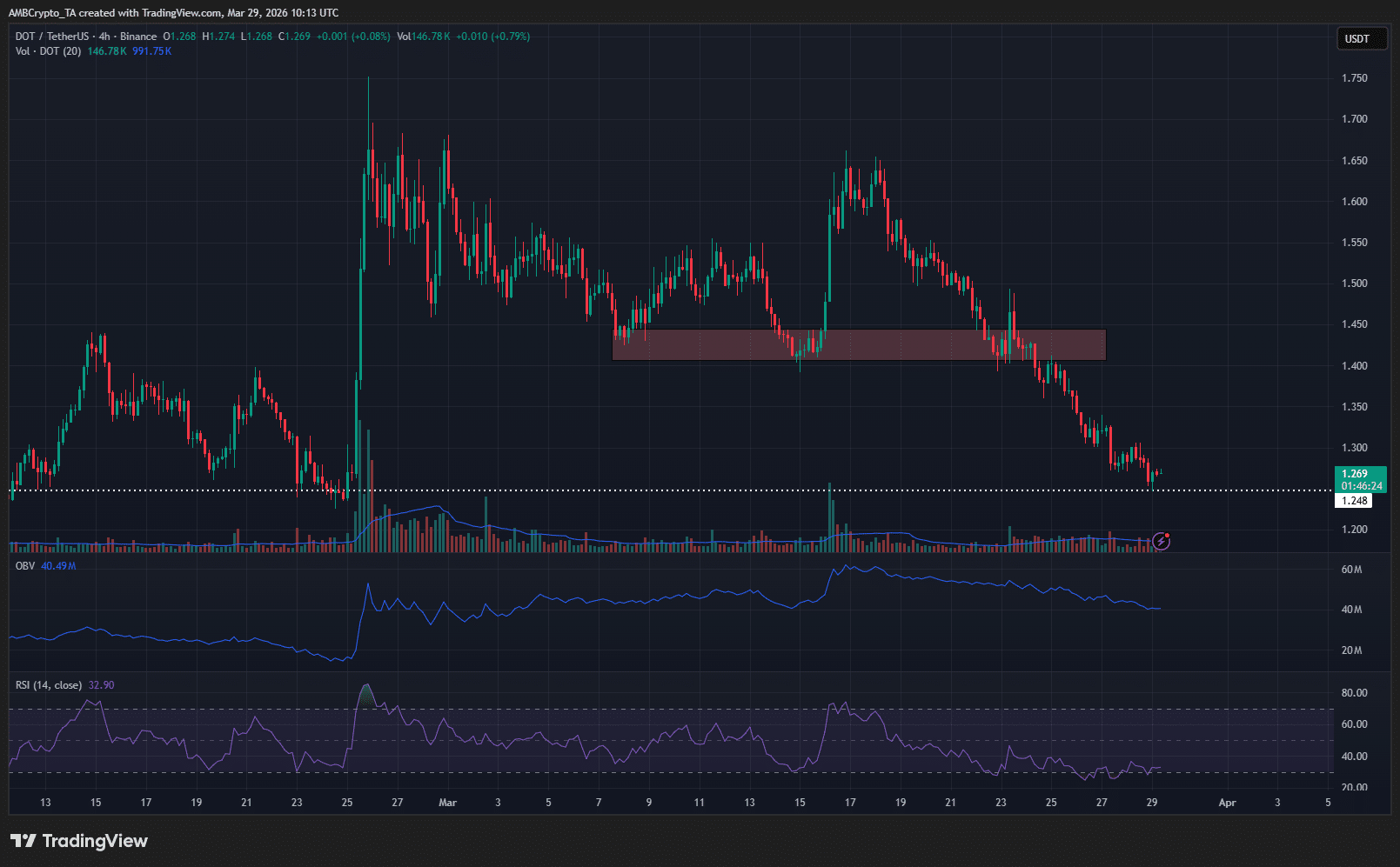
DOT ha estado en modo exclusivamente bajista en los gráficos de precios durante la última semana. El soporte de mediados de marzo en $1,40-$1,45 se probó el lunes 23 de febrero. Se mantuvo por un breve tiempo pero fue roto por la presión de venta un día después.

En el momento de escribir, el soporte de $1,25 de principios de febrero estaba bajo asedio. El RSI estaba formando una divergencia alcista con el precio en los últimos días, lo que podría producir un rebote de precio pronto.

Aave acumula pérdidas semanales considerables

El popular protocolo DeFi Aave continuó su tendencia bajista de seis meses y anotó una pérdida del 10,7% para la semana. Finalmente se rompió la zona de soporte de $100-$105 de febrero.

El aumento de las reservas en exchanges reforzó la presión de venta. Tal y como están las cosas, es probable que la altcoin registre más pérdidas.

Los precios del protocolo NEAR prueban $1,3 como resistencia antes de deslizarse a la baja

La fuerza relativa del sector de la IA se ha desvanecido, con solo algunos tokens mostrando una fuerza notable. NEAR no fue uno de ellos, habiendo perdido un 9,7% durante la última semana.

Los niveles de $1,3 y $1,2 habían sido soportes interinos establecidos a principios de mes, pero habían caído por debajo de ambos y estaban en $1,16 en el momento de escribir.

Otros perdedores notables

El errático rendimiento de los tokens del sector cripto de IA fue destacado por Internet Computer [ICP] cayendo un 7,1% durante la semana. El sector tiene tokens en ambas categorías, mostrando que los traders deben buscar altcoins selectas y fuertes y narrativas en evolución.

Ethena [ENA] y Mantle [MNT] cayeron un 6,5% y un 7,2%, respectivamente. Worldcoin [WLD] fue otro destacado desempeño débil, con una caída semanal del 12,5%.

Bitcoin está en un punto de decisión, pero la volatilidad aún podría golpear fuerte

Fue alentador que Bitcoin pudiera defender los mínimos locales de $65,6k, y Ethereum continuara por encima de $2,000. Esta estabilidad podría ser frágil. La inflación impulsada por el petróleo y las escaladas en Medio Oriente podrían poner más estrés en el mercado cripto.


Resumen final

  • DeXe y FET continuaron su estelar desempeño, con Bittensor siendo un toro líder en el sector de las altcoins.
  • Los desempeños de Memecore y SIREN dieron un giro positivo a un mercado de memecoins por lo demás estancado.


Пов'язані питання

Q¿Cuáles fueron los principales ganadores semanales en el mercado de criptomonedas mencionados en el artículo?

ALos principales ganadores semanales fueron TAO (Bittensor) con un aumento del 44.7%, Memecore con un 33% de subida, Canton (CC) con una rally del 13.47%, seguidos por DeXe (18.5%), FET (11.8%) y Chiliz (11.9%).

Q¿Por qué Polkadot (DOT) aparece como uno de los perdedores semanales?

APolkadot registró pérdidas significativas, cayendo hasta el soporte de febrero en $1.25, debido a la presión de venta y la ruptura de niveles clave de soporte previos en $1.40-$1.45.

Q¿Qué factores externos podrían afectar negativamente al mercado de criptomonedas según el artículo?

ALa inflación impulsada por los precios del petróleo y las escaladas de tensión en Oriente Medio podrían generar estrés adicional en el mercado de criptomonedas, afectando su estabilidad.

Q¿Cómo se desempeñó el sector de memecoins en comparación con Bitcoin y Ethereum?

AEl sector de memecoins tuvo un rendimiento superior, con una subida del 5.8%, mientras que Bitcoin y Ethereum cayeron un 3.5% y 5% respectivamente, gracias al impulso de tokens como Memecore y SIREN.

Q¿Qué indicador técnico sugiere un posible rebote en el precio de Polkadot (DOT)?

AEl RSI (Índice de Fuerza Relativa) estaba formando una divergencia alcista con el precio en los últimos días, lo que podría indicar un rebote próximo en el precio de DOT.

Пов'язані матеріали

The Gold Buy-on-the-Dip Guide: Watch Interest Rates, Not Just War

"Gold Buying Guide: Focus on Interest Rates, Not Just War" Four months ago, gold buyers likely didn't anticipate buying at a peak that even a war couldn't sustain. After hitting a record high of $5,596 on January 29, gold entered a bear market just 91 days later, its fastest decline since 2008. A key trigger was the Fed's hawkish shift, highlighting that monetary policy, not geopolitics, is the primary driver. The article argues that the traditional "buy gold in turmoil" script has changed. While the US-Iran conflict initially boosted prices, the sustained rally in oil prices heightened inflation fears, forcing central banks to maintain or consider tighter policy. Since gold yields no interest, higher rates increase its opportunity cost, eroding its appeal. This dynamic was evident when gold fell sharply on May 18 despite positive peace talks, as lower oil prices eased inflation and thus rate hike pressures. The recent sell-off is also part of a broader market deleveraging. Correlations between gold, Nasdaq, and Bitcoin spiked as leveraged investors sold liquid assets to cover losses, creating a synchronized downturn. Historically, gold bottoms align with policy shifts, not conflict resolutions. The 2008 and 2022 bear markets ended with shifts to extreme easing and peak inflation expectations, respectively. For potential buyers, the author suggests monitoring three signals: 1) Peak interest rate hike expectations, 2) Reopening of the Strait of Hormuz (to ease oil/inflation pressure), and 3) A return to net inflows for Gold ETFs, indicating the end of forced selling. While predicting the exact bottom is impossible, the author's personal strategy involves scaling into a position across price levels like $4000, $3700, and $3500, committing no more than 30% of the intended total allocation initially, and adding the remainder only if key signals emerge. The core conclusion: In turbulent times, watching interest rates is more crucial than watching wars.

marsbit4 хв тому

The Gold Buy-on-the-Dip Guide: Watch Interest Rates, Not Just War

marsbit4 хв тому

Recent On-Chain Review: No Clear Narrative Under U.S. Stock Market Pressure, Just Hype

This article analyzes the current state of the Solana meme coin and community token ecosystem, highlighting a market caught between two dominant forces: attention-based PvP and a gradual return to community-centric projects. The first part explores the "Attention PvP" dynamic, where success is driven by celebrity endorsements, viral events, and speed. Examples include $JOTCHUA, which surged after its meme creator's social media activity, and $WORLDCUP, which outperformed a similar Base chain project ($PITCH) largely due to influencer support. The recent "pump.fun GO" feature, allowing bounty tasks for token promotion, is critiqued for fostering sensationalist and often negative stunts—like people getting token tickers tattooed on their bodies for rewards—reminiscent of old internet shock content. In contrast, the article points to a resurgence of organic, community-driven tokens that survive market volatility through strong holder bases and shared ideology, not just hype. Influencer Ansem is cited, arguing that durable meme coins rely on communities willing to endure losses and promote their core message daily. Examples given are older tokens like $neet (anti-work ethos), $troll, $buttcoin, and $triplet, which have maintained relative price stability. A prime example of this community-build model is the new project $KINS, the token for the browser-based MMORPG Kintara. Its success stems not from advanced graphics but from consistently delivering updates, fostering player trust, and creating genuine engagement (e.g., in-game economies, events, property auctions). It has attracted a growing player base and even notable KOLs as participants, demonstrating that sustainable growth can come from building trust rather than orchestrating pumps. The article concludes by questioning whether the market is ultimately a game of mutual trust or mutual deception, expressing hope that such reflection might lead to a healthier ecosystem.

marsbit4 хв тому

Recent On-Chain Review: No Clear Narrative Under U.S. Stock Market Pressure, Just Hype

marsbit4 хв тому

On-Chain Scene on Opening Day: $20 Billion Already Staked, How Do On-Chain Contracts Know Who Wins?

On the opening day of the 2026 World Cup, over $2 billion had already been wagered on just the "tournament winner" contracts on platforms like Polymarket and Kalshi. This article explores how these blockchain-based prediction markets actually function once the games begin. It breaks down the massive volume and explains how single-game and tournament-long contracts are priced, with values moving between 1-99 cents to reflect implied probabilities. A key mechanism highlighted is "elimination zeroing," where a team's "champion yes" contract immediately settles to zero once they are mathematically eliminated. The core technical question answered is: how does a smart contract "know" who won a real-world match? The answer lies in oracles. The article details two primary paradigms: UMA's "optimistic oracle" (used by most of Polymarket), which allows a challenge period after a proposed result, and Chainlink's multi-source data aggregation (used by FIFA partners like ADI Predictstreet), which automates settlement with minimal dispute windows. Finally, the article injects a note of caution, citing research estimating that a significant portion of historical trading volume on these platforms might be "wash trading" to inflate numbers. It concludes by contrasting the legal status of these "event contracts" under CFTC rules in the U.S. versus traditional, state-regulated sports betting. As the tournament progresses, the real-time operation of this multi-billion dollar machine—its settlements, eliminations, and underlying mechanisms—becomes a story as compelling as the football itself.

marsbit19 хв тому

On-Chain Scene on Opening Day: $20 Billion Already Staked, How Do On-Chain Contracts Know Who Wins?

marsbit19 хв тому

Sequoia Dialogue with Jensen Huang: Computing Model Undergoes a 60-Year Transformation; You Won't Be Replaced by AI, But You Will Be Dimensionality-Reduced by 'Those Who Master AI'

NVIDIA founder and CEO Jensen Huang, in a conversation with Sequoia Capital's Konstantine Buhler, argues that we are witnessing the most significant computing shift in 60 years—from retrieval-based to generative computing. Instead of just storing and retrieving data, future systems will generate highly personalized content (text, images, video) on demand, powered by massive "AI factories." Huang envisions a global "intelligence network" that will envelop the planet, following the historical patterns of energy and communication grids. He outlines a five-layer investment framework: 1) Energy, 2) Chips/Computers, 3) Infrastructure (data centers), 4) AI Models, and 5) Applications. He predicts this ecosystem will reach a scale of $20 trillion annually. Crucially, Huang pushes back against fears of AI-driven job loss. He distinguishes between specific "tasks" (e.g., typing, analyzing images) and overall "jobs" (e.g., CEO, radiologist). While AI automates tasks, it increases efficiency and demand for the higher-value problem-solving aspects of professions, thus creating more jobs and "up-leveling" careers. The real risk, he asserts, is not being replaced by AI, but being outperformed by someone who effectively leverages it. He urges everyone to embrace AI as a tool for augmented capability and innovation.

marsbit1 год тому

Sequoia Dialogue with Jensen Huang: Computing Model Undergoes a 60-Year Transformation; You Won't Be Replaced by AI, But You Will Be Dimensionality-Reduced by 'Those Who Master AI'

marsbit1 год тому

Торгівля

Спот
Ф'ючерси

Популярні статті

Як купити WLD

Ласкаво просимо до HTX.com! Ми зробили покупку Worldcoin (WLD) простою та зручною. Дотримуйтесь нашої покрокової інструкції, щоб розпочати свою криптовалютну подорож.Крок 1: Створіть обліковий запис на HTXВикористовуйте свою електронну пошту або номер телефону, щоб зареєструвати обліковий запис на HTX безплатно. Пройдіть безпроблемну реєстрацію й отримайте доступ до всіх функцій.ЗареєструватисьКрок 2: Перейдіть до розділу Купити крипту і виберіть спосіб оплатиКредитна/дебетова картка: використовуйте вашу картку Visa або Mastercard, щоб миттєво купити Worldcoin (WLD).Баланс: використовуйте кошти з балансу вашого рахунку HTX для безперешкодної торгівлі.Треті особи: ми додали популярні способи оплати, такі як Google Pay та Apple Pay, щоб підвищити зручність.P2P: Торгуйте безпосередньо з іншими користувачами на HTX.Позабіржова торгівля (OTC): ми пропонуємо індивідуальні послуги та конкурентні обмінні курси для трейдерів.Крок 3: Зберігайте свої Worldcoin (WLD)Після придбання Worldcoin (WLD) збережіть його у своєму обліковому записі на HTX. Крім того, ви можете відправити його в інше місце за допомогою блокчейн-переказу або використовувати його для торгівлі іншими криптовалютами.Крок 4: Торгівля Worldcoin (WLD)Легко торгуйте Worldcoin (WLD) на спотовому ринку HTX. Просто увійдіть до свого облікового запису, виберіть торгову пару, укладайте угоди та спостерігайте за ними в режимі реального часу. Ми пропонуємо зручний досвід як для початківців, так і для досвідчених трейдерів.

149 переглядів усьогоОпубліковано 2024.12.11Оновлено 2026.06.02

Як купити WLD

Обговорення

Ласкаво просимо до спільноти HTX. Тут ви можете бути в курсі останніх подій розвитку платформи та отримати доступ до професійної ринкової інформації. Нижче представлені думки користувачів щодо ціни WLD (WLD).

活动图片