If Bitcoin (BTC) Crosses This Point, Bear Market Might Return

u.todayОпубліковано о 2022-08-15Востаннє оновлено о 2022-08-15

Анотація

According to the daily chart of the cryptocurrency, Bitcoin might be aiming at another retest of an important price level that keeps the digital gold from entering another bear cycle, which looks like the next logical target as the first cryptocurrency failed to gain a foothold above $25,000.

According to the daily chart of the cryptocurrency, Bitcoin might be aiming at another retest of an important price level that keeps the digital gold from entering another bear cycle, which looks like the next logical target as the first cryptocurrency failed to gain a foothold above $25,000.
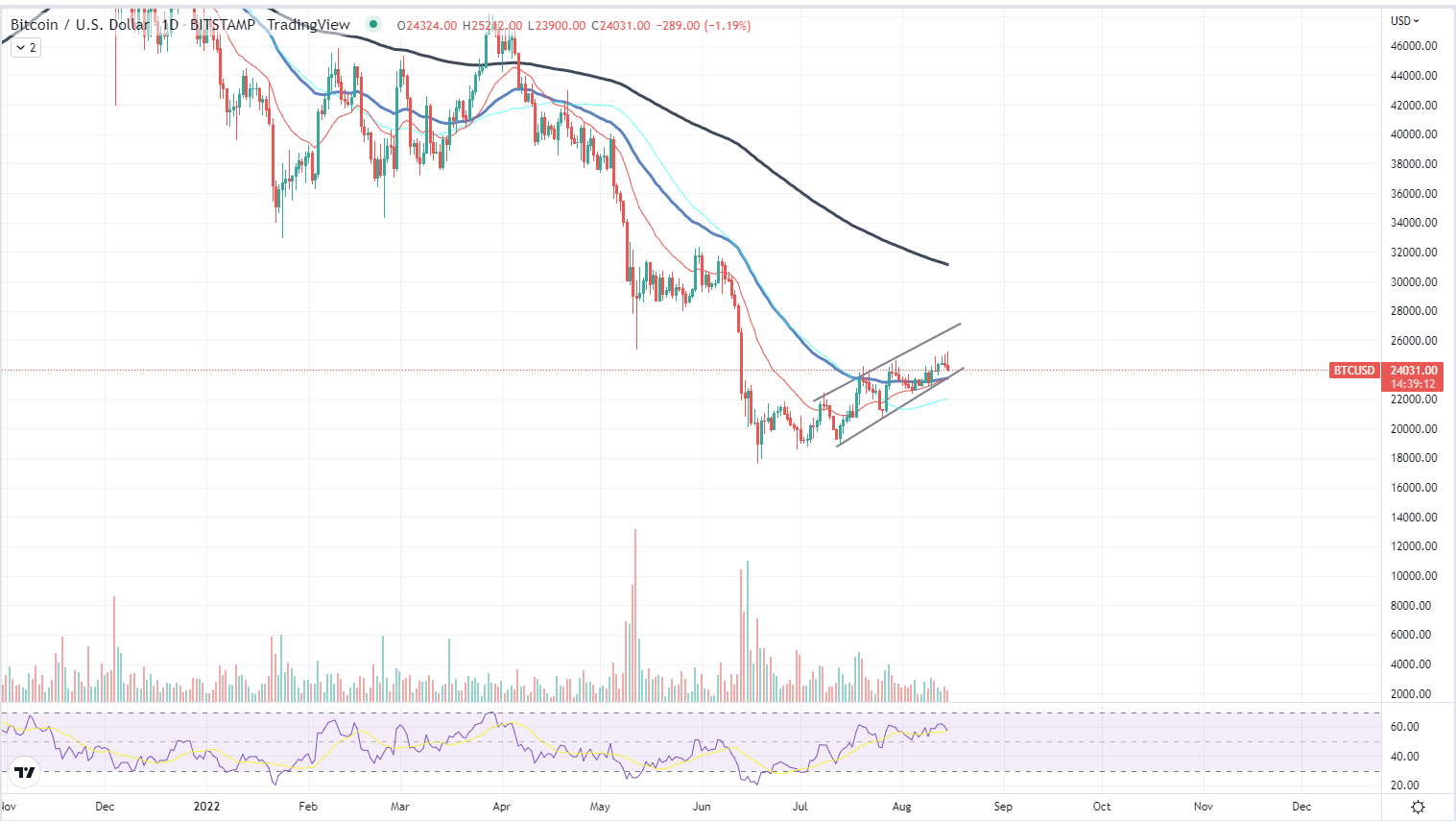
Bitcoin has been moving in the ascending wedge for more than a month after dropping below $20,000 back in June. Since then, the first cryptocurrency gained more than 25% to its value with spikes to a 30% price increase.
Bitcoin chart

Source: TradingView

Unfortunately, there was one pattern that kept the entire market cautious, which is the descending volume profile and suggested that the current trend has no support of traders and investors behind it. At some point, it might end with downward volatility when the market faces strong selling pressure again.
The exact point of the reversal would be a drop below the lower border of the wedge at approximately $23,400. Luckily, the threshold correlates with the important support level of the 50-day moving average that usually acts like a guideline for trending assets.
As for now, there is nothing left but to wait and watch the course of events this week. In addition to the aforementioned negative factors around Bitcoin, we are not seeing a spike in institutional inflows that usually act as fuel for the rally of the first cryptocurrency.
On the bright side, the short-term rally on the cryptocurrency market has shown that the sentiment around investors remains positive despite the most recent plunge to $17,000 that caused the return of panic and desperation to the market.

Пов'язані матеріали

US Government Lifts Ban on Crypto Perpetual Contracts for the First Time: What Does It Mean for the Market?

The U.S. Commodity Futures Trading Commission (CFTC) has issued guidance permitting 24/7 trading and clearing for crypto asset derivatives, effectively opening the U.S. market to crypto perpetual contracts for the first time. This move ends the previous ban and allows American individuals and institutions to trade these instruments around the clock. Direct beneficiaries include Kalshi, which received approval to list a Bitcoin perpetual contract; Coinbase, now the first CFTC-regulated futures commission merchant for U.S. clients to access global crypto derivatives; and CME, which will transition its Bitcoin futures and options to 24/7 trading. The CFTC emphasized this is a specific allowance for crypto assets, noting that traditional commodities like agriculture may not be suitable for non-stop trading. It also requires platforms to undergo case-by-case reviews for compliance and risk management. Industry leaders like Michael Saylor and Brian Armstrong praised the decision for integrating Bitcoin into capital markets and granting U.S. users access to a major global market segment. However, consumer advocacy group Better Markets criticized the CFTC for allegedly neglecting investor protection and favoring the industry it regulates. Other platforms like Kraken have announced plans to launch regulated perpetual futures for the U.S. market. The policy shift is expected to redirect significant liquidity and institutional participation to the newly accessible U.S. crypto derivatives landscape.

Odaily星球日报7 год тому

US Government Lifts Ban on Crypto Perpetual Contracts for the First Time: What Does It Mean for the Market?

Odaily星球日报7 год тому

How the CLARITY Act Reshapes the Stablecoin Yield Economy

The CLARITY Act, recently advanced by the U.S. Senate Banking Committee, fundamentally reshapes the stablecoin yield economy by closing loopholes left by the earlier GENIUS Act. Its Section 404 expands the ban on "hold-to-earn" rewards to all Digital Asset Service Providers (DASPs) and their affiliates, prohibiting any passive, interest-like yield. Crucially, it introduces a legal distinction, permitting "use-to-earn" rewards based on actual activities like spending, trading, or staking. In anticipation of this regulatory shift, major Wall Street asset managers—Morgan Stanley, BlackRock, and JPMorgan—have launched a series of tokenized money market funds (e.g., BlackRock's BRSRV, JPMorgan's JLTXX) designed explicitly for stablecoin reserve assets. These products represent a new, compliant yield layer: the stablecoin issuer earns interest from the underlying tokenized fund, which can then be passed to users through redesigned activity-based rewards. This marks a paradigm shift from a "hold-to-earn" to a "use-to-earn" market. While pathways remain for exchanges to redesign rewards (Path A) and for DeFi protocols to offer yield (Path B), the tokenized reserve asset layer (Path C) emerges as the most robust and strategically positioned infrastructure. However, this concentration—exemplified by BlackRock's BUIDL fund backing over 90% of USDtb's reserves—introduces new systemic risks. The final outcome hinges on regulatory decisions, particularly the OCC's proposed 20% cap on tokenized assets in reserves, which will determine the scalability of this new financial infrastructure layer.

marsbit9 год тому

How the CLARITY Act Reshapes the Stablecoin Yield Economy

marsbit9 год тому

Торгівля

Спот
Ф'ючерси
活动图片