First Mover Asia: Was the Metaverse All Just a Dream?

CoinDeskОпубліковано о 2022-08-02Востаннє оновлено о 2022-08-02

Анотація

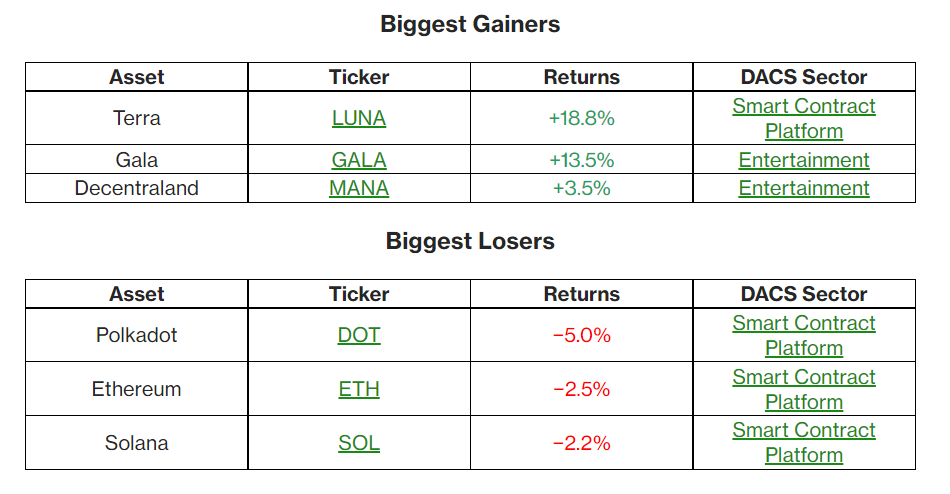
Bitcoin has fallen for four straight days, but the (small-ish) scope of the price decline offers a reminder of how listless digital-asset markets have suddenly become. Sam Reynolds tots up the losses on metaverse-related tokens.

Good morning. Here’s what’s happening:

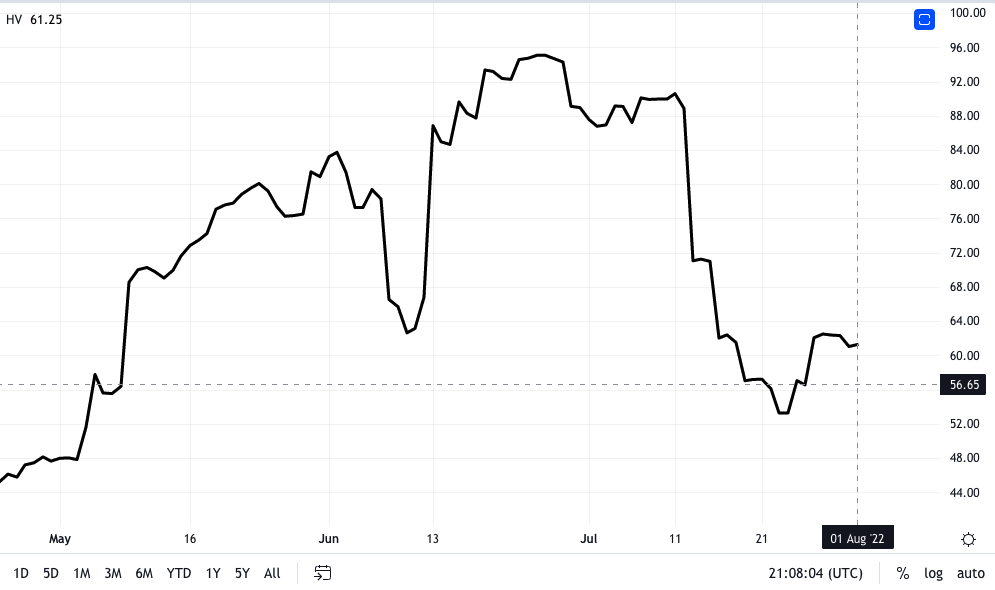
Prices: Bitcoin falls for fourth straight day as traditional markets struggle. Declining volatility in the cryptocurrency's price shows how far digital-asset markets have come since the nervy days of mid-June. (Wells Fargo's still a long-term believer, for what it's worth.)

Insights: Meta's Mark Zuckerberg acknowledges that the metaverse could be a long time in the making. Metaverse-related cryptocurrencies are undergoing their own reality check, having lost $10.9 billion of their market capitalization in the second quarter.

Prices

●Bitcoin (BTC): $23,179 −0.8% ●Ether (ETH): $1,630 −2.8% ●S&P 500 daily close: 4,118.63 −0.3% ●Gold: $1,770 per troy ounce +0.4% ●Ten-year Treasury yield daily close: 2.61% −0.04

Bitcoin has fallen for four straight days. But as market volatility ebbs, the price slide doesn't look like much to worry about.

By Bradley Keoun

Bitcoin (BTC) was lower for a fourth straight day, but there wasn't much to panic about because the price drops have been pretty modest by the standards of usually-volatile cryptocurrency markets: Over the four-day slide, the cumulative price drop is less than 4%.

That's pretty harmless for an asset whose price has been known to fall 16% in a single day.

The listlessness might be a sign that the Northern Hemisphere is entering the dog days of summer, during a (largely) post-pandemic stretch when many people really are taking vacations for the first time in years.

Or it might be a sign of just how little there is in the way of any firm direction in markets, torn between the angst of wondering if the U.S. economy meets the definition of a recession and if the Federal Reserve must still keep ratcheting monetary policy tighter to wring out inflation trending at its fastest in four decades.

Trading volume is light.
One sign of hope for the bulls: Despite this year's crash in crypto markets, traditional financial firms are still keenly interested in the long-term prospects: "We believe digital assets are a transformative innovation on par with the internet, cars and electricity," analysts for the U.S. bank Wells Fargo wrote on Monday. They were quick to add: "At such an early stage of investment development, many investment risks remain."

There's less carnage in the news these days and what appears to be a return to development: The crypto exchange Huobi says it's now able to operate in Australia, and July marked the strongest month of digital-asset fund inflows this year. Coinbase Prime added Ethereum staking for U.S. institutional clients.
Insights

Tens of Billions of Investor Dollars Are Flowing Away From the Metaverse

By Sam Reynolds

Investors are souring on the dream of the metaverse, regardless whether its Meta's superset of virtual reality, augmented reality and the internet – or crypto's cocktail of virtual reality, augmented reality and blockchain.

“We hope to basically get to around a billion people in the metaverse, each doing hundreds of dollars of commerce buying digital goods, digital content, different things to express themselves, so whether that’s clothing for their avatar or different digital goods for their virtual home or things to decorate their virtual conference room, utilities to be able to be more productive in virtual and augmented reality and across the metaverse overall,” is how Mark Zuckerberg described the dream on CNBC’s Mad Money with Jim Cramer.
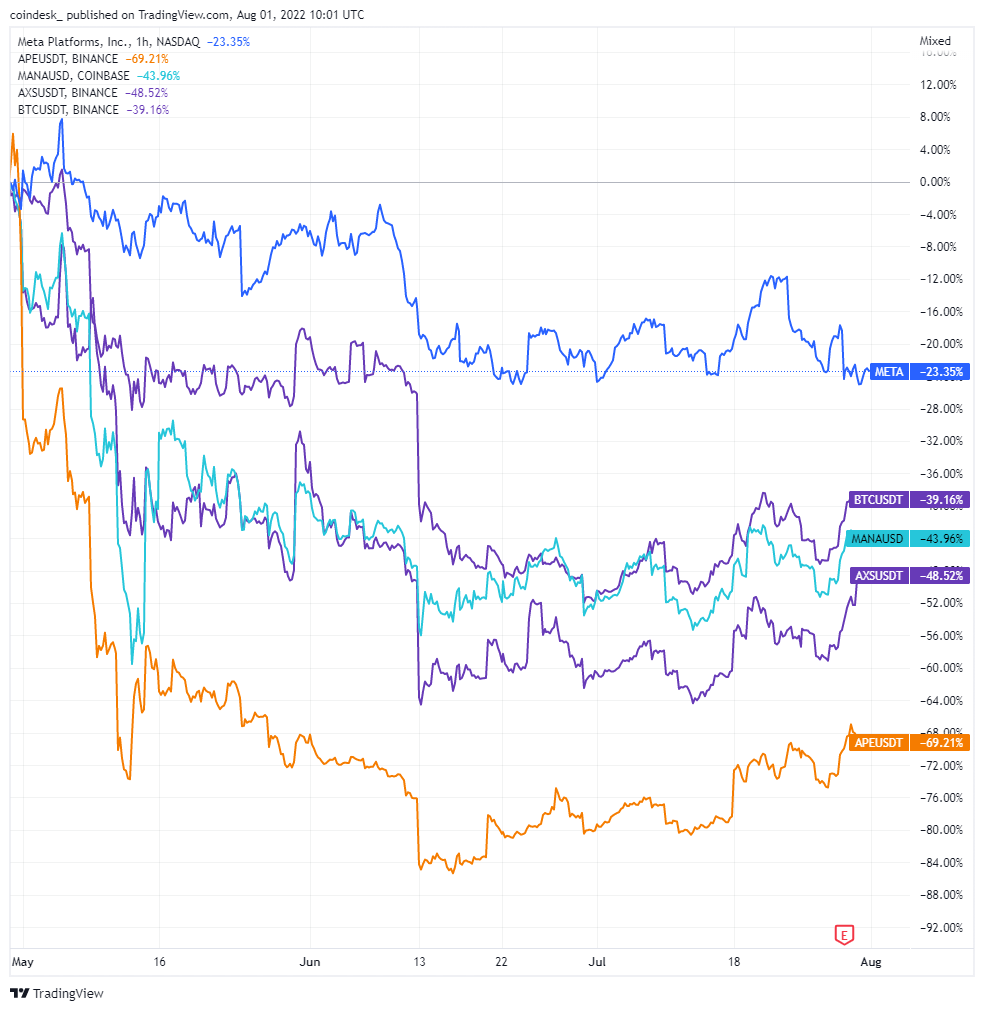
But this vision isn’t at odds with reality. In recent earnings, Meta reported a $2.8 billion loss on its Facebook Reality Labs (FRL) division, home to the augmented and virtual reality operations.

According to 13F filings (a form institutional investors must file quarterly with the Securities and Exchange Commission) aggregated by Whale Wisdom, $21.5 billion in institutional capital flowed out of Meta during the last quarter.

The crypto metaverse isn’t doing much better. Facing a user base that seems to refuse to materialize, and intense market headwinds because of the broader crypto decline, most of the major metaverse tokens saw their market caps dip by over a third as valuations of cryptocurrencies dropped.
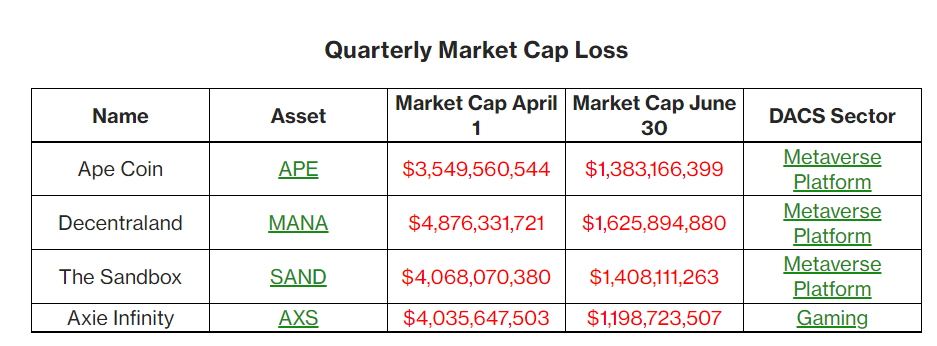
All in all, $10.9 billion departed from the metaverse majors as their market cap deflated. As of late afternoon Asia time on Aug. 1, Decentraland had 803 total online users whereas Steam, an online gaming community, had just under 20 million.

Mark Zuckerberg, Meta’s founder, admits that the current engagement ratio to profitability is a problem. Meta’s virtual world, Horizon Worlds, is said to have 300,000 sign-ups but there’s no publicly available count on active players.

“This is obviously a very expensive undertaking over the next several years,” Zuckerberg said during a recent analysts call. “But as the metaverse becomes more important in every part of how we live, I’m confident that we’re going to be glad we played an important role in building this.”

For a point of comparison, Facebook gained its first million users in less than a year at a per-user acquisition cost that’s infinitely smaller than the company’s pivot to the metaverse. Eight years later, it hit its billionth user.

Zuckerberg’s Meta, and the crypto metaverse majors are nowhere near to following this trajectory. Is this really the future of virtual interaction?


Пов'язані матеріали

To Those Ordinary People Who Haven't Invested in AI: You Think You're Late, You're Just Lacking Your Own Worldview

**Summary:** The article argues that ordinary investors feeling FOMO over missing the AI investment boom lack not timing, but their own independent worldview. Most people chase "what to buy" based on others' opinions (FOMO, envy) rather than fundamental analysis. This leads to costly mistakes: not knowing when to exit winning trades or cut losses on losing ones. The core solution is to develop a personal, long-term (5-10 year) worldview about societal shifts and technological bottlenecks. For most, building this from scratch (Path A) is too demanding. A practical alternative (Path B) is to follow the **capital expenditures (capex)** and strategic investments of visionary leaders, as their money reveals true conviction more reliably than their words. Five key figures to track for different AI perspectives are highlighted: Jensen Huang (NVIDIA, infrastructure), Elon Musk (Tesla/SpaceX/xAI, capex signals), Sam Altman (OpenAI, commercialization, but beware hype), Dario Amodei (Anthropic, technical/safety focus), and Liang Wenfeng (DeepSeek, efficiency/anti-consensus view). The article details how to read capex signals from hyperscalers' financial reports, NVIDIA's revenue breakdown, and strategic investments. It maps the complete AI产业链 (supply chain) from raw materials/energy to models/applications, explaining value flow and inter-dependencies (e.g., how a model release triggers demand across chips, memory, and optics). Finally, it provides an action plan: secure personal finances first, allocate a limited portfolio percentage (max 25%) to the theme, prefer broad ETFs (like QQQ), use dollar-cost averaging over 6-12 months, and write down strict investment rules beforehand to combat emotional errors during market volatility. The conclusion is that a stable, personally-held worldview enables disciplined, long-term investment far more than chasing short-term trends.

marsbit24 хв тому

To Those Ordinary People Who Haven't Invested in AI: You Think You're Late, You're Just Lacking Your Own Worldview

marsbit24 хв тому

Microsoft Halts Vibe Coding: "Burning Tokens" Is Now More Expensive Than Employees

Microsoft has halted the widespread internal use of Claude Code, withdrawing licenses from most employees by the end of its fiscal year, June 30, 2026. This reversal comes just six months after actively promoting the AI coding tool to boost productivity via "vibe coding"—where developers describe intent in natural language and let the LLM generate code. The core issue isn't the tool's effectiveness; internal reports suggest employees preferred Claude Code over Microsoft's own Copilot CLI. The problem is financial: the "copilot mode" adds a variable, consumption-based token cost on top of existing employee salaries without a proportional revenue increase. As usage grew, the token bills became unsustainable, leading to what sources describe as a cost-structure failure. Similar overruns have been reported at other firms like Uber. The article contrasts this with the approach of AI-native startups, exemplified by Y Combinator's philosophy. Here, high token consumption is strategic—it replaces, rather than supplements, human labor. Startups operate with tiny teams where AI agents handle work previously done by many, making the high token bill financially viable as it offsets much larger personnel costs. The conclusion is that "vibe coding" isn't dead, but its economics fail within traditional corporate structures that treat AI as a productivity add-on for existing staff. Success requires a foundational shift to an AI-native organization, where processes are built to be "legible to AI," and the company's core knowledge and assets reside in documented, AI-accessible systems rather than solely in employees' minds. The future divide will be between companies that merely add AI tools and those that redesign their organizations around them.

marsbit44 хв тому

Microsoft Halts Vibe Coding: "Burning Tokens" Is Now More Expensive Than Employees

marsbit44 хв тому

Metrics Ventures Market Watch: The Brewing Storm

In the past month, the market has been actively trading contrasting expectations, balancing global supply chain disruptions fueling re-inflation against both actual and anticipated (Walsh) interest rate hikes. This volatility has impacted commodities and most equities, though tech has temporarily benefited from concentrated short-term liquidity. Fundamentally, as previously analyzed regarding the Strait of Hormuz situation, the US faces deep-seated balance sheet issues beyond what any single Fed chair can resolve. Hypotheses around a figure like Walsh could only materialize if AI fundamentally reshapes production relations. Until then, most non-AI-leading nations (effectively all except the US and China) risk fiscal and monetary policy collapse, rendering the identity of the Fed chair ultimately irrelevant. For crypto assets, there is currently no clear role in these dominant narratives. The market remains strongly capped by the 200-day moving average. While trends may shift from "anything but AI" to "anything but mines," this phase is dominated by the silicon vs. carbon (AI vs. traditional) dichotomy, leaving little room for crypto—though its time will come. **Market Overview & Commentary** The crypto market lacks significant catalysts beyond hype, plagued by low volume and scarce innovation, with clear technical resistance. Currently, crypto struggles for attention as global focus lies elsewhere. Assets like gold, oil, and grains are more direct hedges against supply-chain-driven inflation/stagflation. Bitcoin needs more time for capitulation and consolidation; this reset is expected to last until at least Q4 2026. Looking ahead, three factors will likely drive future market volatility: 1. Whether Walsh repeats the patterns of predecessors like Bassant or Musk, shifting stance into a new policy cycle. 2. The market underestimates the severity of global supply chain damage and the prolonged time needed for repair, which will eventually lead to recognition of acute resource shortages and price swings. 3. AI non-beneficiary, high-inflation nations (e.g., UK, Japan) will face severe fiscal and monetary crises. Rapid AI-driven displacement could trigger a collapse of existing credit and welfare systems. Ultimately, the market may realize that an AI bubble burst could spark contagious sovereign credit crises. The monetary and fiscal responses to such a scenario could serve as the ultimate catalyst for Bitcoin's next major bull run.

marsbit1 год тому

Metrics Ventures Market Watch: The Brewing Storm

marsbit1 год тому

Торгівля

Спот
Ф'ючерси
活动图片