Forbes Editorial: The Most Accurate Short Signal in the Crypto World?

marsbitОпубліковано о 2026-02-06Востаннє оновлено о 2026-02-06

Анотація

Forbes magazine covers have become an infamous bearish signal in the crypto world, often marking the peak of market cycles just before major crashes. The article highlights three key examples: 1. **CZ (2018)**: Featured on the cover during Bitcoin's downturn from its late-2017 high. Bitcoin fell 58% after the issue. 2. **SBF (2021)**: Called "crypto's most powerful man" before FTX collapsed 13 months later, wiping out billions. 3. **Michael Saylor (2025)**: Dubbed "The Bitcoin Alchemist" near Bitcoin's $104K peak. A year later, Bitcoin dropped 40%, and his company faced $6.5B in unrealized losses. The "magazine cover indicator" suggests mainstream media attention often coincides with market euphoria and impending reversals. While Sun Yuchen’s March 2025 cover briefly defied the trend (as Bitcoin continued rising), multiple crypto covers in quick succession were themselves a signal of overheated sentiment. The conclusion: bull markets don’t end in panic—they end on magazine covers. When a trend becomes too popular and even non-traders are talking about it, it may be time to reconsider positions.

Author: Curry, Deep Tide TechFlow
Bitcoin recently hit $60,000, marking the largest single-day drop since the FTX collapse.

Michael Saylor's company, Strategy (formerly MicroStrategy), holds 713,000 bitcoins with an average cost of $76,052. As of last night, the unrealized loss reached $6.5 billion. The stock price has plummeted from a high of $457 last year to $110, wiping out more than three-quarters of its value.

However, a year ago, Saylor graced the cover of the renowned magazine Forbes. The headline read:

The Bitcoin Alchemist. At that time, Bitcoin was priced at $104,000, and Saylor's net worth was $9.4 billion.

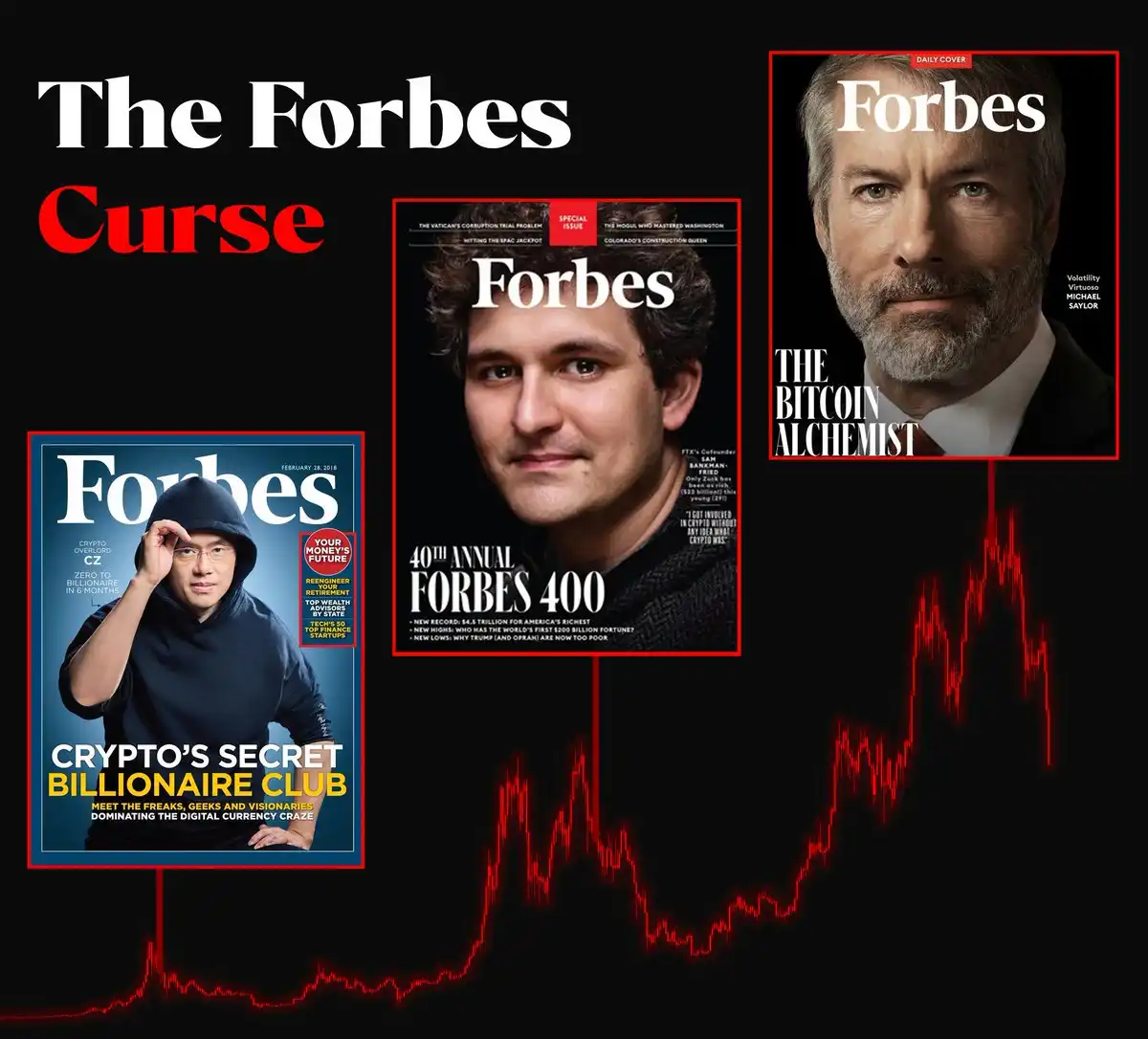
Now, a chart circulating on Twitter lines up three Forbes covers with Bitcoin's price chart. Each cover perfectly marks the starting point of a sharp decline.

Of these three individuals, one has been to prison, one is currently in prison, and the third just lost $6.5 billion.

The Cover: Captured at the Peak of Hype

The first crypto figure to appear on a Forbes cover was CZ.

In February 2018, Forbes featured a cover titled "Crypto's Secret Billionaire Club," with CZ standing in the center, hoodie on, exuding a rugged aura. The fine print read:

From zero to billionaire in just 6 months.

At that time, Bitcoin had just fallen from nearly $20,000 at the end of 2017 to around $7,600. Forbes estimated CZ's net worth to be at least $1.1 billion. Binance, only six months old, was already the world's largest exchange by trading volume.

After the cover was released, Bitcoin briefly rebounded to $10,000. Then, it went nowhere but down.

By December 2018, Bitcoin had fallen to $3,156. From the day the cover was published, the decline was:

58%.

CZ's later story is well-known. On Forbes' 2025 global billionaires list, CZ's net worth was $62.9 billion, ranking first in the crypto industry.

But he hasn't appeared on the cover since.

The second Forbes cover featured Sam Bankman-Fried.

In October 2021, Forbes released its 40th Forbes 400 Richest Americans list, with SBF as the cover star. Under 30 years old, with a net worth of $26.5 billion, he ranked as the 41st richest person in the U.S.

On the cover, he wore his signature gray T-shirt, with curly hair, looking like a college student who had just pulled an all-nighter playing League of Legends.

In hindsight, the magazine's tone was surreal. Forbes called him "the most powerful person in the crypto industry," praising him for building an exchange while donating to charity, a blend of Wall Street and Silicon Valley.

When the cover was released, Bitcoin was around $60,000, just a step away from its then-all-time high of $69,000.

Thirteen months later, FTX collapsed.

SBF had misappropriated over $8 billion in customer funds to cover losses at his other company, Alameda Research. In November 2022, users rushed to withdraw their assets, and FTX couldn't meet the demand. Within a week, the world's third-largest exchange went bankrupt. Bitcoin plummeted from $20,000 to $16,000.

Eventually, SBF was arrested in his luxury apartment in the Bahamas.

He was convicted on all seven charges and sentenced to 25 years in prison. Forbes later created a "30 Under 30 Hall of Shame," with SBF prominently featured.

From cover to handcuffs:

13 months.

The third was Michael Saylor.

On January 30, 2025, the Forbes cover featured "The Bitcoin Alchemist." Bitcoin had just broken through $100,000, and Saylor's net worth had surged from $1.9 billion the previous year to $9.4 billion, nearly a fivefold increase. His company, MicroStrategy, saw its stock price rise 700% in a year and was newly included in the Nasdaq 100 index.

The Forbes article recorded a detail:

On New Year's Eve, Saylor hosted a 500-person party at his estate in Miami. Dancers waved orange Bitcoin glow balls, and outside, a 154-foot yacht named Usher ferried institutional investors and crypto industry leaders to the event.

At the time, Saylor told Forbes:

"We've put a crypto reactor in the middle of the company, sucking in capital and spinning it. Volatility drives everything." This statement was, of course, sincere. Saylor's alchemy boils down to one thing: issuing debt to buy Bitcoin.

When the Forbes cover was released, Bitcoin was at $104,000. One year and six days later, it's at $63,000. A decline of:

40%.

Saylor said on an earnings call that Strategy had built a "digital fortress."

The last crypto mogul to call his company a "fortress" was SBF. That was in June 2022. Five months later, FTX went bankrupt.

The Cover: Both Praise and Curse

There's an old Wall Street concept called the "magazine cover indicator":

When a trend makes it to the cover of a mainstream magazine, that trend has often already peaked.

The reasoning is simple. Forbes editors aren't prophets; like all retail investors, they only notice a story when it's at its most hyped.

The moment a magazine deems "someone in some industry worthy of a cover" is precisely the moment when market frenzy has reached its peak.

The cover isn't the cause of the curse; it's a symptom of the bubble.

However, there was one brief exception to this rule.

In March of last year, Justin Sun graced the Forbes cover with the headline "The Crypto Billionaire Who Helped the Trump Family Make $400 Million."

When the cover was released, Bitcoin was at $87,000. It didn't crash; instead, it rallied to a historic high of $126,000 in October.

Did the curse fail?

Not entirely. When Sun appeared on the cover, it was only two months after Saylor's. One cover in January, another in March—the密集 appearance of crypto figures on mainstream magazine covers was itself a signal. It indicated that the industry's narrative had become so hot that even Forbes editors felt one issue wasn't enough.

When covers start appearing in clusters, in hindsight, the peak of a bull market might have a checklist of symptoms:

Forbes covers, taxi drivers discussing crypto, relatives asking how to open an account... If two out of three signals appear, it's time to think about your position.

So, the real question isn't "Is the Forbes cover accurate?" but rather:

When everyone around you is telling the same story, when that story is so good that even people who don't trade crypto have heard of it, when mainstream media starts deifying figures in an industry...

Are you the one still buying, or the one already selling?

Bull markets don't end in panic. They end on magazine covers.

It's just that the cover stars may change, but the long bear market is always paid for by me.

Трендові криптовалюти

Пов'язані питання

QWhat is the 'magazine Cover Indicator' mentioned in the article, and how does it relate to the cryptocurrency market?

AThe 'Magazine Cover Indicator' is an old Wall Street concept suggesting that when a trend or person makes the cover of a mainstream magazine like Forbes, it often signals that the trend has peaked and is about to reverse. In the context of the cryptocurrency market, the article argues that Forbes covers featuring crypto billionaires like CZ, SBF, and Michael Saylor have each coincided with the start of a major price crash, as the cover is a symptom of peak market euphoria and mainstream attention.

QAccording to the article, what happened to Bitcoin's price after Michael Saylor appeared on the cover of Forbes?

AAccording to the article, when Michael Saylor appeared on the cover of Forbes on January 30, 2025, Bitcoin was priced at $104,000. One year and six days later, the price had fallen to $63,000, representing a decline of 40%.

QWho were the three crypto figures featured on Forbes covers, and what were their respective outcomes?

AThe three crypto figures featured on Forbes covers were: 1. CZ (Changpeng Zhao): Featured in February 2018. Bitcoin fell 58% after his cover. He later became the wealthiest person in crypto but faced legal issues. 2. Sam Bankman-Fried (SBF): Featured in October 2021. FTX collapsed 13 months later, and SBF was arrested and sentenced to 25 years in prison. 3. Michael Saylor: Featured in January 2025. His company, MicroStrategy, faced billions in unrealized losses on its Bitcoin holdings, and the price fell 40% after the cover.

QWhy does the article claim that a Forbes cover is a symptom of a market top and not the cause of a crash?

AThe article claims that a Forbes cover is a symptom, not a cause, because magazine editors are not prophets. They only feature a trend or person on the cover when the story is at its most popular and mainstream attention is at its peak. This moment of maximum hype and widespread recognition often coincides with the top of a market cycle, making the cover an indicator of excessive euphoria rather than a catalyst for the subsequent decline.

QWhat exception to the 'Forbes cover curse' does the article mention, and how does it explain this anomaly?

AThe article mentions that Justin Sun (Sun Yuchen) appeared on the cover of Forbes in March of an unspecified year (likely 2025), and instead of crashing, Bitcoin's price continued to rise to a new all-time high of $126,000 by October. The article explains this anomaly by stating that the curse wasn't entirely broken. The fact that crypto figures appeared on Forbes covers so frequently (Saylor in January, Sun in March) was itself a signal that the market narrative was overheated. The high frequency of covers was a symptom of the peak, even if the immediate crash for one specific cover was delayed.

Пов'язані матеріали

2026 Mid-Year Report On-Chain RWA: Tokenized Stock Market Cap Doubles in a Year, But 90% of Rights Are Hollow Shells

The 2026 Mid-Year Report on On-Chain RWA highlights a significant growth in tokenized stock market capitalization, which nearly doubled from $951 million in March to $1.89 billion by July. However, the report reveals a fundamental contradiction in this "layer 2.5" ecosystem: products with the strongest legal foundation (like regulated U.S. infrastructure) lack liquidity and distribution, while freely tradable offshored wrapper products often lack substantive ownership rights. The increase is driven largely by a few products (SECZ, FGRS, STRCx) and platforms (Ondo, xStocks, Securitize collectively hold over 85% share). While distributed value across networks like Ethereum, Solana, and BNB Chain has grown, the market remains fragmented. Products referencing the same underlying asset (e.g., Apple stock) are distinct legal liabilities with different intermediaries and jurisdictional rules, offering varying degrees of legal claim. The report cautions that headline numbers are misleading, as they reflect changes in distributed token value—driven by issuance, conversions, and price movements—not pure investor inflows. True "canonical shares" with legal ownership, wide wallet distribution, institutional liquidity, and independent on-chain price discovery do not yet exist at scale. Tokenized treasuries show stronger product-market fit, and ETFs may be easier to scale than single stocks. The core takeaway is a trade-off: legal certainty versus liquidity and composability.

marsbit29 хв тому

2026 Mid-Year Report On-Chain RWA: Tokenized Stock Market Cap Doubles in a Year, But 90% of Rights Are Hollow Shells

marsbit29 хв тому

Coldcard Hardware Wallet Hacked: 594 Bitcoin Withdrawn in 25 Minutes

The Coldcard hardware wallet has been compromised, with hackers stealing approximately 594.5 Bitcoin (~$40 million) from 500 addresses in just 25 minutes. The root cause was a critical software bug, undetected for five years, which disabled the device's secure chip for generating true random numbers. This led to the creation of private keys based on predictable data like the processor's serial number, drastically reducing cryptographic security. The attackers exploited this offline by brute-forcing possible seed phrases, finding active addresses on the public ledger, and signing transactions. Initially, Coinkite (Coldcard's maker) claimed only older models were at risk but later admitted all devices running the compromised firmware were vulnerable. CEO Rodolphe Novak (NVK) apologized but ruled out financial compensation for affected users. To secure funds, owners must urgently update their firmware to specific safe versions, generate a completely new seed phrase on the updated device, and transfer all assets to new addresses created with that new seed. While a BIP-39 passphrase can help, it does not replace this migration process. Other Coinkite products like TAPSIGNER were not affected. This incident underscores that even specialized hardware requires rigorous, independent code audits, especially for cryptographic functions. It parallels past failures, like a 2006 OpenSSL bug in Debian, and raises questions about whether automated code analysis can ever fully replace human scrutiny in critical security areas.

cryptonews.ru2 год тому

Coldcard Hardware Wallet Hacked: 594 Bitcoin Withdrawn in 25 Minutes

cryptonews.ru2 год тому

Торгівля

Спот

Популярні статті

Як купити LA

Ласкаво просимо до HTX.com! Ми зробили покупку Lagrange (LA) простою та зручною. Дотримуйтесь нашої покрокової інструкції, щоб розпочати свою криптовалютну подорож.Крок 1: Створіть обліковий запис на HTXВикористовуйте свою електронну пошту або номер телефону, щоб зареєструвати обліковий запис на HTX безплатно. Пройдіть безпроблемну реєстрацію й отримайте доступ до всіх функцій.ЗареєструватисьКрок 2: Перейдіть до розділу Купити крипту і виберіть спосіб оплатиКредитна/дебетова картка: використовуйте вашу картку Visa або Mastercard, щоб миттєво купити Lagrange (LA).Баланс: використовуйте кошти з балансу вашого рахунку HTX для безперешкодної торгівлі.Треті особи: ми додали популярні способи оплати, такі як Google Pay та Apple Pay, щоб підвищити зручність.P2P: Торгуйте безпосередньо з іншими користувачами на HTX.Позабіржова торгівля (OTC): ми пропонуємо індивідуальні послуги та конкурентні обмінні курси для трейдерів.Крок 3: Зберігайте свої Lagrange (LA)Після придбання Lagrange (LA) збережіть його у своєму обліковому записі на HTX. Крім того, ви можете відправити його в інше місце за допомогою блокчейн-переказу або використовувати його для торгівлі іншими криптовалютами.Крок 4: Торгівля Lagrange (LA)Легко торгуйте Lagrange (LA) на спотовому ринку HTX. Просто увійдіть до свого облікового запису, виберіть торгову пару, укладайте угоди та спостерігайте за ними в режимі реального часу. Ми пропонуємо зручний досвід як для початківців, так і для досвідчених трейдерів.

293 переглядів усьогоОпубліковано 2025.06.04Оновлено 2026.06.02

Як купити LA

Обговорення

Ласкаво просимо до спільноти HTX. Тут ви можете бути в курсі останніх подій розвитку платформи та отримати доступ до професійної ринкової інформації. Нижче представлені думки користувачів щодо ціни LA (LA).

活动图片