Trava Finance launches TraDAO, a game-changer for DeFi and Web 3.0

newsbtcОпубліковано о 2022-03-01Востаннє оновлено о 2022-03-01

Анотація

Trava Finance, a leading decentralized marketplace for cross-chain lending, has revealed the launch of its latest product TraDAO.

Trava Finance, a leading decentralized marketplace for cross-chain lending, has revealed the launch of its latest product TraDAO. This development is expected to benefit the Trava Finance ecosystem.
Launching a comprehensive DeFi and Web 3.0 protocol
TRADAO stands out as the first protocol that supports multi-chain deployment in DeFi 2.0 and Web 3.0. It is designed as a protocol owned liquidity (POL) that accumulates value through bonding and auto-compound staking activities regulated by Trava Treasury.
Compared to other platforms in DeFi 2.0 space, TRADAO Protocol offers several unique value propositions to users via its native token called TOD. TOD is a decentralized reserve currency that Trava Treasury backs to ensure that it does not fall below its base value of $1.
To ensure this is achieved, a Mint & Burn mechanism has been initiated to ensure that the value is maintained via different incentives to holders. Furthermore, DeFi users can get an optimized experience using TRADAO.
Users can use the bonding feature to purchase TOD at a discounted price compared with exchanges in other assets such as stablecoins, LP tokens and more. Bonders will have a certain threshold of TOD tokens that they are entitled to vested under specific conditions.
TRADAO further allows users to buy more TOD tokens with less collateral via the bond installment feature. Users can then leverage their assets in the Staking strategy to pay off their initial debt.
A staking feature will be launched that will enable TOD holders to stake their assets in the auto-compounding vault and earn rebate rewards. These rewards are received from bond sales held in Trava treasury or profits from other activities by the protocol.
In addition, TRADAO has initiated a wallet reputation system that will provide users with more benefits. This feature acts as a credit score system. Long-term holders of assets within the Trava ecosystem will be given a high wallet reputation.
An interoperable ecosystem
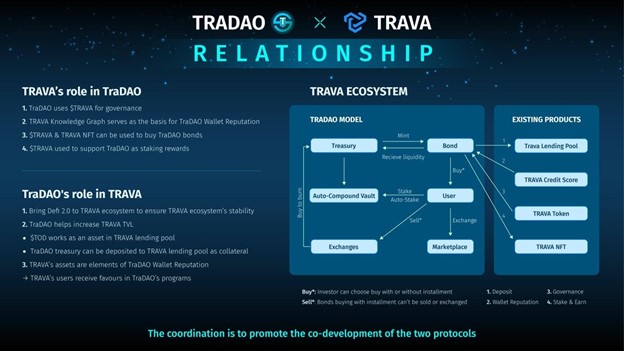

Trava Finance will be integrating TRADAO into its ecosystem. Trava tokens will serve as the governance token and reward tokens. Therefore holders will be able to create proposals and vote to determine the project’s future.
In addition, those that stake TOD tokens will receive rewards in TRAVA tokens and can use them to purchase TRADAO bonds. TRADAO’s liquidity can be deposited to Trava Lending Pool to generate more profit shared with users in the entire Trava ecosystem.
The launch of TRADAO is expected to have several beneficial effects on Trava’s ecosystem stability. Some of these include the increase of TRAVA TVL, TOD tokens to Trava’s lending pool as collateral, and the inclusion of Trava’s assets as part of TraDAO wallet reputation.
More developments are on the horizon
Trava Finance plans to launch an Initial Users Offering (IUO)  on March 2 by 3pm UTC.  Participants will be able to benefit from being the first to use the protocol. The event will include a whitelist, and lucky participants will be able to buy TOD token at the lowest price before it launches on DEX(es).
Trava will also launch the main features of TRADAO in Q1 2022. Users will be able to leverage their tokens to purchase bonds and get rewards. To learn more about Trava Finance and TraDAO visit the links below.

Пов'язані матеріали

The Crypto Scene Is Dead, Perpetual Swaps Are Eternal

The crypto industry is undergoing a fundamental shift. The era defined by minting novel, native digital assets (altcoins) is fading. These assets, lacking real-world cash flows or clear value, are losing relevance as attention and capital flow elsewhere. Two powerful external forces are reshaping the space. First, traditional assets like U.S. stocks, bonds, gold, and oil are being tokenized and traded on-chain. Second, the explosive growth of AI, with its tangible products, has overshadowed crypto's once-dominant "future narrative." This marks a critical pivot: crypto is transitioning from being a "factory for new assets" to becoming a "global conduit for existing assets." Its validated utility is not complex financial reinvention but efficient global settlement, transfer, and trading—the original promise of blockchain. Stablecoins like USDT and USDC exemplify this, offering faster dollar movement rather than replacing it. Consequently, native ecosystems like Ethereum face profound challenges. While still crucial infrastructure, ETH struggles to capture value as users interact with Layer 2s or trade traditional assets without needing to hold it. DeFi's grand narrative of rebuilding finance has narrowed to core needs like cheap transfers and deep liquidity. The true breakout innovation is the perpetual contract (Perp). It brilliantly bypasses the complexities of direct asset ownership (custody, compliance, dividends) by creating pure price exposure. Users can speculate on the price movement of *any* asset—NVIDIA, gold, oil—24/7, globally, and with leverage. This "price casino" model, while risky and ethically fraught, delivers unmatched liquidity and accessibility. Projects like Hyperliquid succeeded not by inventing new mechanics but by perfecting the timing and execution of this model. Key drivers included making on-chain Perps feel like centralized exchanges, post-FTX trust migration towards transparency, and rising demand to trade macro assets and equities round-the-clock. In conclusion, the crypto world's most enduring successes are the dollar (via stablecoins), Bitcoin, and trading. Its new frontier is not creating alternative assets but providing a seamless, perpetual trading layer—a new API—for the world's existing financial system. The age of native altcoins is over; the age of perpetual synthetic exposure has begun.

Odaily星球日报3 хв тому

The Crypto Scene Is Dead, Perpetual Swaps Are Eternal

Odaily星球日报3 хв тому

After Marvell's 32% Surge, the Chinese Chip Family Behind It Emerges

The stock price of Marvell Technology surged 32.5% on June 2nd, driven by NVIDIA CEO Jensen Huang highlighting its custom ASICs and optical interconnects as core to AI data center architecture. This event brought attention to the Chinese semiconductor family behind Marvell: the Dai siblings. The story centers on three siblings, all UC Berkeley graduates, whose three-decade entrepreneurial journey aligns with major semiconductor industry shifts. In 1995, youngest sister Dai Wei Li co-founded Marvell with her husband Sehat Sutardja and his brother, focusing on storage controllers. Eldest brother Dai Wei Min founded EDA company Ultima, later sold to Cadence, and later founded VeriSilicon (芯原) in China, becoming a leading semiconductor IP provider. Second brother Dai Wei Jin co-founded EDA firm Silicon Perspective (sold to Cadence) and GPU IP company Vivante, later acquired by VeriSilicon. The combined "Dai-Sutardja" family network extends beyond Marvell. Their ventures and investments form a comprehensive ecosystem for the post-Moore's Law, chiplet era. Key holdings include: Dream Big Semiconductor (AI SuperNICs, acquired by Arm), Alphawave (high-speed SerDes IP, acquired by Qualcomm), and Silicon Box (a chiplet advanced packaging foundry). VeriSilicon itself thrives on the AI ASIC and IP boom in China. Collectively, the family's AI infrastructure-related portfolio is estimated at over $22 billion. Their strategy represents a distinct path: building critical components for open standards and key manufacturing capacity in the chiplet era, rather than pursuing standalone AI chip dominance. While this path may not create the next NVIDIA, it has enabled repeated successful exits and sustained influence within the global semiconductor industry.

marsbit1 год тому

After Marvell's 32% Surge, the Chinese Chip Family Behind It Emerges

marsbit1 год тому

Microsoft is Afraid of Being Marginalized by AI Giants

Microsoft, once the defining force of the PC era, now faces a familiar challenge in the AI age: the risk of being relegated to a profitable but invisible infrastructure provider. This anxiety was laid bare at Build 2026, where CEO Satya Nadella unveiled a major strategic pivot. The catalyst was a quiet April agreement that dissolved Microsoft's exclusive licensing and cloud-hosting deal with OpenAI, its once-vital partner. This erased Microsoft's key AI moat. With OpenAI and Anthropic defining AI applications and gaining enterprise traction—even within Microsoft's own ranks—Nadella had to answer: without exclusivity, what is Microsoft's role? The answer was a suite of seven in-house AI models, a developer-focused AI workstation (Surface RTX Spark Dev Box), and, most crucially, the Agent 365 platform for enterprise AI governance. The models, notably targeting Anthropic's strengths in coding and enterprise, signal a defensive move. However, the broader strategy is to make the models themselves less decisive. Financially, Microsoft's AI revenue is strong, driven largely by Azure running others' models. Yet its user-facing products like Copilot show weak penetration and engagement. Microsoft earns infrastructure money but lacks direct user mindshare. Nadella's core fear is being "hollowed out." As OpenAI and Anthropic prepare for IPOs and gain financial independence, they may build their own infrastructure, threatening Azure's lucrative AI revenue stream. Microsoft's window is to entrench itself deeper: not as the model creator, but as the indispensable platform for securely deploying, managing, and governing all AI models within the enterprise through Agent 365. Build 2026 revealed Microsoft's bet: in the AI era, the ultimate power lies not in any single model, but in the enterprise "operating system" that controls them. Nadella is determined to ensure Microsoft is the driver of this new era, not just a passenger.

marsbit1 год тому

Microsoft is Afraid of Being Marginalized by AI Giants

marsbit1 год тому

Торгівля

Спот
Ф'ючерси
活动图片