Mantra CEO tells OM holders to withdraw from OKX over ‘inaccurate’ migration plan

cointelegraphОпубліковано о 2025-12-08Востаннє оновлено о 2025-12-08

Анотація

Mantra CEO John Patrick Mullin has urged users to withdraw their OM tokens from the OKX exchange, accusing the platform of posting an "inaccurate" migration plan. Mullin claims OKX provided incorrect dates and details about the upcoming token migration from an Ethereum-based ERC-20 token to a native Mantra Chain token. He stated that OKX has not communicated with Mantra since April 13, when the OM token crashed over 90%, an event Mantra attributed to aggressive exchange leverage policies. Mullin advised users to avoid relying on OKX and complete the migration independently. The official migration is set to occur after January 15, contrary to OKX’s announced December timeline.

Tensions between blockchain platform Mantra and crypto exchange OKX are rising after Mantra accused the exchange of posting incorrect information about its token migration.

In a Monday X post, Mantra CEO John Patrick Mullin urged users of centralized cryptocurrency exchange (CEX) OKX to withdraw their Mantra (OM) tokens and cut their “dependency” on the platform.

“Users should consider withdrawing their OM tokens from OKX[...]. Avoid OKX Exchange Dependency: Complete migration without relying on potentially negligent or malicious intermediaries,” said Mullin.

His warning came in response to a Friday announcement from OKX about supporting the incoming OM token migration.
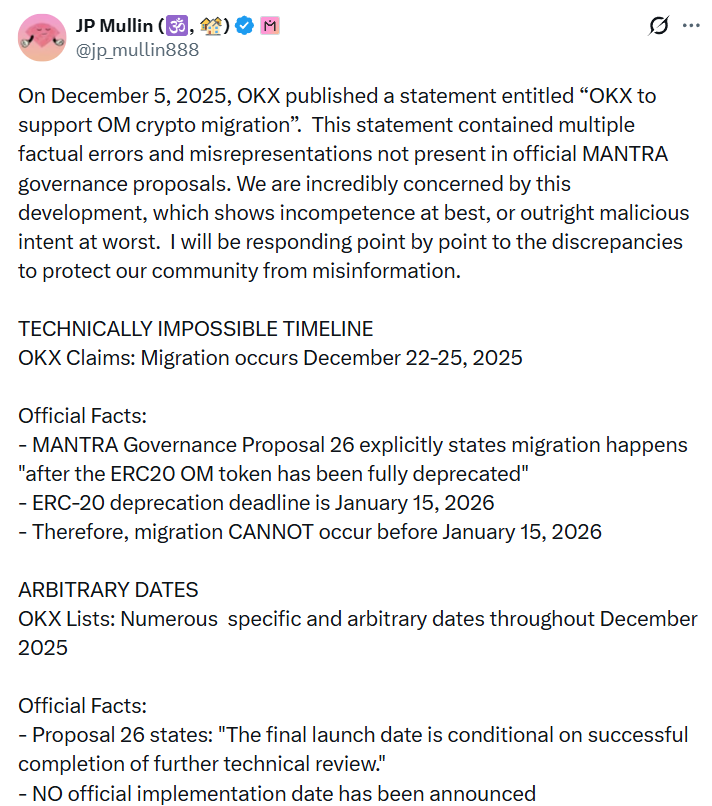
Source: JP Mullin

Related: BitMine buys $199M in Ether as smart money traders bet on ETH decline

According to Mullin, the OKX post contained multiple inaccuracies, including false migration and implementation dates.

OKX said the migration would occur between Dec. 22 and Dec. 25. Mantra’s governance proposal, by contrast, states that the migration will only take place after the Jan. 15 deprecation of the Ethereum-based ERC-20 OM token.

Mullin also said OKX’s post referenced “arbitrary dates throughout December 2025,” while Mantra has not yet announced an official implementation date.

He claimed OKX has not communicated with Mantra since “the events” of April 13, while Mantra has “helpfully [been] communicating with all other major exchanges regarding our migration.”
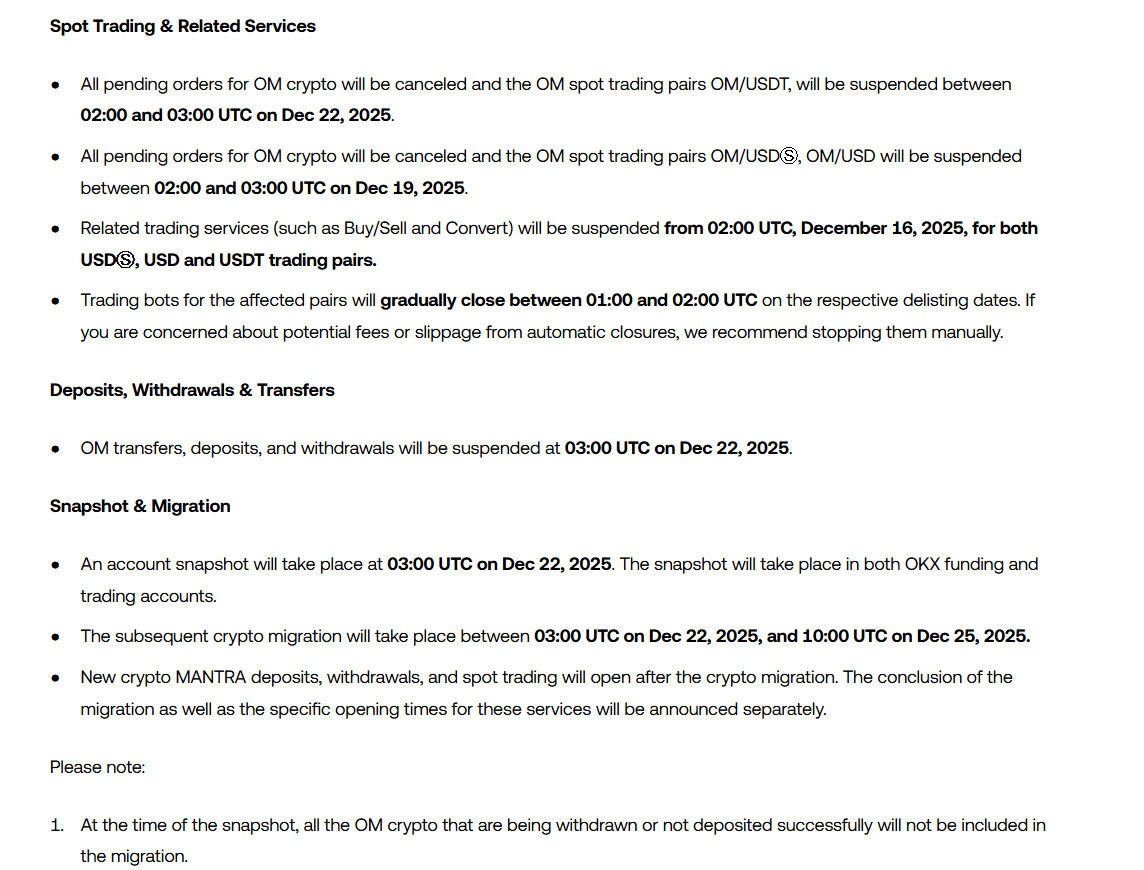
OKX’s OM Crypto Migration post. Source: okx.com

During the incoming migration, the OM token will migrate from an Ethereum-native ERC-20 token to a Mantra Chain-native token.

Cointelegraph has contacted OKX for comment but had not received a response by publication time.

Related: Prediction markets emerge as speculative ‘arbitrage arena’ for crypto traders

April crash still casting a shadow

On April 13, the Mantra’s OM token price fell by over 90% from around $6.30 to below $0.50.
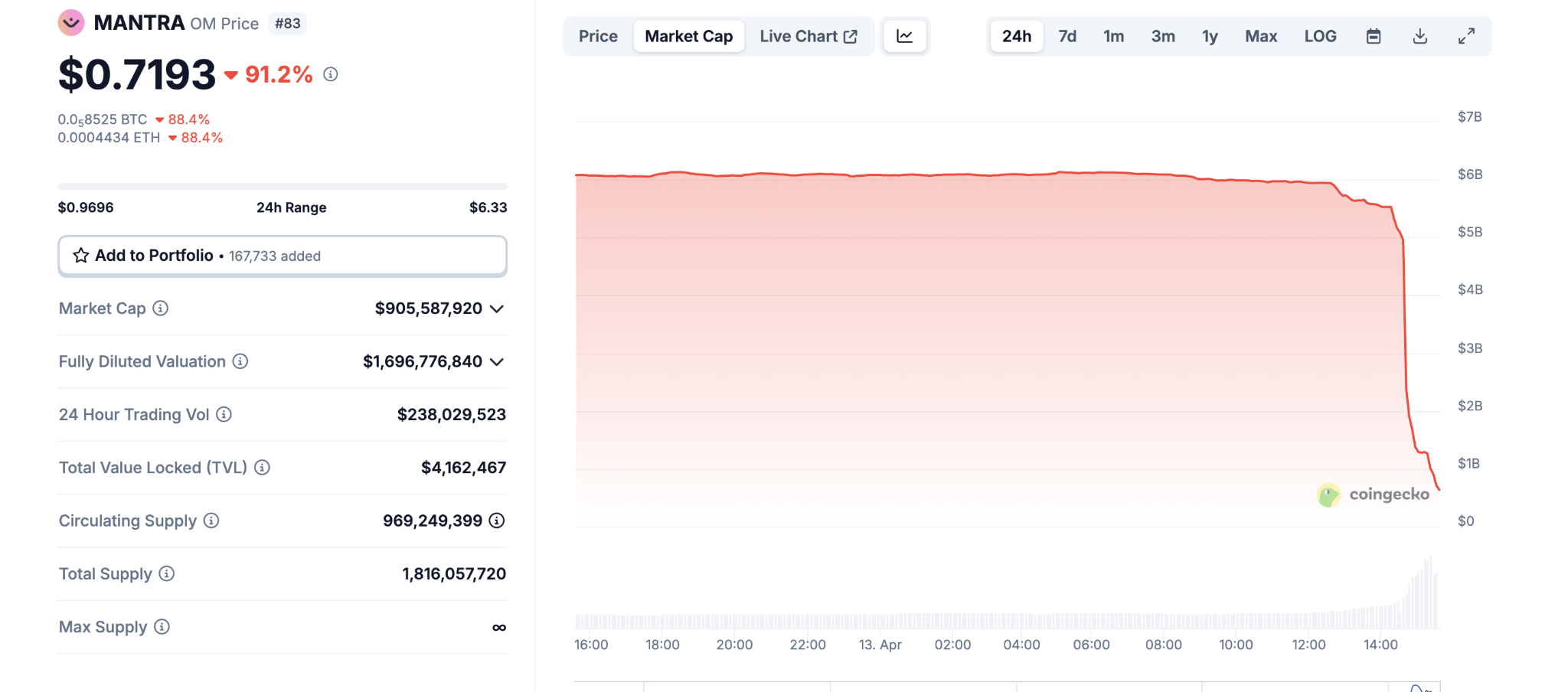
OM/USD, 1-day chart. Source: Coingecko.com

On April 30, Mantra published a post-mortem report that blamed the aggressive trading policies and high leverage on cryptocurrency exchanges for the token crash.

“Liquidation cascades could happen to any project in the crypto industry,” Mullin said in the post, pointing to the role of “aggressive leverage positions” on exchanges as a broader threat to investor safety.

Mullin also urged exchanges to review their leverage policies while implementing a transparency dashboard for OM tokenomics, along with announcing the burning of 150 million staked OM tokens, permanently removing them from circulation in a bid to tighten the token’s supply.

Magazine: If the crypto bull run is ending... it’s time to buy a Ferrari — Crypto Kid
Пов'язані матеріали

Zuckerberg's 'Mango' Image Generation Model Trails Only GPT Image 2, It Learned to Revise Prompts on Its Own

Meta's MSL has launched Muse Image, an advanced image generation model nicknamed "Mango," which ranks second globally in text-to-image benchmarks, closely trailing OpenAI's GPT Image 2. Its key innovation is agent-like behavior: it searches for factual information, writes code for charts, and, most notably, has developed self-correction abilities through reinforcement learning, allowing it to revise its own outputs without explicit programming. This shift emphasizes reasoning over immediate generation. Integrated with Meta's ecosystem, Mango connects with the Muse Spark language model for complex tasks and features a unique "@" function that can incorporate public Instagram photos into generated images—raising privacy concerns as it's enabled by default. The model is directly accessible in Meta AI, Instagram, and WhatsApp, leveraging Meta's vast user base for distribution rather than competing solely on image quality. Accompanying Mango is the preview of Muse Video, a video generation model with integrated audio, currently ranked third in its category. All Mango-generated images include an invisible, persistent watermark (Content Seal) for AI identification, alongside a public detection tool. While Mango advances "thinking" image models, its use of social data poses new ethical questions about consent and digital boundaries.

marsbit26 хв тому

Zuckerberg's 'Mango' Image Generation Model Trails Only GPT Image 2, It Learned to Revise Prompts on Its Own

marsbit26 хв тому

Weng Li's New Blog Proposes 'Self-Evolution Should Start from Harness', DeepSeek's Cui Tianyi Endorses with Repost

Lilian Weng, former OpenAI security VP and co-founder of Thinking Machines Lab, has published a new blog post titled "Harness Engineering for Self-Improvement," proposing a pragmatic path for AI self-evolution. She argues that Recursive Self-Improvement (RSI) may practically begin at the "Harness" layer—the external runtime system governing how models use tools, manage context, and execute tasks—rather than directly from the model rewriting its own weights. The blog outlines a progression from optimizing prompts (Context Engineering) to designing workflows, and ultimately to Self-Improving Harness systems. These systems can identify their own weaknesses, propose targeted, verifiable modifications to the harness code, and validate improvements. Works like Self-Harness and Darwin Gödel Machine (DGM) demonstrate significant performance gains on benchmarks like SWE-bench through such automated harness evolution, rivaling handcrafted agents. DeepSeek researcher Tianyi Cui endorsed the view, noting harness-based self-evolution is as promising as model-based approaches. Weng emphasizes this is complementary to model training, with both reinforcing each other. However, key challenges remain: weak evaluators for subjective tasks, reward hacking, diversity collapse, managing long-term system health versus short-term success, and defining the human oversight role. The consensus is growing: the harness is a critical variable, as the same model can exhibit vastly different capabilities within different harness systems.

marsbit40 хв тому

Weng Li's New Blog Proposes 'Self-Evolution Should Start from Harness', DeepSeek's Cui Tianyi Endorses with Repost

marsbit40 хв тому

Odaily Editorial Department Tea Party (July 8)

Odaily Editorial Team Casual Chat (July 8) This is an informal column from Odaily's editorial team, sharing immediate thoughts on industry news, data, and hot topics from various angles. It presents investment ideas and opportunity hypotheses still under verification—which may not be direct wealth codes but questions in themselves—alongside observations from industry interactions and materials that genuinely enhance the team's understanding. The content is based on real investment and observation experiences, carries no advertising, and does not constitute investment advice. Its purpose is to broaden perspectives and supplement information sources, not to create consensus. Team Member Shares: * **Wenser (@wenser2010):** Noted a deeper correction (nearly 30%) in US and Korean stocks, including memory stocks, but remains bullish on DRAM due to perceived supply shortages. In prediction markets, personal small bets outperformed blind copying; favors France to win the World Cup. Views crypto-related stocks like STRK as bearish for now, while seeing Circle and Coinbase as potential rebound plays. Observes recent strength in software stocks like Microsoft but is unsure if it's a sustained recovery. * **Bcxiongdi (@bcxiongdi):** Discusses the recent "recovery training" in meme coin markets on Solana and BSC, characterized by small-scale PVP opportunities, admitting to having sold many assets too early. Suggests also watching the Robinhood chain. Found World Cup prediction markets challenging, advising to consider buying during matches rather than only before. * **Azuma (@azuma_eth):** Focuses on the US stock market, particularly the significant semiconductor correction. Believes demand fundamentals remain and considers buying the dip in DRAM stocks. Notes a potential rotation signal as hedge funds have recently concentrated buying in tech stocks. Plans to continue adding to RKLB (Rocket Lab) stock, seeing limited downside and high upside potential at current levels after its founder's share sale window closed.

Odaily星球日报56 хв тому

Odaily Editorial Department Tea Party (July 8)

Odaily星球日报56 хв тому

Former Huawei 'Genius Teen' Who Questioned DeepSeek Interview Lands in 'Crossfire' from Web3 Investor

Former Huawei "Genius Youth" Li Bojie recently drew public attention by criticizing his interview experience with DeepSeek. The controversy escalated when Du Jun, co-founder of Web3 investment firm ABCDE Capital, publicly accused Li of being "the founder with the least sense of contractual spirit" he had ever cooperated with, sparking a dispute over Li's startup project, Metagent. Li detailed a frustrating DeepSeek interview where he was accused of potential plagiarism, leading him to end the session. The spotlight then shifted to his venture, Metagent, a Web3+AI project aiming to tokenize AI agents. ABCDE invested $1.5 million, with an initial $500k disbursed. Du Jun claimed the project's progress was severely lacking, with a poor-quality demo and minimal social media activity. He alleged Li stopped communicating, deleted his Telegram, and failed to provide proper financial reporting. In response, Li argued the remaining $1 million was never received, crippling operations and forcing salary cuts. He stated he left Metagent in October 2024 due to family reasons and Web3 compliance concerns, with board approval. He claimed to have fulfilled disclosure duties and that his subsequent projects avoided conflicting fields. Other investors, including ArkStream Capital, shared negative due diligence experiences, citing unprofessional contracts and evasive answers on tokenomics. Metagent's social media went silent in June 2024, effectively stalling. Li has since moved to a new consumer AI agent platform, Pine AI (formerly Logenic AI), which has raised $25 million in Series A funding. He served as its Chief Scientist but recently left, clarifying he was not the founder and departed due to a shift in research interests.

Foresight News1 год тому

Former Huawei 'Genius Teen' Who Questioned DeepSeek Interview Lands in 'Crossfire' from Web3 Investor

Foresight News1 год тому

Торгівля

Спот
活动图片