Cardano In Crisis Mode: Hoskinson Breaks Down The Poison Piggy Attack

bitcoinistОпубліковано о 2025-11-25Востаннє оновлено о 2025-11-25

Анотація

Cardano has just come through one of the most severe technical incidents in its history – a 14-hour chain split...

Trusted Editorial content, reviewed by leading industry experts and seasoned editors. Ad Disclosure

Cardano has just come through one of the most severe technical incidents in its history – a 14-hour chain split that founder Charles Hoskinson insists was “serious, but not existential.” In a late-November livestream, he walked viewers through Pi Lanningham’s “Poison Piggy – After Action Report,” a detailed post-mortem on what happened on November 21, 2025, and what it means for Cardano’s long-held “no downtime” narrative.

Inside Cardano’s 14-Hour Pig-Chain Meltdown

According to Lanningham, a serialization bug in Cardano’s node implementation created the conditions for a unidirectional soft fork. The issue first surfaced on November 20 on the preview testnet, when a malformed delegation certificate was accepted by some nodes and rejected by others. Older nodes correctly rejected the over-long hash; newer nodes, due to a November 2024 code change, truncated it and treated it as valid. That version skew created two incompatible views of the chain.

“The whole reason the testnet exists is to be a safe space” to find these failures, Hoskinson noted. Under normal circumstances, the bug would have been patched and quietly rolled out. Instead, after the fix was identified and was in the process of being communicated to stake pool operators, a near-identical malformed delegation was submitted to mainnet, this time delegating to RATSRATS – conceptually doubling the ticker of RATS, Hoskinson’s own stake pool.

That transaction split Cardano mainnet into two forks. The stricter fork, running older code that rejected the malformed hash, became the “chicken chain.” The permissive fork that accepted it was christened the “pig chain” or “poison piggy.” From that point, the network entered a race: would the poisoned transaction on the pig chain become immutable before the chicken chain could overtake it?

On impact, Lanningham’s numbers are blunt. Cardano remained live but degraded. Transaction inclusion via robust infrastructure slowed dramatically, with delays of up to roughly 400 seconds and block times on the now-dominant chain stretching to around 16 minutes at their worst. Over the incident window, 846 blocks were produced on the pig chain and around 13,900 on the chicken chain. Out of 14,383 observed transactions, 479 – roughly 3.3 percent – were included only on the discarded pig chain and never appeared on the final canonical history. Most of those, when resubmitted, turned out to be invalid due to expired validity intervals or conflicting inputs.

“This constitutes a serious degradation of service for users, but within expected bounds for a high-nines availability of service,” Lanningham wrote. His bottom-line checklist is terse: “Did the chain continue to make progress? Yes. Was service degraded? Yes. Were funds at risk? Potentially. Did the Cardano network recover under essentially worst case conditions? Yes. Would I have confidence to build my business on top of infrastructure that exhibited this level of robustness? Yes.”

The recovery itself is being held up by Hoskinson as proof of both decentralization and design. A patched node was already available thanks to the testnet incident; overnight, IOG, the Cardano Foundation, Emurgo, Intersect, exchanges and many SPOs coordinated via war-room calls and chat channels to upgrade to the fixed version and to follow the more restrictive chicken chain. There was no protocol-level rollback and no centralized “restart.” As stake migrated, block production on the pig chain slowed, the chicken chain accelerated, and Ouroboros’ probabilistic finality properties ensured that once the healthy fork overtook the poisoned one, nodes on the pig chain automatically switched to the longer, denser chain.

“This is the concrete evidence of when the Nakamoto consensus worked as intended and converged the network to a single canonical history,” Lanningham argued. Hoskinson went further, saying, “This could have killed other chains,” but here “time works differently in a distributed system” and effectively stretched the rollback window in Cardano’s favor.

Lessons Learned

Both, however, are clear about the downside. “The fact the bug appeared at all is a failure of our testing rigor,” Lanningham conceded. The reliance of almost all explorers on cardano-db-sync left the ecosystem “flying blind” when that component crashed on the malformed transaction. Many SPOs likely upgraded “blind,” trusting recommendations from founding entities rather than reasoning independently about fork choice. And certain off-chain systems – especially exchanges and bridges – were exposed to replay and double-spend risk, even if early evidence suggests real losses are unlikely.

The post-mortem thus doubles as a roadmap. Lanningham calls for stronger fuzzing and spec-driven testing, richer node-to-client protocols so wallets and exchanges can implement circuit breakers based on real consensus health, more diversity in monitoring stacks, and better education for SPOs on how Ouroboros behaves under stress. Hoskinson, for his part, floated the idea of an AI “upgrade sentinel” for operators and revived demands for a built-in pub/sub channel for emergency alerts.

For the broader narrative war, Lanningham’s position is deliberately dispassionate: “If, after that, you decide for yourself that Cardano ‘went down’, I won’t begrudge you your opinion. I’m not precious about that label… What matters is impact.” Hoskinson is less diplomatic, dismissing most social-media commentary as noise. What he wants the industry to take away is simpler: on November 24, 2025, after Poison Piggy, Cardano is back to one chain – and its next iteration of hardening has already begun.

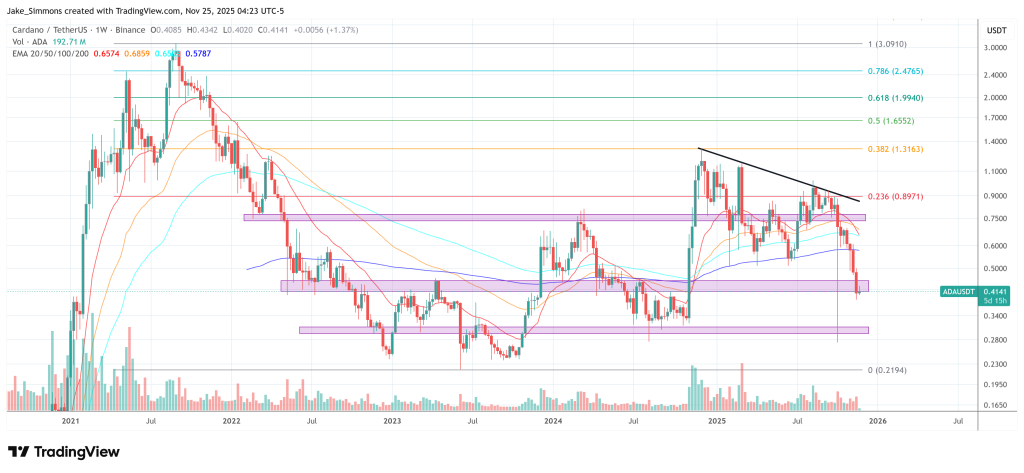
At press time, ADA traded at $0.4141.
Cardano price
ADA remains at critical level, 1-week chart | Source: ADAUSDT on TradingView.com
Featured image created with DALL.E, chart from TradingView.com
Editorial Process for bitcoinist is centered on delivering thoroughly researched, accurate, and unbiased content. We uphold strict sourcing standards, and each page undergoes diligent review by our team of top technology experts and seasoned editors. This process ensures the integrity, relevance, and value of our content for our readers.

Jake Simmons has been a Bitcoin enthusiast since 2016. Ever since he heard about Bitcoin, he has been studying the topic every day and trying to share his knowledge with others. His goal is to contribute to Bitcoin's financial revolution, which will replace the fiat money system. Besides BTC and crypto, Jake studied Business Informatics at a university. After graduation in 2017, he has been working in the blockchain and crypto sector. You can follow Jake on Twitter at @realJakeSimmons.

Трендові криптовалюти

Пов'язані матеріали

$2 Trillion: Countdown to AI's Largest IPO in History

The countdown for the largest IPO in AI history, a potential $2 trillion listing for Anthropic, is underway for October. The staggering valuation, reportedly projected by several investors, contrasts with the company's own internal restraint on setting a public target. Founded five years ago by former OpenAI core members, Anthropic's growth has been meteoric. Annual recurring revenue (ARR) surged from ~$9B in late 2025 to $47B by May 2026, with Q2 2026 revenue of $11.5B marking a 14x year-over-year increase. Bank valuations are even based on internal 2028 revenue forecasts of $190-200B. A key growth driver is Claude Code, its AI coding assistant. Its ARR quintupled in five months to $2.5B by February 2026, now constituting nearly 20% of total revenue. Surveys indicate Anthropic commands roughly 40% of enterprise LLM spending, doubling OpenAI's share in programming-specific use. However, alongside this explosive growth, reports detail significant internal cultural strife. Critics describe a divisive "priesthood" of PhD executives, led by CEO Dario Amodei, who promote a "save humanity" narrative that some employees find cult-like and alienating. This has reportedly created a demoralized workforce and a covert "underground network" of dissent among engineers torn between lucrative pre-IPO equity and a toxic work environment. Anthropic now faces a pivotal paradox: pursuing its mission of "safe" AI requires immense capital for compute, yet that capital demands relentless commercial growth. As it approaches its historic IPO, the company must navigate intense regulatory scrutiny, soaring operational costs, and internal tensions—any of which could destabilize its post-listing trajectory, much like SpaceX's significant post-IPO stock drop. The stage is set for a defining moment in tech history.

marsbitЩойно

$2 Trillion: Countdown to AI's Largest IPO in History

marsbitЩойно

AI Boosting Efficiency and Cutting Costs Makes VC Increasingly Expensive

"AI for Cost Reduction Makes VC Funding More Expensive" Despite the "cost-reduction and efficiency" narrative of AI, venture capital (VC) investment in the AI sector is becoming increasingly costly. While AI tools lower the initial costs for many startups—with team sizes shrinking across funding stages—the market is polarizing. For top-tier AI teams, especially those from leading companies like Google and OpenAI, funding rounds are now larger and valuations are higher than ever at the seed and early stages. For example, new ventures by prominent researchers are securing billions in funding with valuations reaching tens of billions before having a mature product. This creates a "barbell" market: lightweight startups need less capital, while elite AI firms attract massive investments early on. This dynamic raises the cost for VCs to acquire and maintain meaningful ownership stakes. As valuations soar early, securing the same equity percentage requires significantly larger capital commitments. VCs must now invest more upfront and reserve substantial funds for follow-on rounds to avoid dilution, prompting large firms like Accel and a16z to raise massive new funds. Consequently, capital is concentrating intensely in a few perceived winners like OpenAI and Anthropic, widening the gap between large and small VC funds. While high valuations bake in future growth expectations, they also compress potential returns, demanding that portfolio companies achieve unprecedented scale. For major VCs, the core strategy is clear: secure early positions in potential winners and maintain the capital to keep investing as valuations rapidly escalate.

marsbit25 хв тому

AI Boosting Efficiency and Cutting Costs Makes VC Increasingly Expensive

marsbit25 хв тому

An Eight-Year Investment Takes a Sharp Turn: Why Did Ethereum Suddenly Abandon Poseidon?

On August 13, Ethereum researcher Justin Drake announced a significant shift in Ethereum's Layer-1 cryptographic roadmap: abandoning the SNARK-friendly hash function Poseidon in favor of traditional functions like SHA2 or BLAKE2. This decision ends eight years of research and investment, marking a major revision to the post-quantum security strategy. Poseidon, introduced in 2019, was highly efficient for zkRollups and zkVMs within SNARK circuits. However, its need for prolonged cryptanalysis and the pressing timeline for quantum resistance revealed limitations. Recent breakthroughs in SNARK design, specifically using binary fields, now enable traditional, battle-tested hash functions to perform as efficiently as Poseidon within SNARKs. Benchmarks show modern laptops can now verify over a million traditional hash calls per second. This change is partly driven by accelerated concerns over quantum computing threats. Reports warn that "Cryptographically Relevant Quantum Computers" could break current blockchain signatures like ECDSA by the early 2030s, risking trillions in assets. Ethereum's response focuses on hash-based post-quantum signature schemes, deemed more quantum-resistant than some lattice-based alternatives under pressure from AI cryptanalysis. Ethereum's updated post-quantum roadmap targets a production-ready "leanVM" for signature aggregation by 2027, with full deployment across consensus, execution, and data layers by 2028. The shift to mature hash functions like SHA2 reduces reliance on newer algorithms and aligns with the goal of using widely analyzed cryptographic primitives. Other major blockchains are also preparing. Solana's core teams have independently chosen the NIST-standardized Falcon signature scheme for its compact size. Starknet plans a phased migration, starting with replacing its Pedersen hash with BLAKE2. Ethereum's move signifies a strategic pivot towards proven security foundations for the quantum era.

marsbit1 год тому

An Eight-Year Investment Takes a Sharp Turn: Why Did Ethereum Suddenly Abandon Poseidon?

marsbit1 год тому

Programmers Worldwide Are Wasting Money on Anthropic! The Company Can't Stand It Anymore

Anthropic recently published guidelines to help developers using Claude Code reduce unnecessary token costs. The key recommendations include: 1) Clear (/clear) conversations after completing a task to avoid carrying irrelevant file reads and command outputs into the next task. 2) Set the model and reasoning effort level at the start of a session, as switching mid-session invalidates the prompt cache, requiring a full-price recalculation of the entire dialog history. 3) Attach files using @ references instead of typing paths manually to avoid extra tool calls and searches that bloat the context. 4) Add quiet flags to verbose commands (e.g., in CLAUDE.md) to minimize lengthy output in the dialog history. 5) Use /compact while the session cache is still warm (before breaks) to compress the dialog at one-tenth the cost. 6) Offload large-output tasks to a sub-agent, which runs in an isolated context and only returns conclusions, preventing intermediate outputs from polluting the main dialog. The article explains token pricing: input tokens (prefill) are processed in parallel, while output tokens (decode) are generated serially, making output tokens five times more expensive. Caching is crucial for savings—if a request's prefix (system prompt, CLAUDE.md, dialog history) matches the previous one byte-for-byte, reading it costs only 10% of the standard input price. However, cache invalidation occurs when changing models, effort levels, fast mode, compressing dialogs, after cache expiration, or when resuming old sessions. Dialog history also grows quadratically (O(n²)) as file contents and command outputs accumulate, increasing costs per round. Proactive context management—like isolating noisy tasks, using /rewind to trim unproductive turns, and task-based session clearing—is becoming an essential skill for cost-effective AI-assisted development.

marsbit3 год тому

Programmers Worldwide Are Wasting Money on Anthropic! The Company Can't Stand It Anymore

marsbit3 год тому

Pax Silica vs. WAICO: The US Wants to Prohibit Europe from Using Chinese Artificial Intelligence

The United States is preparing to demand that European and other partners abandon Chinese artificial intelligence initiatives, threatening exclusion from the American-led "Pax Silica" coalition, according to a leaked U.S. State Department document. This ultimatum forces signatories of the "AI Opportunity Statement" to choose between the Western technological ecosystem and alternative frameworks, with China not explicitly named but clearly targeted. Pax Silica is a U.S. strategy for AI and semiconductor hegemony, launched in late 2025. Its European presence expanded significantly in mid-2026. Concurrently, China, Russia, and 27 other nations established the World AI Cooperation Organization (WAICO) in July 2026 as an independent intergovernmental platform promoting AI governance based on UN principles. This situation creates a difficult choice, especially for European nations balancing strategic autonomy with dependence on U.S. tech and security. It also pressures Global South countries with pragmatic ties to both Washington and Beijing. The formation of competing blocks risks fragmenting the global tech landscape, forcing companies to split supply chains, increasing costs, and potentially leading to incompatible standards and protocols. The era of open globalization in AI may be ending, replaced by geopolitical confrontation where technological sovereignty trumps economic efficiency. The decisions made will shape the global digital economy for decades.

cryptonews.ru5 год тому

Pax Silica vs. WAICO: The US Wants to Prohibit Europe from Using Chinese Artificial Intelligence

cryptonews.ru5 год тому

Торгівля

Спот

Популярні статті

Як купити ADA

Ласкаво просимо до HTX.com! Ми зробили покупку Cardano (ADA) простою та зручною. Дотримуйтесь нашої покрокової інструкції, щоб розпочати свою криптовалютну подорож.Крок 1: Створіть обліковий запис на HTXВикористовуйте свою електронну пошту або номер телефону, щоб зареєструвати обліковий запис на HTX безплатно. Пройдіть безпроблемну реєстрацію й отримайте доступ до всіх функцій.ЗареєструватисьКрок 2: Перейдіть до розділу Купити крипту і виберіть спосіб оплатиКредитна/дебетова картка: використовуйте вашу картку Visa або Mastercard, щоб миттєво купити Cardano (ADA).Баланс: використовуйте кошти з балансу вашого рахунку HTX для безперешкодної торгівлі.Треті особи: ми додали популярні способи оплати, такі як Google Pay та Apple Pay, щоб підвищити зручність.P2P: Торгуйте безпосередньо з іншими користувачами на HTX.Позабіржова торгівля (OTC): ми пропонуємо індивідуальні послуги та конкурентні обмінні курси для трейдерів.Крок 3: Зберігайте свої Cardano (ADA)Після придбання Cardano (ADA) збережіть його у своєму обліковому записі на HTX. Крім того, ви можете відправити його в інше місце за допомогою блокчейн-переказу або використовувати його для торгівлі іншими криптовалютами.Крок 4: Торгівля Cardano (ADA)Легко торгуйте Cardano (ADA) на спотовому ринку HTX. Просто увійдіть до свого облікового запису, виберіть торгову пару, укладайте угоди та спостерігайте за ними в режимі реального часу. Ми пропонуємо зручний досвід як для початківців, так і для досвідчених трейдерів.

1.2k переглядів усьогоОпубліковано 2024.12.10Оновлено 2026.06.02

Як купити ADA

Обговорення

Ласкаво просимо до спільноти HTX. Тут ви можете бути в курсі останніх подій розвитку платформи та отримати доступ до професійної ринкової інформації. Нижче представлені думки користувачів щодо ціни ADA (ADA).

活动图片