Биткоин упал в зону перепроданности впервые с февраля

cryptonews.ruОпубліковано о 2025-12-20Востаннє оновлено о 2025-12-20

За последние несколько дней котировки первой криптовалюты продемонстрировали резкое снижение. Цена актива опустилась до шестимесячного минимума на фоне усиления позиций продавцов. Падение ниже ключевых психологических отметок заставило участников рынка готовиться к возможному продолжению негативной динамики.

Однако технический анализ выявляет скрытые сигналы. Ряд индикаторов указывает на формирование потенциальной возможности для входа в рынок.

Исторические параллели и сигналы индикаторов

Индекс относительной силы (RSI) вошел в зону перепроданности. Это произошло впервые за последние девять месяцев и свидетельствует об экстремальном давлении со стороны продавцов. Последний раз подобные условия наблюдались в феврале, что предшествовало значительному восстановлению котировок.

Исторически такие показатели часто предвещают разворот тренда. Однако точное время начала восстановления остается неопределенным.

В ходе предыдущего аналогичного цикла биткоин потерял еще 10% стоимости перед началом роста. Повторение этого сценария может привести к снижению цены до $77 164. Только после этого покупатели смогут перехватить инициативу. Если же текущая поддержка устоит, отскок произойдет раньше, без глубокой просадки.
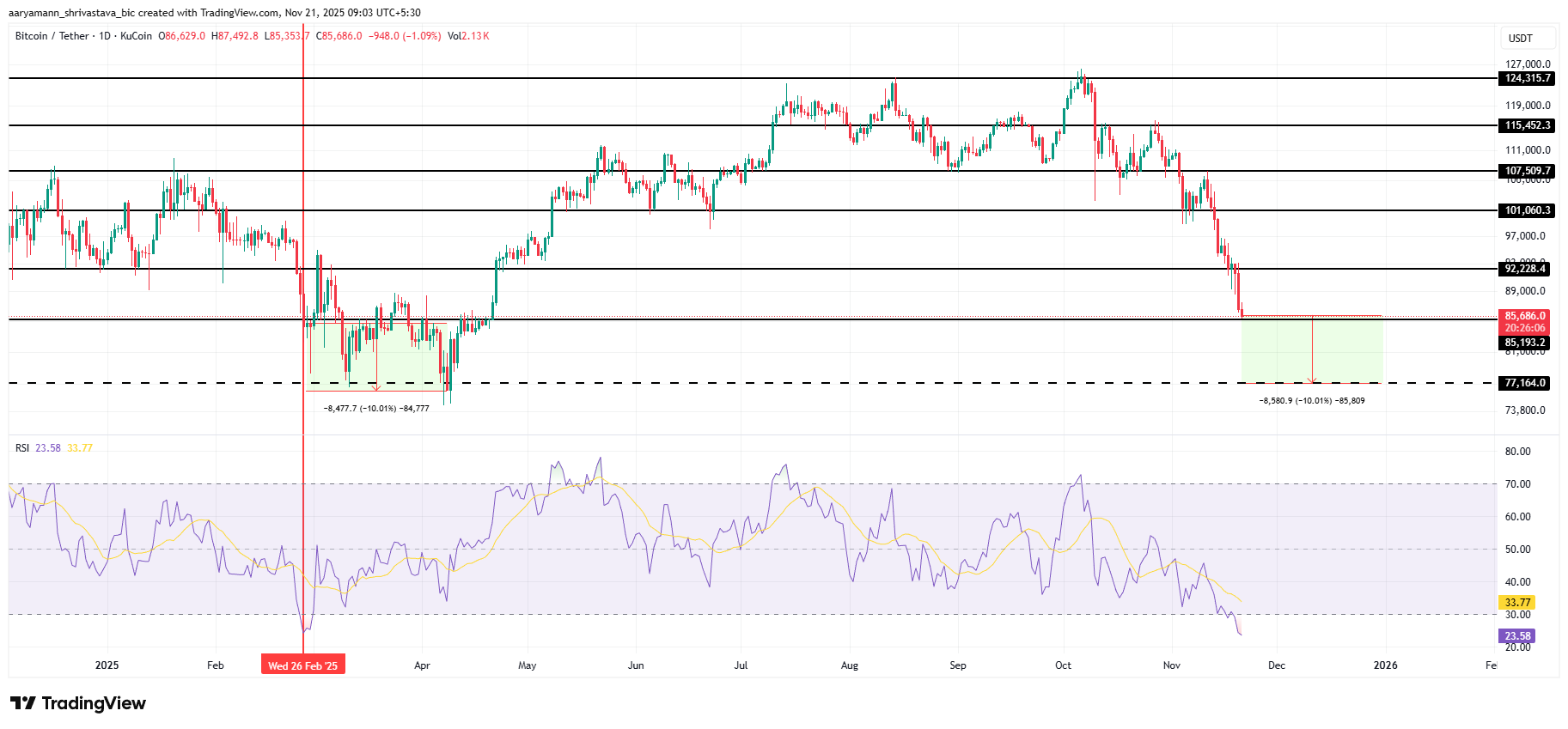
Биткоин RSI
RSI биткоина. Источник: TradingView

Макроиндикаторы импульса также указывают на недооцененность. Коэффициент MVRV биткоина находится на уровне -14%, что является самым низким показателем за последние три года. 30-дневный MVRV подает два четких сигнала: держатели в настоящее время несут убытки, а BTC недооценен по сравнению с историческими нормами. Такая обстановка способствует замедлению продаж и увеличению накопления.

Диапазон от -8% до -18% эксперты называют «зоной возможностей». В этом интервале давление продавцов, как правило, истощается. Затухание продаж ведет к стадии аккумуляции, которая служит фундаментом для последующего роста цен.
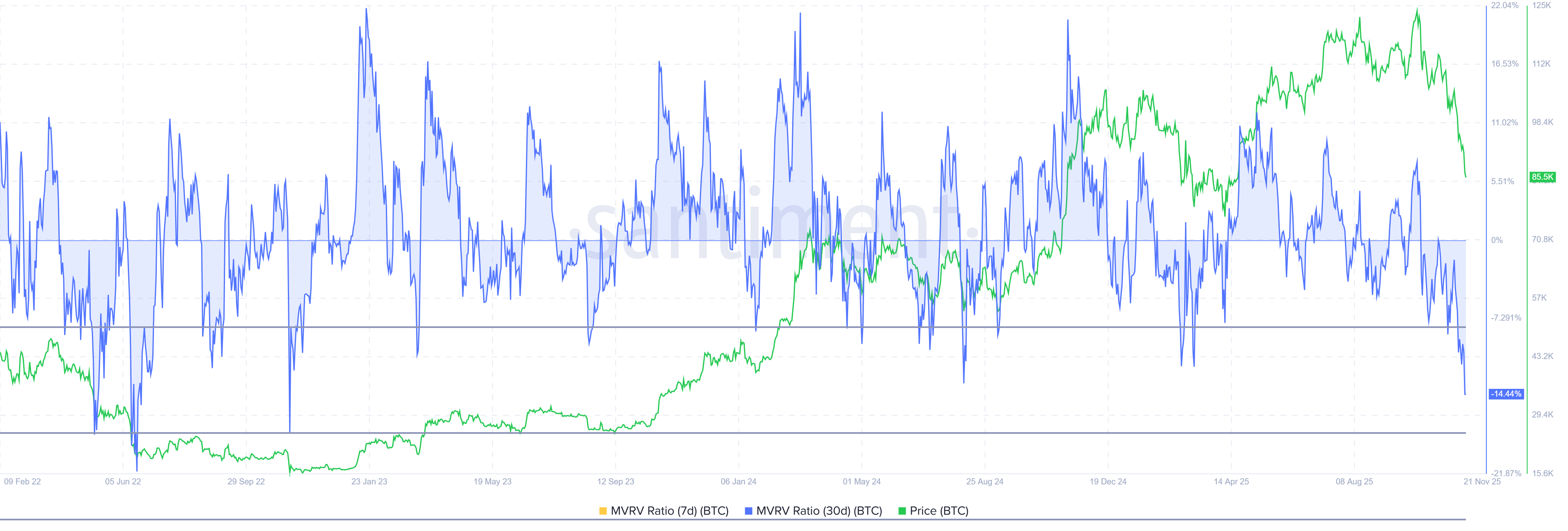
Коэффициент MVRV биткоина
Коэффициент MVRV биткоина. Источник: Santiment

Сценарии дальнейшего движения котировок

На момент написания материала биткоин торгуется в районе $85 860. Цена удерживается выше критически важного уровня поддержки $85 204. Согласно текущим метрикам, актив может испытать незначительное снижение перед началом восстановления. Этот сценарий вероятен, если условия перепроданности усилятся.

Продолжение нисходящего тренда грозит падением к отметке $77 164, что соответствует историческому паттерну RSI. Альтернативный негативный сценарий предполагает снижение до $80 000 в случае потери уровней $85 204 и $82 503. Оба варианта означают сохранение давления на рынок до момента стабилизации.
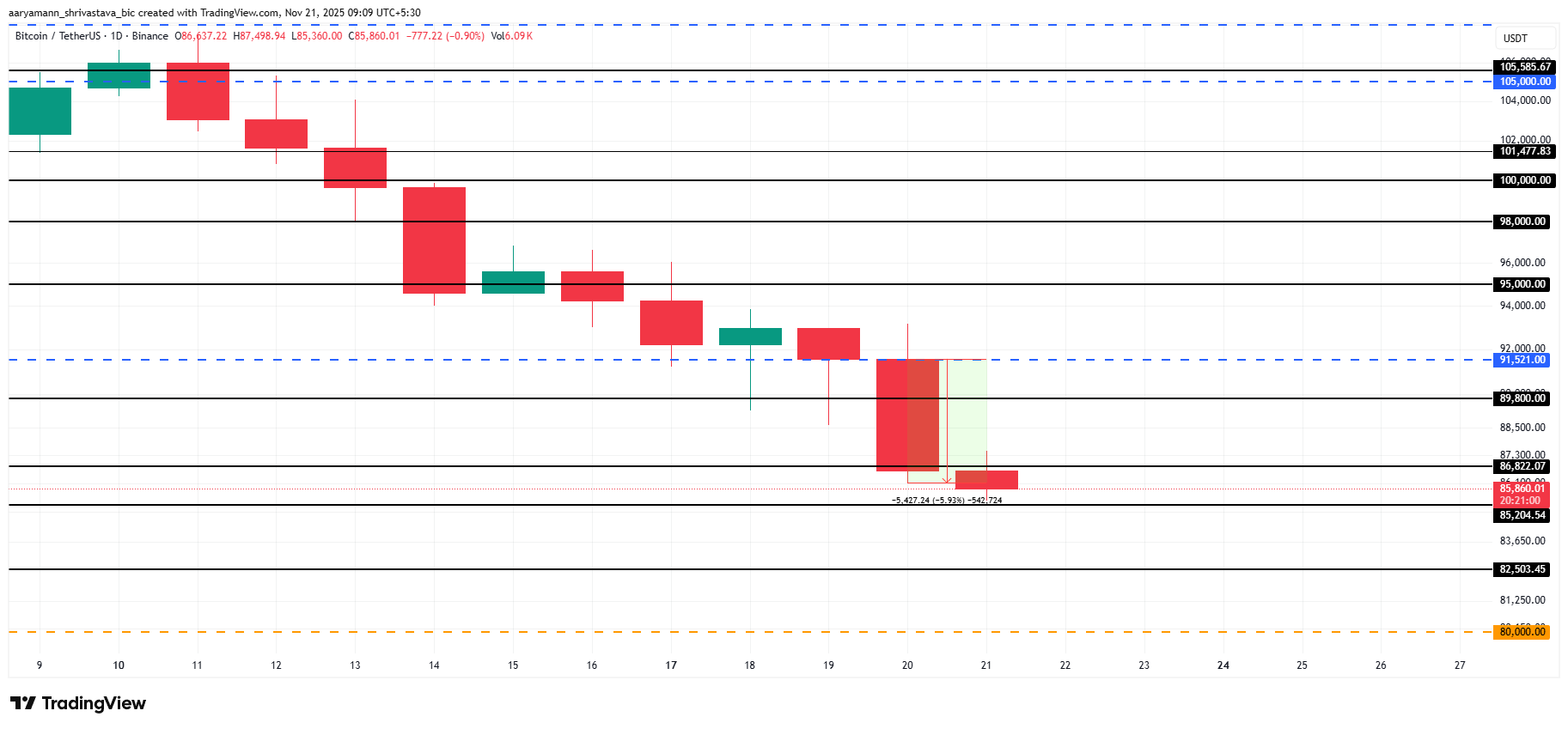
Анализ цены биткоина.
Анализ цены биткоина. Источник: TradingView

В случае успешного отскока от текущих значений цена может преодолеть отметку $86 822 и протестировать уровень $89 800. Закрепление выше этих значений позволит быкам нацелиться на превращение $91 521 в уровень поддержки. Конечной целью этого движения станет отметка $95 000. Такой исход отменит «медвежий» прогноз и подтвердит начало уверенного восстановления.


Пов'язані матеріали

The Entire Internet Hails Noam's Joining, But OpenAI's Loss Bill Just Got Thicker

While the AI community celebrates Noam Shazeer, co-author of the "Attention Is All You Need" paper, joining OpenAI as Head of Architectural Research, the company's audited financials reveal a starkly different reality. In 2025, OpenAI reported $13.07 billion in revenue but a massive $20.92 billion operating loss. Even excluding a one-time accounting charge, the cash burn is severe, with $3.7 billion consumed in Q1 2026 alone. This high-profile hiring occurs against a backdrop of significant internal research talent drain, with key founders and researchers departing as the company's focus shifts from exploratory research to product iteration. Meanwhile, OpenAI's fundamental business model faces a deep crisis. It paid Microsoft $10.59 billion for compute in 2025, while its vast user base of 9 billion weekly actives includes only 50 million paying customers, making growth a direct driver of escalating costs. The article argues Shazeer's recruitment is less about technical necessity and more about crafting a compelling narrative for OpenAI's upcoming IPO, aiming to justify a rumored $1 trillion valuation to future public market investors. It contrasts OpenAI's strategy with Anthropic's reported path to profitability, which relies on a strong enterprise customer base and cost control, rather than star-powered narratives. Ultimately, the piece concludes that while Shazeer's architectural work may take 1-2 years to materialize, OpenAI's financial clock is ticking much faster, with its massive losses undercutting the celebratory headlines.

marsbit25 хв тому

The Entire Internet Hails Noam's Joining, But OpenAI's Loss Bill Just Got Thicker

marsbit25 хв тому

Market Trend (June 19): US-Iran Deal Drives Out Geopolitical Premium; Chip Stocks Soar to New Highs; Energy Sector Leads Declines

U.S. Market Trends (June 19): U.S.-Iran Deal Eases Tensions, Chip Stocks Soar, Energy Sector Leads Declines. U.S. stocks rallied on Thursday as the signing of a temporary U.S.-Iran deal in Geneva de-escalated Middle East tensions, with Saudi oil tankers transiting the Strait of Hormuz. This geopolitical relief helped markets recover from recent Fed-driven volatility. The S&P 500 rose over 1%, the Nasdaq gained nearly 2%, and the Dow Jones Industrial Average closed at another record high. The Philadelphia Semiconductor Index surged over 6% to a historic peak. Chip stocks were the standout performers. Reports of an Apple-Intel design and foundry deal for certain products, alongside mentions of potential Nvidia and SpaceX collaborations with Intel, propelled the sector. Intel surged ~10.5%, while memory chip makers like Micron also saw significant gains, highlighting sustained confidence in long-term AI capital expenditure. In contrast, the energy sector was the day's sole loser, with the S&P 500 energy sub-index declining as WTI crude fell ~2% to around $74.29/barrel. The reopening of key shipping routes erased prior geopolitical risk premiums. SpaceX extended losses for a second day on news of a potential large bond offering. Market volatility (VIX) dropped sharply, indicating a swift reversal of post-Fed jitters. Treasury yields dipped slightly but remained elevated. The focus now shifts to upcoming economic data, including next week's PCE inflation report and Micron's earnings, which will serve as a key test for the AI trade's durability.

marsbit47 хв тому

Market Trend (June 19): US-Iran Deal Drives Out Geopolitical Premium; Chip Stocks Soar to New Highs; Energy Sector Leads Declines

marsbit47 хв тому

Will MicroStrategy Fall Into a Death Spiral? How Will the Macro Outlook Evolve in the Second Half of the Year?

**Summary:** The discussion centers on recent Bitcoin price declines and the evolving financial strategy of MicroStrategy (MSTR). The core argument is that the primary pressure is not from one-off Bitcoin sales by MSTR, but from the market's new expectation that MSTR may need to engage in *sustained, small-scale* Bitcoin sales to cover cash flow obligations for its growing portfolio of preferred shares and debt instruments (like STRC). This shift is driven by its stated goal of maintaining "bitcoins per share neutrality." The market is now testing whether it can absorb this potential ongoing selling pressure without entering a severe "death spiral" with Bitcoin's price. A resolution may involve MSTR softening its approach to avoid damaging both its stock and Bitcoin. The conversation then explores the parallel rise of AI-related stocks. The guest posits that AI is fundamentally restructuring labor, with "tokens" (representing access to AI models/compute) becoming a new form of capital and a substitute for human execution. This drives corporate efficiency and profits, benefiting upstream hardware providers (semiconductors, data centers), which explains the sustained rally. This represents the early stages of a "machine economy." Regarding crypto exchanges offering US stock trading, this is seen as a natural evolution. With few crypto-native assets generating lasting value, exchanges are pivoting to distribute valuable real-world assets (RWAs). This doesn't necessarily harm crypto's long-term prospects, as blockchain infrastructure may become crucial for future machine-to-machine economies. The analysis concludes that the era of rampant altcoin speculation is likely over, heavily damaged by the liquidity shock of the "1011" event (likely referring to a major market crash). Meme-driven capital has largely migrated to US equities. Looking ahead, macroeconomic uncertainty is rising due to potential large IPOs (e.g., SpaceX) and the US elections. While short-term market corrections are possible, the long-term trends of AI-driven productivity gains and the maturation of blockchain towards real-world utility and institutional adoption remain intact.

marsbit51 хв тому

Will MicroStrategy Fall Into a Death Spiral? How Will the Macro Outlook Evolve in the Second Half of the Year?

marsbit51 хв тому

Торгівля

Спот
Ф'ючерси
活动图片