By | AI Chang Fan Tiao
Altman wrote on X: "Noam was one of the people I most wanted to work with when I started OpenAI. It only took 10 years. Worth it."
OpenAI's Chief Research Officer Mark Chen promptly announced: Noam Shazeer joins as Head of Architecture Research.
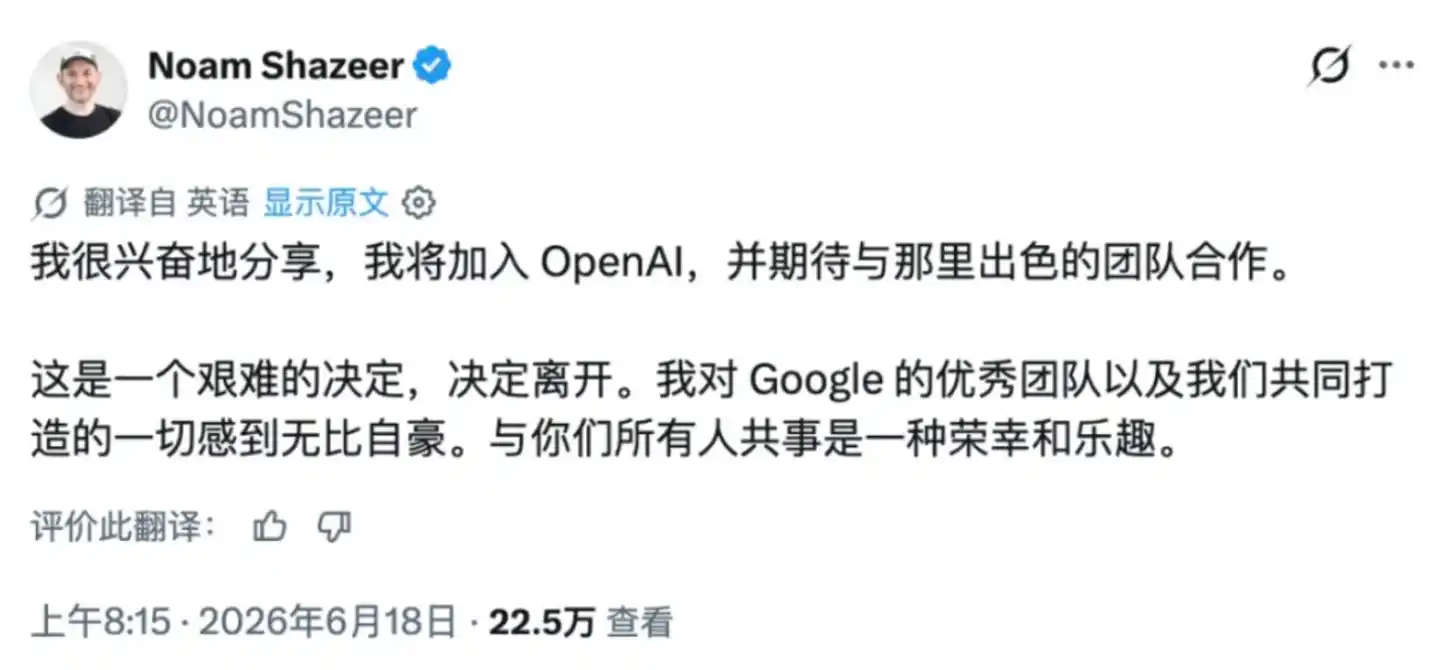
The entire internet lined up to cheer, "With the father of Transformer in charge, the next super-intelligence is guaranteed."
The same week, another document circulated within the industry: the first complete exposure of audited financial data shows OpenAI's 2025 revenue at $13.07 billion, with an operating loss of $20.92 billion. Including a one-time non-cash provision for restructuring, the net loss was nearly $39 billion. Even deducting that non-recurring accounting phantom loss, the real cash flow operating hemorrhage remains a bottomless pit. In Q1 2026, cash burn was $3.7 billion, exceeding half of the revenue for the same period.
So before hastily cheering that "OpenAI is steady," this isn't a technical success story at all—it's merely a check written on the back of $20.92 billion in operating losses. What OpenAI bought has nothing to do with the future; it's just a page in a story for the next round of investors.
Talent Is Leaking, Stars Are Filling In
Noam's resume is indeed dazzling. Core author of the 2017 paper "Attention Is All You Need," key contributor to Transformer, MoE, and T5. He left Google in 2021 to found Character.AI. In 2024, Google brought him back with a $2.7 billion technology licensing agreement, appointing him co-lead of Gemini. Less than two years later, he departed again.
Google proved one thing with $2.7 billion: Money can buy someone's time, but it can't buy the soil that makes them stay. Now OpenAI intends to try again with equity.
But OpenAI's soil isn't necessarily more suitable for pure research than Google's. Over the past three years, this company has been witnessing a talent swap: co-founder Karpathy left, Ilya Sutskever left, John Schulman left, and Jan Leike, head of the superalignment team, left. Large swaths of the core founding team have departed, leaving few in the core decision-making layer.
According to public industry data, research positions accounted for 23% of OpenAI's total hires in 2021 but dropped to 4.4% by 2024. Former internal researchers bluntly stated: The team's focus has shifted entirely from "exploratory research" to "product iteration." A few people jumping ship is just the surface. The truth that the research soil is being inch-by-inch squeezed out by product KPIs can no longer be hidden.
What he's facing is fundamentally not a lab starting from scratch. The system that Karpathy couldn't tolerate—and could only pursue "personal projects" within—is the mess Noam is inheriting. He's merely filling the hole left by the departure of Karpathy and others.
Sky-High Talent Buys Can't Save the Accounting Dilemma
Everyone is discussing what new architecture Noam can bring to OpenAI. But OpenAI's current predicament has nothing to do with "lacking someone who can write Transformer."
The financial figures are laid bare: In 2025 alone, R&D expenses included a $10.59 billion computing power leasing fee paid to Microsoft; total annual R&D cost was $19.18 billion; inference computing costs were $7.5 billion; and sales and marketing investments were $5.73 billion. On the other side are 900 million weekly active users, with only 50 million being paid users. Massive free traffic is a pure cost bottomless pit—the larger the user scale, the heavier the computing bill.
Even OpenAI itself is cutting costs: leaked documents show it has scaled back the Sora video model and trimmed non-core businesses to control costs. Cutting businesses to save money on one hand while spending exorbitantly to hire people on the other is anxious procurement.
The anxiety isn't unique to OpenAI; the industry wind has shifted long ago.
Microsoft's own Copilot Cowork has already abandoned the unlimited pricing model for a pay-per-use system due to high costs, and reportedly even considered integrating DeepSeek V4 as a cost-effective option. Even GitHub, under Microsoft, has turned to AWS for support due to AI computing shortages. If the financier's own computing pool isn't sufficient, who will foot OpenAI's astronomical computing bill next?
Cook publicly warned that the AI boom has driven storage chip prices up fourfold since 2024, a trend expected to continue until 2027, potentially increasing the price of the next iPhone by $270. These numbers serve more as industry indicators; the real hard math is inside OpenAI: computing hardware costs continue to climb, and efficiency gains from model architecture optimization simply can't keep pace with hardware price hikes. Noam can design more efficient model structures, but he can't fix the CFO's nightmare. Every additional free user adds another rigid computing bill.
The technical side offers no answers; the capital side must.
OpenAI is in a critical window of IPO preparation, with valuations touted as high as $1 trillion. Underwriters need sufficiently impactful stories to support the valuation. "The father of Transformer overseeing R&D" is exactly the kind of narrative material capital markets love most. The calculation for this investment isn't about how much model performance improved; the core question is whether it adds another highlight to the roadshow PPT.
Retail investors might get excited about "the father of Transformer joining," feeling the technical moat has thickened. But institutional investors, seeing the $20.92 billion operating loss in 2025, will only ask three practical questions:
Will this person suddenly make free users willing to pay?
Can he get Microsoft to discount the $10.59 billion computing bill?
Can he make departed research veterans return?
If the answer to all is no, then his value is merely a footnote in the valuation story. The biggest winners are always the early shareholders and underwriters. One more "genius in charge" story allows them to gracefully transfer the risk of $20.92 billion in operating losses to secondary market bag holders.
The Winner Between Two Paths Is Already Emerging
What is Anthropic doing during the same period?
In enterprise adoption rate statistics from multiple institutions, Anthropic's share has climbed to the 35%-40% range, significantly narrowing the lead with OpenAI and even surpassing it in some samples. More critically is its customer mix, with about 80% of revenue coming from enterprise clients; many Fortune 100 companies have already listed Claude on their procurement sheets. The company reportedly achieved its first profitable quarter in history and has confidentially filed for an IPO. Anthropic opens an office in Seoul, taking orders from NAVER and Nexon, earning real cash flow.
Anthropic didn't poach the "father of Transformer," nor does it rely on a single genius to prop up valuation. It relies on its enterprise-focused, compliant, neutral positioning, controllable token costs, and deep integration of Claude Code into development scenarios. What enterprise clients want has little to do with parameter counts; they want a "safety net that won't cause trouble" and a ledger that makes sense.
Google DeepMind's Hassabis hasn't moved in a decade, and Google didn't spend $2.7 billion to "redeem" him from outside. True innovative soil, which grows and retains research talent, cannot be bought annually for billions spent on external stars. The soil is only alive when it nurtures and keeps its own talent.
Anthropic has proven one thing: Profitability has little to do with individual genius; the foundation lies in the commercial soil.
OpenAI has also proven one thing: Individual genius cannot mask the hardening of commercial soil. Especially when you're buying talent at sky-high prices while watching your homegrown talent leave.
Conclusion
The next-generation architecture led by Noam will take at least 1 to 2 years to materialize. Yet, extrapolating from the Q1 2026 burn rate of $3.7 billion, annual cash consumption will not be less than $14.8 billion. This hasn't even accounted for the inevitably inflated marketing and compliance costs before the IPO.
Google spent $2.7 billion to rent one person for two years; OpenAI now intends to rent again using equity. The difference isn't the payment method. Google at least had its income statement to cushion it then; OpenAI's money for this is written on the back of $20.92 billion in operating losses, discounted by IPO valuation bubbles.
The ledger doesn't care about genius. The ledger only cares: How many quarters do you have left to wait?