Tether ускорит продвижение товарного кредитования наличными и USDT

cryptonews.ruОпубліковано о 2025-03-16Востаннє оновлено о 2025-11-17

По словам генерального директора Паоло Ардоино, эмитент стейблкоинов Tether расширяет свое присутствие в сфере товарного кредитования, причем в этом секторе уже задействованы миллиарды долларов.

В интервью Bloomberg Ардоино сообщил, что на данный момент Tether предоставил трейдерам сырьевых товаров кредит на сумму около 1 500 000 000 долларов обеспечивая финансирование как наличными, так и своим стейблкоином USDT.

Компания нацелена на торговлю традиционными сырьевыми товарами, включая продукцию доходного фарминга и нефть, планируя увеличить свое присутствие.

«Мы собираемся резко расшириться», - сказал Ардоино.

Кредитную деятельность ведет недавно созданное подразделение Tether по торговому финансированию - бизнес-направлению, которое обычно фокусируется на краткосрочном кредитовании, используемом для облегчения движения товаров по глобальным цепочкам поставок. Торговое финансирование в сырьевом мире обычно обеспечивает торговцев финансированием, необходимым для покупки, транспортировки и доставки грузов.

Bloomberg сообщил, что некоторые компании, возможно, не решаются брать займы в USDt, хотя это нежелание может быть перевешено растущим финансовым влиянием Tether. Имея в обращении USDt на сумму почти 184 000 000 000 долларов, на сегодняшний день Tether входит в число самых прибыльных компаний в расчете на одного сотрудника.

Продвижение Tether в сырьевые товары опирается на существующее присутствие Tether в этом секторе. Ее токенизированный золотой продукт Tether Gold увеличился в размерах во время роста цен на слитки, и Ардоино недавно заявил, что компания владеет более 100 тоннами физического золота.

Рисунок 1.

Продвижение стейблкоина способствует диверсификации Tether

Быстрое расширение Tether в новые направления бизнеса коренится в успехе его работы со стейблкоинами. Первоначально USDT был создан для того, чтобы предоставить привязанный к доллару актив криптовалютным трейдерам, в то время, когда отрасль изо всех сил пыталась получить доступ к традиционным банковским услугам.

С тех пор стейблкоины превратились в основной финансовый инструмент, используемый для денежных переводов, трансграничных платежей и онлайн-расчетов, который ценится за свою скорость, низкую стоимость и круглосуточную возможность перевода. Этот рост превратил Tether в одну из самых высокодоходных компаний в индустрии цифровых активов, что позволило диверсифицировать компанию в торговое финансирование, сырьевые товары, искусственный интеллект и другие предприятия.
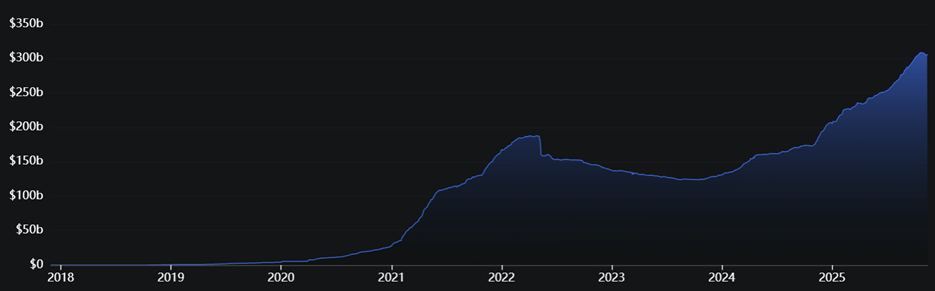
Рисунок 2. Общий рынок стейблкоинов сейчас оценивается более чем в 300 000 000 000 долларов. Доминирование USDT составляет около 60%. Источник: DefiLlama.

Крупные финансовые учреждения также начали изучать технологию стейблкоинов в различных формах. JPMorgan продолжает расширять использование своего токена JPM Coin на основе блокчейна для институциональных платежей, а Citigroup запустила пилотные проекты токенизированных депозитов и расчетов.

Платежный гигант Visa недавно расширил свои собственные возможности расчетов по стейблкоинам, позволив избранным предприятиям получать выплаты в долларах США в рамках новой пилотной программы.

Пов'язані матеріали

Olympus DAO Myth Reappears? A "Sovereign On-Chain Central Bank" Written with 4000 Lines of Immutable Code

A new project called The Standard Reserve has emerged, branding itself as a "sovereign on-chain central bank." It aims to replicate core central bank functions—currency issuance, money supply adjustment, and reserve accumulation—entirely through 4,000 lines of immutable code, with no human governance. Its core mechanism is a "reflexive monetary policy" based on a single signal: the net ETH flow into or out of the system's sole Uniswap v4 ETH/$STANDARD pool. Sustained net ETH inflows trigger an "expansion" phase, increasing $STANDARD issuance and using protocol fees to buy tokenized gold as a permanent hard reserve. Net outflows (or zero flow) trigger an immediate "contraction" phase, reducing issuance and using fees to buy back and burn $STANDARD. The system involves six key entities: the $STANDARD token (hard-capped at 1 billion), the central Uniswap pool, the Central Bank contract, Charter NFTs (acting as "banking licenses"), Branch units under each Charter (which earn a share of newly minted $STANDARD), and separate Vaults for expansion (buying gold) and contraction (buying back $STANDARD). To participate, users ideally acquire a Founding Charter NFT (initially 1,000 are free via allowlist/public mint). Each Charter comes with one Branch; more can be opened by burning $STANDARD for "expansion permits," increasing revenue share. Retiring a Branch lets users claim accumulated $STANDARD but imposes a dynamic exit fee (higher if many exit simultaneously), with half the fee burned and half distributed to remaining participants. All protocol revenue (from pool fees and Charter auctions) is allocated: 70% to the active Vault (for gold or buybacks), 15% to permanent protocol-owned liquidity, and 15% to the team. The project presents an innovative, game-theoretic model where user actions (expanding Branches by burning tokens or exiting) align with system goals of building reserves or inducing deflation. However, it is fully anonymous, with key parameters undefined and unaudited code, posing significant risks.

marsbit24 хв тому

Olympus DAO Myth Reappears? A "Sovereign On-Chain Central Bank" Written with 4000 Lines of Immutable Code

marsbit24 хв тому

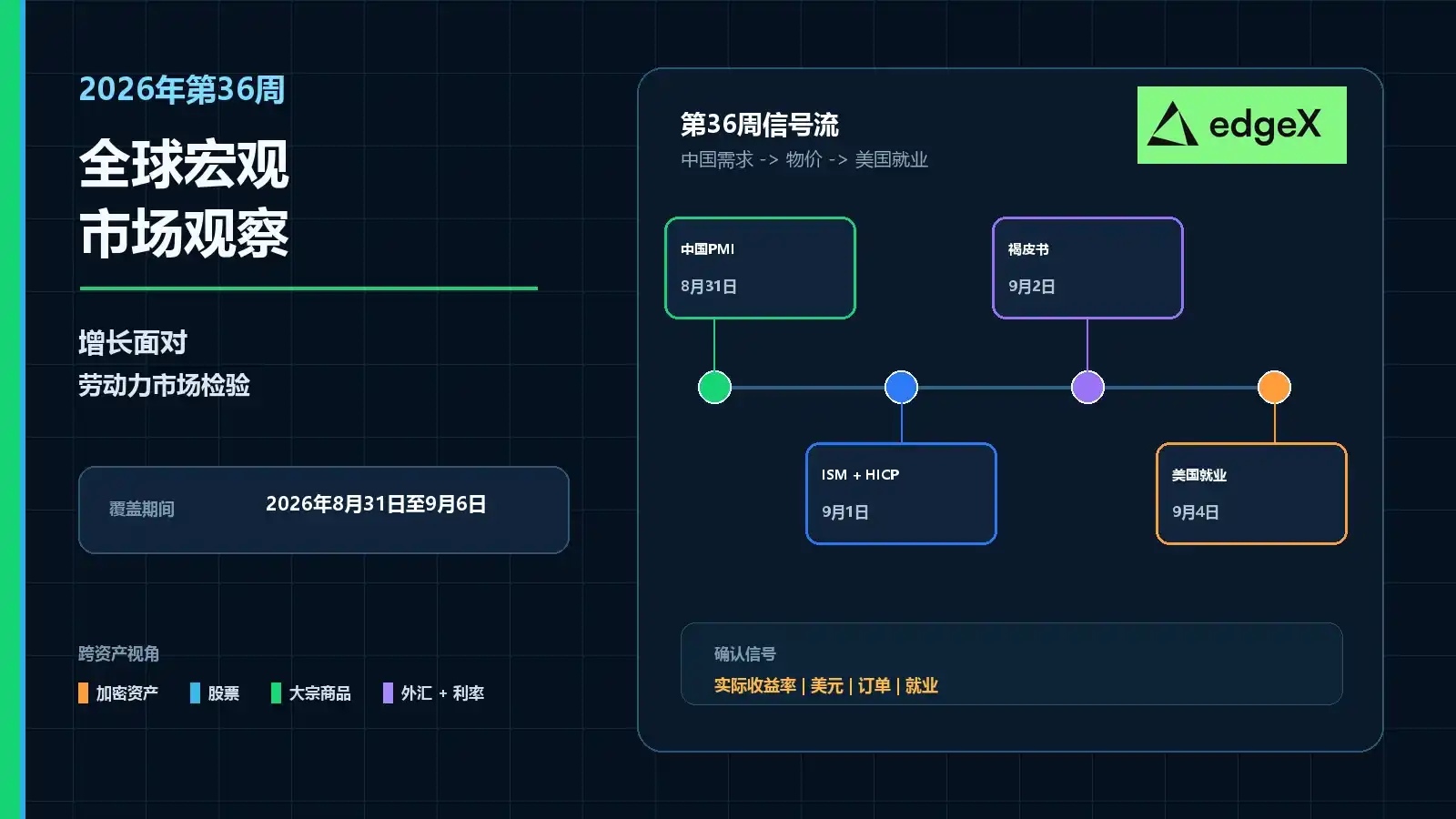
US Jobs, China PMI, and Inflation on Stage: Can Global Growth Maintain Resilience?

**Week 36 Macro Outlook: Key Data to Test Global Growth Resilience** The week from August 31 to September 6 will shift focus from policy discussions to a critical test of global economic activity. The sequence of events is key, starting with China's official August PMI on Aug 31, which will provide early signals on factory orders, services, and employment following July's contraction. The data flow then broadens. On September 1, US ISM Manufacturing PMI and the Eurozone's flash inflation estimate will offer simultaneous checks on demand, prices, and regional divergence. The subsequent US Federal Reserve Beige Book on September 2 adds granular, qualitative evidence on consumer spending, wages, and regional conditions. Australian Q2 GDP and Canadian trade and jobs data will test resilience in other major economies. The week's pivotal event, however, is the US August employment report on September 4. It will decisively influence expectations for interest rates, the US dollar, and broader risk appetite, acting as a final cross-check for the preceding data. The core question for markets is whether global growth can remain resilient. An ideal outcome would combine a rebound in China's PMI, stable US jobs growth, cooling inflation, and signs of a gradual demand slowdown. Conversely, weak Chinese manufacturing, sticky Eurozone prices, and disappointing US non-farm payrolls would create a more complex scenario of reduced corporate confidence and limited room for aggressive monetary easing, increasing pressure on cyclical assets. Investors should monitor the breadth of improvements—such as new orders and employment—rather than headline PMI figures alone. Confirmation across different data points is crucial. A positive combination of steady activity and disinflation could support equities, industrial commodities, and risk assets like crypto. However, if a growth slowdown triggers lower yields, it must be distinguished from a scenario of rising recession risks that would pressure corporate earnings, potentially limiting rallies. The market's final reaction will hinge on whether the week's signals align to either reinforce or challenge the current growth narrative.

marsbit27 хв тому

US Jobs, China PMI, and Inflation on Stage: Can Global Growth Maintain Resilience?

marsbit27 хв тому

Торгівля

Спот
活动图片