I. Project Background and Overview
Since the rise of the internet in the 1990s, the HTTP protocol has been the cornerstone of information transmission, defining how browsers communicate with servers and shaping user behavior online. However, within the HTTP/1.1 standard, one status code has long been neglected — 402 “Payment Required". Originally designed as an entry point for native internet payments, it remained inactive for nearly thirty years. This was not due to a lack of demand but rather the absence of the necessary technological and ecosystem foundations: While credit cards and PayPal popularized electronic payments, they relied on external account systems, complex integration processes, and high-cost structures, making them incompatible with HTTP’s native architecture. Consequently, the internet evolved under a “free + advertising” model, where users became accustomed to paying nothing directly, and companies keep afloat through ads or subscriptions. There is no escaping the fact that the model fueled the internet’s explosive growth, but it also produced major downsides: excessive user data collection, unfair income distribution for content creators, and traffic monopolies by ad giants. In essence, the lack of a native payment layer on the Internet directly shaped the Web2 commercial ecosystem.
In September 2025, Coinbase and Cloudflare jointly introduced the x402 Protocol, aiming to fully activate the 402 status code and create a true native payment layer for the internet. The vision goes beyond simply “making HTTP chargeable”; instead, it leverages blockchain, stablecoins, and smart contracts to overcome the fundamental barriers that prevented early-stage internet payments from becoming embedded in the protocol itself. Coinbase provides the crypto payment infrastructure and stablecoin ecosystem, while Cloudflare contributes its global CDN and edge computing capabilities, embedding the protocol into the existing network stack with minimal architectural changes. The core value of x402 can be summarized as follows: 1) Payment-as-Settlement: Transactions are finalized within seconds via blockchain and stablecoins, eliminating intermediated clearing processes. 2) HTTP-Native Integration: Designed around standard HTTP status codes, it is fully compatible with existing internet protocols and naturally embedded in the Web environment. 3) Frictionless Onboarding: With only “one line of code", websites or APIs can enable payment functionality, drastically reducing integration barriers. In essence, x402 does not aim to replace Visa or PayPal, but rather to fill a long-standing gap in the internet protocol stack — a missing “value transmission module". Just as SMTP standardized email and DNS standardized domain resolution, x402 aspires to become the payment protocol standard of the digital world. To understand why x402 is necessary, one must examine the limitations of current payment systems: 1) High Fees: Credit card and third-party payment providers typically charge 2–3% fees, which can exceed the transaction amount in micropayment scenarios. 2) Settlement Delays: Funds often settle on a T+1 or longer cycle, creating cash flow pressure for merchants. 3) Cross-Border Barriers: Fragmented and inconsistent exchange rates, compliance and regulatory systems make small cross-border payments nearly impossible. 4) Lack of Programmability: Traditional systems are not designed for automation, hindering conditional or machine-to-machine transactions without human interference. These shortcomings were tolerable in the Web2 era, dominated by advertising and subscriptions, but in the AI economy where micropayments and automated transactions become core needs, traditional systems can't measure up.
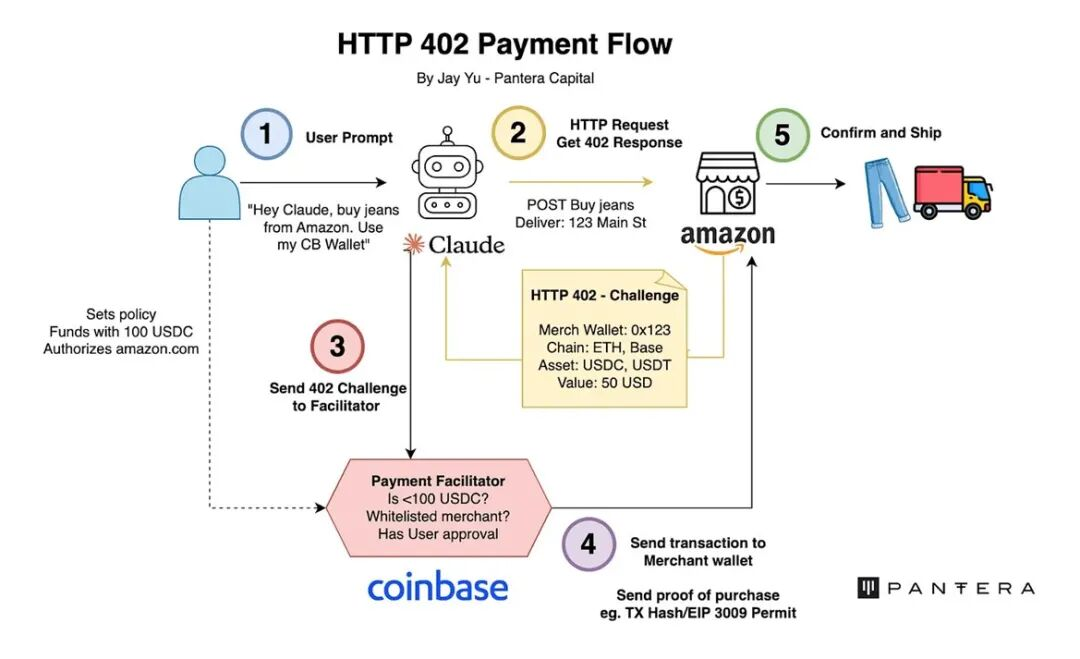
The introduction of 402 is tightly linked to the rise of AI agents. AI agents can autonomously complete tasks, invoke services, and make payments, gradually becoming key participants in the digital economy. According to Gartner, by 2030, machine customers will influence over $30 trillion worth of purchases. Similarly, the World Economic Forum projects that the AI agent market will grow from $7.84 billion in 2025 to $50.3 billion by 2030, with a compound annual growth rate (CAGR) of 45%. The operational logic of AI agents demands a payment system that satisfies four conditions: 1) High-frequency, low-value transactions: Each API call or data request may only cost $0.001–0.01. 2) Full automation: Payments must be entirely programmable, without human intervention. 3) 24/7 uptime: Machine transactions never stop, demanding extreme system reliability. 4) Global interoperability: AI agents transcend borders, requiring a universal settlement layer. Traditional payment networks fail in all these aspects, while x402 is purpose-built for them. In this sense, the AI economy represents the true historical mission of the 402 protocol. Several technological breakthroughs in recent years have finally made the activation of 402 feasible: 1) Stablecoins such as USDC and USDT provide a stable value anchor for micropayments, free from crypto volatility. 2) Layer-2 scaling solutions like Base and Polygon have drastically lowered gas fees, enabling sub-cent transactions. 3) Account abstraction and smart contract wallets have made blockchain payments nearly as seamless as Web2 experiences, enabling features such as permission control, multi-signature, and spending limits. 4) Edge computing infrastructure from providers like Cloudflare enables fast, global verification and payment confirmation with minimal latency. These converging conditions have created the optimal window to awaken the “long-dormant 402". In the x402 architecture, payment and HTTP requests are seamlessly integrated into a standardized closed loop: The client requests a resource before the server responds with a 402 status code, including payment details such as amount, address, and currency. Then the client wallet automatically generates a payment transaction and submits it to the blockchain. Upon payment confirmation, the client re-requests the resource with proof of payment. At last, the server verifies the payment and returns the original content. This “pay-to-access” experience makes micropayments as natural as web browsing — with users barely aware of the underlying complexity. The greatest strategic significance of x402 lies in its open, non-proprietary design. Coinbase and Cloudflare chose to open-source the protocol and establish foundation-based governance to prevent monopolization. This approach ensures that: 1) Any service provider can integrate it without barriers. 2) The protocol layer remains neutral, independent of specific business models and needn't compete straightforward with the ecosystem applications. 3) It complements rather than replaces existing giants like Visa, Google, and Anthropic. Such positioning strengthens x402’s acceptance, making it resemble internet infrastructure rather than a company-owned product.
Looking back over thirty years of internet evolution, payments have always been the missing puzzle piece. The 402 status code, long dormant due to technical and commercial constraints, now stands ready to be activated. With the convergence of blockchain, stablecoins, and AI agents, this long-awaited piece is finally in place. The launch of x402 is more than a technical upgrade — it represents a potential redefinition of the internet's commercial paradigm:
a shift from advertising-driven to value-driven models, from account-based systems to protocol-native architectures, and from human-to-human to machine-to-machine payments. In essence, the “Project Background and Overview” section reveals that x402 is not just a payment tool, but the long-delayed missing link in the history of the internet — a piece that, after thirty years, is finally ready to fall into place in 2025.
II. Ecosystem Development & Market Outlook
The introduction of the x402 protocol is not merely the release of a technical specification, but a recomposition of a multi-party ecosystem. After its launch, both Coinbase and Cloudflare emphasized that x402 is not a private protocol owned by any single company, but rather an “internet-native payment layer standard". This openness positions it from the start as a core of an ecosystem, rather than as an isolated standalone product. The ecosystem being built around x402 is developing along five main vectors: infrastructure, platform applications, partner integration, developer community, and market education — showing a bottom-up network effect growth model. In other words, the market outlook for x402 and its ecosystem expansion is not about a single breakthrough, but about coordinated advancement across multiple segments.
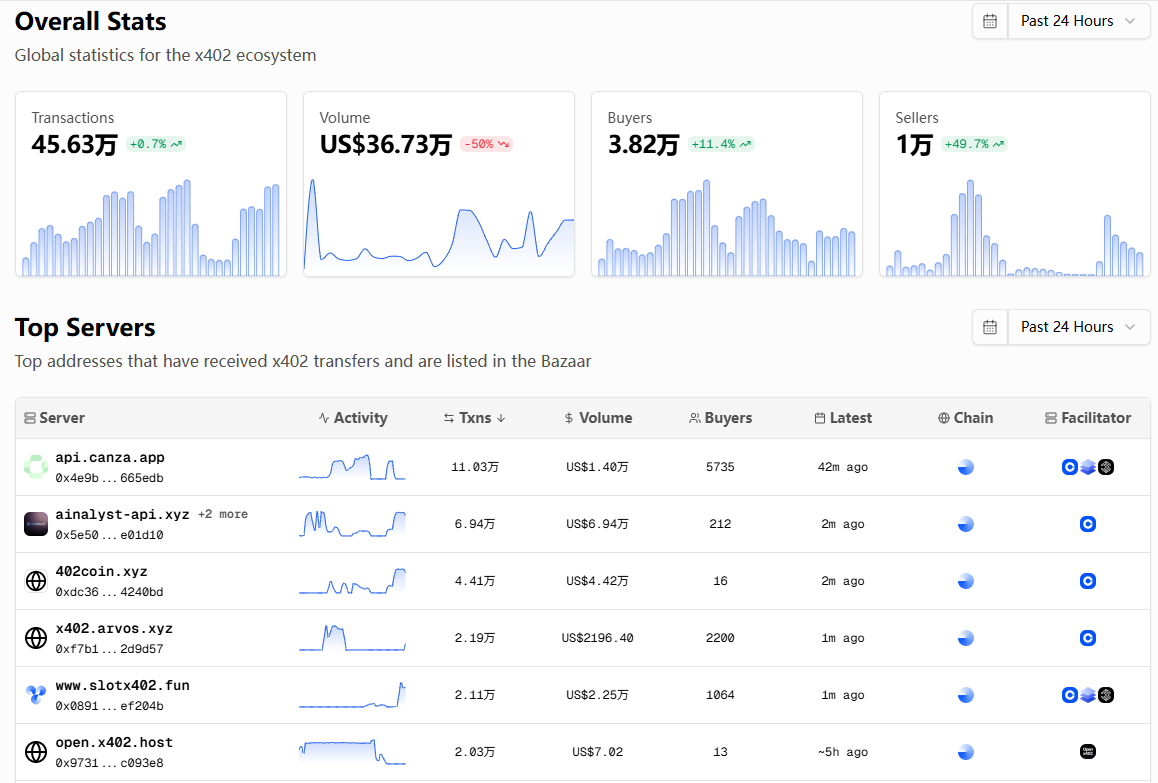
At the infrastructure layer, x402 chooses the most minimal entry point: deep compatibility with HTTP via the 402 status code. Developers need only “one line of code” to empower a website or API with payment capability. This minimalist onboarding logic not only lowers the barrier for small and medium developers, but also allows large platforms to experiment without incurring large migration costs in the early stages. The middleware, client libraries, and multichain adapters provided by Coinbase and Cloudflare further reduce development and maintenance burdens. In particular, multi-chain adapters enable service providers to select the most suitable blockchain environment for each scenario — for instance, using Polygon for low-cost, high-throughput applications, Ethereum mainnet for high-security contexts, or Base (Coinbase’s own chain) for seamless integration with the exchange infrastructure. This flexibility significantly enhances the protocol’s universality, thereby increasing its odds of becoming a de facto standard. At the platform level, Coinbase's x402 Bazaar is the earliest application showcasing a nascent ecosystem. This marketplace, targeted at AI agents and developers, enables service providers to list their APIs, data sources, or functional modules; users or AI agents can invoke them on demand and instantly pay through x402. Its value lies in solving the long-standing billing and integration difficulties in the API economy. Historically, monetizing APIs often requires complex registration, subscriptions, and monthly billing cycles. But in the x402 Bazaar environment, “call → pay → settle” becomes seamless; micropayments make pay-per-call feasible. For AI agents, this means they can autonomously and flexibly invoke services in the marketplace without relying on manual human authorization or tying to credit cards. This marketplace mechanism is highly aligned with the autonomy of AI agents and presents Coinbase and Cloudflare with a potentially massive growth vector. If x402 Bazaar can accumulate sufficient supply and demand, it may evolve into an “App Store for AI agent economy".
Cloudflare’s participation brings an entirely different dimension of leverage for the protocol. As one of the world’s largest CDN and cybersecurity providers, Cloudflare controls over 20% of global internet traffic, and its Workers edge computing platform is already a tool used by millions of developers to deploy lightweight services. Embedding x402’s payment functionality into Cloudflare Workers enables numerous small websites, APIs, and services to adopt payment features with zero architecture changes. This “zero-friction deployment” makes it possible for the protocol to spread rapidly among long-tail developers (i.e., numerous smaller-scale developers beyond the major platforms), a segment that inherently offers the most fertile ground for micropayment use cases. Whether unlocking blog posts or making single-use calls to niche developer tools, these applications become payment-enabled with Cloudflare’s distribution power. This strategy stands in sharp contrast to traditional payment gateways, which typically target medium to large enterprises and require complex integration. But x402 reverses this path: break into the long-tail developer communities first, then gradually feed back into mainstream commercial systems. More importantly, x402 does not confine itself to crypto-native ecosystems, instead, it actively seeks interoperation with traditional payment systems. Visa’s involvement provides a critical bridge for the entire ecosystem. Through interoperability with Visa’s TAP protocol, x402 can reconcile stablecoin payment with traditional credit card networks. This bridging design is strategically significant: It avoids direct competition with conventional payment networks, while offering users and enterprises a dual-track option. In familiar scenarios, credit cards could still be used and in new scenes like machine-to-machine and cross-border micropayments, users could rely on x402 and stablecoins to complete their trading. This gradual transition reduces the difficulty of market education, enabling traditional enterprises and consumers to accept the new protocol with lower psychological and technical cost. In other words, Visa’s participation transforms x402 from a Web3 experiment into a protocol with a path to mainstream financial systems.
In the partner matrix, the participation of tech giants such as Google, AWS, and Anthropic should not be overlooked either. Google’s proposed AP2 (Agent Payments Protocol) was originally conceived as a unified payment framework for AI agents, supporting multiple traditional payment methods. Its combination with x402 adds the possibility of stablecoin and on-chain payment. In Google’s demo, a user issues a single prompt, and the AI agent, enabled by AP2 plus the x402 extension, completes a series of tasks including research, inventory checks, payment and settlement. This experience demonstrates the prototypical “end-to-end automated transaction” flow in the AI agent era, where x402 functions as the payment layer. Anthropic’s participation further validates AI companies’ urgent need for such a payment standard. Automated payments will be indispensable for AI assistants like Claude in the future to interact with many third-party services. Without a standard like x402, these AI assistants will struggle to operate with full autonomy in commercial settings. Ecosystem development depends not only on major enterprises' engagement, but also critically on the open source community. From its inception, x402 opted for an open-source path under the Apache 2.0 license, with the code published on GitHub. Within months, the protocol gained over 1,600 Stars, and developers contributed SDKs in multiple languages, visual configuration tools, and sample applications. These community tools further lower the access threshold for ordinary developers and drive self-expansion of the ecosystem. In addition, engineers from Coinbase and Cloudflare actively engage in community discussions, respond to feedback, and publish iterative updates. Such an open model is reminiscent of the early IETF standardization process for the internet, foreshadowing x402’s potential evolution into a truly standardized protocol.
On the market size, x402 sits at the intersection of two high-growth domains: global digital payments and the AI agent economy. The global digital payments market already exceeded $10 trillion by 2025, while the AI agent market is forecasted to reach $50 billion by 2030, with a compound annual growth rate of over 40%. This means x402 has the potential not only to penetrate the existing massive payments market, but also to serve as the foundational infrastructure in the emerging machine economy. The API economy and micropayments for digital content are the most immediate application domains. According to forecasts, the global API management market will hit $6.18 billion by 2027, while content monetization is poised for a resurgence as the ad-driven model faces constraints. Traditional subscription models can limit user experience, because users may only want to pay for a single article, song, or tool invocation. The micropayment capability of x402 enables a “decomposed subscription” model, potentially unleashing more diversified business models. In terms of competitive landscape, x402 does have rivals. Micro-payment solutions in the Bitcoin ecosystem, such as Lightning Network, have long existed, and some decentralized applications offer token-driven payment mechanisms. However, their limitations lie in failing to integrate into the internet protocol layer. In other words, the native binding with HTTP, browser environments, and APIs inherently faces barriers. Traditional payment networks, though entrenched, lack advantages in micropayment, cross-border low-fee transactions and automation. x402’s differentiation lies in its HTTP-native design, frictionless onboarding, and cross-chain compatibility, giving it a unique position in the market. It does not compete head-on with any single payment system; rather, it provides a shared “interface” via standardization. This positioning makes it easier to gain support from multiple parties, thereby increasing the chance of forming a broad alliance ecosystem.
In summary, the x402 protocol’s ecosystem is already showing early vitality: from Coinbase Bazaar to Cloudflare Workers, from Visa TAP to Google AP2 cooperation, from active open-source communities to mature developer tools, and from long-tail micropayment use cases to autonomous transactions by AI agents — all of these together outline a vast potential market. While uncertainty remains, especially in regulation and mass adoption, the general direction is quite clear: x402 is becoming a critical interface merging AI economy and internet payments. If the first section emphasizes the historical background and technical necessity of the emergence of 402 protocol, this second part reveals the chain reaction and the reshaping of commercial structure it may trigger. The future of the protocol depends not only on technical maturity, but on whether its ecosystem can generate positive feedback loops. Once network effects take hold, its rate of adoption could far outpace that of traditional payment innovations.
III. Investment Potential and Risks
If the x402 protocol has already demonstrated sufficient prospects and implementation logic at the technical and ecosystem levels, then from an investor’s perspective the most critical aspect remains how to assess its potential value and risks. This involves not only its network-effect potential as a protocol standard, but also the business value that applications, platforms and services built around the protocol can provide. At the same time, it necessitates fully acknowledging the multiple challenges it may face in the years ahead across dimensions such as technology, regulation and market adoption. In other words, investors need to establish reasonable expectations between macro narratives and micro indicators in order to grasp the strategic opportunity embedded in x402.
First, from the potential side, x402’s greatest value lies in its “protocol-layer network effect”. In the history of the internet, every successful underlying protocol has evolved into long-term infrastructure, carrying investment value that endures across economic cycles. For example, TCP/IP established the entire communications framework of the internet, SSL/TLS became the de facto standard for secure network communication, and SMTP propelled email’s widespread adoption. Once established, these protocols are extremely difficult to be replaced and can deliver long-term dividends for the industry chain built on top of them. If the x402 protocol can become the standard for “payment as HTTP”, its value lies not in the profitability of a single application, but in the reinvention of the entire internet business model. Once widely adopted, the x402 protocol could empower millions of websites, billions of devices and countless AI agents with payment capabilities, reinforcing network effects and eventually forming path-dependency on the de facto standard. Once such standard-driven dividends emerge, their value is hard to assess using traditional valuation methods because they involve a fundamental ecosystem restructuring. Second, from the ecosystem investment perspective, multiple layers of commercial opportunities may emerge around the x402 protocol. At the base layer are protocol-related infrastructure services, such as payment gateways, verification services, multichain adapters and exchange-rate services. These belong to the “protocol tool layer”, analogous to routers, firewalls and load-balancers that emerged around TCP/IP. This layer is typically the first to realize commercialization because it provides essential support for the protocol’s operation and cannot be bypassed by users or developers. Above this layer lie platform applications, such as the x402 Bazaar and Cloudflare Workers integration, which may become the earliest scenarios to achieve revenue at scale. Further upwards are entirely new business models derived from the protocol such as AI agents making on-demand calls to third-party services, content creators monetizing their work directly via micropayments, and machines in IoT ecosystems performing autonomous payments. Once validated by the market, these models may generate long-term stable cash flows. When evaluating, investors should pay attention to these distinct layers of ecosystem opportunities that could drive the steady growth of foundational infrastructure and capture the high-elasticity returns of application layers.
However, all potential must be weighed against risks. The dominant risk for the x402 protocol is technical scalability. In theory, Layer 2 blockchains and state-channel technologies can support low-cost, high-concurrency transactions, but in practice when AI agents truly proliferate at scale, the payment system may need to handle hundreds of thousands or even millions of micro-transactions per second. This kind of pressure may exceed the capacity of existing public chains and Layer 2 solutions, causing transaction congestion, rising fees and deteriorating user experience. If scalability cannot be resolved, x402’s micropayment advantage may be weakened or overtaken by alternatives. Therefore, investors must continuously track the protocol’s performance in real-world conditions, including key metrics such as average confirmation time, failure rate, fee dynamics, and the distribution of load across multiple chains. A second dimension of risk is regulatory uncertainty. Although stablecoins are gradually being accepted within mainstream finance, their compliance status varies significantly across different jurisdictions. In the United States, stablecoins face intense scrutiny from Congress and regulatory agencies in terms of AML (anti-money-laundering), KYC (know-your-customer), payment licensing; in Europe, frameworks like MiCA provide a compliance path but details are still to be finalized; in emerging markets stablecoin payments may even be viewed as threats to monetary sovereignty and thus subject to restriction. The x402 protocol’s "account-less, direct-payment" model delivers a seamless user experience, but it may conflict with regulatory requirements for identity verification and anti-money laundering. Should major jurisdictions tighten supervision, the protocol’s adoption speed could be severely impacted. Hence, the uncertainty of regulatory policy will be a core external risk to its commercial trajectory. Market acceptance uncertainty likewise deserves attention. Although logically the demand for micropayments and AI-agent driven payments is clear, user and enterprise habits tend to be path-dependent. Most internet users are accustomed to subscription or ad-supported models; whether they are willing to switch to “pay-per-use” still requires market education.
In addition, security risk must also be closely monitored. As a payment protocol, x402—if breached—could trigger large-scale fund losses or a systemic trust crisis. Although the protocol incorporates protections such as anti-tampering, replay-attack mitigation and minimal information leakage, it still faces challenges from hacker attacks, smart-contract vulnerabilities, wallet security issues, etc. The history clearly shows that any protocol involving fund flows must endure long-term security validation and iteration before earning market trust. Investors should therefore monitor whether the protocol has suffered major security incidents in practice, and the extent to which the foundation and development team invest in security audits and their incident response capabilities. In the competitive dimension, although the x402 protocol enjoys the unique advantages of HTTP-native integration and cross-chain compatibility, it is by no means free of rivals. Micropayment solutions like the Lightning Network in the Bitcoin ecosystem, Rollup-based micropayment schemes, and large internet companies’ proprietary payment systems (such as Apple Pay and Google Pay) could serve as alternatives in specific scenarios. Most notably, if conventional payment networks quickly iterate, launch low-fee programmable micropayment tools and leverage their existing massive user bases for rapid adoption, x402’s differentiated advantages could be partly weakened. Hence, investors should dynamically observe competitors’ moves and evaluate the sustainability of x402’s differentiators. Despite substantial risks, the investment value of the x402 protocol lies in the “paradigm-shift dividend” it potentially offers. Much like how cloud computing, despite early security and compliance concerns, eventually became the inevitable choice for IT infrastructure, the demand for an internet-native payment layer is almost irreversible. If x402 can pioneer the standard and gain multi-party endorsement through open-source and foundation governance models, its long-term value will not rest on short-term profits, but on its strategic position as the “underlying standard of the digital economy”. For venture capital firms, this implies early-stage investments in ecosystem-adjacent enterprises may yield outsized returns; for traditional financial institutions, participating in standard formation and ecosystem construction can help them secure a proactive position in the AI-agent economy; for industry capital, building application scenarios around x402 may deliver entirely new growth trajectories.
Practically, investors should monitor several core indicators to judge the protocol’s progression: 1) Adoption rate – including GitHub developer activity, SDK download volumes, Cloudflare Workers integrations, and the number of connected websites and APIs; 2) Transaction metrics – including daily transaction counts, average transaction value, confirmation times and failure rates; 3) Ecosystem indicators – including active supply and demand on Bazaar, participation of mainstream AI platforms and content platforms; 4)Compliance indicators – including legal status of stablecoins, KYC/AML compliance frameworks in major jurisdictions, and communication between the foundation and regulatory agencies. Taken together, these metrics represent the critical signals for the protocol’s successful transition from an early experiment phase to broad-based adoption. In sum, the investment potential of the x402 protocol lies in its possibility to become the de facto standard for internet payments, empower the AI-agent economy and micropayment models, and drive the restructuring of internet business models. Nevertheless, it faces significant risks including technology, regulation, market acceptance and competition as well. For investors, the key is to understand the relationship between the protocol’s long-term logic and short-term volatility, recognizing the potential for standard-driven dividends while remaining prepared for the challenges posed by uncertainty. Only those investors who can engage early, track progress relentlessly, and adjust strategy flexibly can truly capture the maximum value from this potential payment revolution.
IV. Conclusion
The introduction of the x402 protocol is not only a technological innovation, but also a structural reshaping of the internet payment system. By re-activating the HTTP 402 status code that has lain dormant for thirty years, it embeds payments into the fundamental protocol layer of the internet, thus opening a channel for value transmission alongside information transmission. Leveraging blockchains, stablecoins and Layer 2 scaling solutions, x402 equips itself with the features of “payment as settlement,” “frictionless onboarding,” and “chain-agnostic” architecture, providing the essential infrastructure needed for the AI-agent economy and micropayment scenarios. The combined efforts of Coinbase and Cloudflare, along with participation from major players such as Visa, Google, and Anthropic, give the protocol significant potential for cross-industry integration and standardization from the outset. The open-source community’s enthusiastic response further fuels long-tail innovation. However, risks must not be overlooked. Technical scalability still needs to be tested in real-world environments, regulatory uncertainties may slow global adoption, users and enterprises will need time to adjust their payment habits, and competitors may provide alternatives in certain scenarios. In other words, for x402 to become mainstream, it must pass through three phases: feasibility validation → large-scale adoption → de facto standardisation — a process which will be shaped by technology evolution, policy progression and market education.
From an investment perspective, the value of x402 does not lie in short-term revenue curves but in the paradigm-shift it might trigger: The internet business model may move from “ad-subsidy + subscription lock-in” to “micropayments + immediate value exchange”, AI-agent autonomous payments may drive the rise of the machine economy, and the global payments system may evolve toward a new unified interface. For enterprises, early pilots and integrations mean a strategic head-start in the future ecosystem; for investors, the multi-layered opportunities surrounding both the protocol and its ecosystem merit close attention. Therefore, it is fair to say that the x402 protocol represents a pivotal milestone in the evolution of the internet — it is not only the product of technological maturity, demand catalyst and ecosystem synergy, but also the starting point of a leap-frog transformation. In the coming years, its ability to become the standard for an “internet-native payment layer” will determine whether it remains a fleeting innovation experiment or evolves into the foundational infrastructure for a new global commercial paradigm. Regardless of the ultimate outcome, x402 has already illuminated the long-missing puzzle piece in the course of internet development, opening up a new horizon for the future of value transmission.