Cardano Founder Slams ‘Clickbait’ Reports He Blamed ADA Users

bitcoinistОпубліковано о 2025-11-05Востаннє оновлено о 2025-11-05

Анотація

Charles Hoskinson issued a rebuttal on November 3, rejecting circulating headlines that claimed he blamed Cardano’s users for the network’s...

Trusted Editorial content, reviewed by leading industry experts and seasoned editors. Ad Disclosure

Charles Hoskinson issued a rebuttal on November 3, rejecting circulating headlines that claimed he blamed Cardano’s users for the network’s decentralized finance shortfall. In a brief video, the Cardano founder said media outlets misrepresented his prior comments about participation patterns across the ecosystem, stressing that his point was a structural “mismatch” between who stakes and governs versus who takes part in DeFi—not blame.

“I never once blamed anyone from the Cardano ecosystem for the DeFi [woes],” Hoskinson said, naming The Crypto Basic as an example of outlets whose framing he called fundamentally inaccurate. “I’m sorry crypto media that you guys are […] and you just want clickbait headlines. You guys have to cut this the […] out.” He added that there is “not a single person in the Cardano ecosystem who I am blaming for our DeFi situation right now.”

Cardano’s DeFi Gap Is A Participation Mismatch

Hoskinson’s core claim is numerical and directional rather than accusatory. He argued there is a demonstrable divergence between Cardano’s high participation in staking and governance and its lower participation in DeFi protocols, which depresses total value locked. “I pointed out in a video that there is a mismatch between the people who participate in staking and governance and the people who participate in DeFi. And if there was proportionality there… our TVL would be at least five to 10 billion,” he said. He characterized the recent headlines as “materially wrong and factually wrong” because they attributed intent—“blaming users”—that he explicitly disavowed.

The founder anchored his point in a specific user count comparison. Some third-party measurements, he said, “are asserting that Cardano has only 10,000 to 50,000 actual users when there’s 1.3 million who are using staking.” For Hoskinson, that delta underscores that Cardano “has a large population, a large wallet base, and a lot of users as evidenced by the enormous level of participation in both governance and staking,” even if those participants are not currently “deploying to the other side of the aisle, to the TVL side, to the DeFi side.”

He repeatedly emphasized that diagnosing the participation gap is an ecosystem responsibility, not a morality play. “I’m not blaming them for not participating,” he said. “Never once said it’s their fault and they’re bad people and they’ve done something wrong.” Instead, he called for a frank community conversation about the drivers behind users’ choices. “It could be slippage. It could be fees. It could be user experience. It could be yields. It could be safety concerns. It could be education. There could be 150,000 different reasons for that. But we as an ecosystem have to have that discussion.”

The remedy, in his view, is a coordinated governance agenda rather than a media narrative. He urged Cardano stakeholders to treat the participation gap as a 2026 workstream and to fund targeted initiatives through delegated authority. “We as an ecosystem have to ask why that mismatch exists and how can we correct that mismatch… as a 2026 governance agenda, and get some delegated authority funding and effort to correct that,” he said. If the proportionality problem were addressed, Hoskinson argued, “that alone can get our TVL up 5 billion to 10 billion,” potentially placing Cardano “in the top ranks of TVL, the top five to top 10.”

The dispute originated, he said, when media took a narrow, data-driven observation about where Cardano users allocate capital and translated it into a blame narrative. “People say something very specific, very targeted, and then it gets misinterpreted, and then everybody judges you based upon the headlines,” he said. “I’m not going to allow the crypto media to go ahead and put words in my mouth.” He reiterated the same point multiple times for emphasis: “I did not blame the Cardano ecosystem. I did not blame the Cardano users for anything. I was very careful, guarded, and specific in the things that I said.”

Hoskinson coupled the clarification with a broader critique of crypto media practices. “If you continue to broadcast, you’re lying to people,” he said, adding, “I expect that from the crypto media because they are scum. They do lie. Everything’s sensational. Everything’s clickbait.” He framed his intervention as a corrective to prevent a headline cycle from hardening into accepted fact: “The record has been corrected.”

Beyond media criticism, the practical substance of his message focused on mobilizing existing users rather than conjuring new ones. “We have the users. We have the capital,” he said. “For some reason, those users with their capital are not participating in DeFi.” While he acknowledged having personal “suspicions” and hearing “frustrations” from ecosystem participants, he stopped short of diagnosing root causes, instead calling for an open, data-first process to “systematically chip away” at barriers that deter stakers and governance participants from crossing into DeFi activity.

Across the video, Hoskinson’s throughline never deviated: the issue is proportional participation by an already large user base. “There is a mismatch between the people participating in staking and governance—of which it’s seven figures over a million people—and the people participating in DeFi,” he said. “We have to get to the bottom of that mismatch as an ecosystem… But I’m not blaming the Cardano users for that mismatch. I’m not saying it’s their fault. I’m not saying that they did something wrong.”

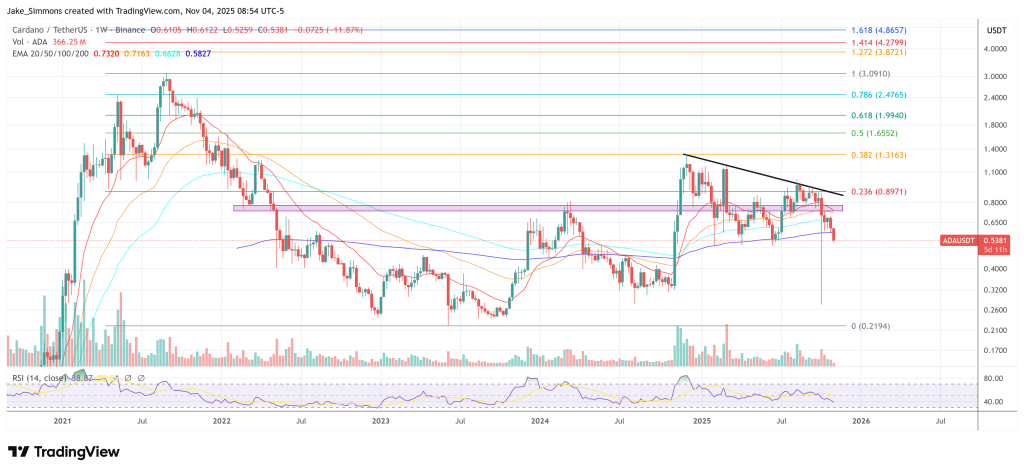
At press time, ADA traded at $0.538.
Cardano price
ADA drops below the EMA200, 1-week chart | Source: ADAUSDT on TradingView.com
Featured image created with DALL.E, chart from TradingView.com
Editorial Process for bitcoinist is centered on delivering thoroughly researched, accurate, and unbiased content. We uphold strict sourcing standards, and each page undergoes diligent review by our team of top technology experts and seasoned editors. This process ensures the integrity, relevance, and value of our content for our readers.

Jake Simmons has been a Bitcoin enthusiast since 2016. Ever since he heard about Bitcoin, he has been studying the topic every day and trying to share his knowledge with others. His goal is to contribute to Bitcoin's financial revolution, which will replace the fiat money system. Besides BTC and crypto, Jake studied Business Informatics at a university. After graduation in 2017, he has been working in the blockchain and crypto sector. You can follow Jake on Twitter at @realJakeSimmons.

Пов'язані матеріали

The Veil of Mythos Becomes Anthropic's Lever to Move Trillions

The article discusses Anthropic's reported upcoming $30 billion funding round, which would value the company at over $900 billion. It analyzes how the company has leveraged strategic narratives around its unreleased "Mythos" model, rather than just its publicly available products, to drive this massive valuation. Key points include Google's surprising $40 billion investment in a competitor, suggesting it is buying strategic positioning. Anthropic's "Glasswing" cybersecurity project and the unreleased Mythos model are portrayed not through direct proof, but through carefully crafted narratives of being "too powerful for public release," creating an aura of exclusive, high-level capability. This is bolstered by reports of the White House and NSA seeking access to Claude/Mythos despite previous security concerns, implying indispensable technology. Furthermore, Anthropic's reported rapid revenue growth—from a $1 billion annual run-rate in late 2024 to over $30 billion by April 2026, largely driven by enterprise API and Claude Code—provides a financial story for investors. The article concludes that Anthropic's core business model is effectively converting unverifiable technical potential, government interest, and future revenue projections into a compelling narrative that secures immense capital, using the actions of wealthy investors and powerful institutions as the ultimate validation of its worth.

marsbit42 хв тому

The Veil of Mythos Becomes Anthropic's Lever to Move Trillions

marsbit42 хв тому

Google CEO Admits Lagging Behind in Coding

Google CEO Sundar Pichai acknowledged in a recent interview that Google's Gemini AI models are currently "lagging behind" in coding capabilities, particularly for complex, long-horizon tasks requiring advanced developer expertise. He noted the field is advancing at an "unprecedented" pace, where 30-60 days now brings changes equivalent to five years in the past. Pichai expressed that achieving Artificial General Intelligence (AGI) now seems closer than previously imagined due to rapid progress. While highlighting strengths in text, multimodal, and reasoning tasks, Pichai admitted competitors like Anthropic and OpenAI have focused more intently on coding. He emphasized Google's commitment to catching up, citing internal tools like Antigravity 2.0 and the newly released Gemini 3.5 Flash, which aims to address previous shortcomings. Regarding Google Search's AI-driven overhaul, Pichai stated changes will be gradual to align with user needs, not disrupt the core search experience or its advertising model. He addressed public AI anxiety as understandable, given the technology's potential to reshape jobs and society, but remained optimistic about AI augmenting human capabilities and creating new opportunities. Pichai stressed the need for broad societal dialogue and responsible development as AI approaches more advanced, potentially recursive self-improvement stages. He affirmed Google's long-term commitment to leading in AI while navigating its profound implications responsibly.

marsbit2 год тому

Google CEO Admits Lagging Behind in Coding

marsbit2 год тому

The Paradox of Automation: The Stronger the AI, the Busier Humans Become

The Paradox of Automation: The more powerful AI becomes, the more work humans have to do. This article, based on observations from AI-heavy company Every, argues that while AI agents automate tasks like coding, writing, and customer service, they don't eliminate human jobs. Instead, they transform work and create *more* demand for human expertise. AI commoditizes "yesterday's human capabilities" by cheaply generating code, text, and images from past data. This leads to an abundance of similar, generic outputs. Consequently, what becomes scarce and valuable is human judgment in the present moment: knowing *what* is worth doing, *why*, and *how* to do it well. The article identifies two collaboration models: "Agent employees" for delegated tasks and "human-AI collaboration" within tools like Claude Code for complex work. In both cases, humans are essential to set direction, judge quality, and maintain systems. As AI makes execution cheap, human roles shift from executors to designers, reviewers, and meaning-makers. The author addresses "benchmark anxiety" by explaining that AI excels within specific, human-defined problem "frames." As AI masters one frame (e.g., code rewriting), new, more complex frames emerge (e.g., deciding *when* to rewrite). This creates an ongoing cycle where AI chases the frames, but humans remain the "framers." Even with advanced AGI, this dynamic may persist as long as AI lacks true human-like agency and self-directed purpose. The core paradox holds: automation amplifies the need for the very human judgment it seems to replace.

marsbit3 год тому

The Paradox of Automation: The Stronger the AI, the Busier Humans Become

marsbit3 год тому

Торгівля

Спот
Ф'ючерси

Популярні статті

Як купити ADA

Ласкаво просимо до HTX.com! Ми зробили покупку Cardano (ADA) простою та зручною. Дотримуйтесь нашої покрокової інструкції, щоб розпочати свою криптовалютну подорож.Крок 1: Створіть обліковий запис на HTXВикористовуйте свою електронну пошту або номер телефону, щоб зареєструвати обліковий запис на HTX безплатно. Пройдіть безпроблемну реєстрацію й отримайте доступ до всіх функцій.ЗареєструватисьКрок 2: Перейдіть до розділу Купити крипту і виберіть спосіб оплатиКредитна/дебетова картка: використовуйте вашу картку Visa або Mastercard, щоб миттєво купити Cardano (ADA).Баланс: використовуйте кошти з балансу вашого рахунку HTX для безперешкодної торгівлі.Треті особи: ми додали популярні способи оплати, такі як Google Pay та Apple Pay, щоб підвищити зручність.P2P: Торгуйте безпосередньо з іншими користувачами на HTX.Позабіржова торгівля (OTC): ми пропонуємо індивідуальні послуги та конкурентні обмінні курси для трейдерів.Крок 3: Зберігайте свої Cardano (ADA)Після придбання Cardano (ADA) збережіть його у своєму обліковому записі на HTX. Крім того, ви можете відправити його в інше місце за допомогою блокчейн-переказу або використовувати його для торгівлі іншими криптовалютами.Крок 4: Торгівля Cardano (ADA)Легко торгуйте Cardano (ADA) на спотовому ринку HTX. Просто увійдіть до свого облікового запису, виберіть торгову пару, укладайте угоди та спостерігайте за ними в режимі реального часу. Ми пропонуємо зручний досвід як для початківців, так і для досвідчених трейдерів.

937 переглядів усьогоОпубліковано 2024.12.10Оновлено 2025.03.21

Як купити ADA

Обговорення

Ласкаво просимо до спільноти HTX. Тут ви можете бути в курсі останніх подій розвитку платформи та отримати доступ до професійної ринкової інформації. Нижче представлені думки користувачів щодо ціни ADA (ADA).

活动图片