Does Sentiment Shifting Slowly Signal A Crypto Recovery Ahead?

newsbtcОпубліковано о 2022-07-06Востаннє оновлено о 2022-07-06

Анотація

The crypto market has lost momentum after the extended weekend in the United States. Bitcoin and other larger cryptocurrencies have been recording losses during today’s trading session and could continue...

The crypto market has lost momentum after the extended weekend in the United States. Bitcoin and other larger cryptocurrencies have been recording losses during today’s trading session and could continue to trend downside in the short term.

At the time of writing, the crypto total market cap stands at $860 billion with sideways movement over the past weeks. This metric has been trending to the downside since late 2021, but took a severe loss in April-May 2022, as seen in the chart below.

Crypto Bitcoin AR 1

The crypto total market cap trends to the downside on the 4-hour chart. Source: Tradingview

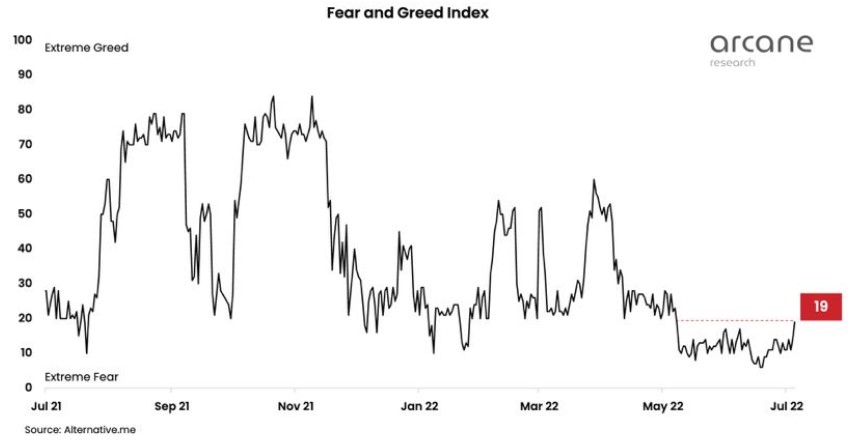
As a consequence, the general sentiment across the crypto market trended to the downside and recorded extreme fear levels on the Fear and Greed Index. The price of Bitcoin and other larger cryptocurrencies often finds a local bottom or top when the Index stands close to 10 or 80 respectively.

The crypto market did find a bottom in June when BTC’s price traded close to $17,000 and pushed the Fear and Greed Index to extreme levels. Since that time, the number one cryptocurrency has pushed the market slightly upwards and has been forming a new range between $18,600 and $21,000.

These levels stand as the major area of resistance along with $22,000. Market participants seem more positive on a probably break above these levels, according to a recent report from Arcane Research. The first stated the following on the shift in market sentiment over the past weeks:

"The sentiment in the crypto market has been depressed for several months, but we’re seeing a slight improvement this week. After the Fear and Greed Index climbed to 19 yesterday, we’re at the highest point in two months. While we’re still comfortable in the “Extreme Fear” area, we’re now pushing towards the “Fear” area, and the market is slightly more optimistic (…)."
Crypto Bitcoin BTC BTCUSD AR

Source: Arcane Research

Ready For More Crypto Downside?

The crypto total market cap and the performance of the altcoin market are bound to BTC, ETH, and larger cryptocurrencies. As NewsBTC has been reporting, the sector is currently impacted by macro-economic factors; rising inflation, and interests rates hikes by the U.S. Federal Reserve (FED).

These factors’ influence over the market must mitigate before the nascent asset class can decouple from traditional finances. In the meantime, any bullish momentum will remain susceptible.

If the price of Bitcoin is unable to push above $22,000 soon, the market could see a decline in the Fear and Greed Index. Data from Material Indicators and their Trend Precognition Indicators suggest it is likely to see a re-test of lower levels. Via Twitter, the analysts wrote:

"BTCUSDT and ETHUSDT were both rejected at the 21 Day Moving Average and now we see the Trend Precognition A1 Slope Line rolling over on the D chart indicating a short term loss of momentum."


Пов'язані матеріали

The Value Distribution of Stablecoins

**Summary: The Value Distribution of Stablecoins** The article argues that stablecoins are evolving from mere trading tools into broader channels for dollar access. It divides the stablecoin ecosystem into four layers to analyze how value is distributed: 1. **Issuance Layer:** Mints stablecoins, holds reserve assets, and captures the spread between reserve yield and user costs (e.g., Tether, Circle). This layer currently earns the largest profit margin. 2. **Infrastructure Layer:** Connects stablecoins to the traditional financial system, handling fiat on/off-ramps, banking integration, compliance (KYC/AML), and asset management (e.g., Bridge, BVNK). This is the "unglamorous" but critical work, building the essential bridges between crypto and real-world finance. 3. **Acquiring/Distribution Layer:** Integrates stablecoins into merchant systems, manages payment flows, and provides enterprise financial software (e.g., Stripe, Coinbase). They act as the access point for businesses. 4. **Application Layer:** The end-users and businesses that ultimately use stablecoins for payments, settlements, or as a store of value. They benefit from convenience but have little pricing power. The core thesis is that while the issuance layer currently dominates profits, the often-overlooked **infrastructure layer holds significant long-term potential**. The real challenge and barrier to mass adoption is not the on-chain transfer of stablecoins (which is simple), but the complex "last mile" integration into existing business workflows, banking systems, and regulatory frameworks across different countries. Companies in this layer are currently in a "land grab" phase, investing heavily to build networks, secure bank partnerships, and establish compliance pathways. While their position is currently pressured by the profitable issuers above and distribution platforms below, the article suggests that if stablecoins become a default financial rail for businesses, the infrastructure providers who have done the hard work of integration will ultimately gain strong pricing power and become entrenched, essential players.

marsbit6 год тому

The Value Distribution of Stablecoins

marsbit6 год тому

The Value Distribution of Stablecoins

The Value Distribution of Stablecoins The article argues that stablecoins are evolving from a mere trading tool into a broad "dollar channel." It analyzes the industry's value chain through four layers: 1. **Issuance Layer (e.g., Tether, Circle):** The top layer that mints stablecoins, holds reserve assets, and captures the thickest interest rate spread. 2. **Infrastructure Layer (e.g., Bridge, BVNK):** Connects stablecoins to the traditional financial system, handling critical but complex "dirty work" like fiat on/off-ramps, banking integration, compliance (KYC/AML), and cross-border settlement. 3. **Acquiring/Distribution Layer (e.g., Stripe, Coinbase):** Embeds stablecoins into merchant systems, manages payment flows, and integrates with enterprise software. 4. **Application Layer:** End-users and businesses that ultimately use stablecoins for payments, settlement, or storing value. The author posits that while the issuance layer currently captures the most profit, the most overlooked and potentially critical layer is infrastructure. The core challenge for stablecoin adoption isn't the on-chain transfer (which is simple), but bridging the gap between blockchain and the real-world financial system. This involves solving practical problems for businesses: fiat conversion, reconciliation, tax handling, and user onboarding. Infrastructure companies are currently in a difficult "land-grab" phase—building networks, securing banking relationships, and achieving compliance country-by-country. They face pressure from both the profitable issuance layer above and distribution platforms below. However, the author suggests this layer is building a crucial moat. Once stablecoins become a default business rail, the infrastructure players who have done the hard work of integration may gain significant, durable value and pricing power.

链捕手6 год тому

The Value Distribution of Stablecoins

链捕手6 год тому

Торгівля

Спот
Ф'ючерси
活动图片


