Something ‘Very Big’ Is Coming To Cardano, Says Charles Hoskinson

bitcoinistОпубліковано о 2025-10-28Востаннє оновлено о 2025-10-28

Анотація

Cardano founder Charles Hoskinson says the network is on the cusp of a significant shift, reacting to news that an...

Trusted Editorial content, reviewed by leading industry experts and seasoned editors. Ad Disclosure

Cardano founder Charles Hoskinson says the network is on the cusp of a significant shift, reacting to news that an HTTP-402–based payments standard—known as “x402”—is being brought to Cardano and integrated with Masumi, an agent-to-agent protocol built atop the chain. “This is very big for Cardano,” Hoskinson wrote on X on October 27, in response to the demo announcement.

The catalyst is a proof-of-concept published by Masumi cofounder Patrick Tobler showing a live x402 “pay-to-access” flow that ends in an on-chain action: a memecoin mint on Cardano. Tobler framed it as a milestone en route to standardizing how autonomous agents and web services exchange value via APIs without log-ins or OAuth.

“x402 is coming to Cardano (and Masumi)! … The first x402 Proof-Of-Concept Memecoin Mint,” he posted, adding that users can try the demo with 2 USDM for payment and a small amount of ADA for fees—and stressing that the token itself is strictly a technical showcase with “0 future plans.”

What This Means For Cardano

In a series of follow-ups, Tobler described x402 as a revival of the web’s long-dormant HTTP 402 “Payment Required” status code, generalized for modern machine-to-machine commerce. “Built around the HTTP 402 status code, x402 enables users to pay for resources via API without registration, emails, OAuth, or complex signatures,” he wrote, noting that Coinbase developed the protocol and that it is integrated into Google’s Agent Payments Protocol (AP2).

The Masumi implementation pairs that transport-level payment primitive with smart-contract guarantees for identity, refunds, and decision logging—“turning Cardano into the financial backbone of the agent economy,” as he put it.

The demo itself makes the flow concrete. When a user hits the endpoint, the server responds with “402: Payment Required.” The front end prompts a connected Cardano wallet to construct the payment. The payment proof is then transmitted in the 402 header; the server relays it on-chain, waits for finality, and only then returns the protected resource—in this case, minting the demo memecoins. “Please note: This is NOT a real memecoin. It is ONLY a proof-of-concept intended to showcase the technology!” Tobler emphasized.

Context matters for why Hoskinson’s enthusiasm resonated. x402 has been positioned by Coinbase as an “internet-native payment protocol” for AI agents and APIs, with instant, stablecoin-settled micropayments and merchant tooling. Separately, Google introduced AP2 as an open agent-payments layer designed to support multiple rails—including stablecoins—and to standardize authorization and auditability for agentic commerce. An x402 integration at the chain and smart-contract level gives Cardano a clear line into that emerging stack.

The choice of USDM for the demo highlights another Cardano-specific ingredient: a fiat-backed USD stablecoin native to the network, launched by Moneta (formerly Mehen). USDM’s role in the x402 flow is straightforward—precise, low-friction settlement per request—while ADA remains necessary for network fees. For agent-to-agent use cases, the combination is pragmatic: deterministic fees plus dollar-denominated pricing.

Tobler said the team is now drafting the x402 standard for both Cardano and Masumi, and explicitly not limiting the spec to simple address-to-address transfers. “By not only doing Address-To-Address like most other blockchains do but actually writing the standard to work with the Masumi Smart Contract, we’re making our x402 implementation the most powerful one out there,” he wrote.

At press time, ADA traded at $0.6659.
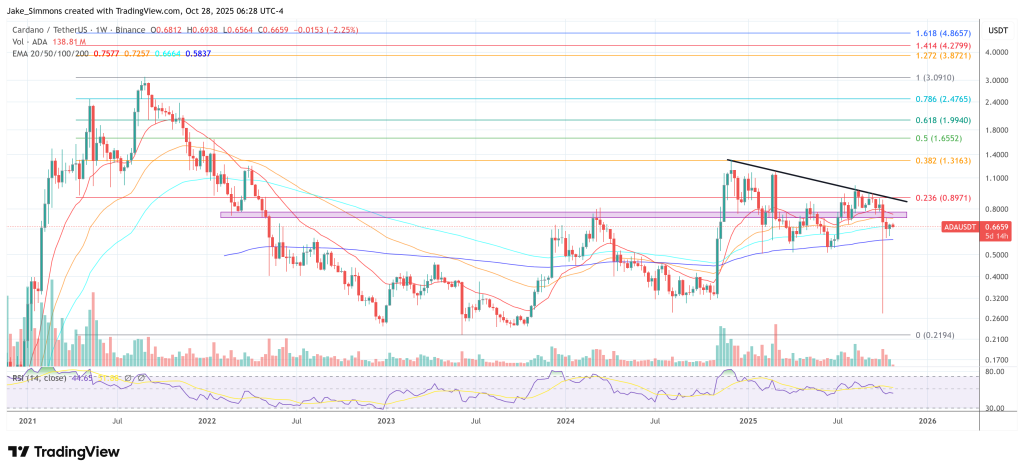
Cardano price
ADA remains below key resistance, 1-week chart | Source: ADAUSDT on TradingView.com
Featured image created with DALL.E, chart from TradingView.com
Editorial Process for bitcoinist is centered on delivering thoroughly researched, accurate, and unbiased content. We uphold strict sourcing standards, and each page undergoes diligent review by our team of top technology experts and seasoned editors. This process ensures the integrity, relevance, and value of our content for our readers.

Jake Simmons has been a Bitcoin enthusiast since 2016. Ever since he heard about Bitcoin, he has been studying the topic every day and trying to share his knowledge with others. His goal is to contribute to Bitcoin's financial revolution, which will replace the fiat money system. Besides BTC and crypto, Jake studied Business Informatics at a university. After graduation in 2017, he has been working in the blockchain and crypto sector. You can follow Jake on Twitter at @realJakeSimmons.

Пов'язані матеріали

Investors Frantically Snap Up AI Firms with 'No Profits': A High-Stakes Gamble on 'the Right to Define the Future'

"Investors are pouring billions into Chinese AI startups with no profits, betting on the future of the industry. A state-backed fund is reportedly in talks to lead DeepSeek's funding at a $45B valuation, just weeks after it was valued at $10B. Along with companies like Zhipu AI, MiniMax, and Kimi (backed by Meituan and Alibaba), their combined valuation exceeds $140B. This isn't a typical venture capital play. Investors are paying for 'future definition rights'—a chance to set the standards for the next tech era. Morgan Stanley notes a 6-12 month window for this scarcity premium before more AI companies go public. Despite massive losses, these companies show strong growth. Zhipu AI's API revenue grew 60x, Kimi's annual recurring revenue doubled to $200M in a month, and MiniMax turned its gross margin positive, with over 70% of revenue from overseas. Their valuations vastly exceed profitable firms like iFlytek. Crucially, technical progress underpins this growth. DeepSeek's latest model boasts costs just 1% of a leading competitor's, while Zhipu AI has raised API prices due to high demand. However, gaps with top global models remain. Tech giants like Tencent and Alibaba, investing heavily while describing their own AI efforts as 'leaky boats,' are also investing in these startups as a hedge. Key risks loom: the closing scarcity window, computing power bottlenecks limiting growth, and the sustainability of DeepSeek's cost-advantage model. With state capital now a major player, the success of these companies has become a strategic national concern. The next year will test if their soaring valuations can be justified by future profits."

marsbit28 хв тому

Investors Frantically Snap Up AI Firms with 'No Profits': A High-Stakes Gamble on 'the Right to Define the Future'

marsbit28 хв тому

SEC Slams the Brakes at the Last Minute, Halting "Tokenized U.S. Stocks"

On May 22, the U.S. SEC postponed the release of a key "innovation exemption" draft that would have permitted crypto-native platforms to issue and trade tokenized U.S. stocks on decentralized venues without full traditional exchange compliance. This would have legalized a "third-party token" model used overseas, where platforms issue tokens tracking stock prices without the underlying company's involvement, raising unresolved questions about shareholder rights, dividends, and sanctions enforcement. Meanwhile, the SEC had already approved a different, compliant path for tokenization led by Nasdaq and NYSE. Their model integrates tokenized stocks into existing settlement systems (like DTCC), preserving all shareholder rights. This creates a fundamental conflict: crypto platforms seek a permissionless, 24/7 on-chain parallel market, while traditional exchanges advocate for an upgraded, regulated version of the current system. Intense lobbying from traditional exchange groups like the World Federation of Exchanges argued the exemption would create an unfair regulatory advantage and dilute investor protection. Even some compliant crypto firms favored delay. Internally, SEC commissioners were divided on the scope and pace of the exemption. The delay highlights a critical policy crossroads. With significant trading volume already occurring overseas, the SEC's decision will determine whether the U.S. embraces a dual-track system for tokenized equities or sidelines itself from an emerging global infrastructure. The core unresolved question remains the legal status and rights of holders of third-party tokenized stocks. The SEC paused because the draft framework risked creating a major new asset class with profound, unanswered legal implications.

marsbit37 хв тому

SEC Slams the Brakes at the Last Minute, Halting "Tokenized U.S. Stocks"

marsbit37 хв тому

Is a Super IPO Wave Coming? Will It Drain and Crash the U.S. Stock Market?

The article discusses concerns about a potential "super IPO wave" hitting the U.S. stock market, with major companies like SpaceX, OpenAI, and Anthropic preparing to go public. While these large IPOs could collectively raise hundreds of billions, raising fears of a market "blood drain," analysis suggests the impact may be limited. Key points include: * Historical data shows IPO waves often coincide with strong market returns, as they typically occur during periods of high investor demand. * Model estimates suggest even the largest IPOs might only cause a market dip of around 1%. They are more likely to trigger a routine market pullback rather than end a bull market. * The current demand side remains supportive due to high household cash balances, strong corporate earnings growth, continued stock fund inflows, and robust share buyback announcements. * The main risk lies in concentrated investor positions, particularly in large-cap tech stocks, which are at elevated levels. A shift in funds towards new issuances could pressure these crowded sectors. * Recent fund flows show strength concentrated in U.S. and tech stocks, while other regions like Europe and Japan are experiencing outflows. The conclusion is that the IPO wave itself is unlikely to crash the market unless it coincides with a weakening in underlying demand factors like earnings or fund inflows into U.S. equities. The focus should be on whether demand can continue to absorb the new supply.

marsbit42 хв тому

Is a Super IPO Wave Coming? Will It Drain and Crash the U.S. Stock Market?

marsbit42 хв тому

Vitalik is Personally 'Dismantling' the Ethereum Foundation

Vitalik Buterin recently published an extensive article addressing core concerns about Ethereum's future direction and the role of the Ethereum Foundation (EF). He clarifies that the EF is not his personal domain nor the central authority of Ethereum; it operates as just one node within the broader ecosystem. The board makes collective decisions, with significant operational work led by Aya Miyaguchi, allowing Vitalik to focus on technical matters. The article critiques the perception that the EF should act like a conventional, fast-moving tech company. Buterin warns that merely chasing higher TPS, lower latency, or better marketing—like other chains—risks diluting Ethereum's foundational values. He draws a parallel to Google's evolution away from its "Don't be evil" ethos. Instead, the EF's renewed mandate is to focus on preserving and strengthening Ethereum's core principles, summarized as CROPS: **C**ensorship-resistance, **R**esistance to capture, **O**pen source, **P**rivacy, and **S**ecurity. The foundation will concentrate its limited resources (holding only ~0.16% of ETH) on these long-term, non-commercializable fundamentals, while ecosystem growth, applications, and market-facing activities should be driven by external teams and capital. Buterin outlines key technical priorities aligned with this vision: 1) Advancing formal verification to mathematically prove the absence of bugs; 2) Enhancing consensus security to maintain operation without reliance on social coordination during outages; and 3) Reducing dependency on intermediaries (like RPCs) to strengthen user sovereignty and privacy. He acknowledges ETH as Ethereum's most valuable asset, crucial for security, but stresses that promoting its value is a task for the wider ecosystem, not the EF. Ultimately, Buterin's message is a strategic refocus: the EF will become a smaller, more focused entity guarding Ethereum's essential, harder-to-achieve properties, ensuring it remains distinct not just in performance but in its commitment to decentralization, resistance, and security.

marsbit47 хв тому

Vitalik is Personally 'Dismantling' the Ethereum Foundation

marsbit47 хв тому

Торгівля

Спот
Ф'ючерси

Популярні статті

Як купити ADA

Ласкаво просимо до HTX.com! Ми зробили покупку Cardano (ADA) простою та зручною. Дотримуйтесь нашої покрокової інструкції, щоб розпочати свою криптовалютну подорож.Крок 1: Створіть обліковий запис на HTXВикористовуйте свою електронну пошту або номер телефону, щоб зареєструвати обліковий запис на HTX безплатно. Пройдіть безпроблемну реєстрацію й отримайте доступ до всіх функцій.ЗареєструватисьКрок 2: Перейдіть до розділу Купити крипту і виберіть спосіб оплатиКредитна/дебетова картка: використовуйте вашу картку Visa або Mastercard, щоб миттєво купити Cardano (ADA).Баланс: використовуйте кошти з балансу вашого рахунку HTX для безперешкодної торгівлі.Треті особи: ми додали популярні способи оплати, такі як Google Pay та Apple Pay, щоб підвищити зручність.P2P: Торгуйте безпосередньо з іншими користувачами на HTX.Позабіржова торгівля (OTC): ми пропонуємо індивідуальні послуги та конкурентні обмінні курси для трейдерів.Крок 3: Зберігайте свої Cardano (ADA)Після придбання Cardano (ADA) збережіть його у своєму обліковому записі на HTX. Крім того, ви можете відправити його в інше місце за допомогою блокчейн-переказу або використовувати його для торгівлі іншими криптовалютами.Крок 4: Торгівля Cardano (ADA)Легко торгуйте Cardano (ADA) на спотовому ринку HTX. Просто увійдіть до свого облікового запису, виберіть торгову пару, укладайте угоди та спостерігайте за ними в режимі реального часу. Ми пропонуємо зручний досвід як для початківців, так і для досвідчених трейдерів.

946 переглядів усьогоОпубліковано 2024.12.10Оновлено 2025.03.21

Як купити ADA

Обговорення

Ласкаво просимо до спільноти HTX. Тут ви можете бути в курсі останніх подій розвитку платформи та отримати доступ до професійної ринкової інформації. Нижче представлені думки користувачів щодо ціни ADA (ADA).

活动图片