Hoskinson Says Cardano Will Anchor The Human Internet In The AI Age

bitcoinistОпубліковано о 2025-10-14Востаннє оновлено о 2025-10-14

Анотація

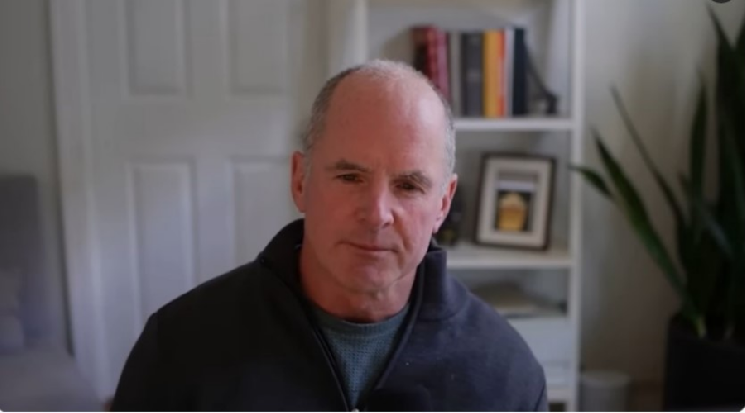
Cardano founder Charles Hoskinson used an October 13 livestream to sketch an expansive, two-track future for the web, arguing that...

Trusted Editorial content, reviewed by leading industry experts and seasoned editors. Ad Disclosure

Cardano founder Charles Hoskinson used an October 13 livestream to sketch an expansive, two-track future for the web, arguing that accelerating AI automation will force a structural split between a bot-dominated “slop land” and an invitation-only “human internet” whose trust rails run on decentralized identity, NFTs and on-chain incentive systems. In that architecture, he said, Cardano’s stack—spanning DIDs, the Midnight data-protection network, and a planned decentralized social platform—would serve as foundational infrastructure.

Opening with a diagnosis that “the internet is dying,” Hoskinson framed the problem as a runaway rise in automated accounts and AI-generated media that he believes has already tipped major platforms away from authentic human interaction. “The majority of internet users today are bots,” he claimed, citing “credible 2025 research” that allegedly pegs the share of botlike X accounts at 45%–64%.

“Over the next five years, the slop will get so bad that there’s going to be a better than 75% chance that what you see is a bot.” His contention is that this trajectory effectively nullifies social discourse: “We are no longer interacting with humans… The probability that it’s actually Bob and not Robo Bob is going to approach zero by 2030.”

Cardano’s Role In Rebuilding The Human Internet

Hoskinson’s proposed remedy centers on cryptographic identity and attestations. He placed decentralized identifiers (DIDs) at the core, coupled with “proof-of-humanity” methods that bind a persistent identifier to a verified person without leaking private data. “What [DIDs] allow you to do is assign to a person an ID and then you can prove properties about that person,” he said, adding that humanity checks could draw on a variety of approaches—from existing “Proof of Humanity”-style mechanisms to more novel biometric signals. He even referenced experiments related to his Quantum Hosky gaming venture, suggesting “your brain actually has a unique fingerprint… and you can use your brain for proof of human.”

Once identity is anchored, the Cardano founder argued, content itself must carry provenance. He envisions authenticity NFTs attached to media artifacts, cryptographically signed by a DID that has passed a humanity test. “When you look at content you will have a marketplace for non-slop… ‘Verified made by human,’ a proof of humanity,” he said. That, in turn, would allow clients to filter feeds to human-originated material and restore high-signal social spaces.

The architectural consequence, in Hoskinson’s view, is a bifurcated web: one substrate optimized for autonomous agents and AI-to-AI commerce, and a separate, admission-controlled human layer. “We’re basically going to create an invitation-only second internet… the only place humans are allowed to go,” he said. Agents would still traverse the open web to execute tasks on a user’s behalf—shopping, research, negotiations—while the human layer preserves identity, privacy and discourse.

Blockchains, he argued, are indispensable to both halves. For the human layer, the chain becomes “the ledger for humanity… the place where the DIDs live… where the NFT[s] verifying [genuine] content are.” For the agentic layer, it provides coordination of model licensing, personalization data, and payments among swarms of bots. He described a coming marketplace of pre-parameterized, task-specific agents—“Uncle Bob’s magic hatbot” as a toy example—bought, tuned and composed much like today’s app economy, but transacted as digital goods on an “AI ledger.” “What if that marketplace lives on an AI ledger?” he asked. “This will be the next-gen browser as the interface.”

Privacy-preserving data sharing, Hoskinson said, is where Cardano’s Midnight fits. Framing it as a way to “share without sharing,” he positioned Midnight as a substrate that lets users lend the semantic value of their personal data to agents (for example, preferences that improve recommendations) while keeping raw information shielded. “That’s why we got Midnight,” he said.

Hoskinson Plans A Decentralized Social Platform

Beyond identity and provenance, the Cardano founder called for new truth-seeking primitives built into social applications: prediction markets, “veracity bonds” and what he termed an “epistemic funnel.” In his telling, users and institutions that assert facts could post economic stakes that are slashed if claims later prove false, while consumers would run claims through layered tests—automated AI checks, authenticity NFTs, reputational vouching—before conferring belief. “I think all the media has to be here,” he said, arguing that economic consequences would curb low-quality publishing. “There are lots of money to be made in building these applications that enforce epistemic hygiene.”

On the business side, he forecast an AdTech realignment as human attention slips and agents transact directly with paywalled content on a micro-licensing basis. “Humans aren’t there to watch [ads]… a whole multi-trillion-dollar industry is going to be disrupted,” he said, predicting protocols where agents “check out” articles or datasets for cents and negotiate usage and summarization rights through machine-readable contracts. He referenced emergent “402/ATA”-style access standards and “X.42”-type protocols in that context, while stressing the need for a neutral settlement layer.

While much of the AMA surveyed the broader industry, Hoskinson repeatedly returned to Cardano’s roadmap and adjacent efforts. He suggested the ecosystem would move “after we get done with Midnight and get that out by RealFi and Quantum Hosky” to “some form of decentralized social network,” integrating proof-of-humanity credentials, authenticated content, and truth-market mechanisms. He also highlighted Lace as the prospective on-ramp: “We have the perfect interface for it… Lace is a great on and off ramp because it has the money there. It’s built right into the browser… and Lace is just about to go into mobile.”

The normative thread running through the session was a rejection of price fixation and a call to re-center crypto on coordination and civilizational resilience. “If you think it’s just token go up, token go down… you’re a useless person,” he said bluntly. He portrayed the industry’s purpose as “to liberate humanity’s economic, political, and social systems,” adding that blockchains “create a shared space for a synthetic objective reality… immutable, timestamped and auditable,” that lets societies bind rights and rules to accelerating technologies.

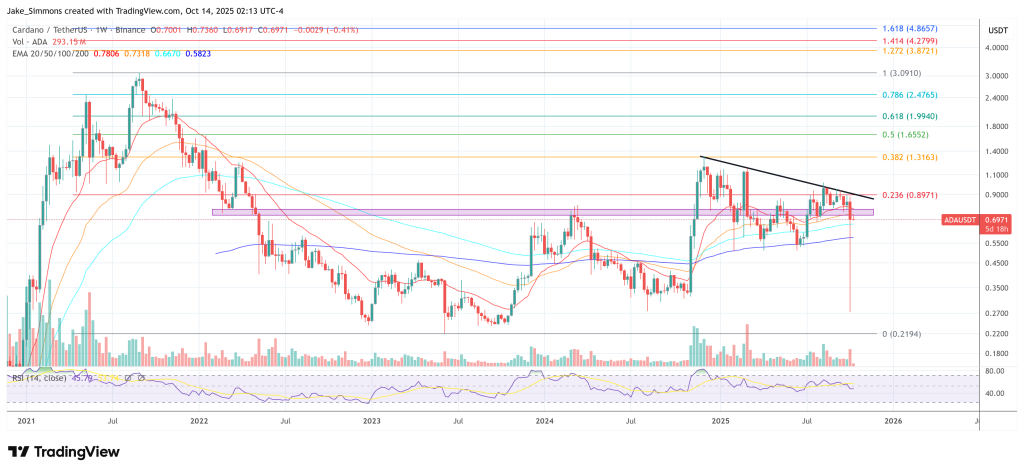
At press time, Cardano (ADA) traded at $0.69.
Cardano price
Cardano is now below the red resistance band again, 1-day chart | Source: ADAUSDT on TradingView.com
Featured image created with DALL.E, chart from TradingView.com
Editorial Process for bitcoinist is centered on delivering thoroughly researched, accurate, and unbiased content. We uphold strict sourcing standards, and each page undergoes diligent review by our team of top technology experts and seasoned editors. This process ensures the integrity, relevance, and value of our content for our readers.

Jake Simmons has been a Bitcoin enthusiast since 2016. Ever since he heard about Bitcoin, he has been studying the topic every day and trying to share his knowledge with others. His goal is to contribute to Bitcoin's financial revolution, which will replace the fiat money system. Besides BTC and crypto, Jake studied Business Informatics at a university. After graduation in 2017, he has been working in the blockchain and crypto sector. You can follow Jake on Twitter at @realJakeSimmons.

Пов'язані матеріали

From Suppliers to Shareholders: The Big Three Memory Chip Giants Jointly Invest in Anthropic, AI Supply Chain Power Structure Undergoing Reshuffle

For the first time, memory chip giants Micron, Samsung, and SK hynix have jointly invested in the same AI company, Anthropic, as part of its massive $65 billion Series H funding round. This strategic move, positioning the three rival HBM suppliers as "strategic infrastructure partners," highlights a fundamental shift in the AI industry's power dynamics. With HBM (High Bandwidth Memory) being a critically scarce resource essential for AI model training and inference, securing a stable supply has become a key competitive differentiator. By making these chipmakers shareholders, Anthropic aims to lock in this vital component for its rapid expansion, which includes securing major compute commitments from Amazon, Google, and others. For the memory trio, this investment represents a strategic bet on defining the future of AI hardware. Each company gains: SK hynix reinforces its dominant position in the NVIDIA supply chain; Samsung diversifies its client base beyond NVIDIA; and Micron leverages its geopolitical significance as the sole US-based HBM maker. Their collective move signals that competition in AI is evolving beyond model capability to encompass control over the entire compute supply chain—from chips and memory to power and networking. This vertical integration trend, where infrastructure providers become direct stakeholders in AI firms, marks the industry's maturation as AI transforms from a research project into essential global infrastructure, setting the stage for a new era of ecosystem competition.

marsbit3 хв тому

From Suppliers to Shareholders: The Big Three Memory Chip Giants Jointly Invest in Anthropic, AI Supply Chain Power Structure Undergoing Reshuffle

marsbit3 хв тому

Investment Philosophy of Gavin Baker, an Early Nvidia Investor: Long AI Infrastructure Bottlenecks, Short Overall Market Risk

Gavin Baker, an early investor in Nvidia and founder of Atreides Management, outlines his investment philosophy: going long on AI infrastructure bottlenecks while hedging against broader market risk. He argues AI is not a bubble but a supercycle driven by constraints in power, wafers (semiconductors), and compute efficiency (tokens per watt). True alpha, he believes, lies not in application-layer companies like OpenAI but in "picks and shovels" providers—companies solving physical bottlenecks in GPU connectivity (e.g., Astera Labs), memory (Micron), inference chips (Cerebras, Positron), advanced manufacturing (TSMC, ASML), and energy supply. His portfolio reflects this barbell strategy: concentrated bets on key infrastructure players alongside a significant put position on the QQQ ETF to hedge overall market downside. Baker contends this cycle differs from the dot-com bubble because demand is fueled by the strong balance sheets of hyperscalers (Google, Meta, Amazon, Microsoft), not debt, and physical supply constraints (e.g., chip manufacturing capacity) prevent runaway overinvestment. He highlights the growing importance of inference (vs. pre-training), vertical/small language models, sovereign infrastructure deployment speed, and the convergence of energy and space (e.g., orbital compute). His long-term view is that performance-per-watt and token cost reduction will dictate winners as AI scaling hits fundamental physical limits.

marsbit1 год тому

Investment Philosophy of Gavin Baker, an Early Nvidia Investor: Long AI Infrastructure Bottlenecks, Short Overall Market Risk

marsbit1 год тому

Apple Re-invented Image Compression with AI: Same Quality, One-Third the File Size

Apple’s PICO: An AI-Powered Image Codec That Cuts File Size by Two-Thirds at Equal Perceived Quality In 2025, JPEG AI became the first international standard for learned image compression. However, it, like most codecs, still prioritizes mathematical metrics like PSNR over true perceptual quality—what the human eye finds pleasing. Apple researchers have introduced PICO (Perceptual Image Codec), a neural codec designed to optimize for human perception. It tackles key practical challenges: 1) Speed: A novel "one-shot context model" accelerates entropy encoding without sacrificing compression efficiency. 2) Artifacts: A dedicated TextFidelity loss preserves text clarity, and a TilingArtifact loss eliminates color seams between image tiles processed in parallel. 3) Control: It avoids the "hallucinations" common in GAN-based perceptual models. In a large-scale human evaluation (74,925 comparisons), PICO achieved the same perceived quality as standards like AV1, VVC, and JPEG AI while using only 30-43% of the bitrate. It also outperforms other learned perceptual codecs by 20-40%. Remarkably, it runs in 230ms (encode) and 150ms (decode) on an iPhone 17 Pro Max. While less efficient on synthetic graphics, PICO represents a significant shift from optimizing mathematical scores to directly targeting human visual experience, making high-quality perceptual compression practical for consumer devices. The work builds on expertise from WaveOne, whose team joined Apple and previously advanced neural video compression.

marsbit1 год тому

Apple Re-invented Image Compression with AI: Same Quality, One-Third the File Size

marsbit1 год тому

Торгівля

Спот
Ф'ючерси

Популярні статті

Як купити ADA

Ласкаво просимо до HTX.com! Ми зробили покупку Cardano (ADA) простою та зручною. Дотримуйтесь нашої покрокової інструкції, щоб розпочати свою криптовалютну подорож.Крок 1: Створіть обліковий запис на HTXВикористовуйте свою електронну пошту або номер телефону, щоб зареєструвати обліковий запис на HTX безплатно. Пройдіть безпроблемну реєстрацію й отримайте доступ до всіх функцій.ЗареєструватисьКрок 2: Перейдіть до розділу Купити крипту і виберіть спосіб оплатиКредитна/дебетова картка: використовуйте вашу картку Visa або Mastercard, щоб миттєво купити Cardano (ADA).Баланс: використовуйте кошти з балансу вашого рахунку HTX для безперешкодної торгівлі.Треті особи: ми додали популярні способи оплати, такі як Google Pay та Apple Pay, щоб підвищити зручність.P2P: Торгуйте безпосередньо з іншими користувачами на HTX.Позабіржова торгівля (OTC): ми пропонуємо індивідуальні послуги та конкурентні обмінні курси для трейдерів.Крок 3: Зберігайте свої Cardano (ADA)Після придбання Cardano (ADA) збережіть його у своєму обліковому записі на HTX. Крім того, ви можете відправити його в інше місце за допомогою блокчейн-переказу або використовувати його для торгівлі іншими криптовалютами.Крок 4: Торгівля Cardano (ADA)Легко торгуйте Cardano (ADA) на спотовому ринку HTX. Просто увійдіть до свого облікового запису, виберіть торгову пару, укладайте угоди та спостерігайте за ними в режимі реального часу. Ми пропонуємо зручний досвід як для початківців, так і для досвідчених трейдерів.

959 переглядів усьогоОпубліковано 2024.12.10Оновлено 2025.03.21

Як купити ADA

Обговорення

Ласкаво просимо до спільноти HTX. Тут ви можете бути в курсі останніх подій розвитку платформи та отримати доступ до професійної ринкової інформації. Нижче представлені думки користувачів щодо ціни ADA (ADA).

活动图片