Что может означать сокращение сроков одобрения ETF для криптовалют?

cryptonews.ruОпубліковано о 2025-04-25Востаннє оновлено о 2025-09-26

На прошлой неделе Комиссия по ценным бумагам и биржам США одобрила новые стандарты листинга для акций трастовых фондов, основанных на сырьевых товарах. Это изменение политики может сократить путь к запуску спотовых криптовалютных биржевых фондов (ETF), но у некоторых инвесторов остаются вопросы.

Аналитик Bloomberg по ETF Джеймс Сейфарт заявил, что изменение политики, объявленное SEC 17 сентября, станет позитивным шагом на пути к «волне запусков спотовых криптовалютных ETP».

Эрик Балчунас, другой старший аналитик Bloomberg по ETF, предположил, что SEC только что одобрила регулирование для криптовалютных ETF, «при условии наличия у них фьючерсов на Coinbase», намекая на различные правила, с которыми столкнутся заявители в зависимости от инвестиционного инструмента, который они планируют предложить.
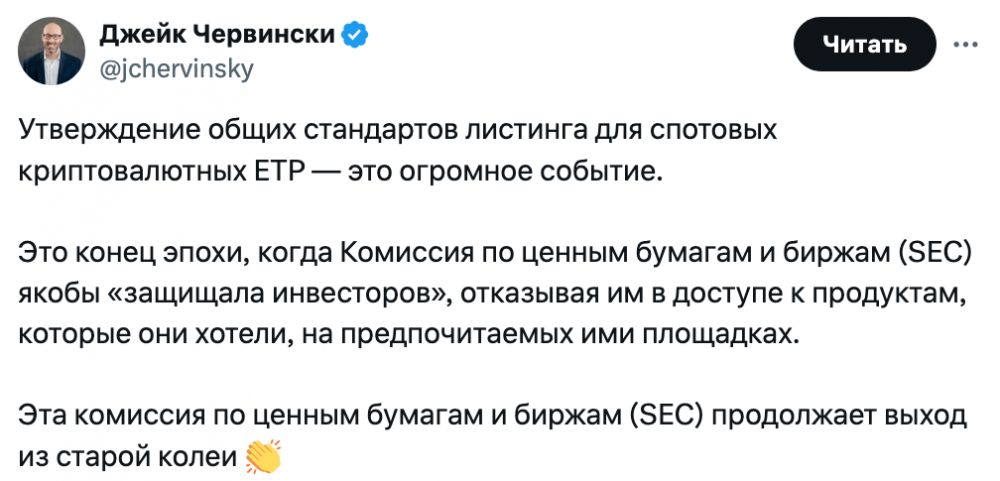

Источник: Джейк Червински

«Для новых фьючерсов или спотовых ETF в уже «легитимированной» категории (BTC, ETH) эти недавние изменения правил практически не влияют на сроки одобрения», — отметил Соён Ким, доцент кафедры финансов Школы бизнеса Ливи при Университете Санта-Клары.

«Однако для фьючерсов или спотовых ETF на цифровые активы, которые ещё не прошли индивидуальную проверку, эти изменения правил могут сократить время одобрения с нескольких лет до нескольких месяцев. Конечно, потенциальный ETF по-прежнему должен соответствовать существующим стандартам формирования, листинга и торговли ETF».

Федерико Брокате, руководитель отдела бизнеса в США компании 21Shares, эмитента ETF, отметил, что «активы, подпадающие под действие стандартов листинга», будут «гораздо более предсказуемыми для эмитентов и инвесторов», что значительно сократит сроки одобрения.

«Для активов, подпадающих под действие стандартов листинга или соответствующих требованиям, больше не требуются [заявки] S-1 и 19b-4», — сказал Брокате. «Теперь, если продукт соответствует общим стандартам, таким как соответствие существующим фьючерсам или сопоставимым структурам, биржа может напрямую разместить его на бирже».

Есть ли какие-либо риски для эмитентов ETF или розничных инвесторов?

SEC сокращает количество принудительных мер против криптовалютных компаний и в целом принимает политику, благоприятствующую отрасли, что, по мнению некоторых, может привести к снижению защиты инвесторов.

Кэролайн Креншоу, единственный член Комиссии по ценным бумагам и биржам от Демократической партии, заявила после объявления стандартов листинга, что изменение политики обходит требования по проверке защиты инвесторов. Она добавила, что криптовалютные ETF, которые, вероятно, появятся в результате этой политики, являются «новыми и, возможно, непроверенными продуктами».

«Наша миссия, в конечном счёте, заключается в защите инвесторов, а не в ускоренном листинге и торговле на бирже непроверенными инвестиционными продуктами», — сказала Креншоу.

Ким заявил, что «все ранее существовавшие требования к проверке остаются в силе», добавив, что изменения в правилах «лучше рассматривать как разъяснения».

«Давние обширные требования, предусмотренные законами 1933 и 1940 годов, по-прежнему действуют и не были смягчены недавними решениями Комиссии по ценным бумагам и биржам США (SEC)», — заявила она.

Грег Бенхайм, исполнительный вице-президент по продуктам компании 3iQ, управляющей цифровыми активами, заявил, что общие стандарты листинга могут помочь рядовым инвесторам определить, какие монеты стоит покупать.

«Например, ETF AVAX и ETF ADA сильно отличаются, но инвестор может не оценить это в полной мере, — сказал Бенхайм. — В долгосрочной перспективе это проложит путь для отрасли к определению того, какие активы имеют значительную розничную привлекательность в формате ETF, а какие — нет».

На неделе после изменения стандартов листинга компания Hashdex, управляющая активами, расширила свой крипто-ETF, включив в него Ripple (XRP), Solana (SOL) и Stellar (XLM). Однако Балчунас и другие предполагают, что вскоре их может стать гораздо больше, указывая на 22 монеты с фьючерсами на Coinbase, которые «подходят для спотовой ETF-интеграции».
Пов'язані матеріали

Financing Weekly Report | 11 Public Financing Events, Stablecoin Payment Infrastructure Company Trace Finance Completes $32 Million Series A Round Led by CoinFund

Financing Weekly Report | 11 public funding events recorded, with a total scale exceeding $264 million. The stablecoin payment infrastructure sector remains a hot spot. Key Deals: - Trace Finance, a stablecoin payment infrastructure firm, raised $32 million in a Series A round led by CoinFund to expand in Latin America and Asia-Pacific. - Galaxy Ventures co-led a $140 million Series A round for Karta, a US credit card provider for global travelers without requiring an SSN. - Instant payment platform Interchecks completed a $50 million Series C round. - Paradigm led a $9 million Series A for Latin American cross-border payment app El Dorado. - Range, a stablecoin compliance startup, raised $8.3 million in an oversubscribed Series A. - RWA infrastructure project Renaiss raised $1.5 million to expand its on-chain collectibles platform. Sector Breakdown: - Infrastructure & Tools: 6 deals, including the above-mentioned Trace Finance, Range, and Renaiss. - Centralized Finance (CeFi): 3 deals, led by Karta's $140 million round. - DeFi: 1 deal – reinsurance protocol Re secured strategic investment from Coinbase Ventures. - Prediction Markets: 1 deal – K25.ai completed a $10 million Pre-A round from NewGen. Other notable transactions include digital asset depository RDC raising $7 million, ad-tech startup EarnOS securing $6 million, and a $1 million strategic investment in LitVM, a ZK Layer 2 for Litecoin. The report highlights sustained investor interest in stablecoin payment infrastructure, compliant on-chain finance, and real-world asset (RWA) tokenization.

marsbit37 хв тому

Financing Weekly Report | 11 Public Financing Events, Stablecoin Payment Infrastructure Company Trace Finance Completes $32 Million Series A Round Led by CoinFund

marsbit37 хв тому

When Transfers Become Truly Frictionless: How Sui Uses 'Zero Gas' to Become the Underlying Infrastructure for Stablecoin Payments

Title: Sui Launches Zero-Gas Stablecoin Transfers to Become the Foundation for Stablecoin Payments Sui has introduced a zero-gas fee feature for peer-to-peer stablecoin transfers, eliminating the need for users or businesses to hold separate SUI tokens to pay transaction costs. This innovation, built on a new underlying account architecture called Address Balances, significantly reduces validator processing costs for eligible transactions. Currently, the feature applies to a whitelist of stablecoins for transfers meeting a minimum amount, effectively preventing spam. This development aims to unlock mainstream payment use cases for stablecoins—such as everyday purchases, remittances, and subscriptions—by removing cost and complexity barriers. It is also positioned to benefit high-frequency micro-payments for AI agents and institutional B2B payments, reducing operational friction. Major custody provider Fireblocks has already announced support. The move follows Sui processing over $1 trillion in stablecoin transfer volume since August 2025. Looking ahead, Sui plans to enhance this infrastructure with protocol-level confidential transactions later in 2026, aiming to provide scalable, free, and privacy-preserving payments. Together, these advancements strengthen Sui's goal of becoming the default settlement layer for stablecoin payments.

marsbit39 хв тому

When Transfers Become Truly Frictionless: How Sui Uses 'Zero Gas' to Become the Underlying Infrastructure for Stablecoin Payments

marsbit39 хв тому

Ethereum Is Retracing the Path of the Internet and Linux: No One Yields, and the Neutral Party Ultimately Prevails

This article argues that Ethereum is following the historical path of open, neutral systems like the Internet and Linux, which eventually triumphed over proprietary, centrally-controlled alternatives. Major financial institutions like JPMorgan, Stripe, and Circle are building their own proprietary blockchains or networks (e.g., Tempo, Arc), but will never agree to build on a competitor's controlled infrastructure. This creates the perfect opportunity for Ethereum as the only neutral, credibly neutral settlement layer that no single entity controls. The piece draws parallels to the 1990s, when experts like Bill Gates predicted proprietary networks (from Microsoft, Oracle) would win over the open Internet, and when Sun Microsystems' Unix lost to the open-source "bazaar" development model of Linux. This model, described in Eric Raymond's "The Cathedral and the Bazaar," thrives on permissionless innovation where countless contributors improve the system, outpacing any centralized competitor. Ethereum embodies this through its decentralized development, broad validator distribution, and credible neutrality—rules that are transparent, equally applied, hard to change, and open to all. This has attracted over a million developers and major institutions like Coinbase, BlackRock, and JPMorgan, who choose Ethereum for its security, ecosystem, and sovereignty (the inability of any single party to change the rules). While proprietary chains offer initial speed and control, they inherit the downsides of both centralization and decentralization without the long-term innovation benefits. The article concludes that, just as open systems historically win, Ethereum is poised to become the foundational, neutral settlement layer for global finance.

marsbit48 хв тому

Ethereum Is Retracing the Path of the Internet and Linux: No One Yields, and the Neutral Party Ultimately Prevails

marsbit48 хв тому

Kalshi's Biggest Rival is Not Polymarket

Kalshi's CEO Tarek Mansour has identified the company's primary competitors not as the crypto-based prediction market Polymarket, but as established financial and gaming giants: CME Group, Robinhood, and DraftKings. This reflects a shift in the prediction market landscape, where the 2026 FIFA World Cup is expected to bring massive new trading volume. Traditional platforms are increasingly integrating prediction markets as a feature within their existing ecosystems. Robinhood has seen rapid growth with its prediction markets, contributing significantly to its "other transaction revenue." Similarly, Interactive Brokers (IBKR) integrates contracts from Kalshi and CME Group, while DraftKings and FanDuel (via CME) have launched their own prediction products. This allows these firms to leverage their vast user bases and infrastructure at low marginal cost, turning prediction markets from standalone apps into embedded functionalities. In response, prediction market platforms are evolving along two paths. First, they are expanding into new event categories like sports (e.g., the World Cup) and financial data to reduce reliance on election cycles. Second, they are moving towards becoming infrastructure and liquidity providers for distribution platforms. Kalshi's lead over Polymarket in trading volume is partly attributed to this channel strategy, integrating with brokers like Robinhood, Coinbase, and Webull. However, this strategy faces a challenge as distributors like Robinhood begin building their own in-house prediction market capabilities (e.g., Rothera), potentially threatening the value of pure infrastructure providers. The situation parallels historical tech battles, such as Zoom competing with Microsoft Teams and Google Meet, where embedded features in larger platforms reshape market dynamics. The future of standalone prediction market leaders like Kalshi and Polymarket will depend on their ability to navigate this new competitive landscape dominated by integrated financial and gaming titans.

链捕手55 хв тому

Kalshi's Biggest Rival is Not Polymarket

链捕手55 хв тому

Торгівля

Спот
Ф'ючерси
活动图片