Terra's Crypto Tokens UST and Luna Classic Mysteriously Pumped This Week, UST Climbed by 470%

newsbtcОпубліковано о 2022-07-01Востаннє оновлено о 2022-07-01

Анотація

Luna Classic and the Once-Stable Coin UST Rise Significantly Against the US Dollar.

Terra's Crypto Tokens UST and Luna Classic Mysteriously Pumped This week, UST Climbed by 470%

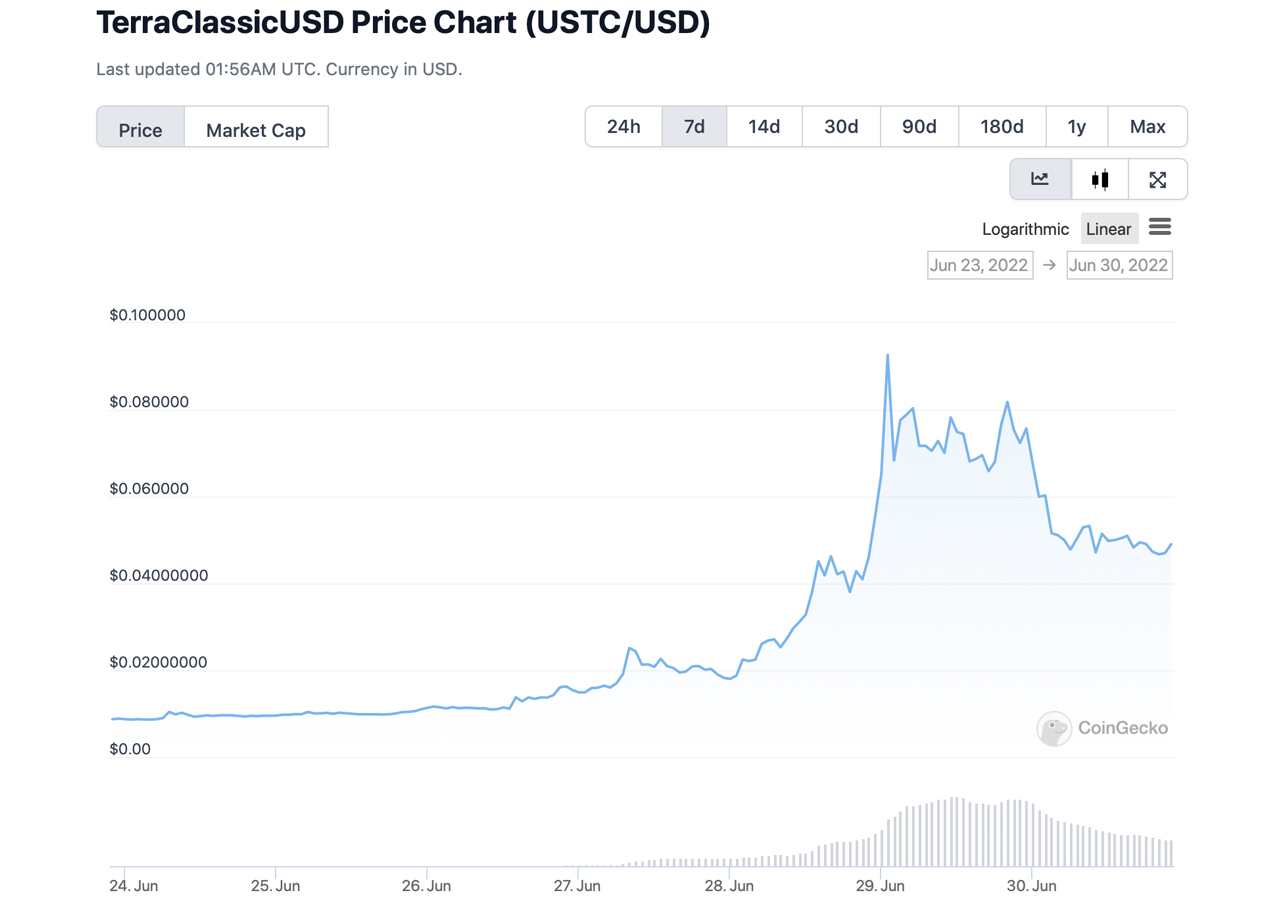
After the downfall of the two most popular crypto assets on the Terra blockchain, the digital currencies terrausd (UST) and luna classic (LUNC) increased a great deal in value against the U.S. dollar in recent times. During the last seven days, LUNC has risen 96.3% and the once-stable coin UST has increased 472.4% this week.

Luna Classic and the Once-Stable Coin UST Rise Significantly Against the US Dollar

It’s pretty well known in the world of digital currencies that some crypto assets never die. That seems to be the case with the two notorious crypto assets luna classic (LUNC) and terrausd (UST), a former stablecoin that is sometimes referred to as terraclassicusd (USTC).

LUNC took the name luna classic because Terra’s new token is now referred to as LUNA. UST was once stable and held the $1 parity from October 2020 up until May 9, 2022. When UST depegged it dropped below a U.S. penny, and tapped a low of $0.006 per unit on June 18, 2022.

However, since the $0.006 per unit low, UST has jumped 617.5% from that range. UST swelled by 472.4% this week to $0.0926 per unit on June 29. While UST dropped in value after that rise, it still held a 24-hour trading range of around $0.04217516 to $0.081822 on Thursday, June 30.
Terra's Crypto Tokens UST and Luna Classic Mysteriously Pumped This Week, UST Climbed by 470%

When UST depegged on May 9, LUNC was already dropping in value, but four days prior, LUNC was exchanging hands for $82 per unit. The day UST depegged, LUNC changed hands at a high that day at $61 per unit, but by the following day, it was trading for $27 per LUNC.

Since then, LUNC hit an all-time low four days after the depegging incident to $0.000000999967 on May 13. Miraculously, not only has LUNC risen 96.3% this week, it is up 10,577% from the all-time low. At the time of writing, LUNC has seen $545.87 million in daily trade volume, while UST recorded $522.60 million during the past 24 hours.

LUNC has a market valuation of around $812,399,236 with 6,907,072,876,045 LUNC in circulation today. There’s 10,254,324,366 UST circulating right now, which gives UST a market valuation of around $477.73 million.

UST holders are still using the Anchor protocol as 573,636,728 UST is locked in the system. The Anchor savings protocol on the Terra Station wallet promises a 16.26% annual percentage yield (APY).

Furthermore, defillama.com statistics indicate that there’s $9.23 million in LUNC held on the decentralized finance (defi) risk management marketplace Risk Harbor. The Terra Classic chain and luna classic (LUNC) still have a fairly active community by observing posts on social media.

Terra Classic still has active validators as well, and just recently a governance proposal was introduced that would give validators a universal minimum commission of 10%. One particular validator called LUNC DAO told its 29,000 Twitter followers that the validator was against the minimum commission rate of 10%.

At the time of writing, 37.04% voted in favor of the proposal and 24.80% said no to the idea. Meanwhile, the new LUNA 2.0 token has had a lackluster week compared to the digital currency’s siblings.

LUNA 2.0 is up 7% this week, but the new crypto asset that stems from the Terra Phoenix blockchain is down 76.6% during the past month. Out of more than 13,000 crypto assets in existence today, LUNA 2.0 commands the 124th position with a $273 million market cap. The once-stable coin UST’s market capitalization ($477.73M), on the other hand, holds the 87th position.

Пов'язані матеріали

Four Questions on the Zcash Orchard Vulnerability: Was It Exploited? Can Funds Be Recovered? Is the Supply Verifiable? And Are There Others?

Zcash Orchard Bug: Four Key Questions Answered A critical forgery vulnerability was discovered in Zcash's Orchard privacy pool, raising four major concerns for users. 1. **Was the Orchard bug exploited?** The likelihood is considered low. The bug was found proactively using advanced AI-assisted tools and was promptly patched, limiting any potential attack window. If exploitation had occurred, evidence would likely have surfaced by now. 2. **Can legitimate Orchard funds be recovered?** It is believed so, based on the assessment that the bug was not exploited. If forgery did happen, existing "turnstile" mechanisms could prevent full recovery of legitimate funds if forged coins were moved out first, though this scenario is deemed unlikely. Users can choose to move funds, but this carries risks like loss of privacy or new wallet/software issues. 3. **Can users verify Zcash's total supply?** Currently, no. The vulnerability's prior existence prevented independent verification of the shielded supply. The proposed "Ironwood" network upgrade will restore this ability by sealing the Orchard pool, allowing anyone running a node to verify that the circulating ZEC does not exceed the correct amount. 4. **Are there other forgery bugs?** Ongoing intensive audits by multiple teams, including AI-assisted analysis, have not found additional forgery vulnerabilities, increasing confidence that none remain. Further work and collaborations are planned to provide additional guarantees. In conclusion, while the team assesses that exploitation was unlikely and the supply is safe, the upcoming upgrade is critical to restore users' ability to independently verify Zcash's supply integrity, moving away from reliance on trust.

marsbit15 хв тому

Four Questions on the Zcash Orchard Vulnerability: Was It Exploited? Can Funds Be Recovered? Is the Supply Verifiable? And Are There Others?

marsbit15 хв тому

Four Questions on the Zcash Orchard Vulnerability: Was it Exploited? Can Funds Be Recovered? Is the Supply Verifiable? Are There Others?

**Summary: Zcash Orchard Vulnerability Analysis** A critical forgery vulnerability was recently discovered in Zcash's Orchard shielded pool, raising concerns about the coin's supply and user funds. The developers, led by Zcash Open Development Labs, acted swiftly to temporarily freeze the pool and deploy a fix. The article addresses four key questions: 1. **Was the vulnerability exploited?** While unknown, the developers believe it is unlikely for several reasons: the bug was difficult to find, using advanced AI tools; the fix was deployed quickly; and typical crypto exploits are fast, with no evidence of abnormal outflows. 2. **Can legitimate Orchard funds be recovered?** If the bug was not exploited, all funds are safe. If exploited, a mechanism limits total withdrawals from the pool to the amount legitimately entered, potentially blocking some legitimate funds. The developers deem this unlikely but advise cautious users to consider moving funds, noting the privacy and risk trade-offs of moving to transparent or Sapling pools. 3. **Can users verify Zcash's total supply?** Not currently. The vulnerability temporarily broke the ability for users to independently verify that no extra ZEC was created. 4. **Are there other forgery bugs?** Ongoing audits by multiple teams, including using advanced AI analysis, have so far found no others, increasing confidence. The proposed "Ironwood" network upgrade is the core solution. It will **seal** the Orchard pool, preventing new entries or internal circulation. This action, combined with the existing withdrawal mechanism, will restore the ability for any node operator to verify that Zcash's supply limit has not been violated, regardless of whether exploitation occurred in the past. The upgrade aims to restore the system's long-term credibility through user-verifiable supply integrity.

Odaily星球日报15 хв тому

Four Questions on the Zcash Orchard Vulnerability: Was it Exploited? Can Funds Be Recovered? Is the Supply Verifiable? Are There Others?

Odaily星球日报15 хв тому

An AI Version of the 'Subprime Crisis'? A Hidden Debt of $1.8 Trillion is Accumulating in the Shadows Amid the Frenzy

Amidst the AI infrastructure construction boom, a massive debt expansion is forming, with the most dangerous portion remaining off-balance sheets. Morgan Stanley research reveals approximately $1.8 trillion in off-balance-sheet exposures, including nearly $1 trillion in purchase commitments and over $800 billion in non-active lease contracts. These future cash outflows are not recorded as liabilities. The leverage of hyperscale cloud companies has surged from 0.9x to 1.8x in just two quarters. Private credit firms like Apollo and Blackstone are shifting leverage into the supply chain through complex, opaque SPV (Special Purpose Vehicle) financing structures. Global AI-related bond issuance has skyrocketed, with annual volume projected to exceed $570 billion. However, capital expenditure growth is outpacing revenue and free cash flow. Major cloud providers may see free cash flow approach zero or turn negative in 2026. A significant 'depreciation cliff' looms as vast amounts of current capital spending, recorded as 'construction in progress,' have yet to begin depreciating, artificially inflating current profit margins. Future depreciation could severely pressure earnings. The core risk is identified as a series of timing mismatches, not an immediate solvency crisis. Investment is racing ahead of monetization, leverage is being obscured, and accounting classifications hinder comparability. The entire financing structure faces a fundamental stress test if AI commercialization lags or enterprise clients shift to cheaper alternatives, potentially triggering chain reactions within the highly interconnected funding ecosystem.

marsbit27 хв тому

An AI Version of the 'Subprime Crisis'? A Hidden Debt of $1.8 Trillion is Accumulating in the Shadows Amid the Frenzy

marsbit27 хв тому

Торгівля

Спот
Ф'ючерси
活动图片