Банк России готовит механизмы тестирования на рынке цифровых финансовых активов

cryptonews.ruОпубліковано о 2025-03-16Востаннє оновлено о 2025-09-17

Банк России планирует разработать механизмы проведения тестирования на рынке цифровых финансовых активов (ЦФА), аналогичные соответствующим механизмам на рынке ценных бумаг.

В проекте основных направлений развития финансового рынка регулятора на 2026–2028 года указывается, что одновременно с введением процедуры тестирования предполагается исключить из регулирования лимиты для неквалифицированных инвесторов на совершение сделок на рынке ЦФА. Сейчас лимит на покупку ЦФА для них составляет 600 000 руб. в год.

Регулятор планирует обязать указывать в решениях о выпуске цифровых финансовых активов возможности их приобретения квалифицированными инвесторами. Такую меру внедрят, чтобы устранить регуляторный арбитраж при покупке сходных по сути финансовых инструментов.

«Рынок ЦФА в 2022-2023 годах прошел стадию становления, и сейчас к нему проявляют интерес крупные компании финансового и промышленного секторов экономики, и малый бизнес. По итогам первого полугодия число операторов информационных систем, осуществляющих выпуск ЦФА, достигло 17, объем действующих выпусков, находящихся в обращении, составил 514 млрд рублей», — сообщается в документе.

На данный момент эмитенты рассматривают ЦФА в качестве инструмента краткосрочного финансирования — подавляющее большинство выпущенных в настоящее время ЦФА (более 90%) идентичны краткосрочным долговым обязательствам, пояснили в ЦБ РФ.

Ранее зампредседателя правления Сбербанка Анатолий Попов заявил, что учреждение запустило бессрочный цифровой финансовый актив для категории квалифицированных инвесторов на корзину из биткоина и эфира.
Пов'язані матеріали

Olympus DAO Myth Reappears? A "Sovereign On-Chain Central Bank" Written with 4000 Lines of Immutable Code

A new project called The Standard Reserve has emerged, branding itself as a "sovereign on-chain central bank." It aims to replicate core central bank functions—currency issuance, money supply adjustment, and reserve accumulation—entirely through 4,000 lines of immutable code, with no human governance. Its core mechanism is a "reflexive monetary policy" based on a single signal: the net ETH flow into or out of the system's sole Uniswap v4 ETH/$STANDARD pool. Sustained net ETH inflows trigger an "expansion" phase, increasing $STANDARD issuance and using protocol fees to buy tokenized gold as a permanent hard reserve. Net outflows (or zero flow) trigger an immediate "contraction" phase, reducing issuance and using fees to buy back and burn $STANDARD. The system involves six key entities: the $STANDARD token (hard-capped at 1 billion), the central Uniswap pool, the Central Bank contract, Charter NFTs (acting as "banking licenses"), Branch units under each Charter (which earn a share of newly minted $STANDARD), and separate Vaults for expansion (buying gold) and contraction (buying back $STANDARD). To participate, users ideally acquire a Founding Charter NFT (initially 1,000 are free via allowlist/public mint). Each Charter comes with one Branch; more can be opened by burning $STANDARD for "expansion permits," increasing revenue share. Retiring a Branch lets users claim accumulated $STANDARD but imposes a dynamic exit fee (higher if many exit simultaneously), with half the fee burned and half distributed to remaining participants. All protocol revenue (from pool fees and Charter auctions) is allocated: 70% to the active Vault (for gold or buybacks), 15% to permanent protocol-owned liquidity, and 15% to the team. The project presents an innovative, game-theoretic model where user actions (expanding Branches by burning tokens or exiting) align with system goals of building reserves or inducing deflation. However, it is fully anonymous, with key parameters undefined and unaudited code, posing significant risks.

marsbit19 хв тому

Olympus DAO Myth Reappears? A "Sovereign On-Chain Central Bank" Written with 4000 Lines of Immutable Code

marsbit19 хв тому

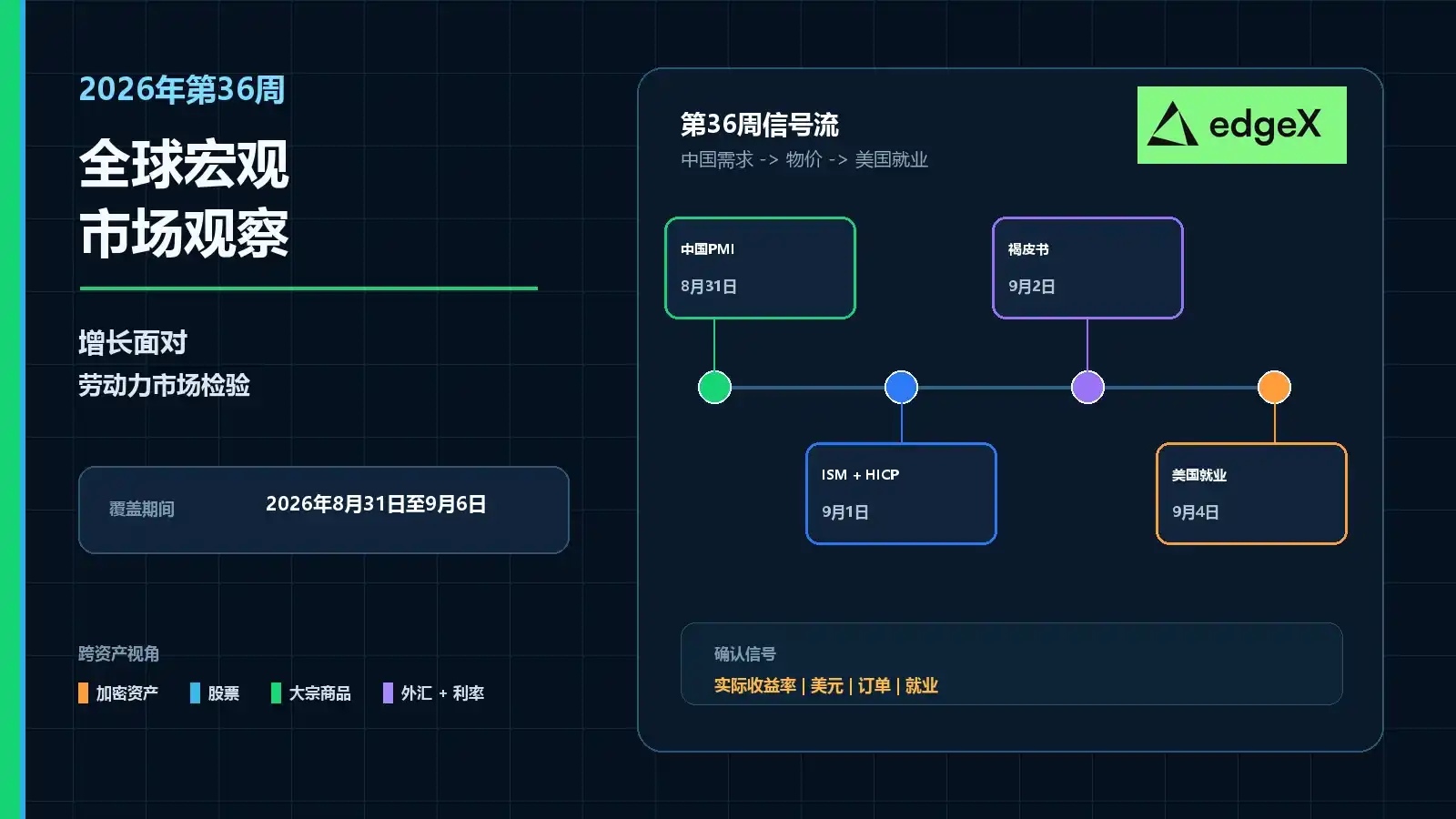
US Jobs, China PMI, and Inflation on Stage: Can Global Growth Maintain Resilience?

**Week 36 Macro Outlook: Key Data to Test Global Growth Resilience** The week from August 31 to September 6 will shift focus from policy discussions to a critical test of global economic activity. The sequence of events is key, starting with China's official August PMI on Aug 31, which will provide early signals on factory orders, services, and employment following July's contraction. The data flow then broadens. On September 1, US ISM Manufacturing PMI and the Eurozone's flash inflation estimate will offer simultaneous checks on demand, prices, and regional divergence. The subsequent US Federal Reserve Beige Book on September 2 adds granular, qualitative evidence on consumer spending, wages, and regional conditions. Australian Q2 GDP and Canadian trade and jobs data will test resilience in other major economies. The week's pivotal event, however, is the US August employment report on September 4. It will decisively influence expectations for interest rates, the US dollar, and broader risk appetite, acting as a final cross-check for the preceding data. The core question for markets is whether global growth can remain resilient. An ideal outcome would combine a rebound in China's PMI, stable US jobs growth, cooling inflation, and signs of a gradual demand slowdown. Conversely, weak Chinese manufacturing, sticky Eurozone prices, and disappointing US non-farm payrolls would create a more complex scenario of reduced corporate confidence and limited room for aggressive monetary easing, increasing pressure on cyclical assets. Investors should monitor the breadth of improvements—such as new orders and employment—rather than headline PMI figures alone. Confirmation across different data points is crucial. A positive combination of steady activity and disinflation could support equities, industrial commodities, and risk assets like crypto. However, if a growth slowdown triggers lower yields, it must be distinguished from a scenario of rising recession risks that would pressure corporate earnings, potentially limiting rallies. The market's final reaction will hinge on whether the week's signals align to either reinforce or challenge the current growth narrative.

marsbit21 хв тому

US Jobs, China PMI, and Inflation on Stage: Can Global Growth Maintain Resilience?

marsbit21 хв тому

Торгівля

Спот
活动图片