18 Block Reorg Slams Monero, Erasing 36 Minutes Of Blockchain

bitcoinistОпубліковано о 2025-09-15Востаннє оновлено о 2025-09-16

Анотація

Monero’s privacy chain endured its deepest-ever chain reorganization in the last 24 hours, when 18 consecutive blocks were replaced, briefly...

Trusted Editorial content, reviewed by leading industry experts and seasoned editors. Ad Disclosure

Monero’s privacy chain endured its deepest-ever chain reorganization in the last 24 hours, when 18 consecutive blocks were replaced, briefly “rewriting” roughly 36 minutes of ledger history and invalidating about 118 already-confirmed transactions. Multiple independent monitors flagged the event late Sunday into Monday, describing a rollback spanning block heights 3,499,659 through 3,499,676 before nodes converged on a new best chain. With Monero targeting two-minute blocks, an 18-block reorg translates to ~36 minutes of history—an extraordinary depth for a mature proof-of-work network.

Monero Hit By Record 18 Block Reorg

“The attack against Monero is back. Hours ago XMR experienced an 18-block reorg. If you accept XMR make sure to wait for more than the usual 10 confs,” warned independent monitor OrangeFren as alerts circulated across crypto social channels. The post, amplified by several industry accounts, captured the immediate operational takeaway for merchants and services: raise confirmation thresholds until conditions normalize.

The incident comes a month after the controversial AI-oriented project Qubic claimed to have marshaled a majority of Monero’s hashrate, a campaign that coincided with a six-block reorg in August and led to temporary deposit suspensions at some exchanges. Security researchers at the time cautioned that the August event did not, by itself, prove sustained 51% dominance—streaks of mining “luck” can produce short, probabilistic reorganizations—but they also warned that persistent hashrate concentration raises the ceiling on how deep such reorgs can go. Monday’s 18-block episode materially raises that ceiling.

Community voices reacted with a mix of alarm and realism. SlowMist founder Yu Xian commented via X: “If no one in the Monero community takes the issue of block reorganization seriously, then this Sword of Damocles will always hang over Monero’s head… It may not necessarily carry out a double-spend attack, but having this capability… It doesn’t even have to strictly exceed 51% of the hash power…”

Qubic founder Sergey Ivancheglo, who is known by the alias “Come-from-Beyond”, posted via X: “Monero will stay because Qubic wanted it to stay.”

At a technical level, a chain reorg occurs when two valid histories compete and the network ultimately converges on the one with the most accumulated proof-of-work, discarding the other and any transactions exclusive to it. In Monero’s design, two-minute target block intervals and dynamic block sizing aim to keep throughput smooth while preserving privacy primitives like ring signatures and stealth addresses.

In practice, however, a miner or pool with outsized hashpower can—at least in bursts—privately extend a side chain and then release it, “out-working” the public tip and forcing nodes to reorganize. That is what appears to have happened here, with a depth that exceeded the de facto 10-confirmation comfort zone commonly used by wallets and exchanges.

The August–September sequence has re-opened a contentious debate inside Monero about defenses. Proposals span the spectrum: “rolling 10-block checkpoints” that finalize recent blocks to cap reorg depth; adopting elements akin to Dash’s ChainLocks to bolt on a finality layer; “detective mining” incentives to counter selfish-mining strategies at the pool level; and even merge-mining concepts that would piggyback Monero’s security on a larger PoW base.

Each trade-off is sharp: checkpoints and ChainLocks introduce degrees of centralization or new trust assumptions, while pool-level changes may be unevenly adopted. The community has not yet coalesced around a specific fix, but the urgency has unmistakably increased.

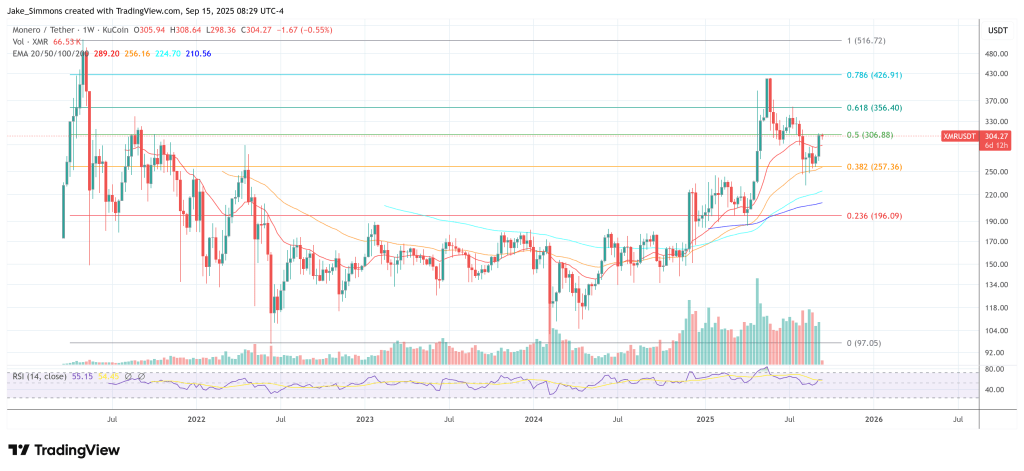
Markets treated the event with surprising resilience. Within hours, XMR rallied between roughly 5% and 7%, trading above $300 on some venues.
Monero price
XMR price, 1-week chart | Source: XMRUSDT on TradingView.com
Featured image created with DALL.E, chart from TradingView.com
Editorial Process for bitcoinist is centered on delivering thoroughly researched, accurate, and unbiased content. We uphold strict sourcing standards, and each page undergoes diligent review by our team of top technology experts and seasoned editors. This process ensures the integrity, relevance, and value of our content for our readers.

Jake Simmons has been a Bitcoin enthusiast since 2016. Ever since he heard about Bitcoin, he has been studying the topic every day and trying to share his knowledge with others. His goal is to contribute to Bitcoin's financial revolution, which will replace the fiat money system. Besides BTC and crypto, Jake studied Business Informatics at a university. After graduation in 2017, he has been working in the blockchain and crypto sector. You can follow Jake on Twitter at @realJakeSimmons.

Пов'язані матеріали

Crypto Bull Is Back, Which Assets Bounced the Hardest?

The cryptocurrency market experienced a significant surge last week, with Bitcoin rallying over 26% to nearly $79,500, its strongest weekly gain since March 2023, fueling discussions of a renewed bull market. This rebound highlighted several key market dynamics. First, short-term directional shifts are increasingly tied to U.S. policy cycles. The rally was driven by two major catalysts: the U.S. Treasury's announcement to increase long-term bond buybacks, easing macro liquidity pressures, and former President Trump's push for clearer crypto legislation, boosting regulatory certainty and risk appetite. Second, Bitcoin spot ETFs solidified their role as a leading market indicator. In the week ending August 21, U.S. Bitcoin and Ethereum spot ETFs saw a combined net inflow of $2.6 billion, the highest since October 2025, signaling strong institutional re-entry. Third, the rally followed a clear capital rotation pattern: Bitcoin's breakout ignited broader gains, with Ethereum (up nearly 30%), major altcoins, and meme coins sequentially posting larger percentage increases. Analysis of the top performers among the top 50 altcoins by market cap revealed the week's biggest gainers: ENA (Ethena) led with a 100.75% surge, fueled by a Coinbase partnership. It was followed by PUMP (Pump.fun, up 88-99%), STX (Stacks, up 82-94%), TRUMP (Official Trump, up 79-91%), and ZEC (Zcash, up 75.15%), which uniquely reached a new all-time high. Meme coins like BOME on Solana also saw explosive gains, exemplifying the high-risk, high-reward sentiment. The rally illustrated a clear path: Bitcoin set the stage, major coins like Ethereum led the charge, and altcoins/meme coins delivered the most explosive returns, mapping the gradient of returning market enthusiasm.

marsbit2 хв тому

Crypto Bull Is Back, Which Assets Bounced the Hardest?

marsbit2 хв тому

Wuhan is About to Witness Its Largest IPO in History

Wuhan is poised for its largest-ever IPO as Yangtze Memory Technologies Co., Ltd. (YMTC) has officially applied for a listing on the Shanghai Stock Exchange's STAR Market, seeking to raise 33 billion yuan. The domestic leader in 3D NAND flash memory chips completed its IPO辅导 (tutoring) process in a record three months, with market expectations valuing the company at 300 billion yuan or higher. YMTC's roots trace back to 2006 with the founding of Wuhan Xinxin. After surviving the global financial crisis and periods of operational difficulty, the company was formally established in 2016 through a joint investment involving Tsinghua Unigroup, the National Integrated Circuit Industry Investment Fund (the "Big Fund"), and local Hubei government funds. With a distinct "national team" background, its major shareholders include provincial and municipal state-owned assets committees and the Big Fund. Based in Wuhan's Optics Valley (East Lake High-tech Development Zone), YMTC's potential listing highlights the region's rise as a tech hub. Optics Valley is already home to 72 listed companies and has ambitious plans to exceed 100 by 2030. The zone recently established four industry-focused母基金 (mother funds) totaling 18 billion yuan to further boost sectors like integrated circuits and optoelectronics. YMTC's IPO would complete the "Optics Valley Seven Stars," a group of leading local optoelectronic and communication giants.

marsbit3 хв тому

Wuhan is About to Witness Its Largest IPO in History

marsbit3 хв тому

Banks and Regulators Join Pilot Project to Test Quantum-Resistant Crypto Transfers

Banks and financial regulators from Europe, the Middle East, and Asia have joined a pilot project to test quantum-resistant crypto infrastructure for digital asset wallets and on-chain transactions. The initiative, announced by the Responsible Fintech Institute and infrastructure provider Safeheron, will use NEAR's quantum-resistant testnet. It will employ the ML-DSA-65 post-quantum digital signature standard, recently finalized by the U.S. National Institute of Standards and Technology (NIST). Participating regulators include the Abu Dhabi Global Market, Bhutan's Gelphu Financial Services Authority, and Malta's Financial Services Authority. Financial institutions involved are Bison Bank and DK Bank. In the pilot, banks will test wallet creation and transactions in a unified application environment, while regulators will initially observe and later contribute to governance mechanisms. The organizers plan to publish a technical paper detailing the research, protocol design, and test results, eventually open-sourcing the core technology. This effort comes as financial authorities prepare for the advent of quantum computers, which threaten current public-key cryptography. For instance, the Hong Kong Monetary Authority aims for the territory's banking sector to be fully prepared for quantum-related security risks by 2030. The Bank for International Settlements (BIS) also recommended in a 2025 document that financial institutions begin a coordinated, phased transition to post-quantum systems.

cryptonews.ru5 хв тому

Banks and Regulators Join Pilot Project to Test Quantum-Resistant Crypto Transfers

cryptonews.ru5 хв тому

Торгівля

Спот
活动图片