Прогноз биткоина в преддверии заседания ФРС: чего ждать

cryptonews.ruОпубліковано о 2025-07-14Востаннє оновлено о 2025-09-15

В преддверии заседания ФРС 17 сентября участники криптосообщества активно делятся прогнозами биткоина. Одни аналитики указывают на риски снижения в условиях фиксации прибыли крупными игроками, другие, напротив, видят сигналы к продолжению роста и обновлению максимумов

Редакция BeInCrypto собрала в одном обзоре прогноз биткоина от участников криптосообщества. Рассказываем, чего инвесторы ждут от криптовалюты и на какие нюансы положения BTC стоит обратить внимание.

Есть риск обвала

Аналитик Doctor Profit обратил внимание на то, что биткоин продолжает двигаться в диапазоне $115 000–$125 000, который является зоной активного выхода крупных игроков.

По его наблюдениям, средняя цена входа розничных инвесторов за последние три месяца составляет $117 000–$122 000, и большинство этих позиций пока остается в убытке. Несмотря на недавние просадки до $107 000, массовой капитуляции розницы не произошло. Этим пользуются маркет-мейкеры и фонды, которые разгружают актив, не оставляя очевидных следов на графике.

Продажи китов:

  • держатели от 1 000 до 10 000 BTC за последние 30 дней продали около 116 000 BTC на сумму $13 млрд;
  • это крупнейший сброс с июля 2022 года.

Фонды и ETF:

  • после мощных притоков в июле, в августе дневные поступления в спотовые ETF снизились до примерно 500 BTC;
  • это резко ослабило спрос и усилило давление со стороны продавцов.

Вывод аналитика:

  • диапазон $115 000–$125 000 — зона фиксации прибыли для крупных игроков;
  • следующая фаза — движение вниз, с ликвидностью в районе $90 000–$106 000;
  • даже рост к $120 000–$125 000 остается лишь «последним выходом» для сильных игроков, а не началом новой волны.

Личная стратегия Doctor Profit:

  • полностью закрыл спот-позиции;
  • вывел все средства в стейблкоины (USDT) и открыл короткие позиции против биткоина;
  • продолжает наращивать шорты в диапазоне $115 000–$125 000.
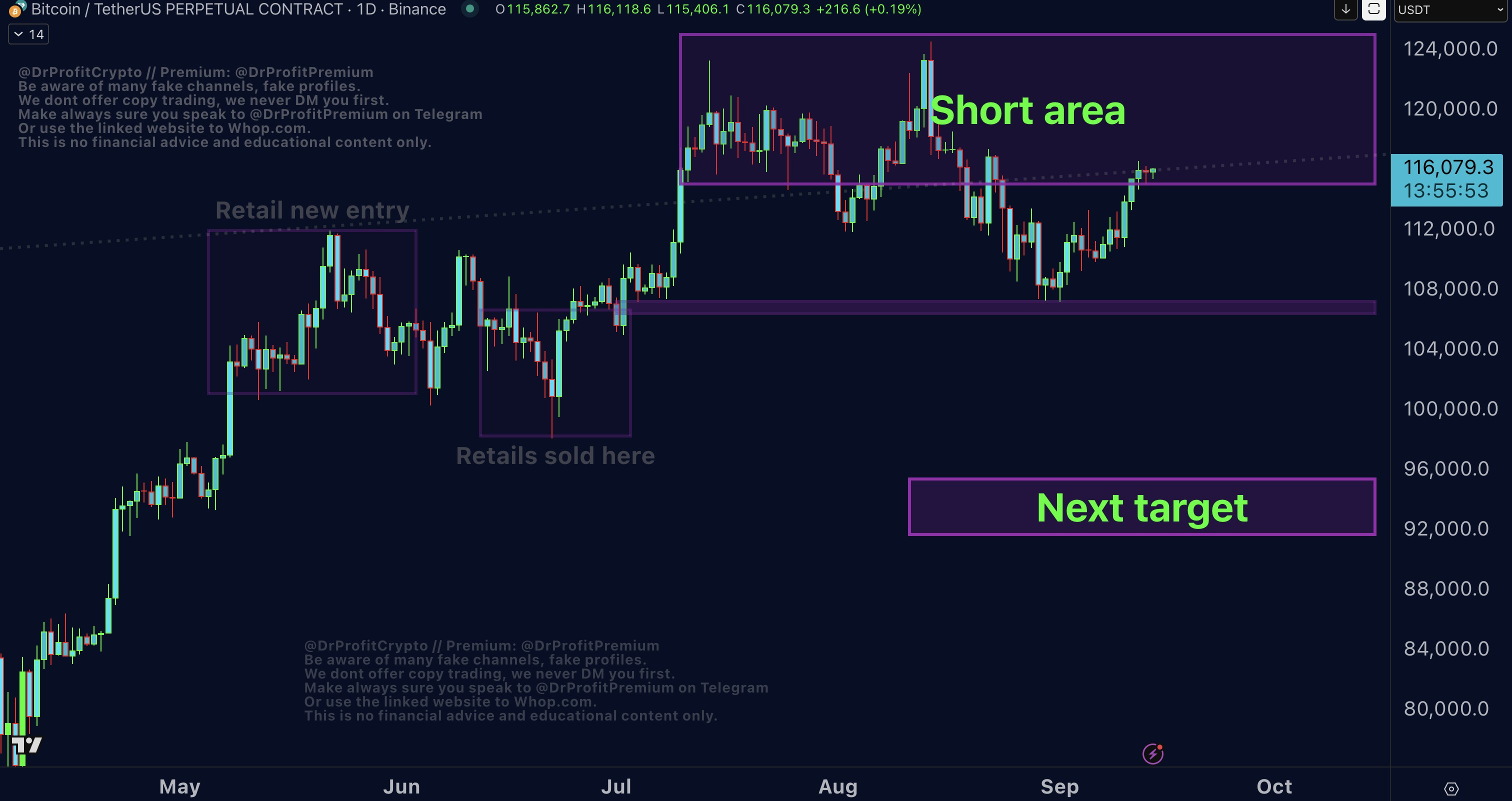
прогноз биткоина от Doctor Profit
Анализ графика биткоина от Doctor Profit

Что касается альткоинов, эксперт отмечает, что текущий рост — это отвлекающий маневр, а большинство лидеров роста — новые и низкокачественные токены. Он предупреждает: говорить о начале «альтсезона» сейчас преждевременно.

Трейдер Wimar.X отметил, что большинство участников рынка недооценивает влияние предстоящего снижения ставок ФРС. По его словам, так называемый «rate cuts pattern» (паттерн падения на снижении ставки) способен привести к падению биткоина в ближайшей перспективе, прежде чем рынок вновь вернется к росту.
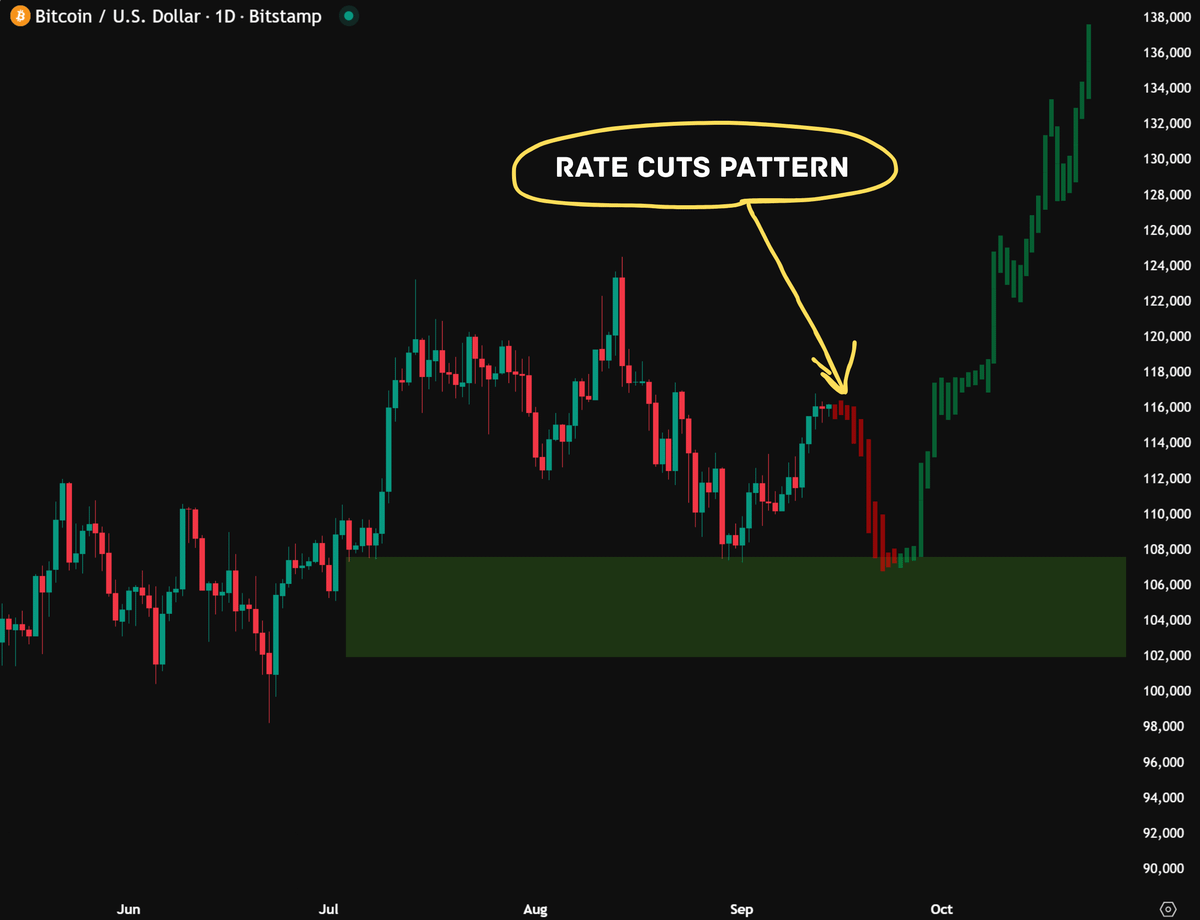
Прогноз биткоина

По его мнению, есть риски падения биткоина до $107 000 на новостях о ставке. Wimar.X подчеркивает, что реакция рынка на снижение ставок зачастую оказывается противоположной ожиданиям розничных инвесторов. Вместо мгновенного роста такие решения вначале провоцируют фиксацию прибыли и краткосрочный обвал.

На момент написания обзора, свыше 96% участников рынка ждут снижения ставки ФРС 17 сентября.

Локальное дно пройдено

По мнению трейдера Mr. Wall Street, биткоин сформировал важный сигнал на дневном таймфрейме MACD — «золотое пересечение», совпавшее с локальным дном по показателю MVRV в районе $107 000. Подобное сочетание индикаторов на этом цикле, по наблюдениям автора поста, встречалось всего три раза:

  • при цене $49 000 во время обвала, вызванного крахом иены;
  • на уровнях $16 000–$18 000 сразу после коллапса FTX;
  • при $76 000 на фоне паники вокруг войны тарифов Трампа.

Каждый раз такие сигналы, как считает трейдер, указывали на локальные минимумы и предшествовали росту на 30–40%. Сейчас ситуация повторилась на $107 000. Mr. Wall Street считает это подтверждением того, что следующая цель биткоина находится в диапазоне $140 000–$150 000.

Трейдер выделяет два возможных сценария:

  • вариант 1: дно уже пройдено, и разворот продолжается прямо сейчас;
  • вариант 2: биткоин встретит сопротивление в районе $120 000, скорректируется к локальным минимумам, а затем начнется движение к $140 000.

Ключевым фактором станет заседание ФРС и выступление Джерома Пауэлла. От намеков на политику в ноябре будет зависеть, какой сценарий реализуется. Сам Mr. Wall Street удерживает свои лонги с $107 000–$108 000 и готов увеличить позиции, если произойдет откат по варианту 2.

Также он оспаривает распространенное мнение о том, что основная ликвидность сосредоточена снизу. По его расчетам, движение на $50 000 вверх даст рынку больше ликвидности за счет ликвидации шортов, чем аналогичное падение вниз.

Что касается макроэкономики, трейдер считает аргумент «слабой экономики» несостоятельным. В начале 2023 года условия также выглядели негативно, но биткоин при этом подорожал с $16 000 до $32 000 за первый квартал. По его мнению, сейчас на рынке слишком много участников, ждущих крупного обвала. Это, напротив, может привести к шорт-сквизу и ускоренному росту.
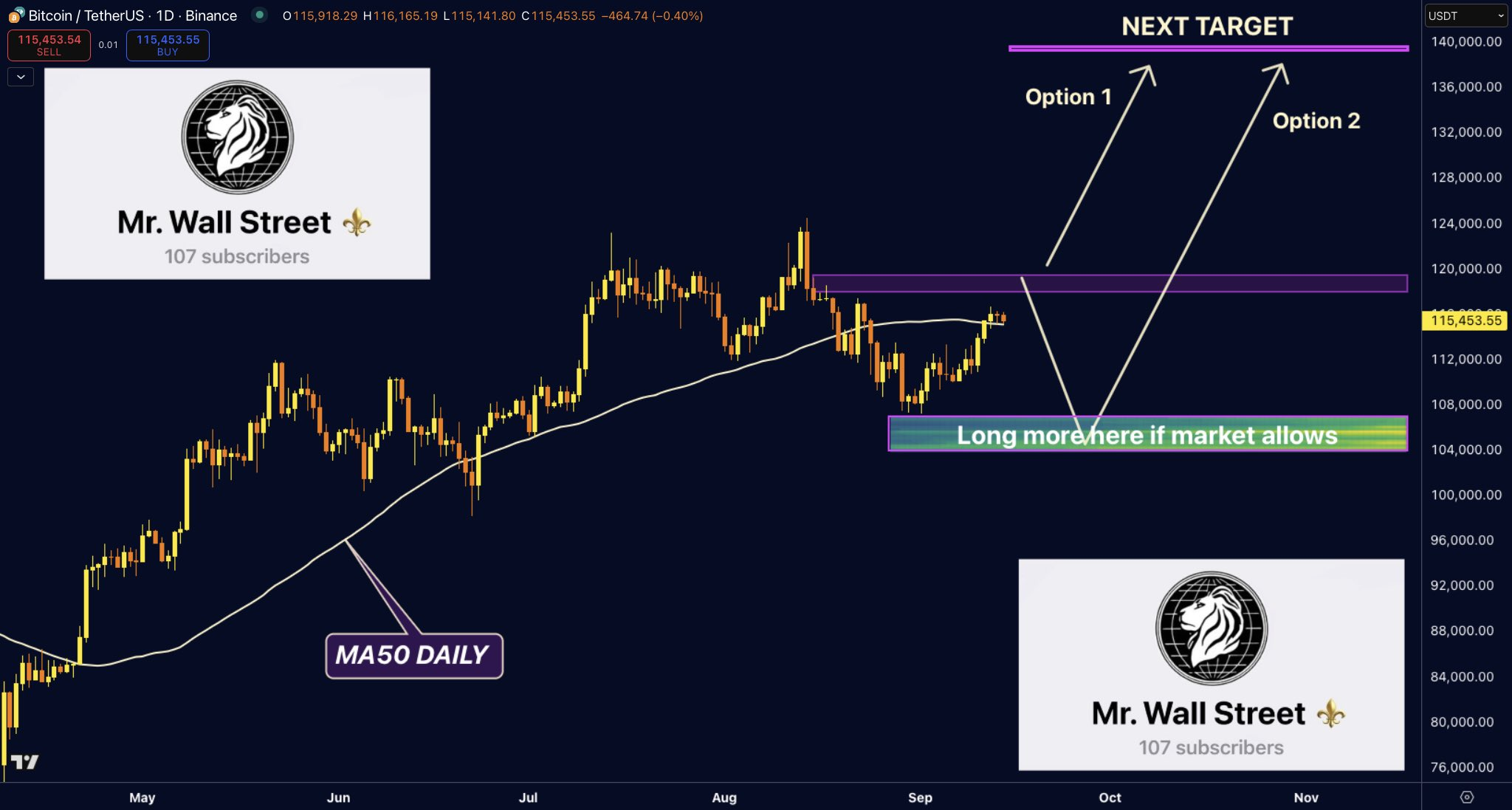
прогноз биткоина
Анализ графика биткоина и прогноз от Mr. Wall Street

По прогнозу Mr. Wall Street, пик эйфории цикла будет достигнут именно тогда, когда большинство начнет догонять рост. В этот момент он планирует полностью выйти из своих позиций.

Пов'язані матеріали

The Philadelphia Semiconductor Index Tumbles Nearly 5% in a Single Night, Optical and Memory Sectors 'Collapse' Together: Surging U.S. Bond Yields Shake AI Belief

On the evening of August 18th, the US stock market saw a sharp sell-off concentrated in the AI hardware sector, with the Philadelphia Semiconductor Index plummeting nearly 5%. Leading AI infrastructure and components companies in fields like optical communication and memory chips experienced some of the steepest declines, such as Fabrinet (-19.38%) and Kioxia ADR (-13%). The sell-off was not broad-based but rather targeted the long-duration, high-momentum stocks previously driven by AI narrative optimism. This market shift is primarily attributed to a significant surge in long-term US Treasury yields, with the 30-year yield hitting its highest level since 2007. Rising yields increase discount rates, disproportionately impacting the valuations of growth stocks whose profits are projected far into the future—a category that includes most AI hardware plays. Additional pressure came from climbing oil prices due to Middle East tensions, which fueled inflation concerns. The article identifies three structural reasons for the severity of the drop in these specific subsectors: excessive prior gains and crowded positioning, high sensitivity to the sustainability of AI capital expenditure narratives, and inherent high volatility within the supply chain. Importantly, the sell-off appears to be a valuation and positioning reset rather than a fundamental repudiation of AI, evidenced by the relatively modest decline in a bellwether like Nvidia (-2.34%). Looking ahead, the direction hinges on three key indicators: whether the 30-year Treasury yield stabilizes, the trajectory of oil prices and geopolitical risks, and the market's pricing of new AI-related corporate debt. For related Asian and A-share markets, short-term negative sentiment spillover is expected, but medium-term drivers like domestic cloud capex may provide divergence. The episode signifies a market transition from pricing AI's "story" to rigorously evaluating its returns against a backdrop of higher financing costs.

marsbit3 хв тому

The Philadelphia Semiconductor Index Tumbles Nearly 5% in a Single Night, Optical and Memory Sectors 'Collapse' Together: Surging U.S. Bond Yields Shake AI Belief

marsbit3 хв тому

Ten Years, Wang Xingxing's Comeback: Unitree Valued at 400 Billion

Over a decade ago, Wang Xingxing, a 29-year-old with a passion for robotics but little funding, demonstrated his struggling robot dog to investors in Hangzhou. In 2019, with his company Unitree nearly out of cash, he captured the attention of Sequoia Capital China's managing director Li Yannan. Despite initial skepticism about the niche market for robot dogs, Wang's vision and deep technical conviction led Sequoia to make an initial seed investment. This marked a turning point. Following Sequoia's lead, a wave of prominent investors including Meituan, Tencent, Alibaba, and various venture capital and state-backed funds joined subsequent funding rounds. Wang's relentless focus and Unitree's technological advancements propelled the company to become a global leader in humanoid robotics. On August 19th, 2027, Unitree Robotics debuted on Shanghai's STAR Market as the first listed humanoid robotics company in China. Its shares skyrocketed over 500% at opening, reaching a market valuation of approximately 400 billion yuan. Wang Xingxing became one of the wealthiest individuals of his generation on the exchange, while Sequoia China, having invested across multiple rounds, remained a major shareholder. The story is celebrated as a classic outlier's triumph—a founder without elite credentials achieving success through pure belief and perseverance. Unitree's IPO is seen as a major milestone for China's embodied AI industry, providing a valuation benchmark and accelerating the sector's maturation. As Wang once stated, he aims to be "a small boat riding the mighty torrent of technology." His journey symbolizes the beginning of a new narrative for Chinese robotics on the global stage.

marsbit3 хв тому

Ten Years, Wang Xingxing's Comeback: Unitree Valued at 400 Billion

marsbit3 хв тому

Manufacturing's Share Drops Below 25%: Is Hangzhou Unconcerned?

Hangzhou is entering a critical phase of industrial restructuring. While its manufacturing-to-GDP ratio has fallen below 25%, the city is not alarmed. Instead, it is strategically navigating a dual focus: advancing advanced manufacturing and expanding its service sector, particularly producer services. Recently, the city celebrated the IPO of a humanoid robotics company, seen as a milestone in moving beyond its e-commerce era. Simultaneously, it set an ambitious target for its service sector: to exceed 2 trillion yuan in value by 2030, with producer services making up over 60%. Data shows a clear trend: the service sector's share of GDP has risen to 75.3%, while manufacturing's share has declined to around 20.1%. This shift revives the debate on whether a strong service sector weakens a city's manufacturing "foundation." Hangzhou's approach challenges the notion of a fixed manufacturing "red line" near 25%. The city argues that the quality and integration of industries matter more than simple ratios. Its strategy is "using software to drive hardware," leveraging its core strengths in digital economy and producer services—like R&D, software, and supply chain management—to empower and add value to manufacturing. This is embodied by its emerging "AI era" companies, whose innovation in Hangzhou feeds into national industrial chains. The city believes that for a hub like Hangzhou, the key is not merely boosting visible manufacturing output, but strengthening the "invisible" competitive edge provided by high-end producer services, which ultimately determine manufacturing profitability. National policy is also shifting from insisting on a "stable" manufacturing share to acknowledging a "reasonable" range, allowing for quality-focused development. Hangzhou's future industrial blueprint aims for a manufacturing share above 22% of GDP by 2027, coupled with a dominant, high-value service sector. The goal is not to choose between manufacturing and services, but to deeply integrate them, using advanced services as the accelerator for next-generation manufacturing.

marsbit28 хв тому

Manufacturing's Share Drops Below 25%: Is Hangzhou Unconcerned?

marsbit28 хв тому

SEC Suddenly Proposes "Regulation Crypto": U.S. Token Fundraising May Become Legal Again

On August 18, the U.S. Securities and Exchange Commission (SEC) proposed a landmark set of permanent rules, "Regulation Crypto Assets," specifically designed for crypto asset investment contracts. The 402-page proposal introduces two registration exemption paths and a groundbreaking safe harbor mechanism, representing the SEC's first dedicated crypto-specific regulatory framework. Two exemption tiers are proposed: a "Startup Exemption" allowing a one-time raise of up to $5 million within four years with basic disclosure requirements, and a "Financing Exemption" permitting raises of up to $75 million every 12 months with stricter obligations, including financial statements and ongoing reporting. Both paths require "principles-based narrative disclosure," a flexible approach distinct from traditional IPO forms. The most transformative element is the investment contract safe harbor. It provides a legal path for tokens to "graduate" from being classified as securities. If an issuer completes or permanently ceases its "essential managerial efforts" as promised in the investment contract and meets specific conditions, it can file with the SEC to have the token exit the securities framework. This creates a novel legal lifecycle where a token can begin as a regulated security for fundraising and later become a non-security asset as the network decentralizes. This move is seen as the SEC pragmatically filling a legislative vacuum, as the stalled CLARITY Act in Congress faces significant delays. The proposal aims to offer a compliant pathway for token offerings within the U.S., countering the trend of projects moving overseas. While currently a proposal open for a 60-day public comment period, it signals a major potential shift from an enforcement-heavy approach toward establishing clearer rules for the crypto industry.

marsbit32 хв тому

SEC Suddenly Proposes "Regulation Crypto": U.S. Token Fundraising May Become Legal Again

marsbit32 хв тому

Late Qing County Magistrates' 'Official Debt' and the Crypto World's 'Exchange Listings': The Cross-Temporal Truth of Financializing Power

This article draws parallels between financialization of power in late Qing Dynasty China and the modern cryptocurrency industry. It opens with a staggering contemporary corruption case involving billions, illustrating how official positions control massive cash flows, akin to toll booths. The core analysis focuses on Du Fengzhi, a late Qing county magistrate. His 22-year journey from passing the provincial exam to finally obtaining a post highlights how bureaucratic "qualification" (like a VC investment) doesn't guarantee immediate benefit. Crucially, upon receiving his appointment, Du had to borrow heavily—"official debt"—to cover travel and networking costs to actually assume his position. Lenders, seeing his future post as a revenue-generating asset, offered loans with exorbitant effective interest rates (e.g., borrowing 4000 taels but receiving only 2000), effectively discounting and financializing his future power. Once in office, Du faced immense pressure from both public tax quotas and his crippling private debt. His diaries reveal aggressive, sometimes extreme, tax collection methods (sealing ancestral temples, pressuring local gentry) to meet these demands. The article argues this created a system where public duty and private financial survival became indistinguishable, with corruption evolving from operational necessity to normalized practice. The piece consistently analogizes this to crypto: VC funding as mere "qualification," the costly "listing" process on exchanges, the role of market makers and KOLs as intermediaries akin to local gentry, and the relentless pressure on funded projects to deliver returns—often leading to perpetual pivots, artificial metrics, and ultimately, the extraction of value from retail liquidity. Both systems, it concludes, are driven by the financialization of future potential, trapping individuals in cycles of debt and obligation with limited alternatives for upward mobility.

marsbit40 хв тому

Late Qing County Magistrates' 'Official Debt' and the Crypto World's 'Exchange Listings': The Cross-Temporal Truth of Financializing Power

marsbit40 хв тому

Торгівля

Спот
活动图片