透视特朗普旗下World Liberty的加密权力游戏​

marsbitОпубліковано о 2025-09-01Востаннє оновлено о 2025-09-02

好消息:Solana链上的又一波热潮即将来袭!

我们终于迎来了梦寐以求的大规模流动性,而这一次,是银行家们为我们的“meme”注入资金。

如果你需要简短总结:@worldlibertyfi 正在为 ETH 和 SOL 生态系统提供 TWAP(时间加权平均价格)服务。仅凭这一点,就足以预示接下来会发生什么。

初看:一个“洗钱”计划?

当我第一次听说 World Liberty 时,老实说,我以为这只是特朗普家族的一场精心设计的“洗钱生意”。

从理论上看,这个逻辑似乎成立:

  • 通过 $TRUMP memecoin 打印数十亿利润;
  • 推出一个为传统金融(TradFi)资金提供流动性服务的平台;
  • 通过这一计划将利润免税转移;
  • 无监管、无触碰,完美达成。

但当时我忽略了一个关键点——今天终于明白过来——World Liberty 的规模远比这更大!

流动性

HUUUUUGE

加密货币的流动性机器

World Liberty 正在定位为链上生态系统中的重要流动性提供者。不管你喜不喜欢:特朗普或许正要拯救我们这些“去中心化狂热者”。

我们一直在渴求流动性,而现在它终于来了。听起来很棒,对吧?

不过,问题来了:掌控资金流入和流出的人,也掌控着整个游戏规则。

在上一轮周期中,中心化交易所(CEX)扮演了这个角色。它们是银行(真正的流动性提供者,法币的源头)与交易者之间的桥梁。

但如今,CEX 基本上已经变得无关紧要。CZ 和 Brian 早就预见到了这一点,这也是他们开始构建自己链上层的原因。

与此同时,就在你阅读这篇文章的时候,World Liberty 已经铸造了数亿美元的稳定币 USD1。
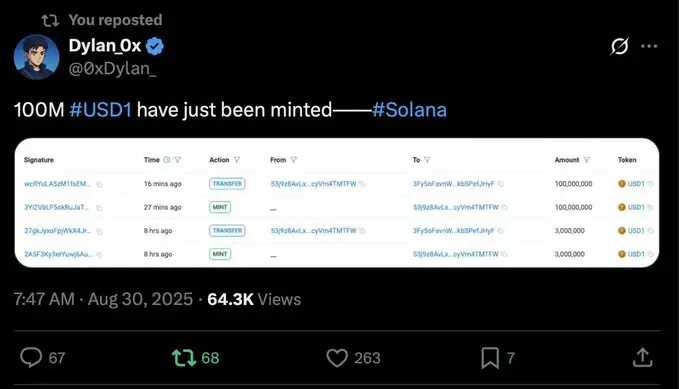
流动性

“USD1钱包”账户管理器

USD1 的问题

到目前为止,这些资金究竟会如何部署仍然是个谜。

谁能获得这些资金?

标准是什么?

是否只需和特朗普家族关系够近?或者需要将公司 10% 的股份交给他们换取资金?

没人能确切知道答案。但关键在于:他们掌控着整个加密领域的流动性流向。

从现在开始,每一个新兴趋势都与特朗普的影响直接挂钩。

不喜欢 Meme Meta(Meme 元宇宙)?他们会转而资助 ICM(链上资本市场)项目。

这月不喜欢 ICM?下个月可能是 AI。

他们可以引导整个周期的走向。

流动性

已婚...有孩子2.0

中心化的隐忧

短期来看,我们赢了:关注度、热度、流动性。去中心化狂热者们将尽情享受这场盛宴。

但从长期来看,真正的赢家是谁?

是加密原住民,还是背后支持这场游戏的华尔街银行家?

问问你自己:还有多少人保留着你曾积累的比特币?还是早已在追逐 Memecoin 的狂潮中把它们赌了个精光?

别告诉我,你把我们的钱都赌在了那些 Memecoin 上,唐尼!(深潮注:唐尼是对特朗普的昵称。)

流动性

我所有的比特币都没了。

透明度、控制和惩罚

我们不再是那个“狂野西部”了。

我们用自由换来了流动性,用乐趣换来了隐私。如今,你在 Solana 上的每笔交易都永久可见。

现在,大多数人可能会想:“我不在乎,他们碰不到我。”

但事实是,他们能碰到你,而且可能真的会这么做。Groypers。(深潮注:指支持极端保守主义的群体)

到了某个时刻,你可能会因为在 2025 年交易过的资产、持有过的代币,甚至说过的话而受到惩罚。这就是这场游戏的苦涩后果:

我们被自己曾经打造的资产定价排挤在外;

我们失去了对自己热爱的生态系统的所有权;

最糟糕的是,我们在自己赖以生存的空间里放弃了自由。

流动性

我们需要 Degenspartan 回来!

以下是我的初步建议

趁着窗口还开着,尽可能赚到最多的钱。

但千万别忘记:世上没有免费的午餐。流动性不是免费的,特朗普的“支持”也不是免费的。

我们正在鲨鱼池中游泳,而那些鲨鱼并不希望“小人物”赢得胜利。

未来如何?

该买哪种币?真相是,除非你能从特朗普圈子里获得直接的内部消息,否则一切都是猜测。他们现在掌控着市场。 就像罗斯柴尔德(Rothschild)曾说过的那样:“谁控制了金钱,谁就拥有了世界。”

我的最佳猜测是:随着 World Liberty 开始 TWAP(时间加权平均价格)进入生态系统,其他基金会跟随其后。

预计中国玩家以及其他势力会投入更多激进收益(更高的年化收益率,更多的杠杆)。

到 2025 年末或 2026 年初,监管可能会介入,将这一切锁定——不是削弱 World Liberty 的力量,而是巩固其权力。

届时,现实世界的初创公司和科技项目将开始链上部署。
Пов'язані матеріали

HSBC Research Report Analysis: Behind 12 Million Starlink Users, the Space Economy is Feeding Back to Earth

HSBC Research Report Analysis: The 120 Million Starlink Users and How the Space Economy is Fueling Earth's Industries. The core value of the new space race is returning to Earth, driving industrial upgrades across multiple sectors, according to an HSBC report covering 12 industries. Key developments include: SpaceX’s Starlink has surpassed a critical scale with 10,200 satellites, 12 million broadband users, and 7.4 million direct-to-cell devices. It is evolving from a backup solution to default infrastructure in maritime, aviation, trucking, and remote areas, complementing rather than competing with terrestrial telecom operators. Starship aims to reduce launch costs to $100-$300 per kilogram, a 95%+ reduction from historical averages. This drastic cost compression is reshaping the economics of satellite manufacturing, in-orbit services, and future ventures like asteroid mining. SpaceX’s plans for orbital AI data centers (100 GW by 2040) and the Terafab vertically integrated semiconductor foundry (a joint venture with Tesla and xAI) represent strategic shifts. While orbital data center costs are currently triple those on Earth, they offer a policy-independent backup for power-constrained AI growth. Terafab poses a potential challenge to the traditional fabless-foundry model. The report warns that aggressive capacity expansion by SpaceX and others could lead to a compute surplus by the late 2020s, potentially commoditizing LLMs and pressuring hardware vendors. The space race is most directly reshaping three core industries: 1. **Power/Utilities:** AI data centers are boosting annual U.S. electricity demand growth. Renewable energy and grid infrastructure are clear beneficiaries. 2. **Semiconductors:** Demand is created for "low-Earth orbit optimized" chips, while the vertically integrated Terafab model threatens traditional foundries. 3. **Robotics/Industrial:** Technologies for space mining, lunar construction, and in-orbit servicing are advancing with direct feedback to terrestrial applications in autonomous machinery and navigation. In conclusion, the space economy is already acting as an accelerator for Earth's industries through Starlink's scale, Starship's cost curve, and strategic projects like Terafab, with the most immediate impacts felt in power, semiconductors, and robotics.

marsbit15 хв тому

HSBC Research Report Analysis: Behind 12 Million Starlink Users, the Space Economy is Feeding Back to Earth

marsbit15 хв тому

Торгівля

Спот
活动图片