Abstract
The Direxion Daily Semiconductor Bull 3x ETF offers leveraged exposure to the semiconductor sector but is subject to volatility decay over multi-day holding periods.
I believe the sector's forward earnings yield of approximately 4% is insufficient to compensate investors for the inherent drawdown risks of holding leveraged funds.
In my view, a safer entry point requires a higher earnings yield and should coincide with key technical support levels.
SOXL's realized volatility can exceed 90%, making it suitable only for tactical intraday trades or after the sector experiences a significant pullback.
The semiconductor sector has pulled back, but growth prospects remain at historically high levels.
I can't help but ask: if the sector's expected returns are still positive, why not use the pullback in the Direxion Daily Semiconductor Bull 3x ETF (SOXL) to position in this niche with 3x leverage?
The reason, in my opinion, is that the current expected return is not attractive enough compared to the risks required to hold SOXL over several days. Allow me to explain below.
What is SOXL
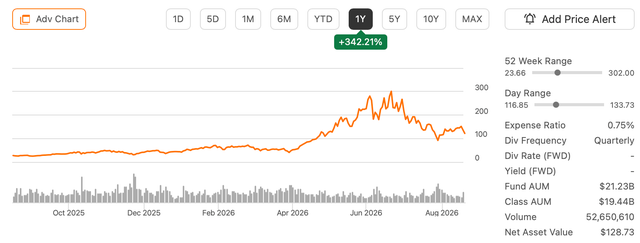
SOXL is a daily leveraged ETF whose primary goal is to achieve +300% of the performance of its underlying index. It must be clarified from the outset that, due to the daily compounding effect (volatility decay), the fund's returns over multi-day holding periods will deviate from 3 times the cumulative performance of the index. The fund is benchmarked against the ICE Semiconductor Index and achieves exposure through leverage, with a Total Expense Ratio (TER) of 0.75% and, naturally, requires daily rebalancing. What is its structure?
Portfolio Composition
The fund employs a hybrid structure: 65.95% of its Net Asset Value (NAV) is directly invested in stocks (physical semiconductor stocks), while it also obtains synthetic exposure equivalent to 234.05% of NAV through total return swaps on the ICE Semiconductor Index. Additionally, there is collateral/cash (money market instruments, US Treasuries, repos) equivalent to 35.73% of NAV, resulting in a nominal exposure equivalent to 335.7% of NAV.
The underlying index is 100% concentrated in the semiconductor industry, divided into two subcategories: Semiconductors, comprising 76.01%; and Semiconductor Materials & Equipment, comprising 23.99%. The top ten holdings are typical of the following companies:
Micron Technology, Inc. (MU), 8.55%;
Advanced Micro Devices, Inc. (AMD), 8.10%;
Nvidia Corporation (NVDA), 6.82%;
Intel Corporation (INTC), 6.34%;
Broadcom Inc. (AVGO), 6.08%;
Applied Materials, Inc. (AMAT), 5.78%;
KLA Corporation (KLAC), 5.65%;
Marvell Technology, Inc. (MRVL), 5.23%;
Lam Research Corporation (LRCX), 4.90%;
Taiwan Semiconductor Manufacturing Company Limited (TSM), 4.27%;
The top ten holdings collectively account for 61.67%.
Volatility Decay is Evident
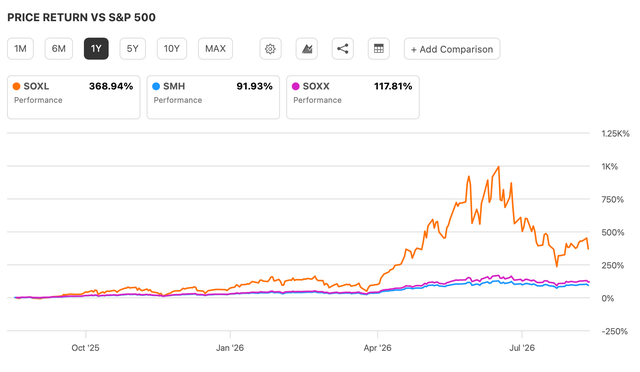
Comparing SOXL with the VanEck Semiconductor ETF (SMH) and the iShares Semiconductor ETF (SOXX) over an annual cycle, during a period very bullish for the sector overall, the performance gap between SOXL (the leveraged fund) and the other two ETFs manifests as a positive spread.
Conversely, during periods of bearish sector performance, the return gap widens in the negative direction. For example, over the past month, SOXL's performance is approximately -14%, while SMH and SOXX are down less than 3%.
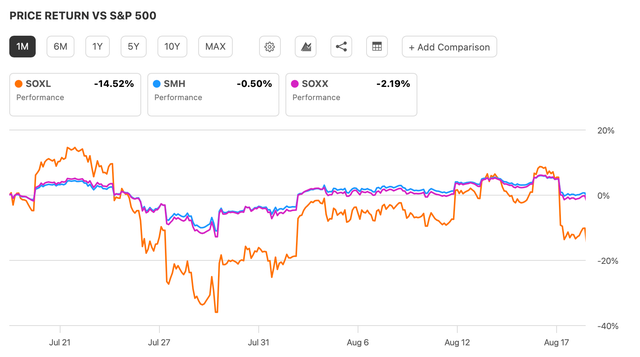
In other words, this reaffirms that this instrument is not designed to simply amplify the benchmark sector's multi-day movements by 3 times, and more than that. It also suggests that if used as an amplifier of portfolio volatility (and potential return), it might be more appropriate to use it after the market experiences a sharp decline, selling pressure is exhausted, and before a bull run arrives. In this regard, the 5-year performance also corroborates my view, though this is merely my personal opinion.
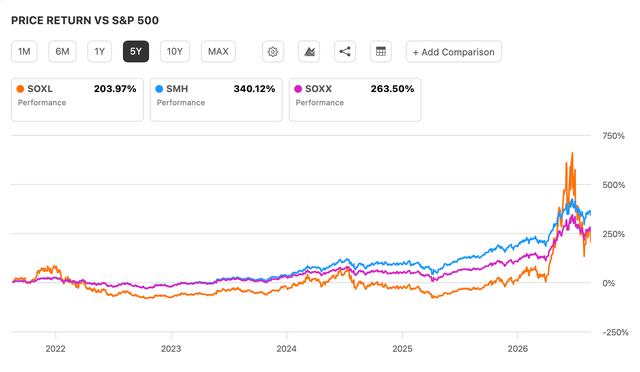
Thus, a question that almost naturally arises is: Given that the semiconductor sector has fallen 30% from its highs to its lows on August 26th, could this be a strategic area to position in SOXL?
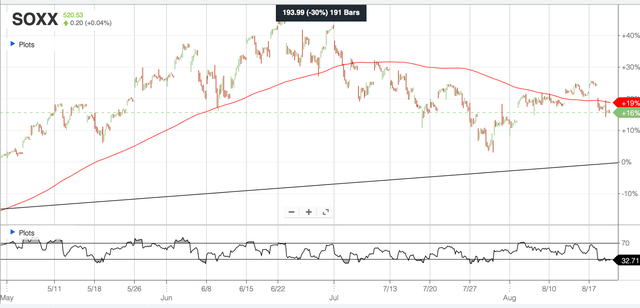
Outlook
The weighted average historical P/E (TTM) ratio of the index constituents ranges between 41.2x and 45.6x, while the blended forward P/E (12-month consensus) drops to between 23.0x and 25.5x. Therefore, the market has clearly priced in a significant acceleration in expected earnings growth. In itself, this implies an earnings yield for this basket of constituents of 2.2% to 2.4%, while the forward earnings yield rises to 3.92% to 4.35%. Such expected returns are not exciting enough for me. More importantly, for these expectations to materialize, overall EPS YoY growth must reach +45% to +65%, which is not a certainty. Assuming the earnings yield also applies with 3x leverage, the expected return would be roughly 12%. How do I view this? Personally, this valuation is not cheap.
My View
SOXL makes some sense as long as your trading timeframe is intraday. But if you are considering it as a return amplifier, then, for me, the key is buying at a cheap price. In my view, a P/E ratio below 20x would meet this condition; at least for the tech sector, this means buying below the 50th percentile of the 10-year distribution. When the earnings yield reaches 5%, I believe SOXL begins to be attractive enough to consider. Compared to current levels, this implies the non-leveraged ETF for the semiconductor sector needs to fall about 10% to 13% from its current price. For SOXL, the decline would be approximately 30% (amplified by volatility decay effects). Coincidentally, this level roughly coincides with the August lows and the 30 level of the 14-period RSI on the weekly chart.
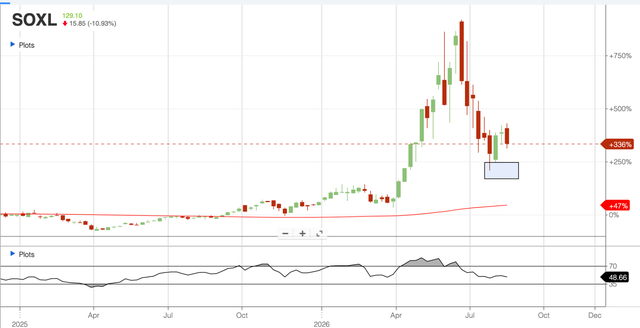
Therefore, I believe the appropriate rating for SOXL should be Hold. Not because I don't think the semiconductor sector's trend will continue, but because I am only willing to take on SOXL's inherent risks when the earnings yield is more competitive.
Risks
It should be noted that the historical annualized volatility of the underlying benchmark is quite high, ranging between 35% and 45%. At least theoretically (as it cannot be accurately calculated over multi-day periods), this implies SOXL's realized volatility would exceed 90% (theoretically impossible to reach 100%). What's the evidence? In the aforementioned historical maximum drawdown, SOXX (the 1x linear index) fell -70.21%, while SOXL fell -90.46% during the same event. To recover to pre-crisis levels, SOXX would need a gain of +235%, while SOXL would need a gain of +952%.
This is why, in my view, taking on this risk only makes sense when the expected return is truly competitive, not merely "acceptable" as it is now. Associated risks include extreme volatility, time decay and volatility decay, and the realistic possibility of losing the entire invested capital. Only experienced traders who fully understand the risks of leveraged ETFs should trade such products. More information can be found in this SEC notice.
Conclusion
Overall, this is not a rejection of SOXL, but it is certainly not a blind "buy the dip." In my view, the question is whether the entry price matches the structural risks borne by this instrument. My opinion is that the expected returns from the semiconductor sub-sector are insufficient to justify the risks investors take by holding SOXL over multiple days.