Какой эффект на криптовалюты окажет уменьшение ключевой ставки?

cryptonews.ruОпубліковано о 2025-04-23Востаннє оновлено о 2025-08-24

После выступления председателя Федеральной резервной системы США Джерома Пауэлла, состоявшегося 22 августа, повысилась вероятность снижения ключевой ставки в Америке, и это событие может повлиять на рынок криптовалют.

Среди экспертов бытует два противоположных мнения относительно последствий уменьшения ключевой ставки. Трейдер, известный под псевдонимом Ash Crypto, оказался среди сторонников бычьего ралли:

В четвёртом квартале этого года федеральное правительство США запустит печатный станок. В совокупности с двумя вероятными снижениями ключевой ставки это вызовет приток капитала в размере нескольких триллионов долларов на крипторынок. Мы находимся на пороге фазы параболического роста курса альткоинов, во время которой они подорожают в 10-50 раз.

Глава исследовательского департамента компании 10x Research Маркус Тилен придерживается иной точки зрения и полагает, что снижение ставки, наоборот, приведёт к падению стоимости виртуальных валют на фоне опасений по поводу рецессии экономики. В этом случае на приток инвестиций сможет рассчитывать разве что биткоин, считающийся цифровым золотом.

Работники аналитической фирмы Santiment тоже не спешат радоваться новости о возможном уменьшении ключевой ставки. По их мнению, эйфория, вызванная этим сообщением, скорее всего, достигла пика и скоро пойдёт на спад. Поэтому бычьим настроениям трейдеров может настать конец. Кроме того, рост курса акций, спровоцированный выступлением Пауэлла, способен сместить фокус внимания с цифровых активов на дорожающие ценные бумаги американских предприятий.
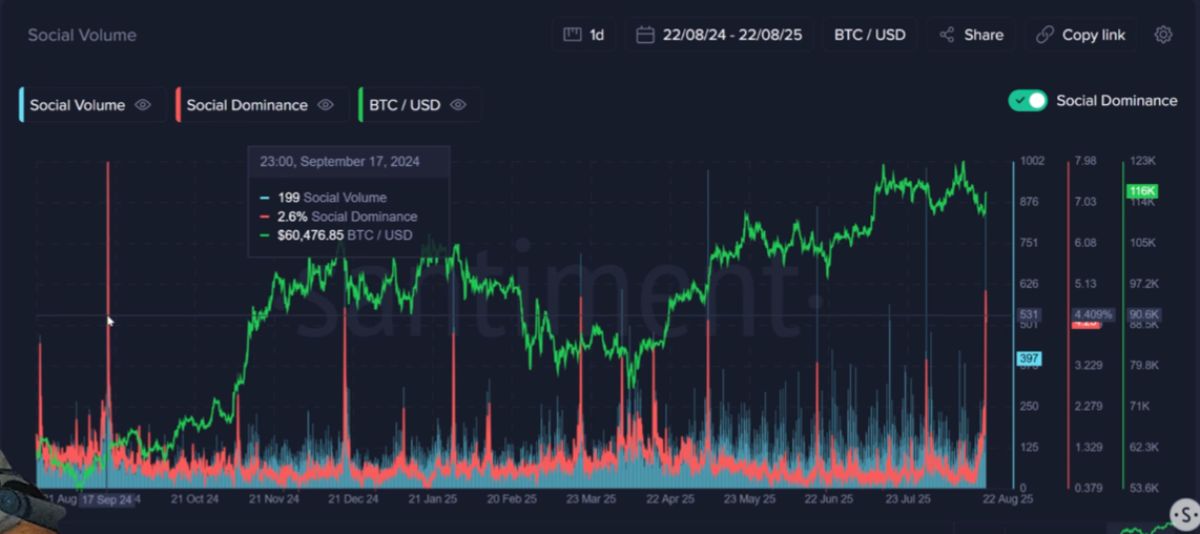
rate-cut-us-discussions-count

Количество обсуждений денежно-кредитной политики властей США (синяя диаграмма)

Учитывая эти факторы, имеет смысл готовиться к началу медвежьего тренда, который должен наступить на рынке криптовалют осенью, если верить теории циклов. Нисходящая тенденция давно назрела, потому что уровень капитализации цифровых активов растёт с января 2023-го, подвергаясь лишь непродолжительным коррекциям.

Пов'язані матеріали

Why Does 'AGI Godfather' Ben Goertzel Believe the Future of AI Relies on Blockchain?

Ben Goertzel, known as the "AGI Godfather," argues that the future of Artificial General Intelligence (AGI) must be built on blockchain to prevent its control by a few corporations or venture capital firms. He believes the core AGI code should be free and open-source, but that this alone is insufficient without a decentralized infrastructure to run it affordably. His blockchain project, SingularityNET, and the broader Artificial Superintelligence Alliance aim to create a user-owned, decentralized network for hosting and deploying AGI, contrasting with the closed models of companies like OpenAI and Anthropic. Goertzel criticizes the shift of other labs from open to closed development. He argues that while a closed path is simpler, an open, decentralized model—akin to Linux and the internet—is both possible and ultimately better for humanity. He envisions an "Agent economy" where individuals orchestrate teams of AI agents to perform tasks, including transactions, on an open network rather than corporate clouds. While his current model relies on cryptocurrency, plans include offering paid AI services to businesses with the decentralized blockchain as the backend. Goertzel predicts human-level AGI could arrive by 2029 and warns that a gap in understanding and access to AGI could drastically worsen inequality. The first test of his decentralized approach will be the upcoming release of the Agent Omega Claw.

Foresight News9 хв тому

Why Does 'AGI Godfather' Ben Goertzel Believe the Future of AI Relies on Blockchain?

Foresight News9 хв тому

A Company Once on the Brink of Bankruptcy Just Surpassed Bitcoin in Market Cap

On June 22nd, driven by rising stock prices, SK Hynix’s market capitalization reached $1.35 trillion, surpassing Bitcoin's total market cap of approximately $1.29 trillion. This temporarily made it South Korea's highest-valued company. The core driver of this surge is HBM (High Bandwidth Memory), for which SK Hynix is the primary supplier to NVIDIA, holding over 60% market share. AI's demand for high memory bandwidth has translated into immense profitability, with SK Hynix reporting a 72% operating profit margin in Q1. The company's success follows a 13-year bet on HBM technology, beginning in 2009. It nearly failed after the 2001 dot-com bubble, was acquired by SK Group in 2012, and was subsequently recapitalized to continue its long-term HBM development. The article contrasts this with the Crypto AI narrative. Capital currently favors AI infrastructure players like SK Hynix due to "real orders, physical barriers, and quantifiable profit margins." In comparison, Crypto AI projects, promising decentralized compute and data markets, remain largely conceptual with limited tangible progress. Examples include Bittensor, whose core mechanisms are still under development, and Bitcoin miners transitioning to AI, who face significant funding gaps and execution challenges. The piece cites analysis suggesting the AI sector has absorbed nearly all new market liquidity since 2022, leaving little for crypto. It concludes that the current AI infrastructure红利 is captured by entities with proven technical barriers and supply capabilities, while crypto networks still need to define their concrete role in the value chain.

链捕手49 хв тому

A Company Once on the Brink of Bankruptcy Just Surpassed Bitcoin in Market Cap

链捕手49 хв тому

Bittensor Moves Towards Ultimate Decentralization: The Critical 18 Months for the TAO Ecosystem is Here?

Bittensor, a decentralized AI protocol, is accelerating its transition to full decentralization over the next 18 months, as outlined in a recent post by co-founder Const. The project currently operates in a "semi-decentralized" state: ownership and network participation are open and permissionless, with TAO distribution based on competitive contribution. However, protocol upgrades and governance have remained under core team control to enable rapid iteration in the fast-evolving AI sector. This strategic shift comes as the ecosystem matures, boasting 128 subnets and a large community. Const argues that continued centralization now poses risks, including single points of failure and regulatory scrutiny. The upcoming decentralization roadmap includes optimizing validator competition, opening liquidity pools, introducing governance rights for Alpha holders, and refining economic models. The move could fundamentally reshape TAO's value proposition, adding governance premiums to its existing valuation based on AI narrative and scarcity. It also signals a potential maturation of the AI crypto sector, where competition may shift from hype to sustainable protocol design and real economic activity. Bittensor positions itself not just as another AI token, but as foundational infrastructure aiming to decentralize intelligence production—analogous to Bitcoin's role in decentralizing money—with the goal of creating a resilient "Millennium Intelligence Federation."

marsbit1 год тому

Bittensor Moves Towards Ultimate Decentralization: The Critical 18 Months for the TAO Ecosystem is Here?

marsbit1 год тому

Торгівля

Спот
Ф'ючерси
活动图片