Объем торгов криптобирж Латинской Америки вырос на 800%

cryptonews.ruОпубліковано о 2025-08-25Востаннє оновлено о 2025-08-25

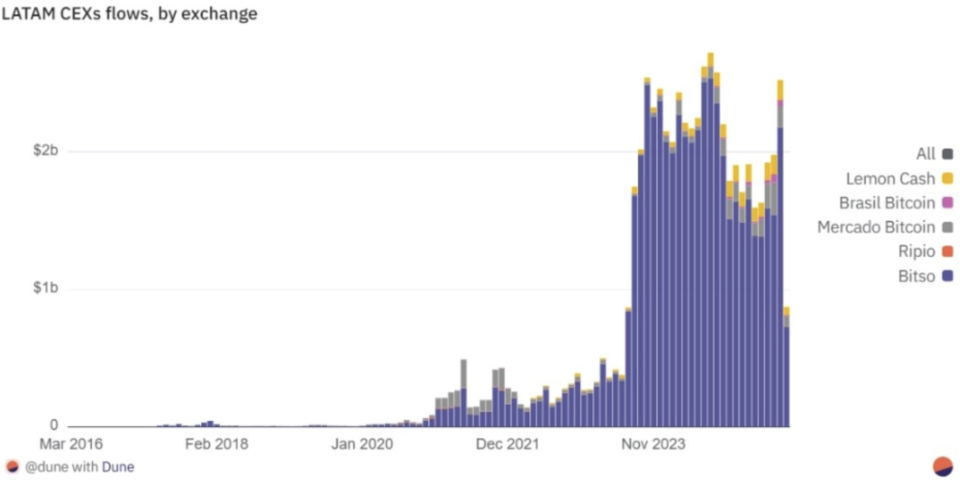
Криптовалютные биржи Латинской Америки зафиксировали рекордный уровень объема криптовалютных торгов, который вырос с $3 млрд в 2021 году до $27 млрд по итогам 2024-го. Всплеск активности клиентов отражает бум интереса к цифровым активам в регионе, заявили аналитики платформы Dune Research.

Ключевыми драйверами роста криптовалютных операций в латиноамериканском регионе Dune Research назвала социальные и экономические факторы, такие как политическая нестабильность и высокая инфляция. Например, в Аргентине, где местная фиатная валюта переживает девальвацию, биткоин и эфир стали популярными инструментами для хеджирования инвестиционных рисков, а долларовые стейблкоины вроде USDT активно применяются для повседневных транзакций благодаря стабильности цены.

Помимо этого, в криптовалютные технологии активно вовлекается молодое поколение. Латинская Америка лидирует по темпам роста числа криптоинвесторов, особенно среди пользователей до 35 лет. Их привлекает доступность и простота покупки токенов через локальные биржи, объясняют специалисты Dune Research.

Криптовалютный рынок латиноамериканского региона достиг по итогам года примерно $162 млрд, но к 2033 году может вырасти до $442 млрд с ежегодным темпом прироста в пределах 11%, предположили аналитики Dune Research.
92.png

Крупнейшая криптобиржа Латинской Америки Bitso значительно укрепила позиции на рынке. Если в 2021 году криптоплатформа обработала транзакции на $2 млрд, то к 2024 году объем торгов на Bitso взлетел до $25.2 млрд, показав рост на 1160%, что составило более 93% общего объема операций с цифровыми активами в регионе. Ближайшие конкуренты, такие как Mercado Bitcoin и Lemon Cash, также отметили значительный прирост транзакций за тот же период, сообщили в Dune Research.

Ранее команда криптовалютной биржи Bitso сообщила, что наибольшей популярностью у трейдеров из Латинской Америки пользуются стейблкоины USDC и USDT, на которые приходится около 39% общего объема покупок цифровых активов.
Пов'язані матеріали

Upbit is Anxious: A Hasty Counterattack Aimed at Regaining Stablecoin Market Share

Title: Upbit's Rushed Counterattack to Reclaim Stablecoin Market Share Facing a dramatic shift in South Korea's stablecoin market, leading exchange Upbit launched a promotional campaign from July 26 to August 9, waiving the 0.05% trading fee for stablecoins paired with the Korean Won (KRW) and rapidly listing new stablecoins like RLUSD and USDG. This move is a direct response to its plummeting market share in this sector. Historically a duopoly with Bithumb, the market has been reshaped since October 2025 when Coinone permanently removed fees for USDC trading. By June 2026, Coinone led with 34.8% of stablecoin volume, followed by Bithumb (31.1%) and Upbit (30.1%). This contrasts sharply with the overall crypto market, where Upbit commands 60%. The data shows stablecoin demand is highly sensitive to fees, as users primarily buy them to transfer capital overseas for derivatives trading or forex arbitrage. South Korean exchanges have seen a net outflow of stablecoins for 18 consecutive months, totaling approximately 14.9 trillion KRW, underscoring their role as a cross-border capital conduit. Upbit's limited-time promotion initially boosted its daily stablecoin volume by 162%, but the surge was almost entirely in USDT (98.1% of volume). The newly listed stablecoins saw negligible, fleeting interest. Furthermore, the promotional effect quickly waned in the second week, with volume dropping 33% on weekdays. A concurrent weakening of the KRW also contributed to the trading spike, independent of the fee waiver. The analysis suggests that once the promotion ends, Upbit is unlikely to retain its temporary gains unless it matches Coinone's permanent zero-fee policy, forcing a choice between market share and fee revenue. Upbit's strategic push may be less about immediate profit and more about preparing for future regulatory shifts. With South Korea's *Digital Asset Basic Act* on the horizon, which will regulate KRW-backed stablecoins, and following Dunamu's (Upbit's parent) integration into Naver Financial to build a payment ecosystem, securing a dominant position in the dollar stablecoin distribution channel holds long-term strategic value. However, potential regulatory conflicts could prevent Upbit from listing a future Naver-issued KRW stablecoin, making the current fight for dollar stablecoin flow even more critical.

marsbit3 год тому

Upbit is Anxious: A Hasty Counterattack Aimed at Regaining Stablecoin Market Share

marsbit3 год тому

Michael Saylor Compares Bitcoin and Gold!

Michael Saylor, founder of MicroStrategy, argues that Bitcoin fundamentally changes how wealth is stored and transferred by transforming digital scarcity into economic value. He describes Bitcoin as the first digital monetary network, combining computers, digital networks, and cryptography. It digitizes monetary assets, allowing their supply to be controlled by public protocols rather than institutions, thus converting economic value into information transmissible over global networks. Comparing Bitcoin to gold, Saylor states that while increasing Bitcoin's supply is harder, its integration with software and transfer is easier. He highlights Bitcoin's proof-of-work mechanism, which ties it to the physical world by consuming real energy to secure the ledger, making past transactions immutable. This creates a shared security system involving miners, energy companies, and investors. Saylor suggests "digital monetary energy" is a more accurate term than "digital gold." He emphasizes that the Bitcoin network is an adaptive ecosystem of miners, nodes, developers, and users. Its core design is intentionally simple, focused on maintaining a secure ledger for scarce digital assets, with complex functionalities built in higher-layer applications. This architecture allows Bitcoin to serve as a foundation for transmitting value and fostering innovation in payments and financial services. Saylor notes Bitcoin's deeper impact lies in creating digital sovereignty, where private keys give individuals permissionless control over their economic power, with ownership verified mathematically, not by institutions. He concludes that while gold's physical scarcity makes it money, Bitcoin's digital scarcity does the same, characterizing Bitcoin as the monetary energy of the digital age.

cryptonews.ru4 год тому

Michael Saylor Compares Bitcoin and Gold!

cryptonews.ru4 год тому

Торгівля

Спот
活动图片