US federal regulators are set to review state regulations of stablecoins to “even out” rules across jurisdictions under the new federal regulatory framework for the sector, the Guiding and Establishing National Innovation for U.S. Stablecoins (GENIUS) Act.
State-Level Stablecoin Rules To Face Federal Review
A federal committee led by the US Treasury Secretary is expected to start evaluating state-level regulatory regimes to determine whether they are similar to the federal regulatory framework under the GENIUS Act.
Following last month’s enactment of the landmark crypto legislation, the Stablecoin Certification Review, comprised of the US Treasury Secretary and the chairmen of the Federal Reserve and the Federal Deposit Insurance Corporation, is in charge of reviewing state-by-state rules and “establish broad-based principles for determining whether a State-level regulatory regime is substantially similar to the Federal regulatory framework under this Act.”
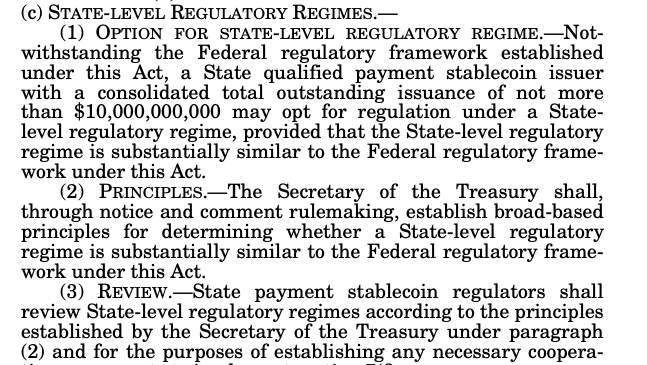
Excerpt from the GENIUS Act. Source: congress.gov
The requirement aims to level out regulatory approaches between states to make compliance by stablecoin issuers more seamless across jurisdictions, as issuers face a different set of rules and policies depending on each jurisdiction, with some states having a stricter approach to the industry while others have a more welcoming strategy.
Gavin Meyers, a financial services regulatory partner at Pierson Ferdinand LLP, told Bloomberg Law that “It creates a potential for less of a mosaic of state-by-state regulation, which kind of plagues other aspects of the financial industry,” asserting that “eliminating that barrier is a highly beneficial aspect of the committee.”
“There will be some wiggle room in states that have been more favorable to crypto generally, like Wyoming,” Meyers affirmed. Notably, Wyoming has passed over 45 pieces of crypto-related legislation since 2016, including a bill in 2023 that authorized a state commission to issue stablecoins pegged to the US dollar.
Moreover, it launched Frontier (FRNT), the US’s first state-issued stablecoin, on seven blockchains, including Ethereum, Solana, and Avalanche, on August 19. Nonetheless, “due to lingering regulatory hurdles, the token is not yet available to the public,” noted crypto journalist Eleanor Terrett on X.
The Importance Of Clear Frameworks
According to the Bloomberg Law report, the federal Committee is ready to “even out the state-by-state approach, curtailing stricter regulatory regimes or building upon permissive state frameworks.”
Rosemary Spaziani, a partner at Gibson Dunn & Crutcher LLP, told the news media outlet that “If 40 states all sign on to what the federal government does, those are going to be pretty simple rubber stamps—they’re going to adopt a model act and incorporate it into their laws,” while “the ones that deviate are probably going to be a bit of a bottleneck.”
Additionally, the companies hoping to enter the stablecoin sector will likely welcome federal oversight to avoid potential compliance issues. Meyers noted that “If you are licensed by whichever state that qualifies under the ‘GENIUS Act,’ that certification is good across the country.”
Recently, leading banking associations sent a joint letter to the US Senate Banking Committee calling for amendments to the GENIUS Act. The associations asked the lawmakers to address multiple “loopholes” in the landmark legislation, arguing that a clear regulatory framework is crucial for the digital assets market.
Among the recommendations, they urged the Committee to strengthen the prohibition on interest payments related to payment stablecoins and to repeal a section of the GENIUS Act that allows uninsured, out-of-state-chartered financial institutions to operate without the host states’ approval, which could complicate regulation.

Bitcoin's performance in the one-week chart. Source: BTCUSDT on TradingView

Related Posts