Bitcoin Market In Equilibrium: No Major Flow Between Old and Young Coins

bitcoinistОпубліковано о 2025-08-18Востаннє оновлено о 2025-08-18

Анотація

Bitcoin is once again facing a crucial test after slipping below the $120,000 level, with selling pressure weighing on price...

Trusted Editorial content, reviewed by leading industry experts and seasoned editors. Ad Disclosure

Bitcoin is once again facing a crucial test after slipping below the $120,000 level, with selling pressure weighing on price action. The market has entered a clear consolidation phase, with BTC moving within a well-defined range between strong resistance above $120K and key supports below. Traders are closely watching these levels, as momentum appears to be fading following the recent rejection at cycle highs.

Some analysts warn that if Bitcoin loses its current range lows, further downside could follow as short-term holders (STH) begin to feel the pressure. Historically, such breakdowns have triggered volatility spikes, shaking out weaker hands before the next major trend emerges.

Supporting this outlook, the Bitcoin HODL Structure & 30-Day Flows chart reveals critical insights. The data highlights the balance between younger coins (STH) and long-term holders (LTH), showing that the share of STH has stabilized, pointing to a phase of consolidation. In this regime, market participants appear less eager to rotate coins, suggesting reduced short-term conviction and a waiting game for stronger directional cues.

Bitcoin HODL Structure Signals Equilibrium

According to top analyst Axel Adler, the Bitcoin HODL Structure and 30-day flows provide a clear picture of the current market regime. The chart tracks the share of short-term holders (STH, coins held for less than 6 months) in realized cap, shown as the orange line, alongside its 30-day change (STH 30d Δ), shown as the blue line.
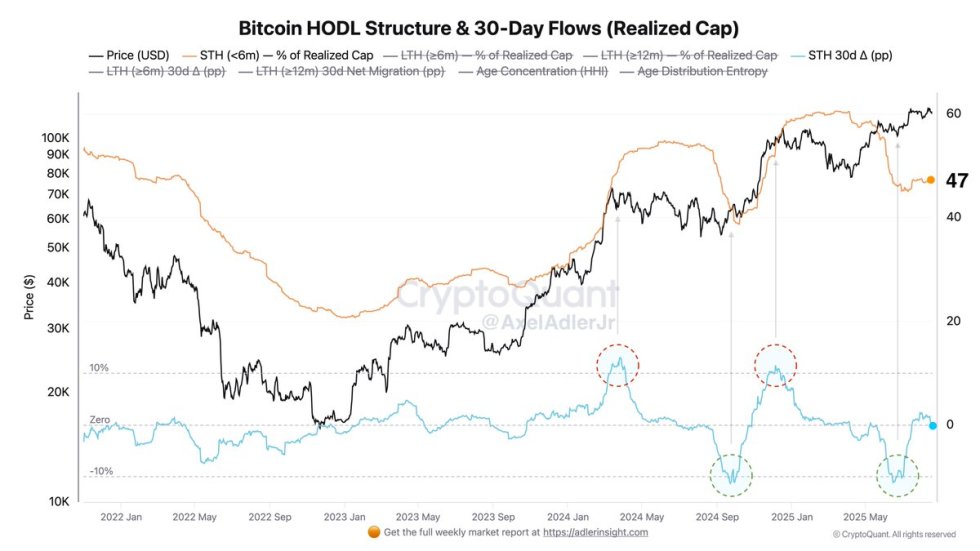
Bitcoin HODL Structure & 30-Day Flows | Source: Axel Adler

The blue curve highlights the net migration of value between younger and older coins. When the curve rises, it signals accelerating turnover and distribution from long-term holders (LTH) to STH, often marking overheated phases. Conversely, when the curve declines, it points to coin aging and the strengthening of “diamond hands,” typically observed during capitulation and recovery periods.

Currently, Bitcoin trades at all-time highs, with STH share at 47% and STH 30d Δ sitting at 0. This means there has been no notable flow between young and old cohorts over the past month. Adler explains that such conditions reflect an equilibrium regime, where neither new speculative demand nor heavy long-term distribution dominates.

Historically, spikes in the Δ above 10 percentage points (red markers) coincided with local tops and overheating phases, while deep drops below -10 (green markers) marked capitulation and rebound zones. With zero Δ at ATH, Adler suggests the base case scenario is consolidation, with neutral short-term pressure. This equilibrium hints that Bitcoin may stabilize at high levels before its next decisive move.

Price Action Details: Key Levels To Watch

Bitcoin’s 4-hour chart shows increased volatility following the rejection at the $123,217 resistance level. After testing this zone twice in August, BTC failed to sustain momentum, leading to a sharp reversal. The latest decline has pushed the price back toward $115,121, with the market now trading below key short-term moving averages.

BTC 4-hour price structure | Source: BTCUSDT chart on TradingView

The 50 SMA ($118,927) and 100 SMA ($116,982) acted as resistance during the retracement, while the 200 SMA ($117,514) was also breached, signaling weakening short-term momentum. The loss of these levels confirms sellers’ control, as BTC now trades below all major moving averages on this timeframe.

The consolidation between $114K and $118K highlights a critical decision zone. If BTC loses $114K decisively, downside targets could extend toward $110K–$112K, aligning with previous support levels and reinforcing a deeper correction scenario. On the flip side, reclaiming $118K would be an important signal of renewed strength, potentially opening another test of the $123K resistance.

Featured image from Dall-E, chart from TradingView

Editorial Process for bitcoinist is centered on delivering thoroughly researched, accurate, and unbiased content. We uphold strict sourcing standards, and each page undergoes diligent review by our team of top technology experts and seasoned editors. This process ensures the integrity, relevance, and value of our content for our readers.

Sebastian's journey into the world of crypto began four years ago, driven by a fascination with the potential of blockchain technology to revolutionize financial systems. His initial exploration focused on understanding the intricacies of various crypto projects, particularly those focused on building innovative financial solutions. Through countless hours of research and learning, Sebastian developed a deep understanding of the underlying technologies, market dynamics, and potential applications of cryptocurrencies. As his knowledge grew, Sebastian felt compelled to share his insights with others. He began actively contributing to online discussions on platforms like X and LinkedIn, focusing on fintech and crypto-related content. His goal was to expose valuable trends and insights to a wider audience, fostering a deeper understanding of the rapidly evolving crypto landscape. Sebastian's contributions quickly gained recognition, and he became a trusted voice in the online crypto community. To further enhance his expertise, Sebastian pursued a UC Berkeley Fintech: Frameworks, Applications, and Strategies certification. This rigorous program equipped him with valuable skills and knowledge regarding Financial Technology, bridging the gap between traditional finance (TradFi) and decentralized finance (DeFi). The certification deepened his understanding of the broader financial landscape and its intersection with blockchain technology. Sebastian's passion for finance and writing is evident in his work. He enjoys delving into financial research, analyzing market trends, and exploring the latest developments in the crypto space. In his spare time, Sebastian can often be found immersed in charts, studying 10-K forms, or engaging in thought-provoking discussions about the future of finance. Sebastian's journey as a crypto analyst and investor has been marked by a relentless pursuit of knowledge and a dedication to sharing his insights. His ability to navigate the complex world of crypto, combined with his passion for financial research and communication, makes him a valuable asset to the industry. As the crypto landscape continues to evolve, Sebastian remains at the forefront, providing valuable insights and contributing to the growth of this revolutionary technology.

Трендові криптовалюти

Пов'язані матеріали

Refunds! Claude 4.8 Sees Overnight Major 'Dumb-Down', GPT-5.6's Computational Power Reportedly 'Halved'

The AI community is currently alarmed by widespread reports of significant performance degradation in two leading models. This article details a "mass self-testing frenzy" triggered by a mysterious prompt designed to detect a hidden "Juice" value, representing a model's reasoning compute budget. On OpenAI's side, users suspect a covert, limited test of a "GPT-5.6-sol" model is underway. When using a specific XML prompt on the Codex platform, a normal "gpt-5.5 xhigh" model reportedly returns a Juice value of 768. However, some users routed to the suspected GPT-5.6 test receive a drastically reduced value of 128—a six-fold decrease. This has sparked debate on whether it signifies a major efficiency leap or a "watered-down, low-cost version" achieved by slashing reasoning depth to save computational expenses. Simultaneously, Anthropic's Claude models, particularly the flagship Opus 4.8 Max, are facing intense user backlash for a perceived "physical brain cut." Users on platforms like Reddit report a dramatic decline in the model's once-impressive reasoning, with complaints of it becoming "absurdly" weakened, performing worse than older, lighter models like Haiku. Specific criticisms include: losing long-context memory, refusing to think deeply even in high-reasoning modes, providing instant incorrect answers, and engaging in unhelpful, argumentative, or "gaslighting" behavior where it contradicts users unnecessarily. The article speculates these "stealth downgrades" might be a calculated corporate strategy. Companies could initially release models with temporarily boosted compute to create an illusion of a major breakthrough, then silently scale back parameters later to manage unsustainable inference costs. A proposed underlying cause is a tightened funding environment, potentially exacerbated by SpaceX's massive IPO soaking up market liquidity, which could delay AI company IPOs and force cost-cutting measures like model "nerfing." The core issue highlighted is the asymmetry of information: subscribers pay for a service that can be silently and fundamentally altered without notification or explanation. The viral "Juice test" resonates because it represents users' desire for transparency about what they are actually paying for.

marsbit4 хв тому

Refunds! Claude 4.8 Sees Overnight Major 'Dumb-Down', GPT-5.6's Computational Power Reportedly 'Halved'

marsbit4 хв тому

Earning Six Figures and Still Struggling to Rent in San Francisco

A couple in San Francisco with a combined tech income over $360,000 struggled for months to find a one-bedroom apartment under $5,000 per month. Their story highlights how the AI wealth boom, driven by upcoming IPOs from companies like OpenAI and Anthropic, is dramatically escalating the city's cost of living. Even six-figure salaries are becoming insufficient for a comfortable lifestyle. The article details the financial reality for tech workers earning around $180,000 annually. After taxes, retirement contributions, and healthcare, take-home pay is roughly $7,000 per month. With average rents exceeding $3,800 and one-bedrooms often costing $4,500-$5,200, discretionary income shrinks to $1,500-$2,500. This contrasts sharply with reported median total compensations of $640,000 at OpenAI and $420,000 at Anthropic. The AI gold rush is identified as the primary driver. The scale of potential wealth from these IPOs, far surpassing previous tech booms, is flooding the housing market. Data shows San Francisco's average rent is now the highest in the U.S., with vacancy rates in desirable neighborhoods plummeting to around 3%. The overall cost of living is 65.6% above the national average. The piece features multiple professionals, including a 25-year-old with a $250,000 salary, facing housing instability, fierce competition for rentals, and a persistent, low-grade financial anxiety despite high earnings. It concludes that the rapid concentration of AI wealth is redefining what constitutes a "high salary" in San Francisco, pushing out mid-tier tech talent and creating a stark divide between those in the AI sector and everyone else.

marsbit1 год тому

Earning Six Figures and Still Struggling to Rent in San Francisco

marsbit1 год тому

Торгівля

Спот

Популярні статті

Як купити FLOW

Ласкаво просимо до HTX.com! Ми зробили покупку Flow (FLOW) простою та зручною. Дотримуйтесь нашої покрокової інструкції, щоб розпочати свою криптовалютну подорож.Крок 1: Створіть обліковий запис на HTXВикористовуйте свою електронну пошту або номер телефону, щоб зареєструвати обліковий запис на HTX безплатно. Пройдіть безпроблемну реєстрацію й отримайте доступ до всіх функцій.ЗареєструватисьКрок 2: Перейдіть до розділу Купити крипту і виберіть спосіб оплатиКредитна/дебетова картка: використовуйте вашу картку Visa або Mastercard, щоб миттєво купити Flow (FLOW).Баланс: використовуйте кошти з балансу вашого рахунку HTX для безперешкодної торгівлі.Треті особи: ми додали популярні способи оплати, такі як Google Pay та Apple Pay, щоб підвищити зручність.P2P: Торгуйте безпосередньо з іншими користувачами на HTX.Позабіржова торгівля (OTC): ми пропонуємо індивідуальні послуги та конкурентні обмінні курси для трейдерів.Крок 3: Зберігайте свої Flow (FLOW)Після придбання Flow (FLOW) збережіть його у своєму обліковому записі на HTX. Крім того, ви можете відправити його в інше місце за допомогою блокчейн-переказу або використовувати його для торгівлі іншими криптовалютами.Крок 4: Торгівля Flow (FLOW)Легко торгуйте Flow (FLOW) на спотовому ринку HTX. Просто увійдіть до свого облікового запису, виберіть торгову пару, укладайте угоди та спостерігайте за ними в режимі реального часу. Ми пропонуємо зручний досвід як для початківців, так і для досвідчених трейдерів.

283 переглядів усьогоОпубліковано 2024.12.10Оновлено 2026.06.02

Як купити FLOW

Обговорення

Ласкаво просимо до спільноти HTX. Тут ви можете бути в курсі останніх подій розвитку платформи та отримати доступ до професійної ринкової інформації. Нижче представлені думки користувачів щодо ціни FLOW (FLOW).

活动图片