Cardano Founder Hails ‘Most Advanced Stablecoin Ever Built’

bitcoinistОпубліковано о 2025-08-01Востаннє оновлено о 2025-08-01

Анотація

Cardano founder Charles Hoskinson has intensified the ecosystem’s push into regulated, privacy-preserving digital dollars, declaring on July 31 that “Moneta’s...

Trusted Editorial content, reviewed by leading industry experts and seasoned editors. Ad Disclosure

Cardano founder Charles Hoskinson has intensified the ecosystem’s push into regulated, privacy-preserving digital dollars, declaring on July 31 that “Moneta’s USDM is becoming the most advanced stablecoin ever built.” The remark, posted on X, came in the wake of a multi-day workshop in Buenos Aires that he said was “making progress on the first Private Stablecoin.”

Hoskinson’s endorsement dovetailed with a dense technical thread from Cardano developer Andrew Westberg that sketched how a privacy-enabled dollar could satisfy enterprise and legal requirements without turning public ledgers into open books. “The stablecoin is a small but important piece of the discussion in Argentina. That being said, the complexity is 10x to 20x that of USDM,” he wrote.

Why Cardano’s USDM Is A Next-Gen Stablecoin

Westberg walked the community through a role-based access model that would let a payroll recipient see only their own payment, an accountant see amounts without personal details, a CFO view the whole, and a court-ordered investigator gain full transparency during discovery. “Really cool tech, but it is a cambrian explosion of complexity to build out something where blockchain can truly eclipse and replace tradfi systems for the first time,” Westberg said.

Those comments follow months of public positioning by Input Output Global’s partner-chain Midnight, a zero-knowledge (“rational privacy”) network designed to let developers program selective disclosure and meet regulatory obligations while shielding counterparties and amounts. Midnight describes its approach as “programmable data protection” for enterprise-grade applications, with smart contracts written in a TypeScript-based language called Compact.

What Hoskinson hailed and what Westberg described are two closely related tracks. On Cardano’s base layer, Moneta Digital LLC issues USDM as a fiat-backed, regulated stablecoin. Moneta identifies itself as a US Money Services Business regulated at the federal level by FinCEN and relevant state authorities, and says reserves are held in bank deposits and money market funds managed by Fidelity and Western Asset Management.

Moneta also opened retail minting with a $1,000 minimum, a stated $0 minting fee, and availability in 19 US states, reflecting the incremental nature of state licensing. As of press time, DeFiLlama shows roughly $12 million USDM in circulation on Cardano.

In parallel, a privacy-preserving instrument is being built for Midnight. An X account branded “ShieldUSD” describes itself as a “fiat-backed privacy stablecoin on @MidnightNtwrk … issued by Moneta Digital LLC @USDMOfficial [and] built by @W3iSoftware,” the development studio where Westberg serves as CTO. While branding and final product details remain in flux, the direction is clear: a fiat-backed dollar with granular permissions that lives natively on a privacy chain and interoperates with public ledgers.

The core design debate—sparked by Westberg’s thread and community replies—turns on whether such complexity is overkill relative to today’s public stablecoins or the prerequisite for real-world finance to migrate on-chain. One respondent argued that USDC would be a “better fit” and that use cases for privacy coins without “government level integrations” are limited. Westberg countered bluntly: “Usdc is not capable of any of the above requirements. Everything it does is public.” He pointed to use cases beyond enterprise payroll—such as paying a public utility where the payer’s identity remains private while the public dataset is anonymized, or compliant remittances that disclose to a verifier only that the receiver is not in a sanctioned country.

Crucially, the privacy layer appears scoped to Midnight. Westberg and subsequent coverage have noted that once assets move off Midnight to public chains, users “lose the privacy,” even if the instrument remains interoperable with other stablecoins for liquidity or settlement. That trade-off—private by default where needed, public when bridged—tracks with Midnight’s own “selective disclosure” model and may reassure regulators that investigatory access can be granted “with a court order,” as Westberg’s payroll example emphasized.

Hoskinson’s choice of Buenos Aires as a backdrop is not incidental. Argentina has been a recurring stage for Cardano’s governance and adoption rhetoric, and for Hoskinson’s advocacy of “private money” that mimics the transactional privacy of cash while remaining auditable under law. The Buenos Aires workshop, framed by him as a milestone on the path to a “first Private Stablecoin,” underscores a push to marry compliance and confidentiality in a jurisdiction where inflation and dollarization have made stablecoins part of everyday economic life.

For Moneta and Cardano, the near-term milestones are prosaic but vital: expanding licensed jurisdictions, growing USDM’s fiat reserves and on-chain supply, integrating with Cardano DeFi venues, and, if the Midnight instrument launches as envisioned, proving that programmable privacy can slot into familiar workflows—payroll, bill payment, remittances—without recreating shadow banking on a blockchain. The longer-term test is market acceptance. USDM’s circulating supply—still modest relative to incumbents—will need to scale, and the privacy variant will need to demonstrate that role-based visibility and regulator-friendly access controls can survive contact with real compliance departments.

For now, the public signal from Cardano’s founder is unequivocal. “Moneta’s USDM is becoming the most advanced stablecoin ever built,” he wrote. The rest of the ecosystem—developers, enterprises, regulators, and users—will determine whether the architecture emerging on Midnight and Cardano can earn that superlative in production rather than in principle.

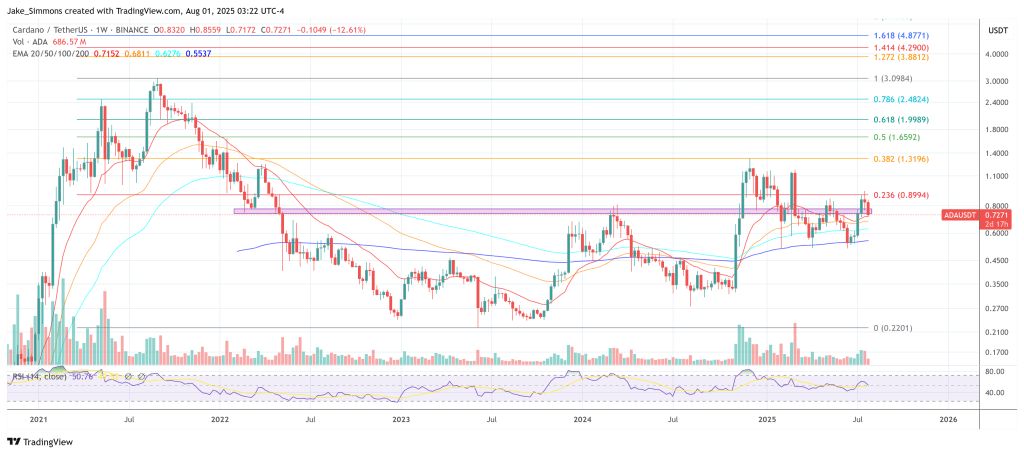
At press time, Cardano (ADA) traded at $0.72.
Cardano price
Cardano dips below key support, 1-week chart | Source: ADAUSDT on TradingView.com
Featured image created with DALL.E, chart from TradingView.com
Editorial Process for bitcoinist is centered on delivering thoroughly researched, accurate, and unbiased content. We uphold strict sourcing standards, and each page undergoes diligent review by our team of top technology experts and seasoned editors. This process ensures the integrity, relevance, and value of our content for our readers.

Jake Simmons has been a Bitcoin enthusiast since 2016. Ever since he heard about Bitcoin, he has been studying the topic every day and trying to share his knowledge with others. His goal is to contribute to Bitcoin's financial revolution, which will replace the fiat money system. Besides BTC and crypto, Jake studied Business Informatics at a university. After graduation in 2017, he has been working in the blockchain and crypto sector. You can follow Jake on Twitter at @realJakeSimmons.

Трендові криптовалюти

Пов'язані матеріали

Stablecoins Are the 'Royalists' of the Crypto World: Open USD Brings the Old Monetary System into the Fray

Title: Stablecoins Are the "Royalists" of the Crypto World: Open USD Brings the Old Monetary System into the Fray The article analyzes the launch of Open USD, a new dollar-pegged stablecoin backed by a coalition of over 140 traditional financial, payment, and tech giants like Visa, BlackRock, and Google. Author Hu Yilin argues that stablecoins like Open USD represent not a "moderate" wing of the crypto revolution, but a "royalist reform" within the old monetary system. He posits that while stablecoins adopt blockchain's efficiency, programmability, and borderless nature, they fundamentally reinforce the US dollar's centrality and the Federal Reserve's authority. They aim to replace inefficient "bureaucrats" (like traditional payment networks) rather than challenge the "monarch" (the dollar-based system). Thus, Open USD symbolizes the old system co-opting blockchain technology to upgrade dollar hegemony, potentially marginalizing native crypto projects like Circle's USDC. Hu contrasts this with more revolutionary paths, like a "Bitcoin standard," which seeks to change the monetary base itself. He warns that if the crypto ecosystem's unit of account, collateral, and value anchor remain dollar-denominated stablecoins,链上繁荣 may enrich the traditional financial system ("off-chain") rather than granting monetary premium to native crypto assets like ETH. Projects with civilizational ambitions, he argues, cannot reduce their narrative to mere "fuel" or transaction fees but must grapple with the core revolutionary idea: that a decentralized market does not require a central bank as the anchor of monetary order.

marsbit28 хв тому

Stablecoins Are the 'Royalists' of the Crypto World: Open USD Brings the Old Monetary System into the Fray

marsbit28 хв тому

Standard Chartered Takes Over USDC Onboarding; Circle Cedes Control for Scale

Standard Chartered and Circle have announced a partnership where institutional clients can now mint and redeem USDC directly through Standard Chartered's existing banking infrastructure, eliminating the need for separate accounts with Circle. Initially launching in the Dubai International Financial Centre (DIFC), this service represents the first time a Global Systemically Important Bank (G-SIB) is offering such direct, integrated access. This move effectively "translates" USDC into a standard banking option, opening the door for major institutional capital like pension funds and sovereign wealth funds that require the trust, compliance, and risk frameworks of a major bank. For Circle, this is a strategic trade: ceding some direct client relationships to leverage Standard Chartered's vast distribution network, thereby potentially massively scaling USDC's circulation and its core interest revenue model. For Standard Chartered, it's a chance to offer a new digital asset service without building the underlying stablecoin infrastructure. The partnership signals a significant shift in the stablecoin narrative. Rather than bypassing traditional finance, stablecoins are becoming integrated into it, with major banks like Standard Chartered positioning themselves at the crucial entry point. The focus is moving from legitimizing stablecoins to determining how value and pricing power will be distributed among issuers, banking channels, and regulatory frameworks in this new, converging landscape.

marsbit3 год тому

Standard Chartered Takes Over USDC Onboarding; Circle Cedes Control for Scale

marsbit3 год тому

Торгівля

Спот

Популярні статті

Як купити ADA

Ласкаво просимо до HTX.com! Ми зробили покупку Cardano (ADA) простою та зручною. Дотримуйтесь нашої покрокової інструкції, щоб розпочати свою криптовалютну подорож.Крок 1: Створіть обліковий запис на HTXВикористовуйте свою електронну пошту або номер телефону, щоб зареєструвати обліковий запис на HTX безплатно. Пройдіть безпроблемну реєстрацію й отримайте доступ до всіх функцій.ЗареєструватисьКрок 2: Перейдіть до розділу Купити крипту і виберіть спосіб оплатиКредитна/дебетова картка: використовуйте вашу картку Visa або Mastercard, щоб миттєво купити Cardano (ADA).Баланс: використовуйте кошти з балансу вашого рахунку HTX для безперешкодної торгівлі.Треті особи: ми додали популярні способи оплати, такі як Google Pay та Apple Pay, щоб підвищити зручність.P2P: Торгуйте безпосередньо з іншими користувачами на HTX.Позабіржова торгівля (OTC): ми пропонуємо індивідуальні послуги та конкурентні обмінні курси для трейдерів.Крок 3: Зберігайте свої Cardano (ADA)Після придбання Cardano (ADA) збережіть його у своєму обліковому записі на HTX. Крім того, ви можете відправити його в інше місце за допомогою блокчейн-переказу або використовувати його для торгівлі іншими криптовалютами.Крок 4: Торгівля Cardano (ADA)Легко торгуйте Cardano (ADA) на спотовому ринку HTX. Просто увійдіть до свого облікового запису, виберіть торгову пару, укладайте угоди та спостерігайте за ними в режимі реального часу. Ми пропонуємо зручний досвід як для початківців, так і для досвідчених трейдерів.

1.0k переглядів усьогоОпубліковано 2024.12.10Оновлено 2026.06.02

Як купити ADA

Обговорення

Ласкаво просимо до спільноти HTX. Тут ви можете бути в курсі останніх подій розвитку платформи та отримати доступ до професійної ринкової інформації. Нижче представлені думки користувачів щодо ціни ADA (ADA).

活动图片