US Treasury Officially Removes Controversial Biden-Era Crypto Broker Reporting Rules

bitcoinistОпубліковано о 2025-07-12Востаннє оновлено о 2025-07-12

Анотація

The US Department of the Treasury and the Internal Revenue Service (IRS) have formally scrapped a controversial crypto rule that...

Trusted Editorial content, reviewed by leading industry experts and seasoned editors. Ad Disclosure

The US Department of the Treasury and the Internal Revenue Service (IRS) have formally scrapped a controversial crypto rule that would have mandated decentralized exchanges to comply with broker reporting obligations.

US Treasury, IRS Drop Crypto Broker Rule

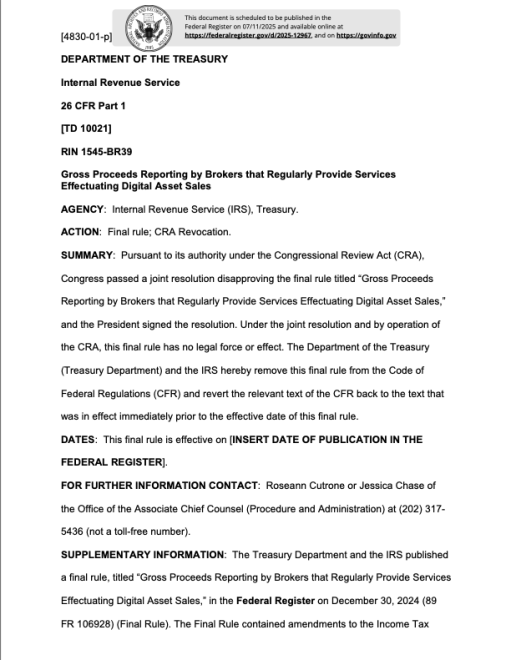
On Thursday, the US Department of the Treasury and the IRS officially revoked the crypto broker rules that required decentralized exchanges and protocols to report detailed customer data to the tax agency.

The rule was originally proposed in November 2021 through the Infrastructure Investment and Jobs Act, aiming to close the “tax gap” by broadening the definition of “brokers” to include crypto exchanges and other intermediaries.
crypto

The US Treasury and IRS revoke controversial crypto broker reporting rule. Source: Federal Register

At the end of the Biden administration, the IRS finalized the rule, expanding the definition of a “broker” while requiring DeFi platforms to report proceeds from digital asset transactions and detail user transaction information, including names and addresses.

As reported by Bitcoinist, the regulation was set to take full effect in 2027 but faced heavy criticism. Industry players considered the policy to be “unworkable” and an overreach, noting that the “arbitrary” definition of a “broker” was too broad, and many market participants didn’t have access to the data the agency was requesting.

In March, Congress passed a joint resolution under the Congressional Review Act (CRA) disapproving of the final rule. The resolution, titled “Gross Proceeds Reporting by Brokers that Regularly Provide Services Effectuating Digital Asset Sales,” was signed by President Donald Trump in April, becoming the first crypto bill signed by a US president.

Starting July 11, 2025, this crypto broker rule has no legal force or effect, as the Treasury Department and the IRS have removed it from the Code of Federal Regulations (CFR) and reverted the relevant text of the CFR to the text that was in effect before the final rule.

The federal agencies noted that the CFR change was made to reflect the accomplishments already achieved through congressional and presidential action. “Accordingly, the Treasury Department and the IRS are not soliciting comments on this action, nor are they delaying the effective date,” the revocation reads.

Shift From Biden-Era Regulation

The rule’s removal follows the regulatory shift under President Trump, who has vowed to turn America into the “crypto capital of the world.” Amid this process, other federal agencies have revoked other Biden-era rules and guidance.

In May, the US Department of Labor (DOL) rescinded its 2022 guidance, which discouraged fiduciaries from including digital asset investments in 401(k) retirement plans. The direction, issued in March 2022, followed Biden’s executive order that required the government to assess the risks and benefits of digital assets.

“We’re rolling back this overreach and making it clear that investment decisions should be made by fiduciaries, not DC bureaucrats,” US Secretary of Labor Lori Chavez-DeRemer explained.

In June, the US Federal Reserve (Fed) announced it had updated its approach to bank examinations to remove “reputational risk” from its guidelines, easing crypto firms’ access to traditional banking.

Meanwhile, the Securities and Exchange Commission (SEC) and the Department of Justice (DOJ) have disbanded their crypto enforcement-focused units and changed their long-criticized “regulation by enforcement” approach.

Notably, Congress is also working to advance the highly anticipated crypto framework, pushing for approval of the stablecoin bill, the GENIUS Act, and the market structure legislation, the CLARITY Act, which will be the focus during the upcoming “Crypto Week.”
crypto, bitcoin, btc, btcusdt

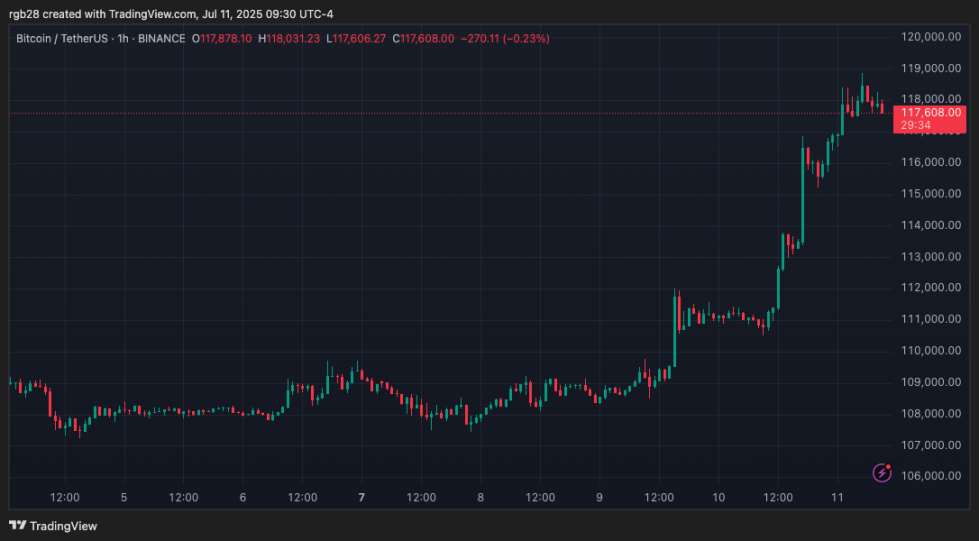
Bitcoin (BTC) trades at $117,608 in the one-week chart. Source: BTCUSDT on TradingView
Featured Image from Unsplash.com, Chart from TradingView.com
Editorial Process for bitcoinist is centered on delivering thoroughly researched, accurate, and unbiased content. We uphold strict sourcing standards, and each page undergoes diligent review by our team of top technology experts and seasoned editors. This process ensures the integrity, relevance, and value of our content for our readers.

Rubmar is a crypto enthusiast who likes learning and improving constantly. She enjoys reporting on the latest news and developments in the crypto industry. Rubmar also enjoys scrapbooking, crafting, simulation games, and watching football.

Пов'язані матеріали

Ethereum Sheds Its Load? What Ethereum Supporters Think About the Lean Ethereum Upgrade and the Future Market

Ethereum is back in focus with the announcement of the "Lean Ethereum" upgrade roadmap, described by Vitalik Buterin as Ethereum's third major update. This proposal aims to fundamentally redesign the consensus, data, and execution layers from first principles, striving to make Ethereum **simpler, more secure (quantum-resistant), more verifiable, and more scalable.** The announcement comes amidst a broader restructuring within the ecosystem, including a 20% staff reduction at the Ethereum Foundation and the emergence of new organizations like EthLabs. This has sparked a debate among Ethereum supporters ("E-bizens"). **Optimists** view Lean Ethereum as a critical refocusing on core protocol fundamentals: * **sassal.eth** calls it the ultimate bullish catalyst, envisioning a future where running a node is so lightweight it could be done on a smartwatch, greatly enhancing decentralization. * **Ryan Sean Adams** sees it as Ethereum moving from "narrative expansion" to "protocol hardening," addressing long-term foundational issues like security and scalability. * Analysts like **BITWU** and **蓝狐 (Blue Fox)** frame it as a third-phase evolution towards a "minimal, durable, and credible base layer" designed for the next decade. * **gigi发财猪** interprets the organizational changes as Ethereum "shedding old baggage and forming new teams" for a lighter, more agile approach. * **Xiyu** notes that the roadmap itself provides a much-needed new narrative for market sentiment recovery. **Cautious voices** acknowledge the vision but emphasize execution and market timing: * **Ignas** warns that while the roadmap addresses key community requests, it overlooks tokenomics, and competitors are gaining ground in areas like RWA. Timely delivery is crucial; delays could be bearish. * **Dankrad Feist**, a former Ethereum Foundation researcher, agrees on direction but criticizes the proposed 3-4 year timeline as too slow for the current market pace, especially with AI-aided development available. **In summary,** optimists believe Lean Ethereum reaffirms Ethereum's long-term value proposition as a decentralized world computer, while the cautious argue that its success hinges on faster delivery and tangible results to maintain market relevance. Despite ongoing criticism, the move signals Ethereum's effort to regroup and reclaim initiative at the protocol level.

marsbit30 хв тому

Ethereum Sheds Its Load? What Ethereum Supporters Think About the Lean Ethereum Upgrade and the Future Market

marsbit30 хв тому

AI Folding: Fable 5 and GPT-5.6 Are Becoming the Privilege of a Few

【AI Accessibility Gap Widens: Elite Tools Like Fable 5 and GPT-5.6 Are Becoming Privileged】 We are witnessing a growing "AI divide." A stark reality is emerging: a tiny fraction of elites, primarily in tech, are using powerful next-generation models like Fable 5 or the upcoming GPT-5.6, while the vast majority of the public only has access to "toys" - free, limited models equivalent to ChatGPT's basic versions (8B to 30B parameters). This creates a massive experiential chasm and cognitive dissonance. Industry outsiders see AI as overhyped and ineffective, unable to grasp its transformative potential, while insiders leverage these advanced models for a decisive competitive edge. The gap isn't just about model quality but product functionality. Free users get a simple chatbot. Paying elites get integrated workflow systems—capable of creating specialized agents, processing complex data, and handling real-world tasks like management, coding, and planning. Demos showcasing AI planning weddings or building apps feel disconnected from everyday needs like managing bills, groceries, or health. The cost barrier is immense, with reports of engineers spending $1000 daily on Fable 5 inference. Elite users employ sophisticated multi-model workflows, combining different AIs for ideation, architecture, execution, and review, completing complex projects in minutes instead of weeks. This divide extends to critical areas like healthcare, where free models are dangerously unreliable for medical queries. However, some argue that for 90% of common business tasks, mid-tier models like GPT-5.5 are sufficient; the perceived limitation often stems from poor integration and lack of context, not model intelligence. Ultimately, unequal access to cutting-edge AI is creating a new form of social stratification, where the most powerful tools are becoming the exclusive privilege of a few.

marsbit1 год тому

AI Folding: Fable 5 and GPT-5.6 Are Becoming the Privilege of a Few

marsbit1 год тому

Cathie Wood's June $77M Investment: Are Crypto Stocks a True 'Substitute' for Bitcoin?

In June, Cathie Wood's ARK Invest purchased $77 million worth of publicly traded crypto-related stocks, including Coinbase, Circle, and Bullish, during Bitcoin's worst monthly performance in four years. This aligns with the investment thesis that such stocks offer a compliant way to gain exposure to the crypto cycle without directly holding Bitcoin. However, data analysis reveals significant drawbacks. A group of nine U.S.-listed crypto companies showed 30-day annualized realized volatility between 68% and 90%, nearly double Bitcoin's 37.6%. Over 90 days, Circle's volatility reached 103.6% versus Bitcoin's 37.8%. Drawdowns were also more severe for stocks like Circle (-51.4%) and MicroStrategy (-48.6%) compared to Bitcoin's -36.4% from its January high. Correlation analysis shows most stocks share only a moderate link to Bitcoin. For example, Circle, Robinhood, and Bullish have a 90-day correlation coefficient of just 0.55–0.58 with BTC, meaning only about one-third of their price movement is explained by Bitcoin's action. The rest stems from company-specific risks: earnings, competition, fundraising, and equity dilution. MicroStrategy (MSTR) is the notable exception, acting as a leveraged Bitcoin proxy with a beta of 1.59 and 0.85 correlation. Coinbase offers relatively balanced exposure. Circle exemplifies "crypto-wrapped" corporate risk, with its recent crash tied to stablecoin competition, not Bitcoin. Robinhood's diversified business insulates it from crypto downturns but also limits upside. Bitcoin miners like RIOT and MARA have posted significant gains year-to-date, driven primarily by their pivot to AI compute services, not Bitcoin's price. The article highlights that investing in crypto stocks often means accepting amplified volatility or layering on business-specific risks absent from direct Bitcoin ownership. For instance, MicroStrategy's recent challenges—its market value falling below its Bitcoin holdings (mNAV <1) and facing potential Bitcoin sales for liquidity—demonstrate equity-specific hazards like dilution and financing pressures not faced by a direct Bitcoin holder. ARK's buying spree represents a bet on a basket of different business models with varying crypto exposure, not a simple, lower-risk substitute for holding Bitcoin.

marsbit1 год тому

Cathie Wood's June $77M Investment: Are Crypto Stocks a True 'Substitute' for Bitcoin?

marsbit1 год тому

Crypto Welcomes the 'July Rebound'? On-Chain Bottom Signals Align, Reversal Still Requires Breakthrough Above $70k

The cryptocurrency market is showing signs of a potential "July rebound," with Bitcoin leading a recovery above $63,000 and total market cap rising. This bounce is attributed to improved macro expectations (weaker US jobs data easing Fed hike fears), a short squeeze in derivatives, and signs of whale accumulation. Key on-chain metrics signal a potential bottom, including the Sharpe Ratio hitting extreme lows, the AHR999 index nearing historic buy zones, and miner pressure reaching significant levels. However, analysts caution this is likely a corrective rebound rather than a confirmed trend reversal. Persistent challenges include weak spot demand, negative Coinbase Premium indicating institutional caution, and ongoing selling pressure in the altcoin market. Market sentiment remains in "extreme fear" territory, and the AVIV ratio suggests the average active Bitcoin investor is still at a loss. For a true bullish reversal, Bitcoin needs to convincingly break above the key $70,000 level (aligned with the Short-Term Holder Realized Price). The path to a new parabolic bull market is seen as dependent on attracting substantially more capital, as capital efficiency has declined. While prices may be approaching a cyclical bottom zone (with estimates between $37k-$60k), the market requires more sustained positive signals for a definitive uptrend.

marsbit1 год тому

Crypto Welcomes the 'July Rebound'? On-Chain Bottom Signals Align, Reversal Still Requires Breakthrough Above $70k

marsbit1 год тому

Торгівля

Спот
活动图片