Биткоин получил недостаточно внимания СМИ во втором квартале

cryptonews.ruОпубліковано о 2025-03-09Востаннє оновлено о 2025-07-09

Согласно исследованию Perception, крупные новостные издания The Wall Street Journal, Financial Times и The New York Times опубликовали всего 13 статей о биткоине во втором квартале.

Аналитическая компания Perception заявила, что освещение биткоина и криптовалют в основных СМИ во втором квартале было поляризованным и недостаточным, несмотря на достижение криптовалютой исторического максимума.

Согласно отчету, опубликованному во вторник, 18 крупных СМИ выпустили в общей сложности 1 116 статей во втором квартале, что выявило «глубоко поляризованный нарратив» в освещении цифровых активов.

В отчете не проводилось прямых сравнений с предыдущими кварталами, но отмечалось «резкое расхождение в тональности» между изданиями: 31% публикаций были позитивными, 41% — нейтральными и 28% — негативными.

Исследование выявило особенно слабое освещение темы в «элитных финансовых изданиях». The Wall Street Journal от News Corp опубликовал всего две статьи о биткоине, в то время как Financial Times и The New York Times вместе выпустили 11 материалов.

На эти три издания пришлось лишь 2% всего медийного освещения биткоина и криптовалют во втором квартале.

Три нарратива СМИ о биткоине

Perception выделила три основных подхода к освещению биткоина в крупных СМИ, которые во многом зависели от степени «редакционной слепоты установочных изданий».

Три нарратива включали «освещение с энтузиазмом» (Forbes и CNBC), «сознательное игнорирование» (The Wall Street Journal и Financial Times) и «устойчивый скептицизм» (традиционные СМИ).

Финансовые СМИ с большим объемом публикаций, такие как Forbes, CNBC и Barron’s от News Corp, заполнили вакуум, оставленный ведущими финансовыми изданиями, в то время как традиционные новостные агентства концентрировались на преступлениях и скандалах.

Различия в тематике криптовалют

Исследование также выявило значительные различия в тематическом охвате криптоиндустрии.

Forbes уделял основное внимание розничному и институциональному внедрению, а также майнингу биткоина. CNBC сосредоточился на банковском секторе, финансовом анализе и инвестиционных инструментах.

Fortune активно освещал майнинг, банковскую сферу и рыночный анализ, в то время как Fox News делал акцент на преступлениях, юридических аспектах и кибербезопасности.
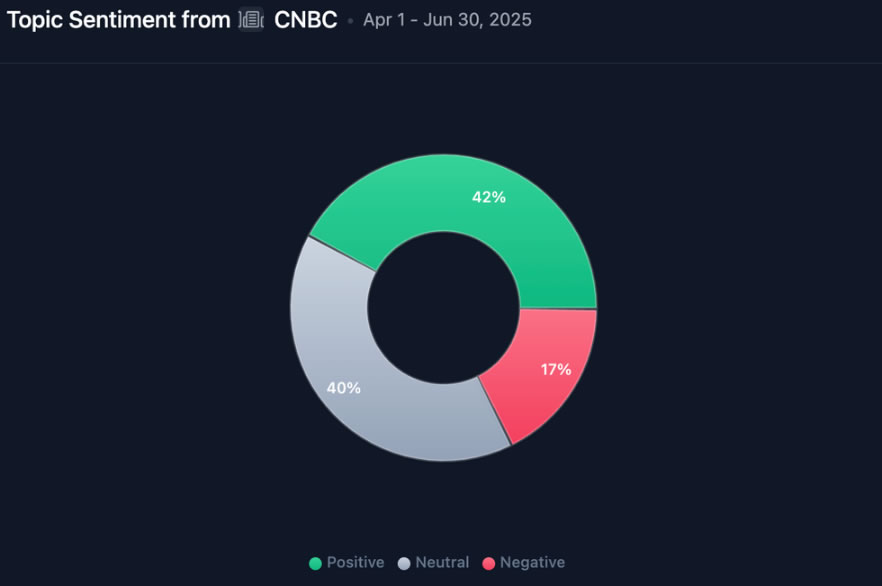

Тональность публикаций CNBC, выпустившего 141 статью о биткоине во втором квартале. Источник: Perception

Информационная асимметрия оставляет читателей в неведении

В отчете сделан вывод, что такой дисбаланс создает значительную «информационную асимметрию».

Инвесторы, полагающиеся на элитные финансовые СМИ для рыночной аналитики, оказываются «систематически недостаточно информированными» о новом трансформационном классе активов.

В итоге получается довольно парадоксальная ситуация. С одной стороны, биткоин достиг рекордных значений и стал глобальным финансовым феноменом, а с другой — ведущие СМИ демонстрируют либо настороженность, либо полное равнодушие.


Пов'язані матеріали

BIT Research: The 2028 Halving Is Not the End, the Real Shake-Up of the Bitcoin Mining Industry Is Just Beginning

The Bitcoin mining industry is undergoing its most complex structural adjustment since inception. Despite Bitcoin's price holding near $61,000 and the network hash rate approaching a record 1 ZH/s, miner profitability is deteriorating. The industry is operating close to its breakeven point, with the 2028 halving expected to accelerate consolidation. The challenges extend beyond the halving's subsidy reduction; the industry's revenue model has yet to successfully transition towards a fee-driven structure. Increasingly, mining companies are evolving from simple Bitcoin producers into infrastructure and energy operators, including providers of AI/HPC computing power. Competition is shifting from pure hash rate expansion to business model upgrades. Economic pressure is evident. The theoretical daily mining revenue at current prices is around $78 million, yet the actual figure is only about $33 million—a 136% gap. Transaction fees remain low at roughly $220k daily, far below historical implied levels. With a current estimated industry-wide breakeven price near $65,000, mining alone is struggling to generate ideal profits. The 2028 halving is projected to push the fundamental production cost floor to approximately $93,289. This will likely accelerate a shift towards consolidation among larger, well-capitalized miners with diversified revenue streams. Competitive advantage will belong to institutionalized players with access to low-cost energy, AI/HPC hosting operations, and stronger balance sheets. In essence, Bitcoin mining is transitioning from a "mining business" to an "infrastructure business." Future profitability and resilience will depend less on block rewards and more on diversified income sources like energy management and computational infrastructure services. For investors, the key question is not the halving itself, but which miners can successfully navigate this business model transformation.

marsbit24 хв тому

BIT Research: The 2028 Halving Is Not the End, the Real Shake-Up of the Bitcoin Mining Industry Is Just Beginning

marsbit24 хв тому

This is How God Karpathy Uses Claude?

Andrej Karpathy, a prominent figure in AI, has reportedly joined Anthropic, leading to a noticeable decrease in his open-source contributions and social media activity. A document claiming to be his personal "CLAUDE.md" file—a set of instructions for the Claude AI to follow within a specific codebase—has been circulating online. While its authenticity is unverified, the content aligns closely with Karpathy's publicly shared principles on effective AI-assisted programming. The document outlines key rules for AI coding assistants, emphasizing the importance of reading existing code thoroughly before writing new code to maintain consistency. It advises against over-engineering, advocating for simple, surgical modifications that match the project's existing style. Other guidelines include clarifying assumptions upfront, writing meaningful tests, thoughtful debugging, and carefully considering dependencies. The core message is that these principles help prevent common AI coding failures, such as introducing unnecessary abstractions, style drift, or making invisible architectural decisions. The community has noted that even experts like Karpathy require detailed instructions to guide AI effectively, akin to managing a junior developer. A related GitHub repository, "andrej-karpathy-skills," which encapsulates these ideas, is reported to significantly reduce Claude's code error rate. Ultimately, the advice stresses that the best CLAUDE.md is tailored to one's own tech stack and coding practices.

marsbit25 хв тому

This is How God Karpathy Uses Claude?

marsbit25 хв тому

Торгівля

Спот
活动图片