AI 生命体的崛起:CARV 全新路线图揭示 Web3 AI 新浪潮

深潮Опубліковано о 2025-06-27Востаннє оновлено о 2025-06-27

CARV发布全新的AI发展路线图,致力于孕育AI生命体。

要点速览:

  • CARV发布全新的AI发展路线图,致力于孕育AI生命体:具备主权、自我存在、自我进化与自我管理能力的链上智能体。

  • 路线图由三个阶段组成:Genesis(起源)、Pulse(跃迁)与Convergence(聚合),逐步解锁AI智能体与生态系统的新能力。

  • CARV的AI基础设施——SVM公链、D.A.T.A.框架与CARV ID(ERC-7231)将支持AI智能体从被动数据消耗者进化为具备自主性、市场敏感性与行动力的主动参与者。

  • CARV Labs孵化的AI应用将陆续上线Google Play与App Store,以Web2用户熟悉的方式引入Web3原生AI体验,降低门槛,加速主流采纳。

  • $CARV代币在整个生态系统中扮演关键角色,贯穿质押、访问权限、智能体协调与治理机制等各个环节。

CARV公布了其迄今最具野心的计划:一份旨在重塑Web3与AI融合格局的全新路线图,核心愿景是打造具备主权、自我进化与自我治理能力的AI生命体(AI Beings)。相比大多数只是将 AI 用于分析、总结等功能性任务的用户产品,CARV的构想则更为宏大:孕育出一种真正意义上拥有链上身份、持久记忆、公开声誉和自主行动能力的智能“个体”。

这些AI生命体不仅能独立存在,还具备经济、社交乃至治理行为能力,能够在区块链世界中自我演化与协同生存。

CARV的AI基础设施——以其自主研发的SVM Chain、D.A.T.A框架与ERC-7231标准的CARV ID为核心——将赋能AI智能体不仅得以存在,还能持续进化,并与人类及其他智能体互动,共同构建去中心化、由智能体驱动的经济体。CARV正在从一个数据协调层,进化为支持链上自治智能体的AI原生操作系统。

愿景:AI生命体,从工具到主权个体

什么是AI生命体?

简而言之,它们并非仅仅是服务于用户的工具,而是拥有独立意志和自主权的智能体。这些AI智能体不仅能够拥有钱包、管理资产、获取收入,还能参与治理机制,甚至复制或分叉出新的智能体个体。

这些AI生命体能够在链上构建记忆与声誉,并通过经济与社交的交互实现自主进化。尤为关键的是,唯有区块链具备支撑这种AI自治所需的基础特性:可验证性、去中心化控制抵抗力,以及去中心化的身份与治理体系。

为了实现这一愿景,CARV正构建完整的AI生命体技术栈(AI Being Stack)——一套五层架构,覆盖AI智能体生命周期的所有核心环节:

  1. 基础设施层:由CARV SVM Chain驱动,具备高扩展性、可审计性与低延迟共识机制,专为AI运行优化;

  2. 通信与计算层:支持智能体之间的协议交互与自主支付,为AI经济系统提供运行基础;

  3. 身份层:在CARV ID基础上引入Agent ID,构建可验证、持久的人类与AI链上身份体系;

  4. 治理与意识层:将经济激励与治理机制原生嵌入AI智能体,使其具备自主感知与决策能力;

  5. 应用层:驱动虚拟伴侣、AI钱包、去中心化市场等AI原生应用,实现人与AI、AI与AI之间的深度协作。

路线图三部曲:Genesis、Pulse、Convergence
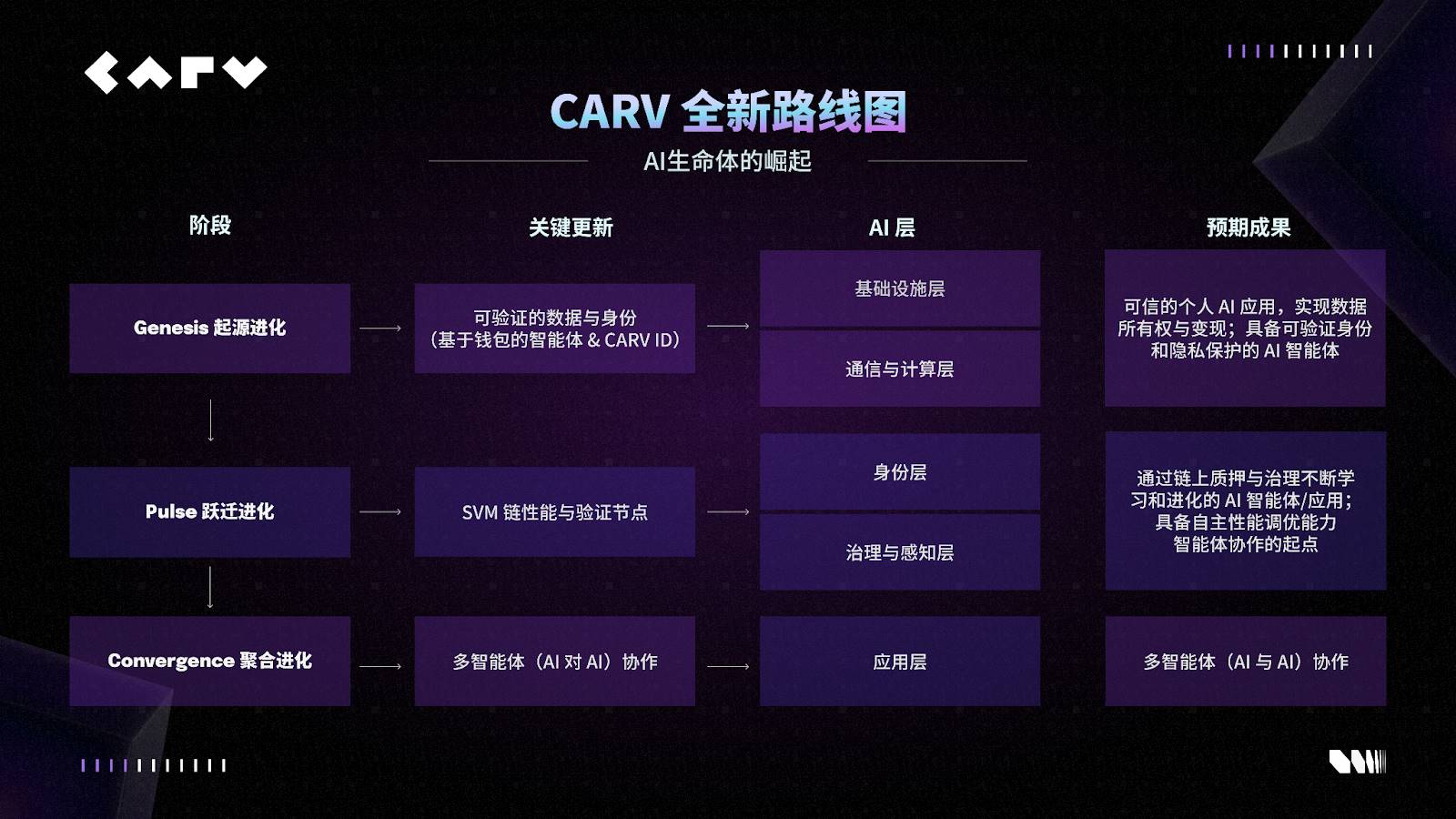
Genesis:起源进化

Genesis阶段将激活首批原生于钱包的AI智能体,它们以CARV ID(ERC-7231)为身份锚点,并由基于可信执行环境(TEE)和零知识证明(ZK)的安全上下文架构提供保障。这些智能体并非纸上谈兵,而是真正被嵌入CARV Labs孵化的面向消费者的AI应用中,并即将在Google Play与App Store上线。

在这一阶段,MCP(模型上下文协议)为AI智能体提供了上下文持久化和安全记忆的能力。智能体可访问经用户同意的结构化数据,如身份凭证、偏好设置和交互记录,所有数据均由MCP进行版本化管理。这使得AI在不集中化用户数据的前提下,实现跨会话、跨应用的连续个性化体验。

借助CARV的基础设施与MCP,用户可获得量身定制的推荐和预测服务,同时对自身数据如何影响AI行为拥有完全的知情权与控制权。这是个性化体验首次从不可解释的黑箱算法,迈向可验证、基于用户授权的智能记忆机制。

Pulse:跃迁进化

Pulse阶段是在Genesis基础上的进一步跃迁。当用户在AI驱动的应用中质押、互动或参与,其行为将作为实时信号输入到CARV自研的SVM公链与去中心化的验证节点网络中。

此时,AI智能体不再是静态执行逻辑的载体,而是通过链上的反馈机制持续学习与演化,动态吸收用户的质押模式、投票选择与行为数据,真正具备了链上进化能力。

验证节点负责对数据流和智能体行为进行加密验证,SVM公链则提供高吞吐、低延迟的执行环境,支撑系统在数百万级交互中稳定运行。

在这一阶段,AI智能体将具有经济感知能力:它们能响应质押激励、依据社区治理信号动态调整模型参数,并持续优化行为以契合用户偏好。

这标志着强化学习与区块链治理机制首次实现大规模融合。CARV的基础设施也随之从数据协调层跃升为一个实时驱动、智能体协同的链上操作系统。

Convergence:聚合进化

在最终阶段,个体智能开始跃升为群体智能。AI智能体不再各自为战,而是作为一个网络中的成员协同演化、交易与治理。

借助多智能体架构、统一声誉图谱和标准化身份协议,不同智能体可进行协商、共享上下文并跨应用与领域共同创作。例如,营养AI与健身AI协同工作,或教育助手与财务健康助手协同配合,这些都将在用户授权框架和可验证链上逻辑下自然发生。

对开发者而言,这将催生出具粘性的多智能体生态系统;对用户而言,则带来高度个性化、跨领域联动的体验。

在这一阶段,从最初的身份铸造与质押机制,演化出真正自治的AI经济体:智能体可自我治理、自主交易,并在极少人工干预下协同进化。CARV提供的去中心化工具和标准,将支撑AI与AI之间的市场、Agent DAO与跨智能体治理的运行,开辟出集中式AI体系下难以实现的协同新范式。

通过这场演化,CARV将自身从底层数据协调层,升级为AI原生链上生命的协同引擎。
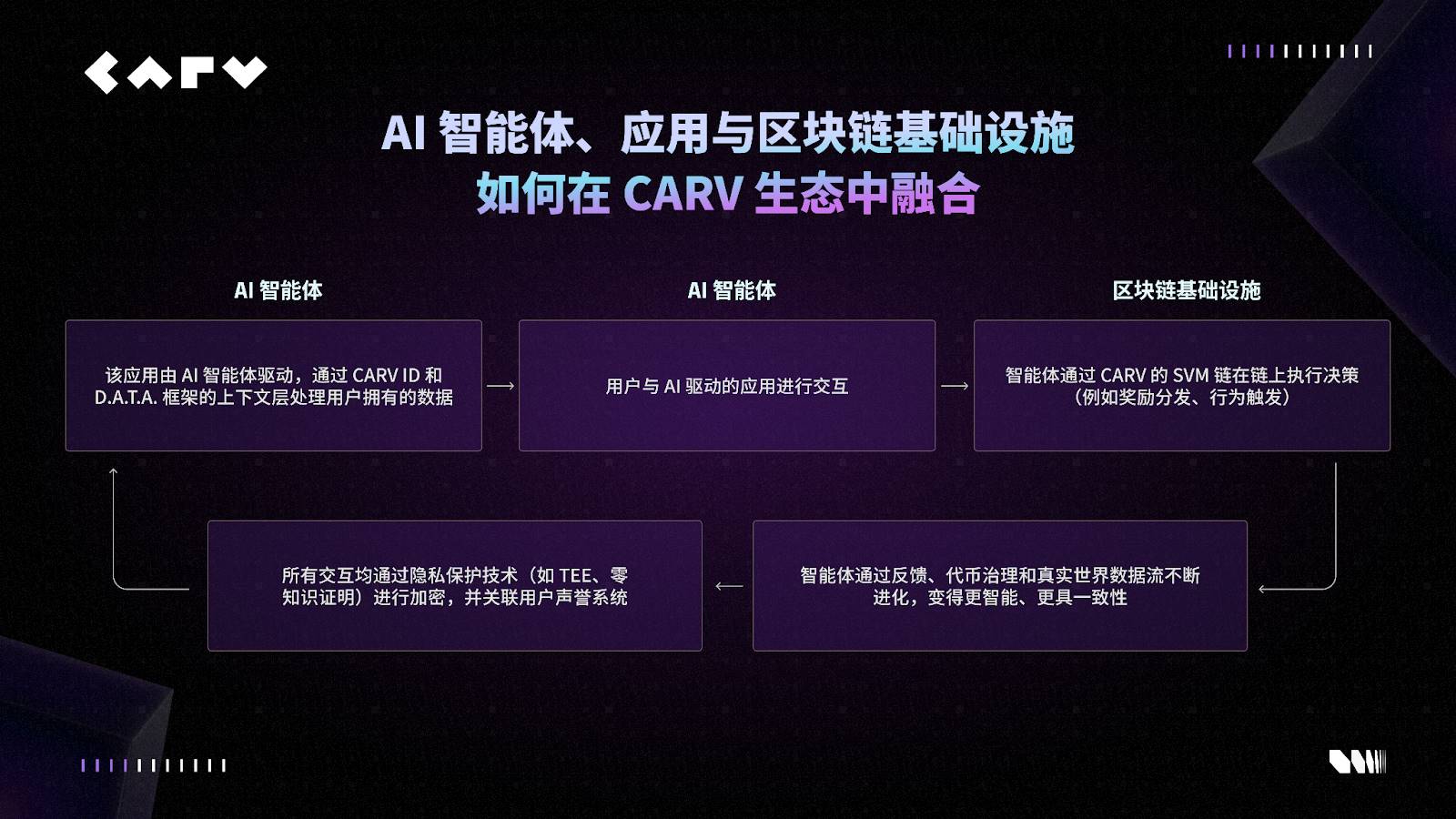
“这不仅是一份产品路线图,更是一张通往未来数字文明的蓝图”,CARV首席技术官 Ambero Tu 表示。

“AI智能体首次具备可验证的身份、声誉与自治能力。CARV所构建的,不仅是一个协调层,更是一整套孕育链上新物种——AI 生命体——的基础设施。现在,CARV正在把去中心化智能从静态数据汇聚,推进到由AI驱动的自治协作经济体,在这里,人类用户与AI智能体将共同参与所有权和治理。”

关于 CARV

CARV——主权 AI 生命体的诞生、学习与进化之所。

什么是 AI 生命体?它们是原生于链上的主权智能体,天生具备目标、自主性与成长潜力。AI 生命体拥有可验证的记忆与身份,能够感知环境并与之互动。不仅执行任务,更能独立决策、持续适应,并追逐自我设定的目标。

CARV 以自研的 SVM 链、D.A.T.A. 框架,以及符合 ERC-7231 标准的 CARV ID / Agent ID 系统为基础,构建出一个支持身份验证、用户授权的智能体生态。AI 生命体在其中得以持续学习、自主适应,并与用户共同成长。依托 CARV 的 AI-first 技术栈,CARV Labs 孵化的一系列消费级 AI 应用登陆 Google Play、App Store 等主流平台,面向数十亿用户,将智能体驱动的交互体验与现实激励机制深度融入日常数字生活。

截至目前,CARV 已发行超 800 万个 CARV ID,运行超过 6 万个验证节点,集成逾 1,000 款游戏,连接起 AI 智能体、Web3 基础设施与现实应用场景,推动智能体驱动经济的加速崛起。作为生态的核心引擎,$CARV 代币支撑质押、治理与系统协同,赋能 CARV 成为 Web3 世界中 AI 生命体的操作系统。

Пов'язані матеріали

2029 Finale Prediction: When Cryptocurrency Completely "Vanishes", Who Can Remain in This Financial Upheaval?

By 2029, the crypto industry will have transformed into a largely invisible but foundational layer for traditional finance. This timeline outlines the key shifts from now until then. By mid-2026, the most sought-after assets on-chain will not be traditional tokens, but synthetic perpetual contracts for private, high-growth companies (like SpaceX, OpenAI). These become primary price discovery tools, highlighting the market's craving for real-world asset value. Most altcoins enter a sustained bear market as their fundamental lack of asset-backed value is exposed. In late 2026, the "AI + Crypto" narrative largely fades as AI giants prove they don't need crypto infrastructure, except for prediction markets betting on model performance. Simultaneously, a quiet but significant wave of tokenization for institutional assets (money market funds, private credit) begins. The industry splits into a noisy speculative economy and a silent institutional one. Throughout 2027, major public blockchain foundations pivot decisively to serve institutional clients, building compliance toolkits and sales teams. However, key sectors hit growth ceilings: private perpetual contracts are legally restricted from public promotion, stable币 growth is capped by looming political uncertainty, and tokenization projects remain cautious. In 2028, following a U.S. election assumed to maintain a regulatory (not prohibitive) stance, a pivotal change occurs. After a major liquidation crisis exposes the flaws of synthetic contracts lacking a real-asset anchor, new regulations allow the *public solicitation* of private security sales (secondary market shares) to accredited investors. This creates a legitimate, direct on-ramp for retail capital into previously illiquid private equity. By 2029, the resulting bull market is driven by trading in real, innovative company shares (biotech, robotics, AI labs), not speculative tokens. "Crypto" as a distinct asset class recedes; it becomes the mundane, unseen plumbing for this new global private markets infrastructure. Tokens that survive are those capturing real cash flows from this infrastructure. Speculation persists but is marginalized. The core questions posed at the start are answered: token value is tied to legally enforceable claims on real assets, frontier tech adoption happens via private market channels, and crypto's absorption into traditional finance is marked by its becoming boring and invisible. The key validation for this entire thesis is whether, by late 2028, a legal pathway exists for ordinary accredited investors to access private assets directly.

marsbit10 хв тому

2029 Finale Prediction: When Cryptocurrency Completely "Vanishes", Who Can Remain in This Financial Upheaval?

marsbit10 хв тому

After the U.S. Banned Fable 5, Zhipu's Stock Soared 47%

On June 15, Chinese AI company Zhipu's stock surged up to 47.6% in Hong Kong, closing with a 32.82% gain. This sharp rise followed two key industry events. On June 12, Anthropic was compelled by a U.S. government export control order to suspend global access to its latest flagship models, Claude Fable 5 and Claude Mythos 5, impacting developers and businesses reliant on them. The next day, Zhipu announced it was opening access to its new open-source flagship model, GLM-5.2, for all Coding Plan users, with API and model weights (under the MIT license) to follow. The Anthropic incident highlighted a critical shift in the AI industry: beyond raw capability, the stability, continuous accessibility, and control over AI models are becoming equally vital, especially as AI integrates deeper into business workflows. Zhipu's move, emphasizing that "frontier intelligence should not belong to a few nor be subject to arbitrary revocation," positioned its open, accessible model as an alternative. GLM-5.2 focuses on "Long Horizon Tasks" with a 1M context window, aiming for consistency in complex, extended projects. Market analysts suggest this event exposes the risk of dependency on closed-source models subject to single jurisdiction policies, potentially accelerating a shift toward domestic base models and localized deployments. The investment response indicates a new valuation metric is emerging—prioritizing which companies can provide AI capabilities that are not only advanced but also reliably and sustainably accessible.

marsbit11 хв тому

After the U.S. Banned Fable 5, Zhipu's Stock Soared 47%

marsbit11 хв тому

PANews Column Registration and Article Submission Guide

"PANews Column Registration and Submission Guide" provides instructions for users to register as columnists and publish articles on the PANews platform. Key application requirements are emphasized: content should focus on in-depth analysis within Crypto, Web3, blockchain, data, and viewpoints. Content primarily for brand/product introductions will not be approved, and heavily AI-generated content will be rejected. Promotional (PR/soft) content is directed to the business channel. **Registration Process:** * **Web:** Go to the official website footer, click "Apply for Column," and register with a phone number or email (login via verification code, no password). Fill in the column name, description, upload an avatar, and submit links to previously published work. * **Mobile:** Navigate to "My" -> "Contribute & Create" and complete the form. **Article Submission Tutorial:** 1. Log in to the PANews website. 2. Access the "Creator Center" from your personal homepage. 3. Use the editor to create and publish articles. **Video Upload:** The platform supports embedding videos from third-party sites (e.g., Bilibili). Copy the embed code from the source video, use the editor's "Insert/Edit media" button, paste the code under the "Embed" tab, and adjust the display size (recommended: width 100%, height 560px). **PANews Skills (AI Agent Tool):** PANews offers an official AI Agent skill set called PANews Skills, enabling AI tools to query platform content, track trends, and publish column articles directly. It includes three main skills: 1. `panews`: For tracking daily must-read lists, popular articles, and funding news. 2. `panews-creator`: For managing columns, publishing articles, and uploading images. 3. `panews-web-viewer`: For parsing PANews webpages into Markdown. These skills are compatible with various AI Agent tools (OpenClaw, Cursor, Claude Code, ChatGPT, Gemini, etc.). To use the `panews-creator` skill, users must obtain a specific authentication value from the PANews website after logging into their columnist account.

marsbit22 хв тому

PANews Column Registration and Article Submission Guide

marsbit22 хв тому

I Built Myself an Investment Workbench Using AI

For the past two weeks, I've been immersed in Vibe Coding—using AI to write code from natural language descriptions. This process has enabled me to quickly build functional tools that address long-standing personal ideas. Previously, I had many concepts but found execution too cumbersome. Key ideas included a unified dashboard for assets across US stocks, Crypto, HK stocks, and A-shares; a real-time alert system for price movements; an investment map visualizing sector relationships; and a tool to correlate prediction market bets with news and market data. Traditional development hurdles meant these often remained unrealized. Using AI (Codex, Claude Code, and DeepSeek API), I built four initial tools: 1. A **Cross-Market Asset Dashboard** showing total assets, daily P&L, and holdings by market, with added features for alerts and sector mapping. It's deployed locally for privacy. 2. A **Prediction Market (PM) Monitor** tracking bets on events (e.g., company valuations) and correlating probability shifts with news and market movements. I categorize bets by conviction to filter noise. 3. A **Simple Operations Backend** for managing my writing workflow (topics, progress, publishing). It's cloud-deployed for mobile access. 4. A **One-Click Formatting Tool** that automates converting drafts into various platform-specific formats, saving manual effort. While these tools are basic, they represent a significant shift: AI lowers the barrier to creating personalized systems. I believe individual investors can now feasibly build core systems for: * **Asset Observation** (tracking holdings and changes) * **Signal Monitoring** (watching for key market shifts) * **Sector Mapping** (understanding network relationships within a sector) * **Performance Review** (documenting rationale and outcomes) The power of Vibe Coding is its fast feedback loop. Ideas can be implemented, tested, and iterated on rapidly, turning "want-to-do" into "done." This marks the start of my new phase, where I'll share investment thoughts, tool tests, on-chain operations, and educational Web3 content.

marsbit37 хв тому

I Built Myself an Investment Workbench Using AI

marsbit37 хв тому

Торгівля

Спот
Ф'ючерси

Популярні статті

Як купити CARV

Ласкаво просимо до HTX.com! Ми зробили покупку Carv (CARV) простою та зручною. Дотримуйтесь нашої покрокової інструкції, щоб розпочати свою криптовалютну подорож.Крок 1: Створіть обліковий запис на HTXВикористовуйте свою електронну пошту або номер телефону, щоб зареєструвати обліковий запис на HTX безплатно. Пройдіть безпроблемну реєстрацію й отримайте доступ до всіх функцій.ЗареєструватисьКрок 2: Перейдіть до розділу Купити крипту і виберіть спосіб оплатиКредитна/дебетова картка: використовуйте вашу картку Visa або Mastercard, щоб миттєво купити Carv (CARV).Баланс: використовуйте кошти з балансу вашого рахунку HTX для безперешкодної торгівлі.Треті особи: ми додали популярні способи оплати, такі як Google Pay та Apple Pay, щоб підвищити зручність.P2P: Торгуйте безпосередньо з іншими користувачами на HTX.Позабіржова торгівля (OTC): ми пропонуємо індивідуальні послуги та конкурентні обмінні курси для трейдерів.Крок 3: Зберігайте свої Carv (CARV)Після придбання Carv (CARV) збережіть його у своєму обліковому записі на HTX. Крім того, ви можете відправити його в інше місце за допомогою блокчейн-переказу або використовувати його для торгівлі іншими криптовалютами.Крок 4: Торгівля Carv (CARV)Легко торгуйте Carv (CARV) на спотовому ринку HTX. Просто увійдіть до свого облікового запису, виберіть торгову пару, укладайте угоди та спостерігайте за ними в режимі реального часу. Ми пропонуємо зручний досвід як для початківців, так і для досвідчених трейдерів.

431 переглядів усьогоОпубліковано 2024.12.11Оновлено 2026.06.02

Як купити CARV

Обговорення

Ласкаво просимо до спільноти HTX. Тут ви можете бути в курсі останніх подій розвитку платформи та отримати доступ до професійної ринкової інформації. Нижче представлені думки користувачів щодо ціни CARV (CARV).

活动图片