Осведомленность о криптовалюте в Сингапуре достигла рекордных 94%, но доля владения падает

cryptonews.ruОпубліковано о 2025-04-23Востаннє оновлено о 2025-05-23

Осведомленность о криптовалюте в Сингапуре достигла исторического максимума: 94% респондентов в недавнем опросе указали на знакомство по крайней мере с одним цифровым активом.

Однако доля владения снизилась, упав до 29% в 2025 году с 40% годом ранее, согласно пятому ежегодному исследованию рынка криптовалют в Сингапуре, проведенному Independent Reserve 21 мая.

Опрос, проведенный в феврале с 1500 участниками, показал, что мужчины по-прежнему более активны в инвестировании в криптовалюту, чем женщины, 35% по сравнению с 24%.

Миллениалы и поколение X (в возрасте 25–54 лет) доминируют среди инвесторов, составляя 71% всех держателей. Среди тех, кто торгует не реже одного раза в неделю, 76% относятся к этой возрастной группе.

Половина сингапурских инвесторов планируют увеличить активы

Несмотря на снижение доли владения, настроения остаются сильными. Более половины текущих держателей (53%) планируют увеличить свои позиции в течение следующих 12 месяцев, а 17% не держателей выразили заинтересованность в выходе на рынок.

Биткоин (BTC) продолжает оставаться якорем криптовалютного рынка в Сингапуре. Его держат 68% криптоинвесторов, а 86% рассматривают его как валюту, средство сбережения или инвестиционный актив. В частности, 77% говорят, что к 2030 году стоимость биткоина превысит 100 000 долларов.

Прямое владение остается предпочтительным методом инвестирования, при этом 61% предпочитают держать свои активы напрямую, а не через биржевые фонды (ETF).

Арбитражная торговля также растет: 67% респондентов заявили, что продали часть или все свои активы, чтобы извлечь выгоду из колебаний цен в прошлом году.
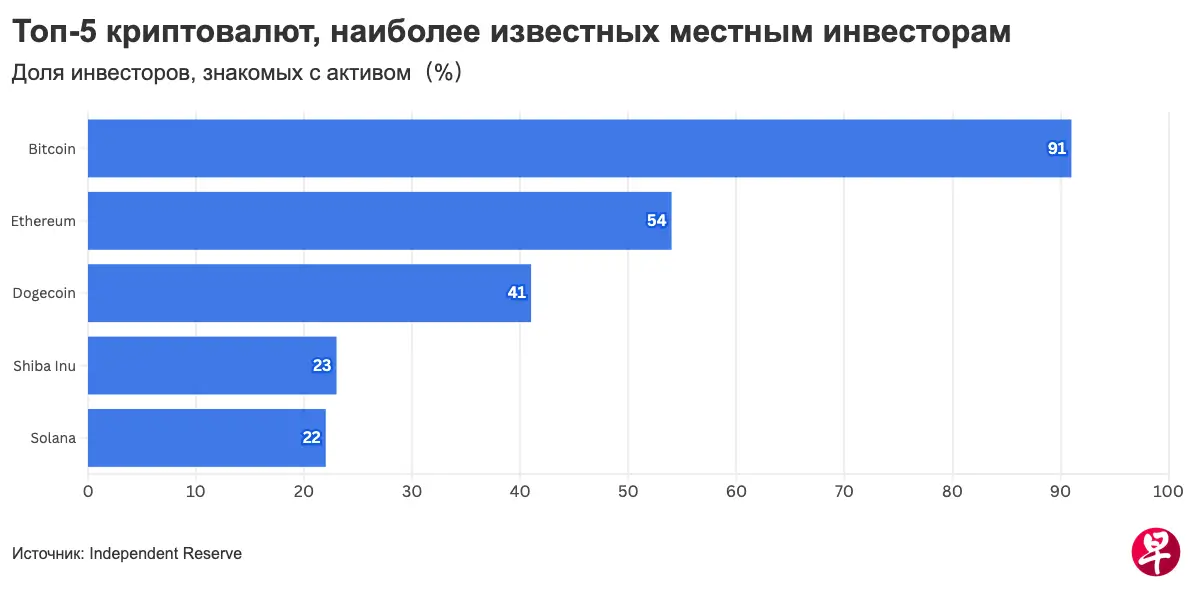

Биткоин — самая узнаваемая криптовалюта в Сингапуре. Источник: Independent Reserve.

Между тем, 46% инвесторов держат стейблкоины, в основном для торговли и деятельности DeFi, причем 83% из них привязаны к доллару США.

Мемкоины остаются спекулятивным сектором рынка, причем 28% респондентов держат по крайней мере одну мем-монету, причем Dogecoin (DOGE) является самой популярной.

Сингапур становится мировым криптоцентром

Сингапур закрепил свою роль в качестве мирового центра разработки блокчейнов и криптовалют, согласно отчету ApeX Protocol за декабрь 2024 года.

В исследовании говорится, что Сингапур лидирует в мире по числу патентов на блокчейны, 2433 рабочих мест, связанных с криптовалютами, и 81 активной криптовалютной бирже.

Гонконг занял второе место с 890 патентами на блокчейн, 1163 рабочими местами в секторе и 52 криптобиржами, что отражает продолжающееся продвижение города в секторе цифровых активов.

В 2024 году Сингапур удвоил свою регулирующую динамику. Денежно-кредитное управление Сингапура выдало 13 лицензий крупных платежных учреждений для криптобирж, что более чем в два раза превышает количество разрешений, выданных в 2023 году.
Пов'язані матеріали

Why Does 'AGI Godfather' Ben Goertzel Believe the Future of AI Relies on Blockchain?

Ben Goertzel, known as the "AGI Godfather," argues that the future of Artificial General Intelligence (AGI) must be built on blockchain to prevent its control by a few corporations or venture capital firms. He believes the core AGI code should be free and open-source, but that this alone is insufficient without a decentralized infrastructure to run it affordably. His blockchain project, SingularityNET, and the broader Artificial Superintelligence Alliance aim to create a user-owned, decentralized network for hosting and deploying AGI, contrasting with the closed models of companies like OpenAI and Anthropic. Goertzel criticizes the shift of other labs from open to closed development. He argues that while a closed path is simpler, an open, decentralized model—akin to Linux and the internet—is both possible and ultimately better for humanity. He envisions an "Agent economy" where individuals orchestrate teams of AI agents to perform tasks, including transactions, on an open network rather than corporate clouds. While his current model relies on cryptocurrency, plans include offering paid AI services to businesses with the decentralized blockchain as the backend. Goertzel predicts human-level AGI could arrive by 2029 and warns that a gap in understanding and access to AGI could drastically worsen inequality. The first test of his decentralized approach will be the upcoming release of the Agent Omega Claw.

Foresight News9 хв тому

Why Does 'AGI Godfather' Ben Goertzel Believe the Future of AI Relies on Blockchain?

Foresight News9 хв тому

A Company Once on the Brink of Bankruptcy Just Surpassed Bitcoin in Market Cap

On June 22nd, driven by rising stock prices, SK Hynix’s market capitalization reached $1.35 trillion, surpassing Bitcoin's total market cap of approximately $1.29 trillion. This temporarily made it South Korea's highest-valued company. The core driver of this surge is HBM (High Bandwidth Memory), for which SK Hynix is the primary supplier to NVIDIA, holding over 60% market share. AI's demand for high memory bandwidth has translated into immense profitability, with SK Hynix reporting a 72% operating profit margin in Q1. The company's success follows a 13-year bet on HBM technology, beginning in 2009. It nearly failed after the 2001 dot-com bubble, was acquired by SK Group in 2012, and was subsequently recapitalized to continue its long-term HBM development. The article contrasts this with the Crypto AI narrative. Capital currently favors AI infrastructure players like SK Hynix due to "real orders, physical barriers, and quantifiable profit margins." In comparison, Crypto AI projects, promising decentralized compute and data markets, remain largely conceptual with limited tangible progress. Examples include Bittensor, whose core mechanisms are still under development, and Bitcoin miners transitioning to AI, who face significant funding gaps and execution challenges. The piece cites analysis suggesting the AI sector has absorbed nearly all new market liquidity since 2022, leaving little for crypto. It concludes that the current AI infrastructure红利 is captured by entities with proven technical barriers and supply capabilities, while crypto networks still need to define their concrete role in the value chain.

链捕手49 хв тому

A Company Once on the Brink of Bankruptcy Just Surpassed Bitcoin in Market Cap

链捕手49 хв тому

Bittensor Moves Towards Ultimate Decentralization: The Critical 18 Months for the TAO Ecosystem is Here?

Bittensor, a decentralized AI protocol, is accelerating its transition to full decentralization over the next 18 months, as outlined in a recent post by co-founder Const. The project currently operates in a "semi-decentralized" state: ownership and network participation are open and permissionless, with TAO distribution based on competitive contribution. However, protocol upgrades and governance have remained under core team control to enable rapid iteration in the fast-evolving AI sector. This strategic shift comes as the ecosystem matures, boasting 128 subnets and a large community. Const argues that continued centralization now poses risks, including single points of failure and regulatory scrutiny. The upcoming decentralization roadmap includes optimizing validator competition, opening liquidity pools, introducing governance rights for Alpha holders, and refining economic models. The move could fundamentally reshape TAO's value proposition, adding governance premiums to its existing valuation based on AI narrative and scarcity. It also signals a potential maturation of the AI crypto sector, where competition may shift from hype to sustainable protocol design and real economic activity. Bittensor positions itself not just as another AI token, but as foundational infrastructure aiming to decentralize intelligence production—analogous to Bitcoin's role in decentralizing money—with the goal of creating a resilient "Millennium Intelligence Federation."

marsbit1 год тому

Bittensor Moves Towards Ultimate Decentralization: The Critical 18 Months for the TAO Ecosystem is Here?

marsbit1 год тому

Japan's AI Dark Horse Emerges: How a 7B Small Model Challenges Fable and Mythos?

In June 2026, Sakana AI's new model Fugu caused a stir in the AI community. Its Fugu Ultra variant achieved scores of 73.7 on SWE-Bench Pro and 82.1 on TerminalBench 2.1, surpassing GPT-5.5 and Claude Opus 4.8, and was claimed to be comparable to export-restricted models like Fable 5 and Mythos Preview. Remarkably, the core of this high-performance system is not a massive model, but a small 7B-parameter RL Conductor model. Fugu operates as a multi-agent orchestrator: the 7B model acts as a "foreman," dynamically analyzing user tasks and delegating subtasks to a pool of top-tier global models (e.g., GPT-5, Gemini 3.1 Pro). It then synthesizes and verifies their outputs. This architecture represents a paradigm shift from monolithic models to an expert-team approach. It enhances performance in complex, multi-step engineering tasks like code review and security testing by enabling cross-validation from specialized models, improving long-session stability and token efficiency. However, Fugu's strengths come with trade-offs: it faces inherent latency due to multiple API calls, relies heavily on underlying US model APIs (creating dependency risks), and its benchmark comparisons with Fable/Mythos are based on reported scores, not head-to-head testing. For Japan's AI ecosystem, which lacks the massive compute and data resources of the US or China, Fugu exemplifies an "asymmetric breakthrough" strategy. Instead of competing directly in parameter scale, it focuses on intelligent orchestration of existing global models, offering a degree of AI sovereignty and resilience. While a significant system-level innovation, its ultimate capability is still bounded by the underlying models it coordinates.

marsbit1 год тому

Japan's AI Dark Horse Emerges: How a 7B Small Model Challenges Fable and Mythos?

marsbit1 год тому

Торгівля

Спот
Ф'ючерси
活动图片