Samourai Wallet и федералы просят время на размышления о прекращении дела против криптомиксера

cryptonews.ruОпубліковано о 2024-12-29Востаннє оновлено о 2025-04-29

Федеральные прокуроры США и соучредители криптомиксера Samourai Wallet попросили суд предоставить им больше времени для рассмотрения возможности прекращения дела после того, как Министерство юстиции отменило меры по обеспечению соблюдения криптоправил.

Юристы генерального директора Samourai Wallet Кионне Родригес и главного технического директора Уильяма Хилла заявили в письме от 28 апреля федеральному судье Манхэттена Ричарду Берману, что они совместно запросили у правительства «продление графика досудебных ходатайств на 16 дней».

Адвокаты руководителей Samourai заявили 10 апреля, что они написали исполняющему обязанности прокурора Манхэттена Джею Клейтону с просьбой о прекращении дела после того, как 7 апреля заместитель генерального прокурора Тодд Бланш распорядился закрыть криптогруппу Министерства юстиции.

«24 апреля 2025 года адвокаты защиты встретились с прокурорами и их руководителями лично в офисе прокурора США, чтобы обсудить эту просьбу», — заявили адвокаты.

«Обвиняемые считают, что продление графика досудебных ходатайств оправдано, чтобы позволить обвиняемым избежать значительных расходов на подготовку своих ходатайств, пока правительство определяет свою позицию», — говорится в письме.

В нем также говорится, что прокуроры согласились отложить слушание «без выражения каких-либо мнений по существу».

В апреле 2024 года Родригес и Хилл из Samourai Wallet были обвинены в сговоре с целью отмывания денег и управлении нелицензированным бизнесом по переводу денег, в чем они оба не признали себя виновными.

В служебной записке Бланш говорилось:

«Министерство юстиции не является регулятором цифровых активов», и оно откажется от правоприменения и расследований, за исключением тех, которые «сосредоточены на преследовании лиц, которые делают жертвами инвесторов в цифровые активы, или тех, кто использует цифровые активы для содействия уголовным преступлениям».
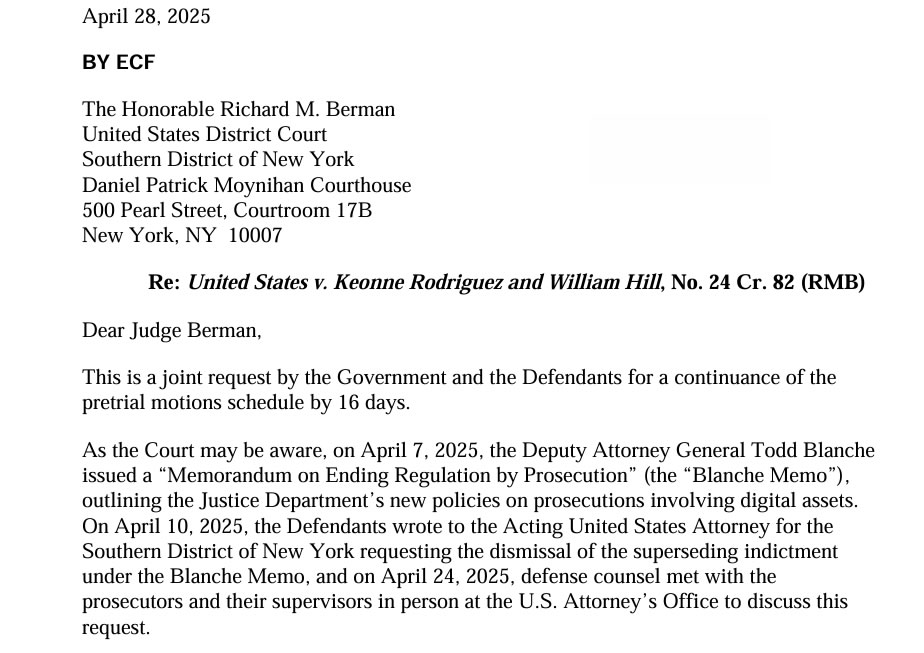

Отрывок из письма судье Берману. Источник: PACER

В настоящее время ходатайства по делу руководителей Samourai должны быть поданы 13 мая, ответы — 10 июня, а ответы — 24 июня. В письме предлагается перенести это на 29 мая для ходатайств, на 26 июня для ответов и на 10 июля для ответов.

Отсрочка не повлияет на дату судебного разбирательства, которая запланирована на начало ноября.

Список отозванных судебных исков по криптовалютам удлиняется

Этот шаг является последним в длинном списке судебных исков, направленных на то, чтобы отменить крипто-дела прокуроров в рамках благоприятной позиции администрации Трампа по отношению к отрасли.

9 апреля генеральный директор SafeMoon Брейден Джон Карони, обвиняемый в мошенничестве с использованием электронных средств и отмывании денег, сослался на директиву Бланш в попытке добиться прекращения своего дела.

Между тем, 28 апреля Фонд образования DeFi подал в Белый дом ходатайство о снятии обвинений с соучредителя Tornado Cash (TORN) Романа Шторма и потребовал немедленных действий по «прекращению незаконной кампании Министерства юстиции эпохи Байдена по криминализации разработки программного обеспечения с открытым исходным кодом».


Пов'язані матеріали

BIS Report Compliance Observations: The True Risks of Stablecoins Go Beyond 'De-pegging'

The BIS report, "Anchoring trust in money: innovation beyond stablecoins," highlights that the primary risks of stablecoins extend beyond potential de-pegging. It argues that the core challenge is whether stablecoins can be integrated into a financial system that is identifiable, monitorable, accountable, and regulatable. While acknowledging efficiency gains like faster payments and programmability, BIS emphasizes that money requires an institutional framework—including legal certainty, liquidity support, and financial integrity controls—which many stablecoins currently lack. The report details compliance risks, noting that while blockchain transactions are transparent, address visibility does not equate to identity or purpose clarity. This creates a systemic risk as pseudonymity, non-custodial wallets, and cross-chain bridges can undermine AML/CFT controls. Furthermore, these risks can spill over into the traditional financial system through on- and off-ramps. The future direction, per BIS, is not to prohibit innovation but to embed regulatory rules—such as identity verification and transaction screening—directly into the technological infrastructure of tokenized finance. The key takeaway for compliance is that any new financial instrument must clearly address questions of customer identification, transaction monitoring, accountability, and cross-border rule consistency to be viable as a mainstream payment tool.

marsbit56 хв тому

BIS Report Compliance Observations: The True Risks of Stablecoins Go Beyond 'De-pegging'

marsbit56 хв тому

When US Giants Collectively "Defect" to Chinese AI Models

When Silicon Valley Giants Turn to Chinese AI Models to Cut Costs A surprising trend is emerging: major U.S. tech companies are significantly reducing AI costs by switching to Chinese models. Coinbase, the largest U.S. cryptocurrency exchange, reportedly halved its AI spending after migrating to China's GLM-5.2 and Kimi 2.7 models, despite increasing usage. They achieved this through a sophisticated three-part strategy: implementing an automatic routing system to select the most cost-effective model per task, boosting cache hit rates from 5% to 60% to reuse computations, and employing "context engineering" to provide AI with more precise, less cluttered information. They are not alone. AI startup Lindy switched from Claude to DeepSeek, saving millions, while Snowflake's tests found GLM-5.2 solved 66% of coding tasks compared to Claude Opus's 67%—but at a fraction of the cost (output pricing is 5-7 times lower). While the top Western models may offer slightly better stability, the massive price differential is leading many businesses to reconsider their value proposition. This shift signals a deeper change in the AI industry, moving beyond pure performance benchmarks to a fierce cost competition. As pressure mounts, even OpenAI and Anthropic have begun slashing prices. For users, this means more choices, lower costs, and a crucial lesson: using multiple models based on task complexity, optimizing with caching, and keeping contexts lean are now key to leveraging AI efficiently and affordably.

marsbit1 год тому

When US Giants Collectively "Defect" to Chinese AI Models

marsbit1 год тому

BIS Report Compliance Watch: The Real Risks of Stablecoins Are Not Just 'De-pegging'

BIS Report Compliance Observations: The real risks of stablecoins go beyond "depegging" The BIS report "Anchoring trust in money: innovation beyond stablecoins" argues that while stablecoins and tokenization offer efficiency gains, their primary risk lies in fitting into an identifiable, monitorable, accountable, and regulatable financial system. Money's trust stems not just from technology but from institutional arrangements: a common unit of account, guaranteed redemption at par, liquidity support, regulatory frameworks, and financial integrity requirements. Stablecoins, operating on permissionless blockchains with pseudo-anonymity and non-custodial wallets, create systemic compliance gaps: unclear customer identity, incomplete fund origins, unexplained transaction purposes, fragmented cross-chain paths, and ambiguous liability. On-chain transparency does not equal compliance transparency. Public addresses don't reveal identity or intent. While blockchain analytics aid law enforcement, they cannot replace routine, large-scale AML/CFT controls. Effective compliance requires a closed-loop process encompassing customer onboarding, transaction monitoring, investigation, reporting, and audit. Stablecoin risks are not confined to the blockchain; they re-enter the traditional financial system via on/off-ramps, exchanges, and payment institutions. This forces banks to monitor client accounts for activity linked to virtual assets. The future direction is not to prohibit innovation but to embed rules into the technology. Tokenized finance should integrate with the existing two-tier monetary system, embedding compliance—like customer identification, pre-transaction screening, and auditable data trails—directly into the transaction flow. For compliance professionals, the key takeaway is that any new financial instrument must answer core questions: Who identifies the customer? Who monitors transactions? Who handles exceptions? Who is liable? Compliance is not the antithesis of innovation but the essential infrastructure for its sustainable growth.

链捕手1 год тому

BIS Report Compliance Watch: The Real Risks of Stablecoins Are Not Just 'De-pegging'

链捕手1 год тому

When American Giants 'Defect' to Chinese AI Models

Summary: The trend of major U.S. technology firms adopting more cost-effective Chinese AI models is gaining momentum. A prime example is Coinbase, the largest U.S. cryptocurrency exchange, which reportedly halved its AI expenditure by switching to Chinese models GLM-5.2 and Kimi 2.7, while its usage volume increased. This was achieved through a sophisticated cost-saving system featuring intelligent model routing (selecting the most suitable model per task), dramatically improving cache hit rates from 5% to 60%, and implementing "Context Engineering" to streamline prompts. This shift is not isolated. Other companies like the AI startup Lindy and data cloud firm Snowflake are making similar moves, drawn by the significant price disparity. For instance, GLM-5.2 costs $1.40/$4.40 per million tokens (input/output), compared to $5/$25 for Claude Opus 4.7. While top Western models may offer slightly higher stability or speed in complex tasks, the performance gap is narrowing, making the price difference harder to justify for many enterprise use cases. The implications are significant for both businesses and individual users. It highlights the importance of a multi-model strategy based on task requirements, the value of caching and reusing outputs, and the effectiveness of providing concise context. Ultimately, this migration signals a potential reshaping of the AI industry's pricing model, moving competition from pure performance benchmarks to practical cost-effectiveness, with increased choice and downward price pressure benefiting end-users.

链捕手1 год тому

When American Giants 'Defect' to Chinese AI Models

链捕手1 год тому

Торгівля

Спот
活动图片