Продвигаемые трейдером Дэйвом Портным мемкоины упали на 97%

cryptonews.ruОпубліковано о 2024-05-28Востаннє оновлено о 2025-04-28

Профессиональный трейдер Дэйв Портной утверждает, что коллекционирует мемкоины «в качестве хобби», хотя он и заработал с их помощью около $70,000. Правда, пять из выбранных им монет упали в цене примерно на 97%.

Начав свою карьеру с освещения спортивных событий и обзоров пиццерий, впоследствии Портной стал дневным трейдером, а потом сконцентрировался на токенах-мемах.

Например, он продвигал токен MONTOYA с рыночной капитализацией в $2,75 млн, достигшей в течение двух минут общей стоимости $9,95 млн.

В дальнейшем токен на основе Solana, названный в честь участника испанского телешоу Love Island, потерял 99,7% стоимости, в результате чего рыночная капитализация понизилась до $25,000.

Ещё один мемкоин Портного Stool Prisondente (JAILSTOOL) был выпущен в качестве шутки, чтобы поиздеваться над Комиссией по ценным бумагам и биржам (SEC) и Комиссией по торговле товарными фьючерсами.

В момент его активного продвижения в социальных сетях 9 февраля 2025 года капитализация JAILSTOOL равнялась $217 млн, сегодня JAILSTOOL упал на 97% до $7 млн.

Портной также промотировал GREED и GREED2. Что мы имеем сейчас: GREED упал на 99,9% относительно пика в $37 млн до текущих $50,000, аналогичным образом GREED2 упал на 99,5% с $5,8 миллионов до $25,000.

Глава Barstool Sports также продвигал KOLHAT, который упал на 99,8% с $3 млн до скромных $10,000. Другой его мемкоин LIBRADICK потерял 99,8%, упав с $14 млн до менее $25,000.

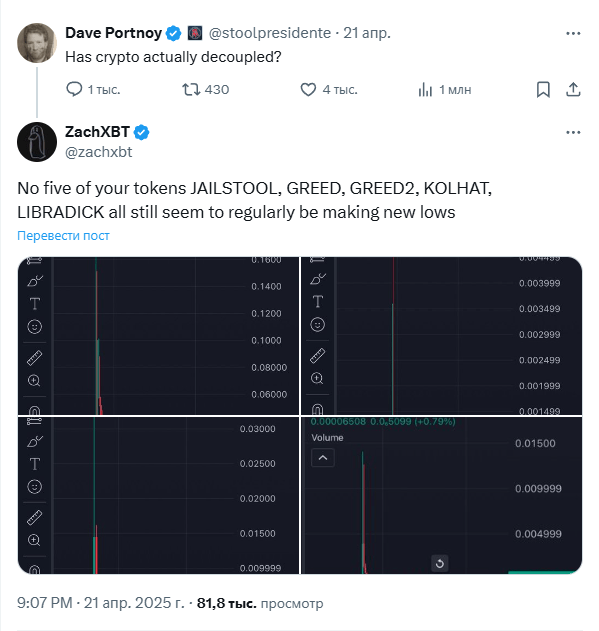
На прошлой неделе известный криптосыщик ZachXBT напомнил подписчикам Портного, что пять его монет рухнули более чем на 99%.
Opera Снимок_2025-04-28_191938_x.com

И всё-таки Портной — везунчик, ведь даже когда он купил поддельные токены LIBRA, из-за чего он потерял $5 млн, команда LIBRA возместила ему убытки.

Пов'язані матеріали

Is Anyone Still Buying in the Crypto Market? Unpacking 3 Common Watch-and-Wait Mentalities Today

Is Anyone Still Buying in the Crypto Market? Unpacking 3 Common Wait-and-See Mindsets This article analyzes the current cautious sentiment in the crypto market, distilled from conversations with sophisticated investors. The author identifies three dominant investor mindsets: 1. **Satisfied with Current Holdings:** Many retain a long-term belief in digital assets but see no immediate catalyst for significant price appreciation. They hold positions to avoid missing a future surge but allocate minimal new capital or attention. A shift requires a new, observable catalyst or a rotation from other portfolio areas. 2. **Waiting for Lower Prices:** This reflects not just short-term timing but a belief about crypto's total addressable market and upside potential. It could change if key perceived cycle bottoms pass without a crash, a major bullish event occurs (e.g., sovereign adoption), or price rebounds trigger FOMO-driven buying. 3. **High Opportunity Cost of Allocation:** The core question is comparative growth. With AI-related equities appearing to offer relentless, high-speed growth, justifying marginal investment into assets without similar perceived momentum is difficult. A slowdown in the AI trade could potentially mark a bottom and trigger capital reallocation into crypto. In conclusion, while long-term conviction persists for many, near-term marginal capital flows are constrained by these beliefs. The author suggests the market may be closer to a bottom than a top, but the current climate is defined by this wait-and-see approach, awaiting a catalyst to reignite broader investor commitment.

marsbit4 хв тому

Is Anyone Still Buying in the Crypto Market? Unpacking 3 Common Watch-and-Wait Mentalities Today

marsbit4 хв тому

China Added 67 New Unicorns in Half a Year, with AI and Robotics Accounting for Over Half

China added 67 new unicorn companies in the first half of 2026, reaching a total of 517 unicorns with a combined valuation of approximately $2.39 trillion. This surge marks a significant rebound after a post-2022 slowdown and sets a new semi-annual record. The growth is primarily driven by Artificial Intelligence (AI) and Robotics, which together account for over 53% of the new entrants. Specifically, 19 new unicorns are in robotics and 17 in AI. Notable companies include DeepSeek ($615.38B) and Kling AI ($18B). The trend indicates a decisive shift from internet consumer models to hard tech innovation. Geographically, new unicorns are highly concentrated in four cities: Beijing (19), Shanghai (18), Shenzhen (9), and Hangzhou (5), which together host 76.1% of the new companies. Hangzhou's overall valuation is boosted significantly by DeepSeek. Valuation distribution among new unicorns is pyramidal: 77.6% are valued between $1B and $2B, indicating early-stage status, while only two exceed $10B. There is a notable "speed divide": many AI/robotics startups achieved unicorn status in under three years, often via corporate spin-offs or led by star founders, while hard tech companies in semiconductors or biotech typically took over eight years. The report concludes that this wave reflects China's accelerating transition into an AI and robotics-powered innovation cycle, characterized by faster company formation, heightened geographic concentration, and a clear focus on foundational technologies.

marsbit46 хв тому

China Added 67 New Unicorns in Half a Year, with AI and Robotics Accounting for Over Half

marsbit46 хв тому

Торгівля

Спот
活动图片