Traders bet on next Pope post Francis demise using Memecoins

TheCryptoTimesОпубліковано о 2025-04-25Востаннє оновлено о 2025-04-25

In the past decade, memecoins have emerged from being everyday internet humor to a multi-billion-dollar niche sector in the crypto industry.

Memecoins have been at the center of debate for quite some time; some hate them, calling them worthless, while others hail them as mainstream cryptocurrencies. Love them or hate them, you cannot simply ignore memecoins. Don’t trust us? Ask the U.S. President Donald Trump himself, who launched his memecoin just a day before his official oath-taking ceremony.

Now, after being at the center of controversies, memecoins have turned holy! The crypto community is now using memecoins to vote on who the next pope will be after the demise of Pope Francis.

Crypto enthusiasts are creating meme tokens based on potential papal successors, church memes, and some Vatican references.

The Passing of the Pope

Born Jorge Mario Bergoglio, Pope Francis became the 266th pope on March 13, 2013. Commitment to social justice, interfaith communication, environmental conservation, and church reform defined him.

Since the eighth-century Syrian pope Gregory III, he was the first born or raised outside of Europe, the first Latin American, the first from the Americas, the first from the Southern Hemisphere, and the first pope from the Society of Jesus. 

At 88 years old, Pope Francis passed away at his Vatican Casa Santa Marta on Easter Monday, April 21, 2025.

The Process of Papal Succession

In either case of the death or resignation of the Pope, the Apostolic See becomes vacant, and preparations begin to elect a new pope.

The next pope is elected by the College of Cardinals, which includes all cardinals under age 80, and they gather in Rome, usually at the Sistine Chapel in the Vatican.

The cardinals, who hold up to four voting rounds daily and are cut off from the outer world, need a two-thirds majority to choose a new pope. Once someone is chosen, he is asked whether he accepts the position and chooses a papal name; white smoke then emanates from the chapel’s chimney to indicate to the world that “Habemus Papam,” which means “We have a Pope.”

Memecoins & the Speculation

The crypto community is empowered to turn even pivotal and sacred things into memes.

According to PolyMarket, a US-based online crypto-based betting site, almost 30% of users voted for the Pietro Parolin coin. Luis Antonio Tagle and Matteo Zuppi followed with 22.9% and 12.3% of the votes, respectively.
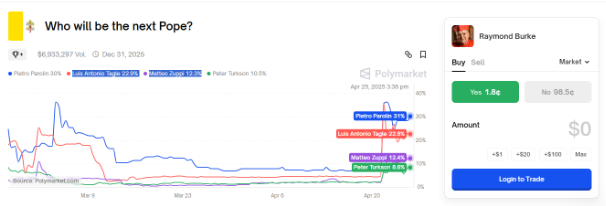
Pope Polymarket

The two trending memecoins, POPE Coin & LUCE Coin, have surged by 770% & 134%, respectively. LUCE reached a high of $0.02517 before settling at around $0.015. On the other hand, POPE reached a market cap of $260,930, according to CoinMarketCap. 

Also Read: Polymarket Sees 41% Chances For US Recession in 2025


Пов'язані матеріали

Embodied Intelligence 'Gaokao' is Insanely Hard, Humans Score 100, Best Model Only 12.8

Embodied AI Faces a Daunting "Everest": New Benchmark Reveals Huge Gap Between Models and Humans A comprehensive new benchmark for robotic manipulation, RoboDojo, has been released, painting a stark picture of the current state of embodied AI. It serves as a unified evaluation platform covering both simulation and real-world robot tasks. The benchmark assesses five core capabilities: Generalization (adapting to new scenes/objects), Memory, Precision manipulation, Long-Horizon multi-step tasks, and Open semantic understanding. It includes 42 simulation tasks and 18 standardized real-world tasks across three dual-arm robot platforms. The results are sobering. In simulation, the best-performing generalist robot policy achieved an average success rate of only 8.80%. Performance in the real world was slightly higher but still low, with the top model succeeding 12.8% of the time on average. In stark contrast, human experts scored 76.03% in simulation and 100% in real-world tests. The benchmark highlights significant, uneven gaps in current models' abilities. While some excel in specific areas like visual recognition or simple actions, they struggle with reliability, especially in long-horizon tasks where errors accumulate and in open-ended semantic instructions. The low scores, particularly in real-world deployment with physical uncertainties like camera noise and contact dynamics, underscore that today's models are far from being robust, general-purpose operational robots. RoboDojo is more than just a ranking; it's an infrastructure designed for fair, reproducible comparison. Its companion system, XPolicyLab, standardizes the interface for different models to be evaluated. Maintained by an academic consortium without commercial ties, it aims to provide a community-wide "altitude meter" to track genuine progress toward reliable and generalizable robot manipulation.

marsbit1 год тому

Embodied Intelligence 'Gaokao' is Insanely Hard, Humans Score 100, Best Model Only 12.8

marsbit1 год тому

Zuckerberg's 'Mango' Image Generation Model Trails Only GPT Image 2, It Learned to Revise Prompts on Its Own

Meta's MSL has launched Muse Image, an advanced image generation model nicknamed "Mango," which ranks second globally in text-to-image benchmarks, closely trailing OpenAI's GPT Image 2. Its key innovation is agent-like behavior: it searches for factual information, writes code for charts, and, most notably, has developed self-correction abilities through reinforcement learning, allowing it to revise its own outputs without explicit programming. This shift emphasizes reasoning over immediate generation. Integrated with Meta's ecosystem, Mango connects with the Muse Spark language model for complex tasks and features a unique "@" function that can incorporate public Instagram photos into generated images—raising privacy concerns as it's enabled by default. The model is directly accessible in Meta AI, Instagram, and WhatsApp, leveraging Meta's vast user base for distribution rather than competing solely on image quality. Accompanying Mango is the preview of Muse Video, a video generation model with integrated audio, currently ranked third in its category. All Mango-generated images include an invisible, persistent watermark (Content Seal) for AI identification, alongside a public detection tool. While Mango advances "thinking" image models, its use of social data poses new ethical questions about consent and digital boundaries.

marsbit2 год тому

Zuckerberg's 'Mango' Image Generation Model Trails Only GPT Image 2, It Learned to Revise Prompts on Its Own

marsbit2 год тому

Торгівля

Спот
活动图片