Solana Under Fire Again — Expert Reveals Why It Isn’t Out Of Beta Yet

bitcoinistОпубліковано о 2025-04-25Востаннє оновлено о 2025-04-25

Анотація

A fresh bout of public scrutiny has erupted around Solana which still labels its mainnet “beta” more than five years...

Trusted Editorial content, reviewed by leading industry experts and seasoned editors. Ad Disclosure

A fresh bout of public scrutiny has erupted around Solana which still labels its mainnet “beta” more than five years after launch. The latest flashpoint unfolded on X, where Helius Labs chief executive Mert Mumtaz sparred with pseudonymous critic Balarchrex over the meaning of the beta tag, the opacity of Foundation wallets and the true extent of client diversity on SOL’s validator network.

Why Is Solana Still In Beta?

The exchange began when Balarchrex accused Mumtaz and Solana co-founder Anatoly Yakovenko of avoiding three contentious topics: “Solana still being in beta, Solana foundation wallets not being public, [and] Solana having one single client.” He dismissed Firedancer—the validator client under development by Jump Crypto—as little more than vaporware. Mumtaz, who leads a prominent Solana infrastructure company, replied that the beta label “is arbitrary and meaningless,” arguing that the chain already “does more scale and revenue than all chains combined while in ‘beta.’”

Pressure quickly shifted to transparency. Balarchrex demanded an on-chain accounting of the Solana Foundation’s holdings, warning that “no institution will ever take SOL seriously as an investment when they have no idea how much SOL is dumping on them.” Mumtaz countered that market behavior suggests otherwise: “Then why are they buying it and expanding to it? Curious.” He added that observers can “easily figure out a range of how much the foundation holds,” but stopped short of providing wallet addresses or precise balances.

Client diversity became the third rail of the conversation. Mumtaz listed three clients already running on mainnet—“agave, jito-agave, frankendancer”—and noted that Firedancer “is already being tested extensively and will be live Q3/Q4.” In his view, the presence of multiple independent teams contributes to code quality: “jito/anza routinely discover new bugs before they make it to production; having 2 independent teams working on same core code and fixing it is now randomly an issue?”

Balarchrex dismissed agave and jito-agave as “just forks of the original Solana code” and pressed for statistics on validator adoption. Mumtaz pointed critics to publicly accessible dashboards such as Solanabeach and validators.app, insisting that the data “is not hidden.”

The beta label, however, refused to fade from the discussion. Balarchrex resurfaced a recent status-update screenshot that still includes “beta” in the mainnet build name and asked why the term resurfaces “every time Solana goes down.” Mumtaz replied that Balarchrex had “hallucinated that entirely,” asserting that the chain has gone down once in over 2 years (and that was due to a devops issue) and that he has “already said the name should be removed several times.”

As tempers frayed, the debate devolved into personal barbs. Balarchrex summarized his position: “Solana is still in beta… The validator clients are the same original code with minor changes… you have still not addressed my points.” Mumtaz dismissed the critique as “grasping at straws,” reiterating that nomenclature has no bearing on the network’s production readiness and suggesting that anyone worried about token supply should “sell your SOL if you’re concerned, I will happily buy it.”

At press time, SOL traded at $148.
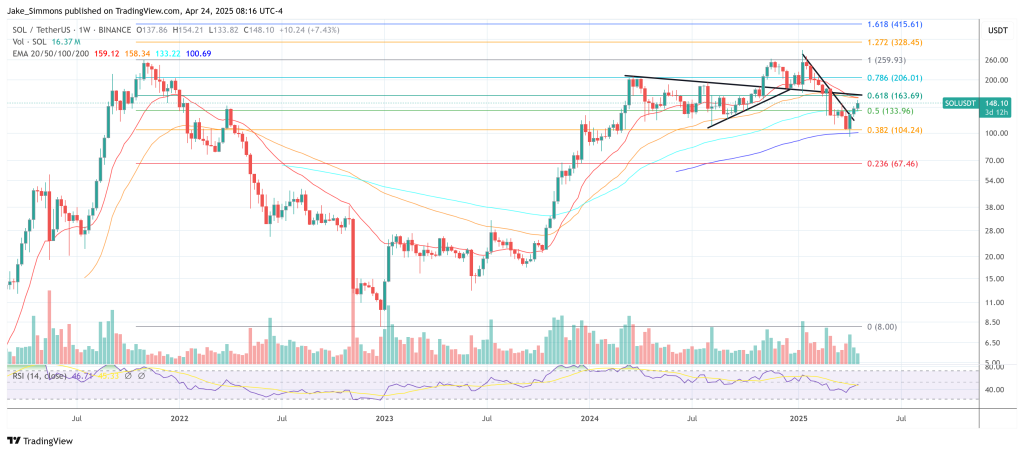
Solana price
SOL reclaims the 0.5 Fib, 1-week chart | Source: SOLUSDT on TradingView.com
Featured image created with DALL.E, chart from TradingView.com
Editorial Process for bitcoinist is centered on delivering thoroughly researched, accurate, and unbiased content. We uphold strict sourcing standards, and each page undergoes diligent review by our team of top technology experts and seasoned editors. This process ensures the integrity, relevance, and value of our content for our readers.

Jake Simmons has been a Bitcoin enthusiast since 2016. Ever since he heard about Bitcoin, he has been studying the topic every day and trying to share his knowledge with others. His goal is to contribute to Bitcoin's financial revolution, which will replace the fiat money system. Besides BTC and crypto, Jake studied Business Informatics at a university. After graduation in 2017, he has been working in the blockchain and crypto sector. You can follow Jake on Twitter at @realJakeSimmons.

Трендові криптовалюти

Пов'язані матеріали

Embodied Intelligence 'Gaokao' is Insanely Hard, Humans Score 100, Best Model Only 12.8

Embodied AI Faces a Daunting "Everest": New Benchmark Reveals Huge Gap Between Models and Humans A comprehensive new benchmark for robotic manipulation, RoboDojo, has been released, painting a stark picture of the current state of embodied AI. It serves as a unified evaluation platform covering both simulation and real-world robot tasks. The benchmark assesses five core capabilities: Generalization (adapting to new scenes/objects), Memory, Precision manipulation, Long-Horizon multi-step tasks, and Open semantic understanding. It includes 42 simulation tasks and 18 standardized real-world tasks across three dual-arm robot platforms. The results are sobering. In simulation, the best-performing generalist robot policy achieved an average success rate of only 8.80%. Performance in the real world was slightly higher but still low, with the top model succeeding 12.8% of the time on average. In stark contrast, human experts scored 76.03% in simulation and 100% in real-world tests. The benchmark highlights significant, uneven gaps in current models' abilities. While some excel in specific areas like visual recognition or simple actions, they struggle with reliability, especially in long-horizon tasks where errors accumulate and in open-ended semantic instructions. The low scores, particularly in real-world deployment with physical uncertainties like camera noise and contact dynamics, underscore that today's models are far from being robust, general-purpose operational robots. RoboDojo is more than just a ranking; it's an infrastructure designed for fair, reproducible comparison. Its companion system, XPolicyLab, standardizes the interface for different models to be evaluated. Maintained by an academic consortium without commercial ties, it aims to provide a community-wide "altitude meter" to track genuine progress toward reliable and generalizable robot manipulation.

marsbit1 год тому

Embodied Intelligence 'Gaokao' is Insanely Hard, Humans Score 100, Best Model Only 12.8

marsbit1 год тому

Zuckerberg's 'Mango' Image Generation Model Trails Only GPT Image 2, It Learned to Revise Prompts on Its Own

Meta's MSL has launched Muse Image, an advanced image generation model nicknamed "Mango," which ranks second globally in text-to-image benchmarks, closely trailing OpenAI's GPT Image 2. Its key innovation is agent-like behavior: it searches for factual information, writes code for charts, and, most notably, has developed self-correction abilities through reinforcement learning, allowing it to revise its own outputs without explicit programming. This shift emphasizes reasoning over immediate generation. Integrated with Meta's ecosystem, Mango connects with the Muse Spark language model for complex tasks and features a unique "@" function that can incorporate public Instagram photos into generated images—raising privacy concerns as it's enabled by default. The model is directly accessible in Meta AI, Instagram, and WhatsApp, leveraging Meta's vast user base for distribution rather than competing solely on image quality. Accompanying Mango is the preview of Muse Video, a video generation model with integrated audio, currently ranked third in its category. All Mango-generated images include an invisible, persistent watermark (Content Seal) for AI identification, alongside a public detection tool. While Mango advances "thinking" image models, its use of social data poses new ethical questions about consent and digital boundaries.

marsbit2 год тому

Zuckerberg's 'Mango' Image Generation Model Trails Only GPT Image 2, It Learned to Revise Prompts on Its Own

marsbit2 год тому

Торгівля

Спот

Популярні статті

Як купити T

Ласкаво просимо до HTX.com! Ми зробили покупку Threshold Network Token (T) простою та зручною. Дотримуйтесь нашої покрокової інструкції, щоб розпочати свою криптовалютну подорож.Крок 1: Створіть обліковий запис на HTXВикористовуйте свою електронну пошту або номер телефону, щоб зареєструвати обліковий запис на HTX безплатно. Пройдіть безпроблемну реєстрацію й отримайте доступ до всіх функцій.ЗареєструватисьКрок 2: Перейдіть до розділу Купити крипту і виберіть спосіб оплатиКредитна/дебетова картка: використовуйте вашу картку Visa або Mastercard, щоб миттєво купити Threshold Network Token (T).Баланс: використовуйте кошти з балансу вашого рахунку HTX для безперешкодної торгівлі.Треті особи: ми додали популярні способи оплати, такі як Google Pay та Apple Pay, щоб підвищити зручність.P2P: Торгуйте безпосередньо з іншими користувачами на HTX.Позабіржова торгівля (OTC): ми пропонуємо індивідуальні послуги та конкурентні обмінні курси для трейдерів.Крок 3: Зберігайте свої Threshold Network Token (T)Після придбання Threshold Network Token (T) збережіть його у своєму обліковому записі на HTX. Крім того, ви можете відправити його в інше місце за допомогою блокчейн-переказу або використовувати його для торгівлі іншими криптовалютами.Крок 4: Торгівля Threshold Network Token (T)Легко торгуйте Threshold Network Token (T) на спотовому ринку HTX. Просто увійдіть до свого облікового запису, виберіть торгову пару, укладайте угоди та спостерігайте за ними в режимі реального часу. Ми пропонуємо зручний досвід як для початківців, так і для досвідчених трейдерів.

477 переглядів усьогоОпубліковано 2024.12.10Оновлено 2026.06.02

Як купити T

Обговорення

Ласкаво просимо до спільноти HTX. Тут ви можете бути в курсі останніх подій розвитку платформи та отримати доступ до професійної ринкової інформації. Нижче представлені думки користувачів щодо ціни T (T).

活动图片