Chainlink & AVAX Gearing Up for a Major Price Rally, while XYZVerse Triggers a Buying Frenzy

bitcoinistОпубліковано о 2025-03-21Востаннє оновлено о 2025-03-21

Анотація

Chainlink and Avalanche are attracting attention as they hint at significant upward movements. At the same time, the presale of...

Trusted Editorial content, reviewed by leading industry experts and seasoned editors. Ad Disclosure

Chainlink and Avalanche are attracting attention as they hint at significant upward movements. At the same time, the presale of XYZVerse is causing a stir, igniting excitement among investors. Could these developments signal major shifts in the market? This article explores the factors behind these trends and what they might mean for the future.

Demand for $XYZ Surges As the Presale Approaches the $15M Milestone

XYZVerse

XYZVerse is the next heavyweight champion of meme coins. Crowned Best NEW Meme Project, it blends the electric energy of sports with meme culture, drawing in millions of fans who want to be part of something bigger.

Every great story needs a hero. Not the biggest, not the strongest—just the one crazy enough to keep pushing forward. That’s XYZepe, the masked fighter, the die-hard believer, and the relentless holder of $XYZ. His mission is to bring XYZVerse to the top of CoinMarketCap and carve XYZ into crypto history. In response, the CMC community is totally behind this future champ: 95% are super bullish on $XYZ.

But greatness isn’t handed out—it’s earned in the ring. $XYZ has already passed through 11 out of 15 presale stages, and the thriving community helps it build momentum for a mindblowing take off.

Undervalued at $0.003333, $XYZ is a bet worth making. By the end of presale, it’s set to soar to $0.1. The fight isn’t over, but the path to glory is clear.

Champions Get Rewarded

In XYZVerse, the community calls the plays. Active contributors aren’t just spectators—they’re rewarded with airdropped XYZ tokens for their dedication. It’s a game where the most passionate players win big.

The Road to Victory

With solid tokenomics, strategic CEX and DEX listings, and consistent token burns, $XYZ is built for a championship run. Every play is designed to push it further, to strengthen its price, and to rally a community of believers who know this isn’t just another meme coin—it’s the start of something legendary.

XYZepe is fighting for glory. Are you ready to join the ring?

AVAX: The Eco-Friendly Blockchain Revolutionizing Speed and Customization

AVAX is the native token of Avalanche, a blockchain that’s making waves for its speed and eco-friendliness. Avalanche can handle up to 4,500 transactions per second, offering quick and low-cost transactions. A standout feature is its customizable subnets, allowing users to create their own tailored networks. This opens up new possibilities for building unique applications. Avalanche uses a special consensus mechanism that combines old and new ideas to confirm transactions in less than two seconds.

In today’s market, AVAX is gaining attention because of these features. Its speed and low fees make it a strong contender against other blockchains like Ethereum, which can be slower and more expensive. The eco-friendly aspect appeals to those concerned about the environmental impact of blockchain technology. AVAX’s support for smart contracts and custom tokens adds to its versatility. As the market evolves, blockchains that offer scalability and sustainability are likely to stand out, making AVAX an interesting player to watch.

Link to the Future: How Chainlink Connects Smart Contracts to Reality

Chainlink is revolutionizing blockchain by bridging the gap between smart contracts and the real world. It allows smart contracts to securely access external data, APIs, and systems. By using a network of decentralized oracles and a reputation score mechanism, Chainlink ensures that the data feeding into smart contracts is accurate and reliable. Its unique three-step approach—data retrieval, data aggregation, and secure delivery—enables seamless interaction between blockchains and real-world applications. Chainlink’s architecture combines on-chain and off-chain components to efficiently process data requests and responses.

The potential of Chainlink lies in its ability to make smart contracts truly smart by connecting them to real-world data. This enhances their utility across various industries, from finance to supply chain. In the current market cycle, Chainlink stands out due to its robust technology and real-world applications. Compared to other coins, LINK has a strong use case and a secure, decentralized network. The LINK token not only rewards data providers but also supports staking for network security. With the growing demand for decentralized applications that interact with external data, Chainlink’s position in the market looks promising.

Conclusion

AVAX and LINK are poised for growth, but XYZVerse stands out as a pioneering sports memecoin aiming for significant gains and community-driven success.

You can find more information about XYZVerse (XYZ) here:

Site, Telegram, X

Editorial Process for bitcoinist is centered on delivering thoroughly researched, accurate, and unbiased content. We uphold strict sourcing standards, and each page undergoes diligent review by our team of top technology experts and seasoned editors. This process ensures the integrity, relevance, and value of our content for our readers.

Пов'язані матеріали

The Evolution Path of Physical Bitcoin

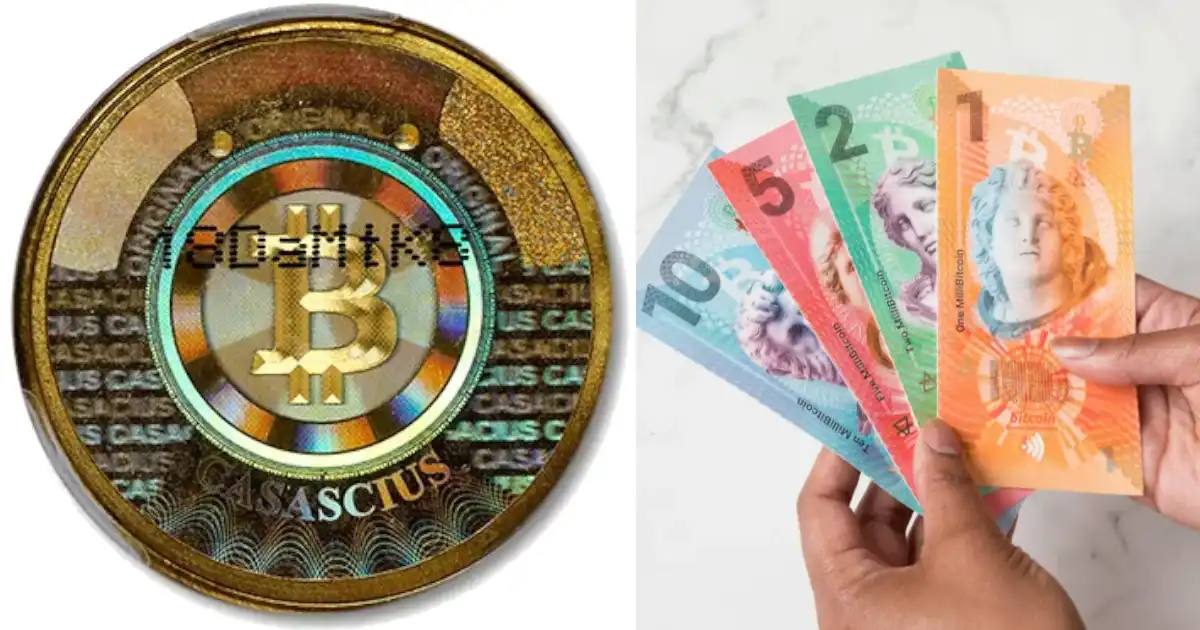
The Evolution of Physical Bitcoin Bitcoin's digital nature is its core strength, enabling self-custody and rapid global transfers. However, its intangibility also hinders mainstream adoption. For over a decade, creators have attempted to materialize Bitcoin while preserving its cash-like properties, yielding notable results. Casascius Coins, launched in 2011, were the first and most iconic physical Bitcoin. Creator Mike Caldwell generated private keys offline, printed them on coins, and sealed them with tamper-evident holograms. This model relied on user trust in the centralized issuer. Production ceased in 2013 due to regulatory pressure from FinCEN. RavenBit Coins emerged in 2014 aiming to decentralize minting by letting users generate and apply their own keys. However, this led to trust issues with numerous untrusted minters and insecure key generation methods. In 2016, Coinkite introduced Opendimes—a breakthrough in bearer asset technology. These USB-shaped devices generate and store keys internally. Funds can be received by checking the public key, but spending requires physically breaking the device to extract the private key. While innovative and open-source, its cost (~$20) and form factor limit its use for small, everyday transactions. Satochip's Satodime, a card-shaped device using similar secure chip technology, followed. It supports NFC interaction and comes in various forms. While potentially cheaper in bulk (~13€), it remains a high-security hardware wallet, not a low-cost cash substitute. A fundamental cost barrier exists. For physical Bitcoin to achieve widespread commercial use, hardware costs must drop below $1 to match the production cost of fiat banknotes. Current secure chips capable of running Bitcoin's cryptographic algorithms (like secp256k1) are too expensive. Chips like NXP's NTAG X DNA (~$3) show cost-reduction potential but lack native Bitcoin curve support. Projects like OfflineCash embed chips in banknote-like paper, but face challenges with durability, the need for custom Bitcoin-enabled chips, and the inherent requirement for users to verify balances online—which conflicts with Bitcoin's trustless ideal. Coinkite's Tapsigner, a ~$20 card with a proprietary Bitcoin NFC chip, is seen as a more practical step forward. It functions as a reloadable hardware wallet for contactless payments, solving the "change" problem and focusing on real-world retail integration, a direction also pursued by companies like Cash App and Square. In summary, the journey to physical Bitcoin has progressed from trusted centralized mints (Casascius) to user-generated keys (RavenBit) and finally to self-contained secure hardware (Opendimes, Satodime, Tapsigner). The core challenge remains developing a sufficiently low-cost, durable, and truly trustless physical bearer asset that can function like cash in daily transactions. Current solutions are either too expensive or introduce new trust assumptions, keeping the ideal of ubiquitous physical Bitcoin just out of reach for now.

marsbit51 хв тому

The Evolution Path of Physical Bitcoin

marsbit51 хв тому

Samsung Relies on Technology Cycles, SK Hynix on HBM, How Did Micron Win a Trillion-Dollar Market Cap?

Micron Technology, the third-largest memory chip maker alongside Samsung and SK Hynix, recently saw its market cap surpass $1 trillion. Founded in 1978 in Boise, Idaho, Micron survived brutal industry cycles while American peers and Japan's memory sector faltered. Its survival is attributed to a dual strategy: leveraging political and legal avenues for critical breathing room, coupled with relentless manufacturing cost control. Historically, Micron sought U.S. government intervention three times. In 1985, it filed an anti-dumping complaint against Japanese firms, leading to the U.S.-Japan Semiconductor Agreement. Ironically, this created an opening for Samsung, which later became its toughest competitor. In 2002, Micron turned "whistleblower" in a DRAM price-fixing investigation, escaping penalties while rivals were fined. In 2017, it sued China's Fujian Jinhua, contributing to its placement on a U.S. entity list, stifling a nascent competitor. However, a major strategic misstep occurred in 2013 with the acquisition of bankrupt Japanese firm Elpida. Integrating Elpida's mobile-DRAM-focused technology diverted resources, causing Micron to miss the critical early decade of development for High Bandwidth Memory (HBM)—the high-performance memory essential for AI chips like NVIDIA GPUs. By the time AI demand exploded in 2022, SK Hynix, which launched the first HBM in 2013, held about 85% of the HBM3 market, leaving Micron with roughly 3%. Micron now faces a triple squeeze. In the high-end HBM market, it lags significantly behind SK Hynix and Samsung. In the mid-to-low end DRAM market, it faces aggressive price competition from China's CXMT. Furthermore, a 2023 Chinese cybersecurity ban on its products slashed its revenue from China, a once-core market, from over 10% to just 7.1% by FY2025, causing it to exit China's data center server business. Beneath its political maneuvering lies Micron's core strength: exceptional manufacturing efficiency and cost control. Decades of engineering have yielded DRAM chips with a smaller cell area than rivals, meaning more chips per wafer and lower unit costs. This efficiency, not subsidies, has allowed it to withstand price wars. While political leverage bought time, Micron is now paying a "time debt" in the HBM race. It is racing to ramp up HBM3E production and develop HBM4, but catching up to competitors who started a decade earlier is a monumental challenge. Its future hinges on whether its expertise in cost control and political strategy can compensate for the lost time in a technology race where early-mover advantage is decisive.

链捕手1 год тому

Samsung Relies on Technology Cycles, SK Hynix on HBM, How Did Micron Win a Trillion-Dollar Market Cap?

链捕手1 год тому

New AMD Paper Overturns Conventional Wisdom: FP4 Training Instability's Cause Is Not Insufficient Randomness

AMD's new research challenges the conventional understanding of FP4 training instability. While reducing precision from FP8 to FP4 promises doubled computational throughput and is supported by new hardware like NVIDIA Blackwell and AMD MI350 series, training large language models natively with FP4 has been notoriously unstable, often attributed to insufficient stochasticity. The paper "Pretraining large language models with MXFP4 on Native FP4 Hardware" demonstrates successful end-to-end FP4 pre-training of Llama 3.1-8B on AMD MI355X GPUs using the MXFP4 format, achieving a 9-10% overall speedup over FP8. Crucially, it identifies the root cause of instability: not randomness, but the accumulation of *structural micro-scaling errors* along the sensitive weight gradient (Wgrad) path. Through controlled experiments, researchers found that quantizing the Wgrad operation to FP4 caused significant convergence degradation. Counterintuitively, common stochasticity-based mitigation techniques like stochastic rounding and randomized Hadamard transforms worsened performance. In contrast, applying a *deterministic* Hadamard transform successfully stabilized training by ensuring consistent error patterns, reducing the extra token cost from 26-27% to just 8-9%. This work has significant implications: 1) It provides a clear diagnostic for low-precision training instability, steering focus towards structural errors. 2) It pushes FP4 from a primarily inference-focused format into the realm of viable training. 3) It leverages the open OCP Microscaling (MX) standard, promoting cross-vendor compatibility. The research marks a critical step towards more economical large model training by further pushing the boundaries of low-precision computation.

marsbit1 год тому

New AMD Paper Overturns Conventional Wisdom: FP4 Training Instability's Cause Is Not Insufficient Randomness

marsbit1 год тому

Торгівля

Спот
Ф'ючерси

Популярні статті

Як купити LINK

Ласкаво просимо до HTX.com! Ми зробили покупку ChainLink (LINK) простою та зручною. Дотримуйтесь нашої покрокової інструкції, щоб розпочати свою криптовалютну подорож.Крок 1: Створіть обліковий запис на HTXВикористовуйте свою електронну пошту або номер телефону, щоб зареєструвати обліковий запис на HTX безплатно. Пройдіть безпроблемну реєстрацію й отримайте доступ до всіх функцій.ЗареєструватисьКрок 2: Перейдіть до розділу Купити крипту і виберіть спосіб оплатиКредитна/дебетова картка: використовуйте вашу картку Visa або Mastercard, щоб миттєво купити ChainLink (LINK).Баланс: використовуйте кошти з балансу вашого рахунку HTX для безперешкодної торгівлі.Треті особи: ми додали популярні способи оплати, такі як Google Pay та Apple Pay, щоб підвищити зручність.P2P: Торгуйте безпосередньо з іншими користувачами на HTX.Позабіржова торгівля (OTC): ми пропонуємо індивідуальні послуги та конкурентні обмінні курси для трейдерів.Крок 3: Зберігайте свої ChainLink (LINK)Після придбання ChainLink (LINK) збережіть його у своєму обліковому записі на HTX. Крім того, ви можете відправити його в інше місце за допомогою блокчейн-переказу або використовувати його для торгівлі іншими криптовалютами.Крок 4: Торгівля ChainLink (LINK)Легко торгуйте ChainLink (LINK) на спотовому ринку HTX. Просто увійдіть до свого облікового запису, виберіть торгову пару, укладайте угоди та спостерігайте за ними в режимі реального часу. Ми пропонуємо зручний досвід як для початківців, так і для досвідчених трейдерів.

1.1k переглядів усьогоОпубліковано 2024.12.13Оновлено 2025.03.21

Як купити LINK

Обговорення

Ласкаво просимо до спільноти HTX. Тут ви можете бути в курсі останніх подій розвитку платформи та отримати доступ до професійної ринкової інформації. Нижче представлені думки користувачів щодо ціни LINK (LINK).

活动图片