Тимоти Петерсон: через десять лет биткоин будет стоить $1,5 млн

cryptonews.ruОпубліковано о 2021-07-10Востаннє оновлено о 2025-01-10

Основатель инвесткомпании Cane Island Alternative Advisors и известный в криптосообществе аналитик Тимоти Петерсон считает, что биткоину нужно 10 лет, чтобы достичь отметки в $1,5 млн.

Свой прогноз эксперт основывает на собственной модели, в центре которой масштабирование сети биткоина.
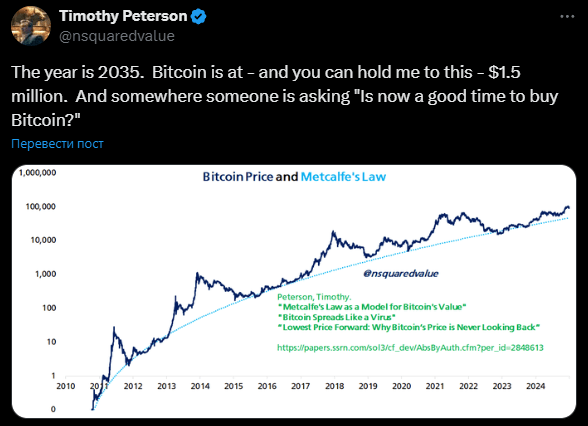
рис 1

Петерсон давно известен как сторонник биткоина. В 2018 году он заявлял, что массовое внедрение BTC по всему миру — это лишь вопрос времени.

Традиционные валютные модели не работают с биткоином, но различные математические законы, объясняющие сетевую связь, дают убедительное объяснение его ценности, — писал тогда Петерсон.

В 2020 году он правильно предсказал, что BTC никогда больше не опустится ниже $10,000. В прошлом году он угадал локальное дно цены биткоина в течение восьми дней, которое было зафиксировано в сентябре.

В последнем посте в соцсетях Петерсон уверил своих подписчиков в бычьем будущем ведущей криптовалюты.

И где-то кто-то всё ещё спрашивает: «Сейчас подходящее время для покупки биткоина?», — написал аналитик.

Мало кто из криптоэкспертов даёт столь долгосрочные прогнозы курса BTC. Однако в краткосрочной перспективе некоторые аналитики ожидают более глубокой коррекции цены актива вплоть до $73,800. Оптимистичные ожидания инвесторов связаны с предстоящей инаугурацией Дональда Трампа, которую многие считают поворотным моментом для всей криптоиндустрии.


Пов'язані матеріали

Outlook for the Post-Encryption Era: Asset Valuation Returns, What to Watch in the Next Decade?

The crypto economy is undergoing its most significant transformation in eight years, characterized by a shift from speculative frenzy to fundamental-driven growth. After the extreme overvaluation and unrealistic expectations of 2021, asset prices, including Bitcoin relative to gold, have corrected significantly. This reset has exposed structural industry weaknesses such as cyclical revenues, regulatory uncertainty, misaligned incentives between equity and token holders, poor disclosure, and a lack of common valuation frameworks, leading to widespread investor fatigue. However, this correction is healthy and has set the stage for a more mature phase. Numerous real-world use cases have emerged and are exhibiting compound growth, independent of token prices. These include peer-to-peer internet platforms, global digital dollars, permissionless exchanges, novel derivatives, global collateral markets, democratized asset creation, open fundraising platforms, and decentralized physical infrastructure networks. Key issues like dual-token models are being resolved, disclosure is improving, and a consensus is forming that most assets must generate cash flow. The leading blockchains (e.g., Ethereum, Solana) are becoming the monetary and financial base layer of the internet, with entrenched network effects. Established Wall Street and Silicon Valley institutions are now launching production-grade products on public chains, a shift accelerated by clearer regulations. While valuations have reset and growth models remain conservative, the potential for exponential growth remains. The broader macro environment—declining institutional trust, unsustainable sovereign debt, currency debasement, deglobalization, and a generational wealth transfer—is uniquely favorable for crypto's adoption. The market is not uniformly maturing; it consists of various products at different adoption stages where speculation will persist in cycles. The core opportunity lies in identifying the few native projects that will become foundational winners as the world rebuilds its economic systems. The current period of disillusionment conceals a generational opportunity for those betting on the new paradigm rather than mourning the old one.

Odaily星球日报36 хв тому

Outlook for the Post-Encryption Era: Asset Valuation Returns, What to Watch in the Next Decade?

Odaily星球日报36 хв тому

Cache hit rate reaches 99.93%, the best Harness for DeepSeek is here, GitHub pulls in 86k Stars

The open-source programming agent "Pi" has surged in popularity on GitHub, amassing around 86,000 stars, largely due to its exceptional efficiency when paired with DeepSeek's models. A key highlight is its remarkably high cache hit rate of approximately 99.93% for input tokens when using DeepSeek. This minimal cache miss rate of 0.07% means most repeated context is reused, drastically reducing computational costs. In a benchmark test by Composio comparing eight major agent harnesses running DeepSeek V4 Flash, Pi achieved the lowest average cost per successful task at about $0.028, significantly outperforming others like Claude Code, which was nearly seven times more expensive. Pi functions as a streamlined "harness" or workspace for AI models, providing core tools like file read/write and command execution while allowing users to add extensions. Its simplicity and specific adaptation for DeepSeek's API—handling its unique reasoning content and tool call formats—make it highly compatible. This design maximizes the efficiency of DeepSeek's low-cost tokens and powerful caching mechanism, as the agent's linear workflow avoids unnecessary changes to earlier prompt sections. While DeepSeek has officially announced its own harness project targeting Claude Code, Pi remains a versatile, user-customizable platform supporting multiple AI providers. It offers developers a cost-effective and flexible alternative, setting a high bar for future official solutions.

marsbit1 год тому

Cache hit rate reaches 99.93%, the best Harness for DeepSeek is here, GitHub pulls in 86k Stars

marsbit1 год тому

When Meme Traffic Meets RWA: The Financial Ambitions of Hyperliquid and Robinhood

When Meme traffic meets RWA: Hyperliquid and Robinhood's Financial Ambitions This article explores the transformative role of speculation in financial market evolution, arguing it can provide the liquidity and capital foundation for mature, compliant businesses. The analysis draws parallels to historical examples, like 19th-century Chicago grain markets, where speculators provided necessary counterparty liquidity for farmers, eventually establishing a global pricing infrastructure. The author examines contemporary cases in crypto. The launch of Uniswap's Pools meme token platform on Robinhood Chain—originally built for tokenized stock trading—demonstrates how speculative meme trading can drive significant user adoption and liquidity. Despite initial volatility, this traffic can seed future, more substantial financial activities. Similarly, Hyperliquid, which began with high-leverage crypto trading, has successfully migrated its speculative model to real-world assets (RWAs) like equities, commodities, and indices. By July, RWA perpetual contract volumes on Hyperliquid surpassed its crypto trading for the first time, showcasing how speculation can build new, all-weather pricing layers. The core thesis is that speculation itself is neutral. Its long-term value and sustainability are determined by the underlying assets it engages with. While pure bubbles collapse, speculation anchored to valuable assets—be it wheat, gold, or equities—can evolve into foundational market infrastructure. Both Hyperliquid’s RWA platform and Robinhood’s strategy of leveraging meme coin enthusiasm to build towards on-chain securities trading exemplify this potential pathway from speculative frenzy to structured financial utility.

marsbit1 год тому

When Meme Traffic Meets RWA: The Financial Ambitions of Hyperliquid and Robinhood

marsbit1 год тому

NVIDIA HBM in Short Supply, Next-Gen GPUs Limited, but This Storage Drive Steals the Spotlight

The article discusses how AI Agents are transforming storage from a passive repository into an active component within AI inference and operation loops. As Agents perform continuous tasks involving models, memory, tools, and logs, data storage needs to evolve beyond simple block devices. The concept of "functional SSDs" is introduced, where capabilities like automatic encryption, compression, indexing, and memory management are embedded closer to the storage medium. This shift is driven by the need to handle Agent-specific data chains—including context, tool trajectories, and long-term memory—more efficiently. The piece analyzes current trends like AI SSDs from companies such as Phison (aiDAPTIV), Longsys (SPU+iSA), and Maxio, which are beginning to participate in the AI data path by managing model weights, KV cache, and prefetching. It further explores the future re-division of labor across the memory hierarchy: HBM for core compute, emerging High Bandwidth Flash (HBF) for read-intensive workloads, DRAM/CXL for mutable state, and functional SSDs for persistent, governed objects like Agent Memory. The conclusion is that storage will become integral to Agent capability, moving from just saving data to enabling next-step actions. The industry is poised to develop along three paths: functionalized SSDs, storage nodes tailored for Agents, and a re-architected, tiered memory system optimized for access patterns, security, and cost-per-token efficiency.

marsbit1 год тому

NVIDIA HBM in Short Supply, Next-Gen GPUs Limited, but This Storage Drive Steals the Spotlight

marsbit1 год тому

Торгівля

Спот
活动图片