As encryption, compression, indexing, memory, and context services move closer to the storage medium, the value boundaries of SSD, DRAM, HBM, and HBF will be redrawn.
AI Agents are transforming computers from systems that "complete a model call after receiving a problem" into running systems that continuously observe, reason, call tools, modify the environment, and maintain state.
A single task might continuously access models, memory, vector indices, business databases, object storage, and web services, while also constantly writing back tool results, execution traces, user preferences, temporary context, and audit logs. The longer an Agent runs, the more its value depends on whether data can be securely saved, correctly retrieved, timely updated, and reused at low cost [1].
This means storage is no longer just the endpoint where data lands after an Agent finishes its work. It is progressively entering the Agent's perception, memory, and decision loops. AI SSDs have already shown the first directions: storing models and adapters, hosting KV Cache evicted from memory, reducing cold start times, and expanding deployable model capacity. Taking a step further, SSDs may also perform encryption, compression, deduplication, tagging, indexing, version maintenance, and lifecycle governance when data is written, and provide long-term capacity for Agent Memory.
This change hasn't appeared out of thin air. Self-encrypting drives can already transparently encrypt and decrypt data within the controller; computational storage standards list compression, encryption, regular expression filtering, and erasure coding as functions that can be executed by the storage side; products like Samsung's SmartSSD have offloaded database scans and video processing to the drive side [4][5][7]. What's new in the Agent era is that these capabilities are no longer solely serving general-purpose data processing but are starting to be reorganized around agent identity, context, memory, tool traces, and token cost.
Future markets might see products named "Secure SSD," "Compression SSD," "Retrieval SSD," "Memory SSD," or "Context SSD," or perhaps these won't form distinct hardware categories but will converge into programmable functional SSDs: the base form remains compatible with standard storage, while upper-layer software discovers and invokes device functions based on the scenario.
NVMe has already formed command sets like Computational Programs and Subsystem Local Memory, providing a standardized path for discovering, configuring, and executing device-side programs [6]. The real industry question is not just whether a processor can be placed inside the drive, but who defines the data semantics, functional boundaries, and end-to-end outcomes.
An Agent is Not a Single Call
But a Continuously Written Data Chain
The primary persistent object for traditional chatbots is conversation history, whereas Agents will generate more complex data graphs. They need to save observations, tool outputs, plans and reflections, intermediate task states, user profiles, environment snapshots, retrieved evidence, and execution logs; the model side also generates KV Cache, Prefix Cache, Adapters, expert weights, and Checkpoints. These objects have different update frequencies, reuse scopes, and security levels, yet collectively determine whether subsequent reasoning can continue.
Agent Memory is also not simply stuffing all historical conversations into a vector database. Recent systematic research on Agent Memory from a data management perspective breaks it down into four modules: representation & storage, information extraction, retrieval & routing, and maintenance, noting that no single architecture excels across all workloads [9].
Systems like Mem0 similarly emphasize converting raw conversations into more compact, reusable long-term memory to reduce input tokens and retrieval burden in long sessions [10]. This implies that the storage layer in the future must not only store content but also store how the content is organized, updated, and forgotten.
Therefore, Agent data persistence requires a richer contract than "write succeeded." A memory object should carry attributes like user/agent identity, tenant, source, time, version, permission, trustworthiness, retention period, and deletability; model context also needs to bind to model version, tokenizer, positional encoding, and adapter. Only when namespaces and lifecycles are explicitly defined can subsequent compression, indexing, caching, and sharing avoid breaking semantic boundaries.
The appropriate role for a functional SSD in this data chain is not to independently judge whether an experience is worth remembering, but to execute deterministic work close to the data once the Runtime has provided the object and policy. For example, selecting keys per tenant, placing data according to lifecycle, compressing and deduplicating eligible objects, maintaining index pages and metadata, prioritizing the reload of data about to be used for inference, and providing feedback on tail latency, write amplification, and media health to the upper layer. Semantic decisions stay with the Agent and Runtime, while data execution gets as close to the medium as possible.
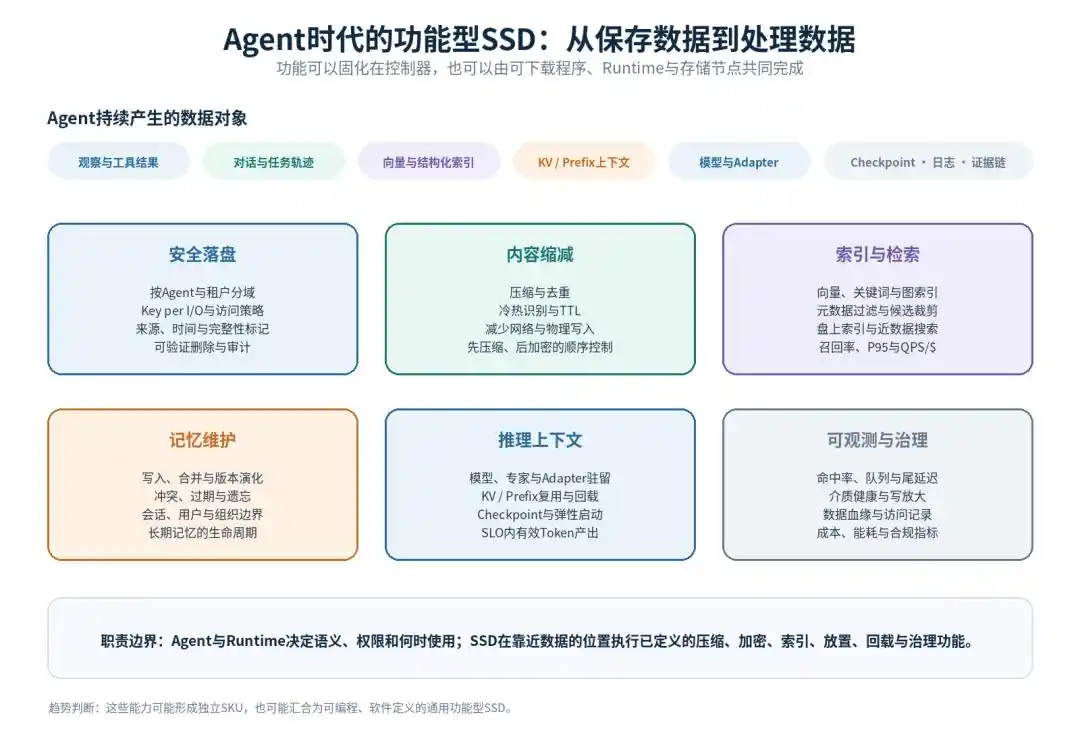
Figure 1. The capability spectrum of functional SSDs in the Agent era. Security, content reduction, indexing, memory, inference context, and governance functions can be solidified in the device or co-executed by downloadable programs, Runtime, and storage nodes. The figure is an industry mechanism inference; computational storage and security capability boundaries refer to SNIA and NVMe specifications [4][5][6].
Key Judgment: The SSD upgrade in the Agent era is not simply about adding in-drive compute power, but about combining standard block devices, discoverable near-data functions, object semantics, and lifecycle governance. Functions closer to the medium should be more deterministic, auditable, and isolatable; decisions closer to the model need to remain in the Runtime.
Automatic Encryption Already Exists; the Change is that Policies are Starting to Follow Agents
"Automatically encrypting data on write" is not a futuristic concept. Self-encrypting drives (SEDs) use dedicated hardware in the controller to encrypt data on writes and decrypt on reads, achieving transparent data-at-rest protection through key management and policy control [5].
For Agent systems, the new requirement is that the encryption granularity evolves from the entire drive or a single namespace to a finer level of user, agent, task, and object: personal memory and application cache on the same endpoint device must not be able to breach each other's boundaries, and shared context for multi-tenant Agents on the cloud side must clearly define what is reusable and what is readable only within a single permission domain.
The NVMe specification has already introduced capabilities like host-managed keys and Key Per I/O [6], laying the foundation for carrying different security contexts with each I/O. Future security-focused SSDs may also combine data provenance, timestamps, access records, integrity verification, and secure deletion, enabling an Agent to not only answer "what do I remember" but also "where did this memory come from, has it been modified, who read it, and when must it be deleted." For finance, healthcare, enterprise knowledge bases, and personal AI, the chain of evidence can be as crucial as retrieval speed.
Encryption also changes the sequence of other near-data functions. Encrypted byte streams are typically difficult to compress and deduplicate effectively, so content reduction should generally precede encryption [5]; indexing needs to distinguish between plaintext features, protected metadata, and searchable ciphertext boundaries. The competitiveness of a functional SSD lies not only in how many functions it has but also in whether it can correctly orchestrate compression, indexing, encryption, persistence, and deletion with a verifiable pipeline, while avoiding expanding the attack surface at any step.
Compression, Indexing, and Memory Maintenance Could Become the Next Set of SSD Functions
Compression is one of the functions easiest to form a commercial closed loop. Agents repeatedly write text, JSON, logs, vectors, checkpoints, and multimedia intermediate results, a significant portion of which has structural redundancy. If compression is completed before data enters the network or NAND, it can reduce transmission, physical writes, capacity usage, and indirectly lower energy consumption and media wear. However, compression ratio, added latency, CPU savings, and write amplification must be weighed together; for already quantized or highly compressed model weights, further compression may offer limited benefit.
The indexing function has a more direct relationship with Agents because memory only has value if correctly recalled. KIOXIA's AiSAQ places vectors and index structures on the SSD, using SSD-friendly clustering and graph search to reduce DRAM footprint, and has demonstrated tens of billions of vector scale retrieval on a single server [8]. It is crucial to distinguish that AiSAQ is primarily a software technology using SSDs as the main index carrier; it does not mean ordinary SSDs will automatically generate embeddings or understand semantics. A more likely industry path is that GPUs, NPUs, or CPUs are responsible for generating representations, while SSDs and near-data programs handle organizing indexes, filtering candidates, and returning smaller result sets.
Memory maintenance is more complex than indexing. Long-term Agent Memory involves addition, merging, conflict, revision, deprioritization, expiration, and forgetting; the same fact may also exist simultaneously as raw record, summary, vector, and knowledge graph representation [9]. Future "Memory SSDs" could provide atomic updates, logs, TTLs, hot/cold placement, and secure deletion for these versions, but they cannot determine what constitutes true memory based solely on similarity. Memory quality still depends on upper-layer extraction, routing, conflict resolution, and evaluation.
From a product perspective, these functions may not require every drive to run complex models. Compression, encryption, hashing, filtering, index page maintenance, and object lifecycle management are suitable for deterministic dedicated circuitry or lightweight programs; embedding generation, reranking, summarization, and memory consolidation are likely performed by the host or independent accelerators.
The key for functional SSDs is to connect these two types of work using unified object IDs and observable interfaces, thereby reducing data movement, rather than cramming all AI computation into the drive.
Edge-side: SSDs Could Become the Long-Term State Layer for Personal Agents
Edge-side Agents continuously interact with personal documents, photos, emails, schedules, application states, browsing history, and device sensor data. Unified memory is only suitable for retaining the current working set, while SSDs can store larger local model libraries, adapters, vector indices, personal memory, and tool traces. As long as they maintain the standard NVMe form factor, functional SSDs can first be directly installed as ordinary system drives in AI PCs and workstations, then gradually enable security, indexing, and context capabilities through drivers, runtime, and firmware.
Their value to consumers isn't "the hard drive can think," but that local AI can remember longer, continue working in weak network conditions, and reduce the amount of raw data and input tokens uploaded to the cloud per task. A meeting Agent can retain audio, summaries, and task state; a programming Agent can maintain repository indices and change history; a home Agent can share authorized photos, documents, and device statuses across devices. The SSD keeps this state near the device, while a Router decides whether to process locally or call the cloud based on quality, privacy, power consumption, and network conditions.
The edge market might also expand from a single drive to small storage nodes. AI PCs, home servers, or storefront edge boxes could provide local model images, personal memory, vector libraries, and encrypted archives for phones, tablets, robots, and cameras, preventing each device from redundantly storing the same data set. The business model could evolve from capacity upgrades to AI PC premiums, local Agent subscriptions, model & skill pack management, and private AI nodes for homes and small businesses.
Local storage does not automatically equal privacy. If applications can arbitrarily read memory, indices cannot delete old versions, or keys are disconnected from device identity, more features could mean a larger attack surface. Edge functional SSDs must treat application isolation, user consent, retention periods, verifiable deletion, and key revocation upon device loss as product capabilities, not just marketing slogans.
Cloud-side: SSDs Will Evolve from Devices to Agent Storage Nodes
Cloud-side Agent state is larger in scale and more in need of sharing. A complex request may chain multiple model calls, tool executions, memory accesses, and network transfers; multi-agent collaboration also generates shared plans, messages, evidence, and execution logs [1]. Node-local SSDs can store models, checkpoints, and high-frequency indices; rack or pod-level flash tiers can host KV, prefix, adapters, and shared memory reused across GPUs; general-purpose object storage continues to hold cold data and long-term fact sources.
Mooncake has already organized CPUs, DRAM, SSDs, and RDMA/NIC into a distributed KV Cache pool, letting the scheduler decide request paths based on cache location and TTFT/TBT targets [3]. NVIDIA's CMX establishes a pod-level flash context layer for KV Cache between HBM, host memory, and general-purpose shared storage, integrating shared storage nodes into the inference data path [2]. The end-to-end benefits of these systems cannot be attributed to a single SSD, but they indicate that "storage nodes participating in token production" is moving from concept to infrastructure product.
The next generation of Agent storage nodes might simultaneously provide context, memory, and governance services. It could maintain shared prefix and KV directories, pre-warm models and adapters, store vector and graph indices, compress and encrypt data per tenant, log tool calls and evidence chains, and expose hit rate, P99 latency, write amplification, energy consumption, and media health to the scheduler. Customers would be buying not just drive capacity and bandwidth, but GPU utilization, SLO goodput, Tokens/$, Tokens/Watt, QPS/$, and audit response speed.
This will also change the business model. Single drives can still be sold based on capacity, endurance, and performance; storage nodes could generate combined revenue as multi-drive appliances, control plane software, runtime licenses, long-term support, and SLAs; higher up, services might be billed based on effective context capacity, memory object count, retrieval throughput, or effective tokens. Once functional SSDs become accountable for end-to-end outcomes, their value boundary expands from semiconductor components to data infrastructure.
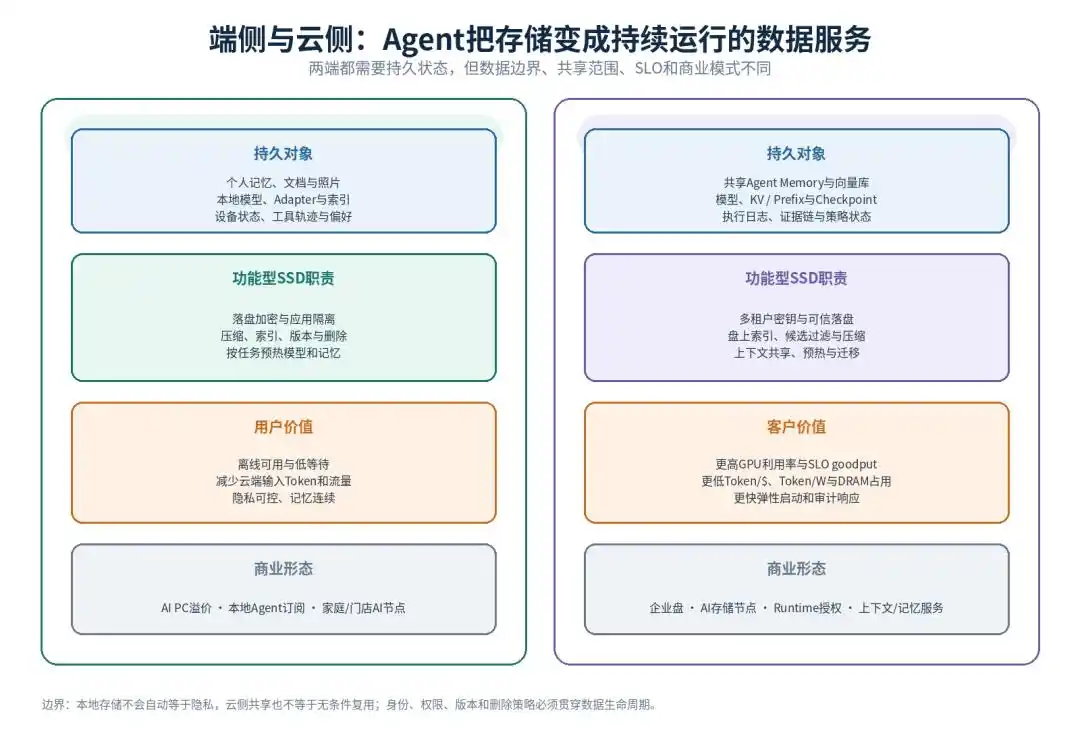
Figure 2. Typical division of labor for edge and cloud Agent storage. Edge emphasizes personal data, local models, offline capability, and privacy control; cloud emphasizes shared context, multi-tenant governance, GPU utilization, and token economics. The figure illustrates product form factor inferences; cluster-side references include Mooncake and CMX [2][3].
The Value Boundaries of HBM, HBF, DRAM, and SSD Will Be Redrawn
The storage restructuring brought by Agents should not be interpreted as SSDs replacing memory. The tiered memory concept proposed by SK hynix at FMS 2026 connects HBM, DRAM, NAND/HBF, and SSD by speed, capacity, and cost, focusing on reducing data movement [11]. This aligns with the reality of Agent systems: data required for the current token, data needed within a few milliseconds, data potentially reusable across sessions, and long-term archived data need to be handled by different media.
HBM remains the core layer closest to GPU compute, hosting current weights, activations, hot KV cache, and intermediate operator states, with metrics being Tokens/s, bandwidth, and compute utilization. Agents' long context and multi-model collaboration will further increase HBM demand, not diminish its value. The constraints for HBM are capacity cost and supply, so systems need to move data not immediately needed to lower-cost tiers and accurately pre-fetch it before use.
HBF, or High Bandwidth Flash, is a new tier that has rapidly taken shape since 2025. The first open specifications disclosed by SK hynix and SanDisk in August 2026 cover capacities up to 512GB, bandwidth divided into three levels from ~0.4TB/s to 3.0TB/s, and UCIe connectivity to processors [12]. HBF uses NAND to achieve larger capacity than HBM, aiming to host large, read-intensive inference working sets between HBM and SSDs. It is still in the early stages of standardization and productization; official specs don't equate to widespread production performance, nor do they eliminate NAND's limitations in latency, write endurance, and variable state access.
The H3 research suggests a clearer division of labor: place read-only data in HBF and keep other data in HBM, building a hybrid inference system leveraging the strengths of both [13]. For Agents, HBF is more suitable for model weights, MoE experts, and large working sets dominated by reads; frequently updated KV cache, activations, and runtime states are still more suitable for HBM or DRAM. If HBF matures, it might reduce the need to add more GPU/HBM for capacity reasons, but more likely it will complement rather than replace them.
DRAM and CXL occupy the middle ground for mutable state and shared capacity. Host KV, index hot sets, prefetch buffers, and Agent runtime states require low latency and frequent modification; CXL expansion, pooling, and sharing can reduce memory islands and provide more flexible capacity to multiple hosts [14]. SK hynix also demonstrated CXL pooled memory and DRAM-SSD hybrid solutions for KV sharing, prediction, and prefetching at FMS 2026, but these are specific demo results requiring validation on more platforms [11].
Functional SSDs handle larger, more persistent, and more governance-intensive warm/cold objects: models, adapters, KV/prefix, vector indices, Agent Memory, logs, and checkpoints. Compared to HBF, SSDs are farther from compute but possess standard form factors, mature ecosystems, capacity and cost advantages, and are better suited for node-level sharing. Future competition won't revolve solely around media bandwidth but around who can deliver the right object within the right deadline and be accountable for effective tokens, retrieval throughput, and data governance.
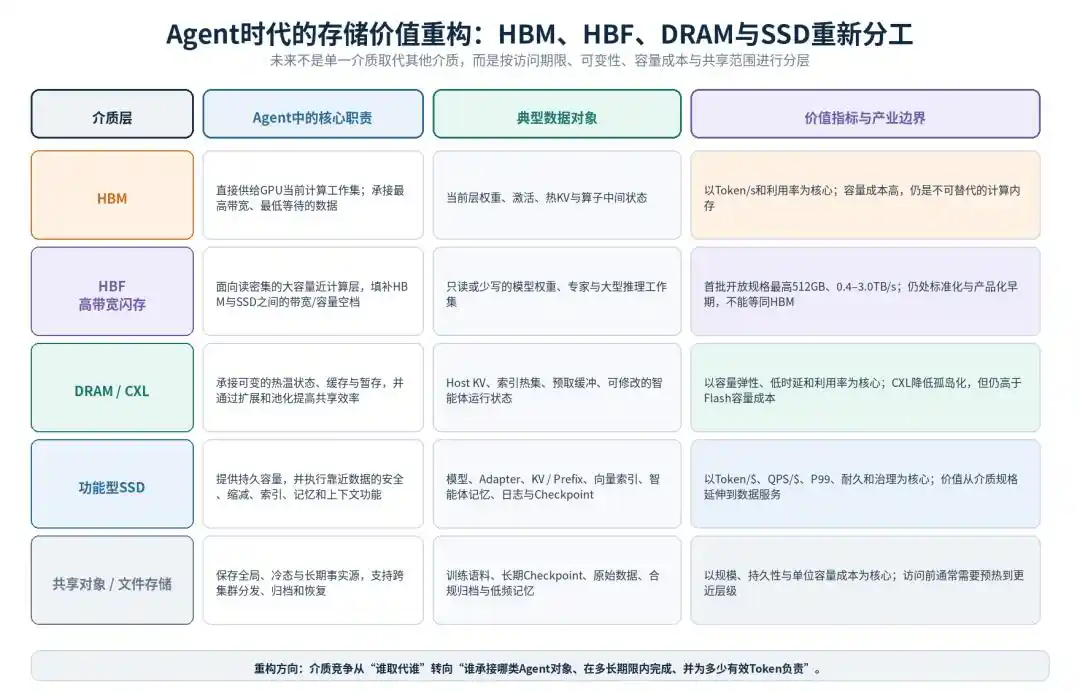
Figure 3. Re-division of labor among HBM, HBF, DRAM/CXL, functional SSDs, and shared storage in the Agent era. HBF specifications use the first open standard specifications disclosed by SK hynix and SanDisk in August 2026 [12]; tiering logic references FMS 2026 Tiered Memory, H3, and CXL materials [11][13][14].
AI SSDs are the First Industrial Examples of Functional SSDs
Current AI SSDs generally enter this trend from two ends. One end is enterprise SSDs optimized for AI workloads, providing a medium foundation for model caching, checkpoints, and vector indices through low latency, high IOPS, sustained bandwidth, endurance, and capacity density. Representatives in this category include Yingren Technology's Dongting N3X and Huawei's OceanDisk LC 560 [19][20]. They primarily address whether AI data can be stably hosted, continuously written, and promptly recalled. They don't automatically possess Agent Memory, indexing, or context semantics just because they are AI-oriented. The other end actively participates in the inference data path: SSDs no longer merely receive generic block requests from the OS but, through middleware, runtime, or storage-side processing capabilities, gradually identify AI objects like model weights, experts, KV cache, and prefetch windows. Phison, Longsys, and Innopeak-Lianyung are three representative research and development approaches in this direction.
Phison's aiDAPTIV adopts a "mature SSD capabilities + middleware + complete toolchain" approach. aiDAPTIVLink manages memory between GPU VRAM and flash, slicing model weights at runtime, prioritizing active weights in VRAM, offloading inactive weights to aiDAPTIVCache SSD, and potentially saving evicted KV cache to avoid recomputation when context is discarded [15]. The commercial value of this path lies in combining SSD, software license, deployment tools, and system support into a deliverable solution: customers can expand usable model and context capacity on workstations or local servers without redesigning compute chips. Its technical focus is compatibility with existing GPU and AI software ecosystems, leveraging mature controllers, firmware, endurance design, and platform partnerships to turn flash into a stable capacity layer alongside VRAM.
Longsys's SPU+iSA is closer to a "storage execution layer + software decision layer" combination. The SPU handles lossless compression, HLC advanced caching, and data scheduling between different NAND media on the device side; iSA makes decisions around MoE expert offloading, KV cache lifecycle, and Device Smart Prefetch, translating AI workload characteristics into prefetch, backfill, compression, and hot/cold migration actions [16]. Thus, it focuses not only on fitting more data into the SSD but also on reducing DRAM footprint, increasing effective capacity, and aligning storage-side processing with endpoint inference rhythm. This path shows that when the controller vicinity possesses stronger execution capabilities, SSDs can evolve from block devices into near-data processing nodes capable of handling compression, caching, and object scheduling.
The Innopeak-Lianyung approach adopts a compute-storage co-defined route. Innopeak starts from model architecture, runtime, OS, CPU/GPU/DRAM synergy, and system reference designs to observe expert activation, KV lifecycle, data precision, and compute windows; Lianyung maps these requirements onto SSD controller, firmware, cache partitioning, queues, NAND adaptation, and mass production systems [17][18]. This allows product definition to reason backward from token latency, model capacity, and system SLO to determine when data should enter the SSD, at what granularity to save it, how to prefetch, and which operations are suitable to offload near the controller, rather than just optimizing existing block I/O. Compared to the previous two paths, this cross-compute-storage collaboration requires deeper system synergy but is more likely to identify new data path problems early and form new device interfaces as model architectures and inference infrastructure continuously evolve.
These three paths are not mutually exclusive. Phison's strength lies in packaging capabilities into deployable solutions rapidly through mature controllers, SSD products, and software toolchains; Longsys attempts to place more processing and scheduling on the storage side with SPU and iSA; Innopeak-Lianyung reverse-engineers device definitions from the junction of compute semantics and storage execution. Together, they illustrate that the core innovation of AI SSDs has shifted from "replacing the drive with a faster one for AI" to "re-partitioning responsibilities between Runtime, memory hierarchy, controller, and flash." This is also why AI SSDs can serve as precursors to functional SSDs: once software can convey object type, priority, lifecycle, and service deadline to the device, the SSD gains the foundation to host more deterministic functions.
Similar R&D approaches could very well migrate to next-generation functional SSDs. Following Phison's path, vendors could add encryption, compression, indexing, and memory service modules managed per Agent or tenant within the SSD+middleware combo, lowering deployment barriers through software compatibility and delivery tools. Following Longsys's path, compression, hot/cold scheduling, index scans, or data consolidation could be executed by the storage processing unit, with policies issued by an upper-layer intelligent scheduler. Following Innopeak-Lianyung's path, one could start from Agent runtime requirements for long-term memory, permissions, TTL, retrieval SLO, and token cost, then co-define controller commands, object metadata, firmware queues, and media layout. The first two paths excel in productization and device-side execution, respectively. The latter path, because it understands both how compute systems consume data and how storage systems organize data, potentially has greater design space when exploring new functions not yet standardized.
This cross-domain background will be even more significant in the Agent era. Many future storage functions are not purely in-drive algorithms: encryption needs to understand permission boundaries for agents, users, and tasks; compression needs to know when data will be used for computation again; indexing needs to collaborate with embedding generators, retrievers, and model routers; Agent Memory also involves writing, merging, forgetting, versioning, and evidence chains. Starting solely from the medium side can easily reduce the problem to bandwidth, capacity, or single operators; starting solely from the model side may overlook FTL, write amplification, tail latency, power-loss protection, and mass production constraints. Collaborative R&D approaches like Innopeak-Lianyung's are precisely positioned to find implementable interfaces between these two sets of constraints, thus having the potential to form differentiated technology paths when developing new functional SSDs, AI storage nodes, and even Agent data infrastructure.
From the functional SSD perspective, the importance of these schemes lies not just in whether they can expand a specific model's capacity, but in that they establish channels for software to exchange information with the medium. Today, they convey model layers, experts, KV blocks, and prefetch hints; tomorrow, they could extend to Agent identity, memory objects, versions, TTLs, access policies, indexing hints, and deadlines. Whoever can solidify functions into stable interfaces, rather than customizing one-off paths for a single model, is more likely to transcend model generations and expand single-drive revenue into runtime licenses, storage nodes, context services, and data services billed per effective token.
Beware of concept inflation. Auto-compression doesn't mean all data saves the same capacity; on-drive indexing doesn't mean the SSD understands semantics; Agent Memory isn't moving a vector database into firmware. Each function should be proven by end-to-end metrics, including compression ratio vs. added latency, recall rate vs. QPS/$, P99 vs. SLO, write amplification vs. endurance, key isolation vs. deletion verification, and ultimately, Tokens/$ and Tokens/Watt.
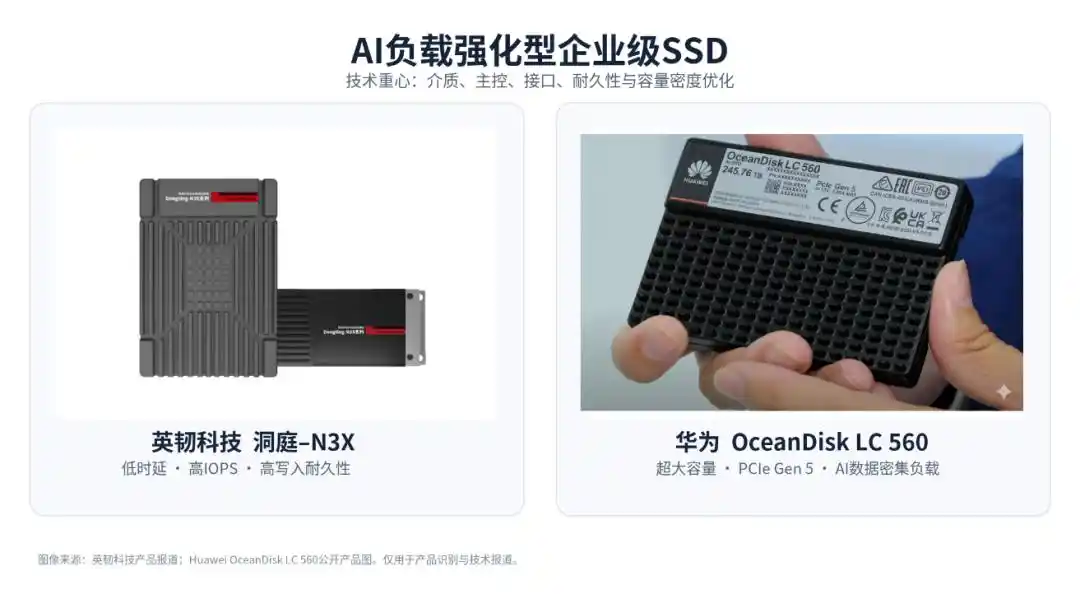
Figure 4. Representative products of AI workload-optimized enterprise SSDs: Yingren Technology's Dongting N3X and Huawei's OceanDisk LC 560. Original images retained; product information from [19][20].
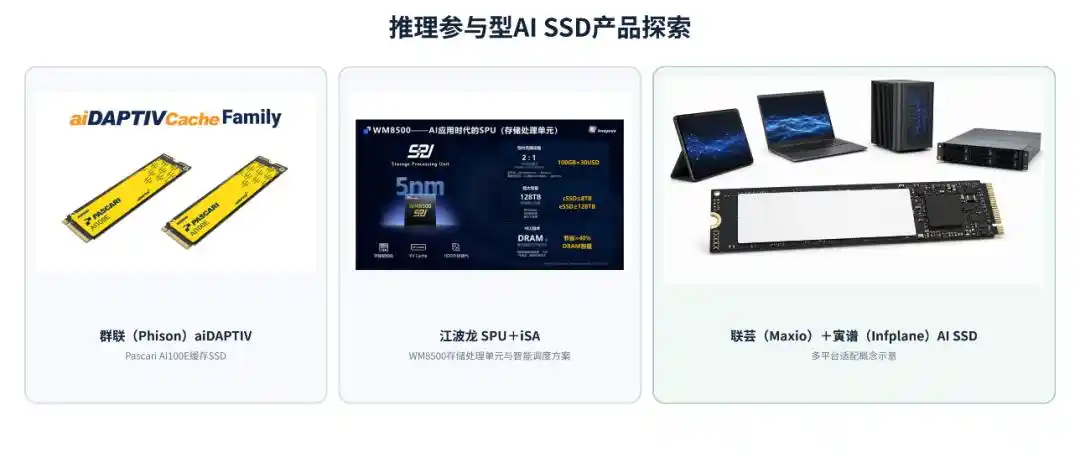
Figure 5. Explorations in inference-participatory AI SSDs: Phison aiDAPTIV, Longsys SPU+iSA, and Innopeak-Lianyung AI SSD approach. Original images retained; path information from [15][16][17][18].
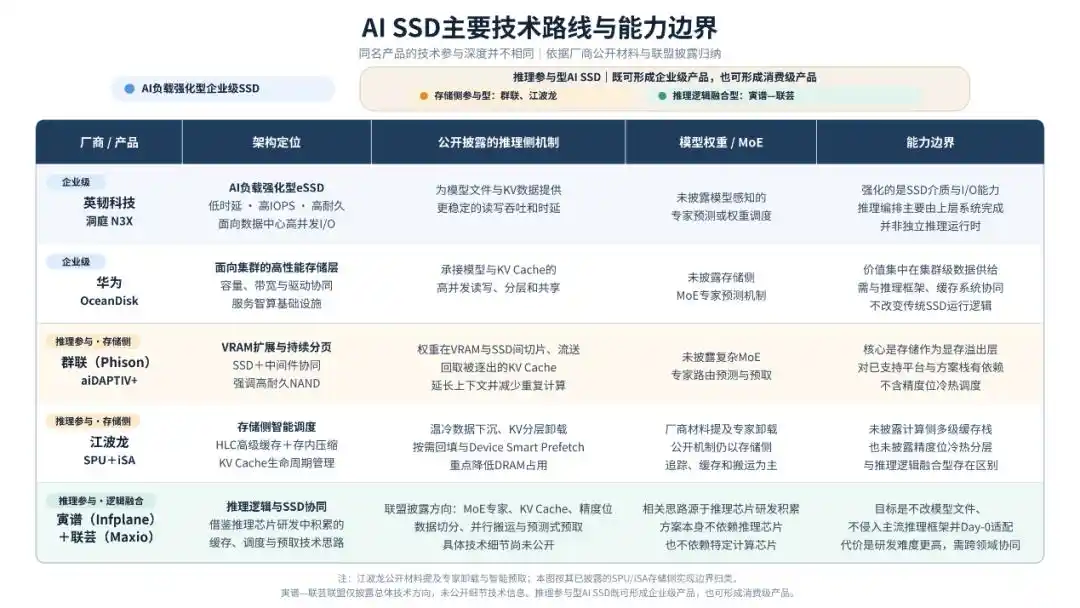
Figure 6. The role of AI SSDs in the LLM inference path and major vendor technology paths summarized in the original article. Original image retained; the added perspectives of encryption, compression, indexing, Agent Memory, HBF, and tiered storage are industry extensions based on this, not altering the existing logic in the figure.
The Future Industry May Develop Along Three Directions Simultaneously
The first direction is the functionalization of SSDs. General-purpose drives will continue to exist, but capabilities like security, compression, retrieval, memory, and context will enter products as fixed functions, downloadable programs, or software-defined configurations. The end market may not need five different SSD types but rather a framework of discoverable, composable, and isolatable functions, with consumer, enterprise, and cloud service products choosing different capability combinations.
The second direction is the nodalization of storage. Single drives solve local capacity and near-data processing, while AI storage nodes combine multiple drives, networking, object directories, keys, indices, context services, and observability, being accountable for end-to-end SLO. Edge nodes serve individuals and device fleets; cloud nodes serve GPU clusters and multi-agent systems. The competitive unit will expand from "per drive" to "how many effective tokens and retrieval requests can a site, rack, or POD deliver."
The third direction is the re-composition of the memory hierarchy. HBM continues to pursue peak bandwidth, HBF attempts to provide larger read-intensive capacity near the package using NAND, DRAM and CXL handle mutable state, expansion, and pooling, functional SSDs provide persistent objects and near-data services, and shared storage holds global cold fact sources. The most valuable system capability will be enabling routers and runtimes to simultaneously see compute power, data location, permissions, deadlines, and media state, orchestrating across multiple tiers instead of relentlessly stacking a single medium.
This will redraw industry barriers. Media vendors control capacity, bandwidth, and efficiency; controller and firmware vendors determine if functions can be stably implemented; runtimes and Agent platforms control object semantics and scheduling; OEMs, cloud providers, and system integrators decide how functions enter real products. Companies that can cross these boundaries, establish standard interfaces, and prove customer outcomes with token economics are more likely to propel SSDs from data containers to the foundational data layer of the Agent era.
Conclusion: Storage Will Become Part of Agent Capability
AI Agents extend storage's value from "preserving the past" to "enabling the next action." Models need weights, inference needs context, Agents need long-term memory and trustworthy evidence, and enterprises need security, compliance, auditing, and cost control. The closer encryption, compression, indexing, memory maintenance, and context services are to the data, the greater the opportunity to reduce movement, recomputation, and DRAM footprint, but the greater the need for clear permission, semantic, and responsibility boundaries.
Therefore, AI SSDs are just the starting point. The future may see more SSDs with specific functions, or converge into unified programmable functional SSDs and Agent storage nodes. Meanwhile, HBM, HBF, DRAM, CXL, and SSDs won't evolve along a simple substitution chain but will re-divide labor based on access frequency, mutability, sharing scope, and retention period. The real industrial opportunity lies in translating the advantages of each medium into lower token cost, higher Agent continuity, and more trustworthy data lifecycle.
References:
[1] NVIDIA, "Scaling Agentic AI Factories Through Extreme Co-Design with NVIDIA BlueField," 2026.https://developer.nvidia.com/blog/scaling-agentic-ai-factories-through-extreme-co-design-with-nvidia-bluefield/
[2] NVIDIA, "Introducing NVIDIA BlueField-4-Powered CMX Context Memory Storage Platform for the Next Frontier of AI," 2026.https://developer.nvidia.com/blog/introducing-nvidia-bluefield-4-powered-inference-context-memory-storage-platform-for-the-next-frontier-of-ai/
[3] R. Qin et al., "Mooncake: Trading More Storage for Less Computation—A KVCache-centric Architecture for Serving LLM Chatbot," USENIX FAST ’25, 2025.https://www.usenix.org/conference/fast25/presentation/qin
[4] SNIA, "Computational Storage Architecture and Programming Model, Version 1.0," 2022.https://www.snia.org/sites/default/files/technical-work/computational/release/SNIA-Computational-Storage-Architecture-and-Programming-Model-1.0.pdf
[5] SNIA, "Storage Security: Encryption and Key Management," 2023.https://www.snia.org/sites/default/files/technical-work/whitepapers/SNIA-Encryption-KM-WP-2023-09-05.pdf
[6] NVM Express, "NVM Express Releases Specifications to Unify AI, Cloud, Client and Enterprise Storage," 2024.https://nvmexpress.org/nvm-express-releases-nvm-express-specifications-to-unify-ai-cloud-client-and-enterprise-storage/
[7] Samsung Electronics, "Samsung Electronics Develops Second-Generation SmartSSD Computational Storage Drive," 2022.https://news.samsung.com/global/samsung-electronics-develops-second-generation-smartssd-computational-storage-drive-with-upgraded-processing-functionality
[8] KIOXIA, "AiSAQ Achieves 4.8 Billion High-Dimensional Vector Search Database on a Single Server," 2026.https://americas.kioxia.com/en-us/business/news/2026/ssd-20260316-2.html
[9] Y. Wang et al., "Are We Ready for an Agent-Native Memory System?," arXiv:2606.24775, 2026.https://arxiv.org/abs/2606.24775
[10] P. Chhikara et al., "Mem0: Building Production-Ready AI Agents with Scalable Long-Term Memory," arXiv:2504.19413, 2025.https://arxiv.org/abs/2504.19413
[11] SK hynix, "The Next-Generation Memory Architecture in the AI Era? SK hynix Charts the Direction at FMS 2026," 2026.https://news.skhynix.com/en/fms-2026/
[12] SK hynix, "SK hynix Unveils First HBF Standard Specifications with Sandisk," 2026.https://news.skhynix.com/en/hbf-at-fms-2026/
[13] M. Ha, E. Kim, and H. Kim, "H3: Hybrid Architecture Using High Bandwidth Memory and High Bandwidth Flash for Cost-Efficient LLM Inference," IEEE Computer Architecture Letters, 2026.https://ieeexplore.ieee.org/document/11371745
[14] Compute Express Link Consortium, "Overcoming the AI Memory Wall: How CXL Memory Pooling Powers Scalable AI Computing," 2025.https://computeexpresslink.org/blog/overcoming-the-ai-memory-wall-how-cxl-memory-pooling-powers-the-next-leap-in-scalable-ai-computing-4267/
[15] Phison Electronics, "How aiDAPTIV+ Works," official product documentation.https://phisonaidaptiv.com/zh-tw/how-aidaptiv-works/
[16] Longsys, "SPU & iSA", 2026. https://cn.longsys.com/about/news/13353.html
[17] Lianyung Technology, "CFMS 2026|AI Inference Era, the Value Leap of Storage Controller Chips", 2026. https://www.maxio-tech.com/news/11645/13048.html
[18] Economic Observer, "Innopeak Partners with AMD to Launch Infplane Mini AI Workstation: Hilbert", 2025. https://www.eeo.com.cn/2025/1222/774317.shtml
[19] Yingren Technology, "From N3X to Gen6: How Yingren Technology Builds Domestic AI SSDs with Three Key Factors", 2026. https://www.yingren.cn/news/%E4%BB%8En3x%E5%88%B0gen6%EF%BC%9A%E8%8B%B1%E9%9F%A7%E7%A7%91%E6%8A%80%E5%A6%82%E4%BD%95%E7%94%A8%E4%B8%89%E5%A4%A7%E8%A6%81%E7%B4%A0%E6%89%93%E9%80%A0%E5%9B%BD%E4%BA%A7ai-ssd/
[20] Huawei, "Huawei OceanDisk LC 560 SSD Data Sheet," 2025. https://e.huawei.com/en/documents/products/storage/97dc7a1dc98f4d3d90b268db03235cf7
This article comes from WeChat public account "Xinzhiyuan", author: ASI Apocalypse, editor: Solomon