27-Year Reign Ends: SK Hynix Market Cap Surpasses Samsung for First Time, an AI-Driven Reshuffle of Korean Chip Power

marsbitОпубліковано о 2026-06-22Востаннє оновлено о 2026-06-22

Анотація

On June 22, 2026, SK Hynix made history by surpassing Samsung Electronics in market capitalization, ending Samsung's 27-year reign as South Korea's most valuable company. This dramatic reversal is powered by the AI boom and SK Hynix's dominant position in High Bandwidth Memory (HBM), a critical component for AI model training. Once a heavily indebted firm on the brink of bankruptcy, SK Hynix bet early on HBM, which has evolved from a niche product to essential AI infrastructure. It now commands a 59% share of the global HBM market. Its financial performance is staggering, with Q1 2026 net profit soaring nearly fourfold year-over-year to KRW 40.35 trillion, translating to over 2 billion RMB in daily net profit. HBM now drives roughly 40% of its revenue with exceptionally high margins. In contrast, Samsung, with its broad portfolio spanning memory chips, smartphones, and foundry services, has lagged in the HBM race while facing headwinds in other divisions. This shift signifies a deeper restructuring of South Korea's economy, moving from consumer electronics to AI-driven growth. However, the future remains competitive. With major capacity expansions planned industry-wide by 2028 and Samsung aiming to catch up in HBM technology, the new market leader cannot afford complacency. This event marks a pivotal moment in the global semiconductor industry's ongoing power realignment.

On June 22, 2026, SK Hynix, once burdened with $14 billion in debt and teetering on the brink of bankruptcy, saw its market capitalization surpass that of Samsung Electronics, which had dominated the Korean capital market for 27 years, to become South Korea's most valuable listed company. Behind this lies a precise, historic gamble—as the AI wave propelled High Bandwidth Memory (HBM) from a niche product to the core of computing power, SK Hynix, with a 59% market share and staggering daily net profits exceeding 2 billion yuan, completed the most dramatic comeback in business history.

The moment that rewrote the history of South Korea's capital market occurred during the trading session on June 22, 2026.

SK Hynix's total market capitalization exceeded that of Samsung Electronics for the first time, making it South Korea's highest-valued listed company. This marked the first time since 1999 that Samsung Electronics relinquished its title as South Korea's "market cap leader." At the intraday peak, SK Hynix's market cap reached 2,080 trillion won (approximately $1.35 trillion), while Samsung Electronics reported a market cap of 2,066 trillion won.
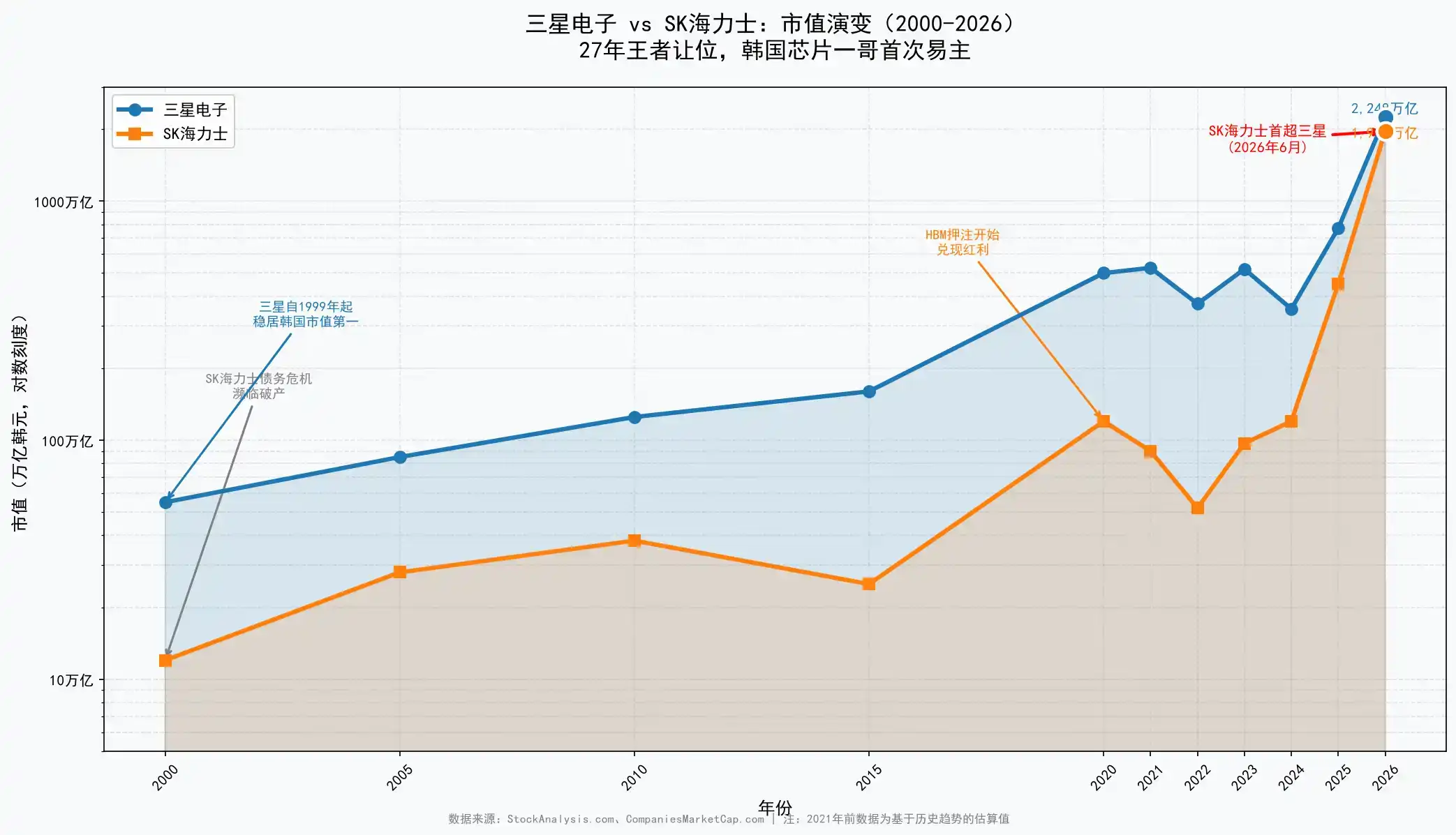
From a debt-ridden enterprise on the verge of collapse to a trillion-dollar empire surpassing the national symbol Samsung Electronics, SK Hynix accomplished one of the most astonishing comebacks in business history over two decades. This is not merely an exchange of rankings between two companies but also a microcosm of how the AI wave is reshaping the global semiconductor industry's power structure.

HBM: From Niche Product to Core Infrastructure of the AI Era

SK Hynix's comeback is essentially a history of "betting right on HBM."

High Bandwidth Memory (HBM) was once a niche category within memory chips. However, in the training of large AI models, GPUs require extremely high-speed data throughput with memory—an NVIDIA H100 requires 80GB of HBM, the H200 requires 141GB, and the latest B200 requires 192GB. Globally, only three companies can produce HBM: SK Hynix, Samsung, and Micron.

SK Hynix has established a near-monopoly advantage in this segment. According to TrendForce data, SK Hynix held a 59% share of the global HBM market in 2025. More critically, in the most lucrative HBM4 segment, Counterpoint Research predicts SK Hynix's market share will reach 54% in 2026 and has already secured over two-thirds of the HBM4 orders for NVIDIA's next-generation Vera Rubin platform, with some institutions predicting the share could exceed 70%.

This advantage is directly reflected in financial data. In the first quarter of 2026, SK Hynix's consolidated revenue reached 52.58 trillion won, a year-on-year increase of 198.1%, breaking the 50 trillion won mark for the first time; net profit reached 40.35 trillion won, nearly quadrupling year-on-year. A simple calculation shows that SK Hynix earned an average net profit of over 2 billion yuan per day in the first three months of this year.

An operating profit margin of 72% not only exceeded NVIDIA's but also far surpassed that of traditional DRAM business. According to Counterpoint Research estimates, the operating profit margin of SK Hynix's HBM business ranges between 75% and 83%, about 10 percentage points higher than its ordinary DRAM business. The HBM business now accounts for approximately 40% of the company's revenue, becoming a veritable profit engine.

Samsung's Dilemma: The Cost of Being Broad

Compared to SK Hynix's sharp focus, Samsung Electronics' problem lies in its "breadth" becoming a burden.

Samsung's business spans memory chips, smartphones, semiconductor foundry, home appliances, and more. Its 2025 revenue scale of 333.6 trillion won far exceeds that of SK Hynix, but the drag from non-memory businesses disperses resources and strategic focus.

In the memory chip sector, Samsung's layout in HBM is noticeably lagging. Although Samsung is also advancing the development of HBM3E and HBM4, it trails behind SK Hynix in customer certification and mass production progress. This has resulted in Samsung watching its competitor exclusively enjoy the premium during the period of most explosive AI computing demand.

What troubles Samsung even more is the simultaneous slowdown of its other businesses. The smartphone business's market share has declined from 54% to 45%; the semiconductor foundry business, due to technological gaps, has failed to secure orders from high-end customers, facing underutilization issues. The profits that the memory business should provide are continuously diluted by losses from other segments.

Furthermore, ongoing labor-management disputes between management and employees are intensifying. Following SK Hynix's milestone bonus agreement last year, Samsung's labor conflicts pose additional challenges to its profit recovery. While SK Hynix employees reap rich rewards from the AI红利, Samsung's organizational cohesion is being tested.

From $14 Billion in Debt to a Trillion-Dollar Empire

The story of SK Hynix's rise is almost a microcosm of the South Korean semiconductor industry.

Its origins can be traced back to Hyundai Electronics, founded in 1983. Relying on government support and chaebol capital injections, Hyundai Electronics rapidly caught up, focusing on DRAM chips, and grew into South Korea's second-largest semiconductor company by the 1990s. In 1999, Hyundai Electronics merged with LG Semiconductor to form Hynix, under the Hyundai Group.

However, the semiconductor downturn in the early 2000s almost pushed the company into bankruptcy. At that time, SK Hynix was saddled with $14 billion in debt and teetered on the brink of collapse. The South Korean government promoted industry consolidation, leading to a duopoly in the DRAM sector with Samsung and Hynix. Subsequently, through several key restructurings and counter-cyclical technological investments, Hynix gradually recovered.

The real turning point was the early bet on HBM. When the market still viewed HBM as a niche product, SK Hynix had already identified it as the future direction for high-performance computing. This strategic vision yielded超额回报 in the AI wave—today, HBM has transformed from a common commodity into a key infrastructure component supporting ChatGPT and advanced AI models.

SK Hynix's comeback has also altered the ecology of South Korea's capital market. The head of South Korea's Financial Supervisory Service recently expressed "regret over not preventing the launch of single-stock leveraged ETFs" and stated that the negative impact of high-risk products related to Samsung and SK Hynix has significantly increased. Retail investor demand for leveraged ETFs of these two stocks remains high, and regulators are considering separate stabilization measures.

Beyond Market Cap: Deep Restructuring of South Korea's Economic Landscape

The significance of SK Hynix's market cap surpassing Samsung extends far beyond a capital market ranking.

Bank of Korea Governor Shin Hyun-song recently stated explicitly that the benefits brought by the expansion of the semiconductor industry are increasingly being transmitted to the overall economy through corporate profits, consumption, and investment improvements. As companies like SK Hynix become new engines for the national economy, South Korea's growth model is shifting from being traditionally driven by consumer electronics to being driven by AI infrastructure.

From a global perspective, this event marks the transformation of the memory chip industry from "commoditization" to "high-value specialization." Traditional DRAM and NAND are highly cyclical commodities with volatile prices. However, HBM, deeply tied to AI computing power, is shedding its commodity attributes and becoming a high-end product with long-term pricing power.

Under the Cycle, No King Reigns Forever

However, SK Hynix's ascension does not mean it can rest easy.

Around 2028, new capacities from Micron's New York fab, SK Hynix's Yongin complex, and Samsung's Pyeongtaek expansion are expected to be released concurrently. TrendForce predicts that memory chip price increases will last at least until the end of 2027, but the landing of new capacity could alter the supply-demand balance. At that point, whether the scarcity premium of HBM will shrink will test the depth of SK Hynix's moat.

Furthermore, Samsung is unlikely to surrender its throne willingly. Samsung still possesses deep accumulation in 3D NAND and advanced process technologies. Once it achieves a breakthrough in HBM4, market competition will intensify rapidly. Today, the market cap difference is only about 14 trillion won, and the suspense over the change of the crown is far from over.

But on this day, June 22, 2026, SK Hynix indeed rewrote history. A company reborn from a debt crisis, through a precise bet on the core infrastructure of the AI era, surpassed the behemoth that had ruled South Korea's capital market for 27 years. This is not the终点, but the latest footnote in the ongoing reshuffle of power within the global semiconductor industry.

Трендові криптовалюти

Пов'язані питання

QWhat significant milestone did SK Hynix achieve on June 22, 2026?

AOn June 22, 2026, SK Hynix's market capitalization surpassed that of Samsung Electronics for the first time, making it the most valuable listed company in South Korea, ending Samsung's 27-year reign as the market leader.

QWhat key technology product is central to SK Hynix's rise and its advantage over competitors?

AHigh Bandwidth Memory (HBM) is the key technology product. SK Hynix holds a dominant 59% market share in HBM, which has become a core infrastructure component for AI computing, driving the company's massive financial growth and market value surge.

QWhat were the main financial results for SK Hynix in Q1 2026 that highlight its success?

AIn Q1 2026, SK Hynix reported consolidated revenue of 52.58 trillion won (a 198.1% year-on-year increase) and a net profit of 40.35 trillion won (a nearly fourfold increase). The company's operating profit margin reached 72%, and it was averaging a net profit exceeding 2 billion RMB per day.

QHow is Samsung Electronics' business strategy described as a contrast to SK Hynix's current success?

ASamsung Electronics' strategy is described as broad but burdensome. Its diverse portfolio, including non-memory businesses like smartphones and foundry services, has diluted focus and resources. This has led to slower progress and missed opportunities in the high-margin HBM market compared to the more focused SK Hynix.

QWhat future challenges are mentioned for SK Hynix despite its current market leadership?

AFuture challenges include the potential for increased HBM production capacity from competitors like Micron and Samsung by around 2028, which could reduce the current scarcity premium. Furthermore, Samsung is actively working to catch up in HBM technology, meaning intense competition is expected to continue.

Пов'язані матеріали

Funding Weekly | Crypto.com Secures $400M Investment, CeFi and Stablecoin Sectors Continue to Attract Capital

Crypto Weekly Investment Recap: Funds Converge on CeFi, Stablecoins, and AI Last week's crypto and AI investment landscape saw significant capital concentration, with a few large deals dominating. **Crypto/Web3 Highlights (July 13-19):** Total investment exceeded **$812 million** across 17 deals. Key trends: * **Centralized Finance (CeFi) & Stablecoins** remained a major magnet, led by **Crypto.com**'s massive **$400 million** raise from Citadel Securities, valuing the exchange at $20B. * **Infrastructure & Tools** saw 7 deals, including **Cyclops** ($20M for stablecoin payments) and **ADI Chain** ($50M for stablecoin settlement infrastructure). * **DeFi** had 2 deals, such as AI-native DEX **Quote Trade** ($4M). * Other notable raises: API broker **Alpaca** ($135M), cross-border platform **Flex** ($70M), treasury firm **ORANGE JUICE** ($40M), and prediction market **Pascal** ($9M). * **Acquisitions:** Keyrock bought BlockFills' trading unit, SBI Holdings acquired Singapore exchange Coinhako, and MoonPay bought startup Glide. **AI & Robotics Highlights:** Investment momentum in AI remained very strong. * Nvidia-backed AI cloud service **Fireworks** raised a massive **$1.5 billion** at a $17.5B valuation. * In robotics, **Walden Robotics** (spun out from Toyota) secured **$300 million**, and Chinese humanoid firm ****逐际动力** **(Climax Dynamics) raised nearly **$200 million** in a Pre-IPO round. * Other significant AI raises included Indian programming platform **Emergent** ($130M) and drone company **Brinc** ($125M), backed by Sam Altman. Overall, the trend shows capital flowing heavily into established crypto financial services, stablecoin infrastructure, and large-scale AI/robotics commercialization.

marsbit58 хв тому

Funding Weekly | Crypto.com Secures $400M Investment, CeFi and Stablecoin Sectors Continue to Attract Capital

marsbit58 хв тому

The Gentlest Bear Market? BTC Bears Exit, ARK and Bitwise Collectively Bullish

**Title: The Mildest Bear Market? BTC Shorts Exit, ARK and Bitwise Collectively Bullish** Bitcoin continues to consolidate around $75,000 while Ethereum struggles near $1,900. Market data shows $116 million in liquidations over 24 hours, with $62.7 million from short positions, and the Fear & Greed Index remains at 35 (Fear). According to Polymarket, there's a 33% probability BTC falls below $50,000 this year. ARK Invest's Q2 2026 Bitcoin report notes technical weakness but identifies potential bottoming signals, including a record high in long-term holder supply, suggesting selling exhaustion. Bitwise's Juan Leon calls this the "structurally mildest bear market" on record, with a ~50% drawdown from highs, less severe than past cycles. He highlights institutional accumulation and a shift in investor dialogue from survival to entry points. Technical analysis from Bit suggests a potential C-wave low may have formed, with an ideal bottoming range between $50,000-$55,000. However, glassnode's CryptoVizArt warns that failure to break $66,000 could signal a local top, as new buyer accumulation is concentrated there. Analyst Darkfost identifies a critical support band between $59,000-$70,000, where 50% of BTC's circulating supply has changed hands. Notably, trader Doctor Profit announced closing all crypto short positions—including BTC shorts from $115k-$125k and over 100 altcoin shorts—for significant profit. He has begun a phased accumulation of Bitcoin spot starting at $64,000, reversing his previous $40k-$50k target, citing structural positives like regulatory clarity and institutional adoption. He argues the anticipated September/October bottom may arrive earlier than the herd expects.

Foresight News1 год тому

The Gentlest Bear Market? BTC Bears Exit, ARK and Bitwise Collectively Bullish

Foresight News1 год тому

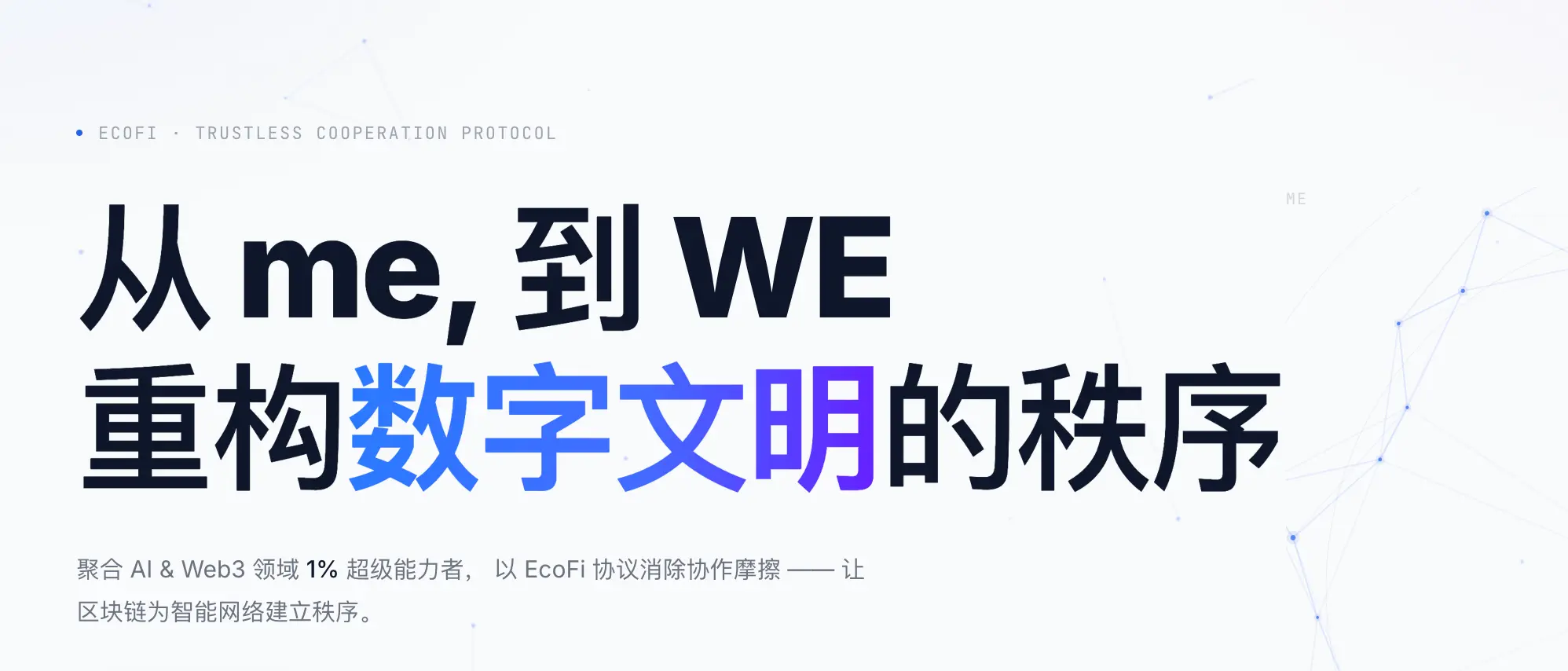
The Evolution of Order in the AI & Web3 Era: The Competitive Dimensions and Exploratory Path of m&W

The article explores the evolution of order in the AI & Web3 era, framing the competition around establishing new foundations for human-AI collaboration. It argues that as AI Agents become core economic participants, the existing Web3 infrastructure—focused on assets, identity, and decentralized governance—is insufficient. The core challenge shifts to building trust, assessing complex contributions, and creating fair value distribution among diverse human and AI actors. The analysis positions the m&WDAO project within this landscape by comparing it to existing paradigms: Colony (human-centric DAO governance), SingularityNET (AI service exchange), Gitcoin Passport (Sybil-resistant identity), and Farcaster/Lens (open social graphs). m&W's distinct path, termed EcoFi (Ecological Finance/Order), aims to integrate these layers. Its three-phase evolution is outlined: 1) **m&W 1.0: Credit Anchoring** - filtering high-quality "Builder" nodes and converting their contributions into non-transferable SBTs (Soulbound Tokens) as a bedrock of trust. 2) **m&W 2.0: Collaborative Economy** - deploying the EcoFi protocol to enable verified, complex task collaboration with a hybrid AI/human judgment system for valuation and dispute resolution, creating a closed-loop value system. 3) **m&W 3.0: Intelligent Order** - where human-originated SBT credit enables trusted AI Agent "digital twins" to participate in a mature human-AI co-creation economy. The conclusion asserts that while other projects solve discrete problems (proving identity, governing contributions, exchanging AI capabilities), m&W's ultimate mission is to address the foundational question of a new socio-economic order for the coming era of human-AI collaborative networks.

链捕手1 год тому

The Evolution of Order in the AI & Web3 Era: The Competitive Dimensions and Exploratory Path of m&W

链捕手1 год тому

Торгівля

Спот

Популярні статті

Як купити CHIP

Ласкаво просимо до HTX.com! Ми зробили покупку USD.AI (CHIP) простою та зручною. Дотримуйтесь нашої покрокової інструкції, щоб розпочати свою криптовалютну подорож.Крок 1: Створіть обліковий запис на HTXВикористовуйте свою електронну пошту або номер телефону, щоб зареєструвати обліковий запис на HTX безплатно. Пройдіть безпроблемну реєстрацію й отримайте доступ до всіх функцій.ЗареєструватисьКрок 2: Перейдіть до розділу Купити крипту і виберіть спосіб оплатиКредитна/дебетова картка: використовуйте вашу картку Visa або Mastercard, щоб миттєво купити USD.AI (CHIP).Баланс: використовуйте кошти з балансу вашого рахунку HTX для безперешкодної торгівлі.Треті особи: ми додали популярні способи оплати, такі як Google Pay та Apple Pay, щоб підвищити зручність.P2P: Торгуйте безпосередньо з іншими користувачами на HTX.Позабіржова торгівля (OTC): ми пропонуємо індивідуальні послуги та конкурентні обмінні курси для трейдерів.Крок 3: Зберігайте свої USD.AI (CHIP)Після придбання USD.AI (CHIP) збережіть його у своєму обліковому записі на HTX. Крім того, ви можете відправити його в інше місце за допомогою блокчейн-переказу або використовувати його для торгівлі іншими криптовалютами.Крок 4: Торгівля USD.AI (CHIP)Легко торгуйте USD.AI (CHIP) на спотовому ринку HTX. Просто увійдіть до свого облікового запису, виберіть торгову пару, укладайте угоди та спостерігайте за ними в режимі реального часу. Ми пропонуємо зручний досвід як для початківців, так і для досвідчених трейдерів.

552 переглядів усьогоОпубліковано 2026.04.21Оновлено 2026.06.02

Як купити CHIP

Обговорення

Ласкаво просимо до спільноти HTX. Тут ви можете бути в курсі останніх подій розвитку платформи та отримати доступ до професійної ринкової інформації. Нижче представлені думки користувачів щодо ціни CHIP (CHIP).

活动图片