Ripple Rumored To Consider Dirham-Backed Stablecoin In UAE

bitcoinistОпубліковано о 2024-11-08Востаннє оновлено о 2024-11-09

Анотація

Ripple Labs could be exploring the launch of a dirham-backed stablecoin in the United Arab Emirates (UAE), expanding beyond its...

Ripple Labs could be exploring the launch of a dirham-backed stablecoin in the United Arab Emirates (UAE), expanding beyond its existing US-dollar-backed stablecoin, RLUSD. This speculation arises following Ripple’s newest blog post dated November 7, 2024, titled “UAE Stablecoin Regulation: A Blueprint for Financial Innovation.” The post hints at significant interest by Ripple in a dirham-backed stablecoin.

Will Ripple Launch A Dirham-Stablecoin?

The blog post outlines the UAE Central Bank’s (CBUAE) newly introduced regulatory framework designed to integrate both dirham-backed and non-AED stablecoins into the nation’s financial systems. “New regulations from the Central Bank of the United Arab Emirates (CBUAE) designed to integrate dirham-backed stablecoins as well as non-AED backed stablecoins into its financial systems are emblematic of this shift,” the Ripple team states.

The CBUAE’s framework aims to bolster the UAE’s standing as a global leader in digital asset regulation by providing clear guidelines that facilitate the issuance and use of AED-backed stablecoins for payments, while allowing non-dirham stablecoins to be registered for virtual asset transactions. “By embracing stablecoins, the UAE is laying the groundwork for safer, more efficient financial systems,” the Ripple blog emphasizes.

Ripple’s involvement in the region is well-established. The National Bank of Abu Dhabi became the first Middle Eastern bank to utilize Ripple Payments for secure and cost-effective remittance solutions, handling nearly $80 million in outbound remittances in 2022. Furthermore, XRP received approval from the Dubai Financial Services Authority (DFSA) for use within the Dubai International Financial Centre (DIFC) late last year.

The potential introduction of a dirham-backed stablecoin by Ripple aligns with the CBUAE’s objectives to promote a regulated stablecoin environment that mitigates the volatility inherent in cryptocurrencies and enhances investor protection. “The CBUAE’s aim is to proactively promote a well-regulated stablecoin ecosystem, specifically dirham-backed stablecoins, to offset more volatile cryptocurrencies and better protect investors,” the blog elaborates.

Notably, Tether has also signaled interest in the UAE stablecoin market, announcing plans to launch a UAE stablecoin pegged to the dirham as an alternative to the US dollar. The region has rapidly become the sixth largest crypto economy globally, processing nearly $400 billion in on-chain value between July 2022 and June 2023, according to Ripple.

The UAE’s comprehensive regulatory approach contrasts with other global frameworks, such as the United States’ proposed Clarity of Payment Stablecoins Act and the European Union’s MiCA regulations. Unlike these, the UAE’s framework permits unlimited use of dirham-backed stablecoins for payments while restricting non-dirham stablecoins to virtual asset transactions without imposing transaction caps. “This measured approach would also manage risks around liquidity, market volatility, compliance and operational challenges,” the blog notes.

“With a tech-forward citizenry and a government eager to foster innovation, the UAE is fertile ground for the integration of digital banking and blockchain into its financial sector,” the Ripple team concludes, adding that “stablecoins are now set to play a crucial role in the country’s economic diversification alongside its broader plans to launch a Central Bank Digital Currency (CBDC).

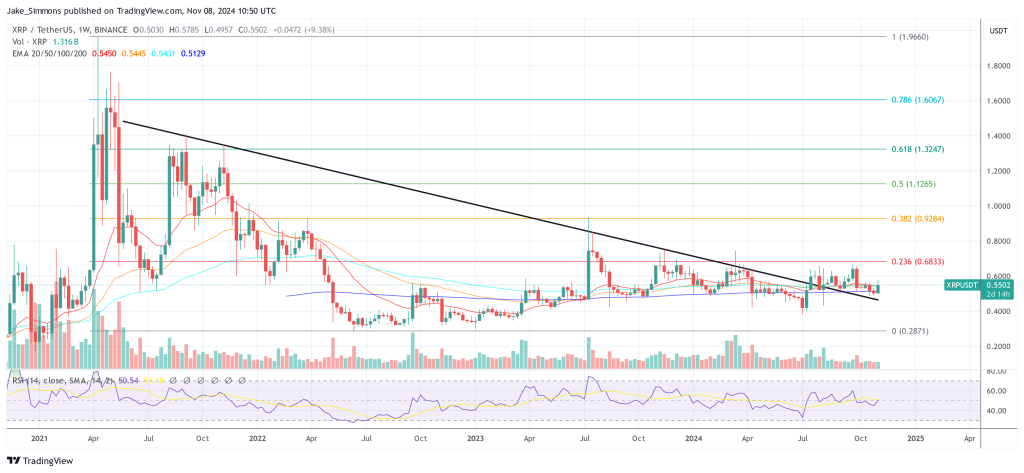
At press time, XRP traded at $0.55.
XRP price
XRP price, 1-week chart | Source: XRPUSDT on TradingView.com
Featured image created with DALL.E, chart from TradingView.com
Jake Simmons

Jake Simmons

Jake Simmons has been a Bitcoin enthusiast since 2016. Ever since he heard about Bitcoin, he has been studying the topic every day and trying to share his knowledge with others. His goal is to contribute to Bitcoin's financial revolution, which will replace the fiat money system. Besides BTC and crypto, Jake studied Business Informatics at a university. After graduation in 2017, he has been working in the blockchain and crypto sector. You can follow Jake on Twitter at @realJakeSimmons.

Пов'язані матеріали

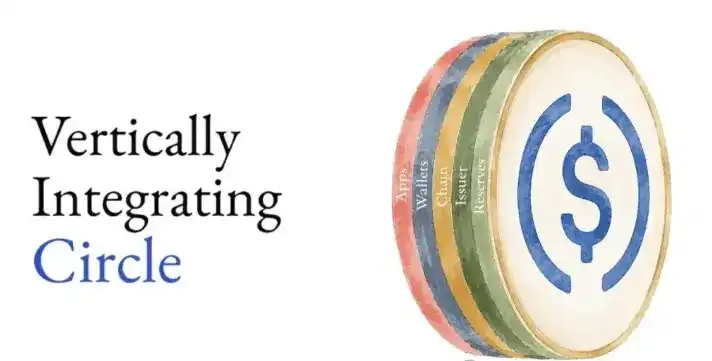
Circle: From Issuance to Infrastructure

Title: Circle: From Issuance to Infrastructure Circle, the issuer of the USDC stablecoin, is undergoing a strategic transformation to reduce its dependence on interest income from reserve holdings, which is declining due to falling interest rates. Historically, Circle's revenue came primarily from the yield on US Treasury reserves backing USDC. However, it also paid significant fees (approximately 60 cents of every dollar earned) to partners like Coinbase for distributing and settling USDC. To capture more value across the financial stack, Circle is vertically integrating into three new layers: 1. **Settlement Layer:** It is launching **Arc**, a native Layer-1 blockchain. Arc, which uses USDC as its gas token, aims to capture transaction fees currently paid to other blockchains (like Ethereum and Solana) and offers features like privacy for institutional payments. 2. **Distribution Layer:** The **Circle Payments Network (CPN)** connects financial institutions directly to Circle, reducing reliance on exchanges like Coinbase. While not yet monetized, CPN growth has improved Circle's margins. 3. **Application Layer:** Circle is building an **AI Agent Economy** infrastructure with products like Agent Wallets and Nanopayments. The goal is to capture fees from high-volume, automated transactions executed by AI agents, a market where USDC already dominates. These moves represent Circle's shift from a single-product company (USDC issuance) to a full-stack financial platform. The strategy faces challenges, including market competition from players like Stripe and Tether, and potential internal tension regarding how value created by the new Arc blockchain and token (ARC) will accrue to Circle's public shareholders (CRCL). Circle's long-term success depends on its ability to successfully execute this vertical integration and diversify its revenue streams away from interest income.

marsbit27 хв тому

Circle: From Issuance to Infrastructure

marsbit27 хв тому

Circle: From Issuance to Infrastructure

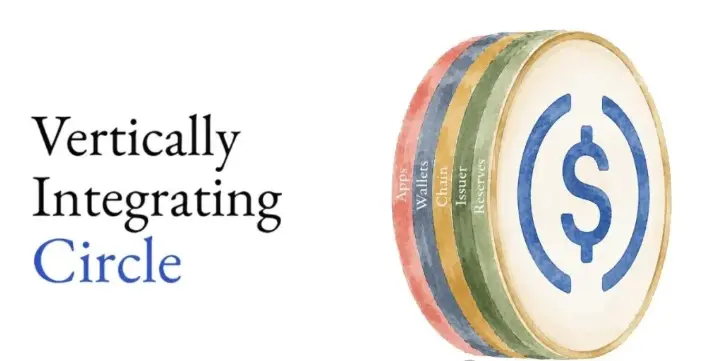
Title: Circle: From Issuance to Infrastructure Circle, the issuer of the USDC stablecoin, is undergoing a strategic transformation from a single-product company dependent on reserve interest income to a vertically integrated, full-stack financial platform. Its primary revenue source, earnings from US Treasury reserves backing USDC, is under pressure from declining Federal Reserve interest rates. Furthermore, Circle pays out a significant portion (~60 cents per dollar earned) to partners like Coinbase for distribution and settlement, leading to value leakage. To address these challenges and capture more value across the payment stack, Circle announced three key initiatives in Q1 2026: 1. **Settlement Layer**: Launching its own Layer-1 blockchain, **Arc**. Designed for institutional use with configurable privacy and quantum-resistant architecture, Arc uses USDC as its native gas token, allowing Circle to capture transaction fees currently paid to other blockchains like Ethereum. 2. **Distribution Layer**: Expanding the **Circle Payments Network (CPN)**, which connects financial institutions directly to Circle, reducing reliance on third-party exchanges for USDC distribution and on/off-ramps. 3. **Application Layer**: Building infrastructure for an **AI agent economy**, including tools for agent wallets, nanopayments, and a marketplace. Circle aims to monetize the high volume of AI-driven microtransactions predominantly settled in USDC. This vertical integration strategy aims to diversify Circle's revenue away from volatile interest income. However, a key challenge remains: aligning the value capture of the new ARC token with the interests of existing public market shareholders (CRCL) who invested primarily for reserve yields. The success of this stack-wide expansion hinges on Arc's adoption and Circle's ability to balance value distribution between its core corporate entity and its new blockchain ecosystem.

链捕手33 хв тому

Circle: From Issuance to Infrastructure

链捕手33 хв тому

Nvidia's Wednesday 'Big Test': The Battle That Will Determine the Fate of the AI Bull Market is Here!

NVIDIA Faces Key AI Bull Market Test with Wednesday Earnings Report NVIDIA is set to release its quarterly earnings after the market close on Wednesday, May 20th (US Eastern Time). This report is seen as a critical stress test for the current AI-driven bull market cycle. The semiconductor sector is technically severely overbought, with extremely bullish options positioning. The rare signal of stock prices and implied volatility rising simultaneously indicates significantly amplified two-way risk around this earnings event. The core tension identified by analysts is strong fundamental demand for AI versus mounting technical pressures. The Philadelphia Semiconductor Index (SOX) is trading approximately 60% above its 200-day moving average, a deviation not seen since the peak of the dot-com bubble in 1999/2000. While NVIDIA's current quarter revenue is expected to beat estimates by a substantial margin, market focus is intensely on the guidance for the next quarter. Historically, NVIDIA's stock has frequently declined on the day following its last five earnings reports. The options market presents contradictory signals: extreme bullish call skew persists, yet there is notable activity in tail-risk hedging via put options on broader indices and semiconductor ETFs. This suggests traders are chasing gains while simultaneously preparing for potential sharp volatility. A broader market concern is narrowing breadth. Despite the S&P 500's YTD gain, only about half of its constituents are positive, with leadership heavily concentrated in a few mega-cap AI and semiconductor names like NVIDIA. Analysts question whether this reflects market health or a "funding source" effect, where money flows out of lagging sectors into the AI trade. The earnings outcome and, crucially, the forward guidance will test the market's conviction in the AI compute super-cycle thesis. Given NVIDIA's high correlation with the semiconductor and broader tech sector, its results are poised to trigger widespread market moves in either direction.

marsbit42 хв тому

Nvidia's Wednesday 'Big Test': The Battle That Will Determine the Fate of the AI Bull Market is Here!

marsbit42 хв тому

Торгівля

Спот
Ф'ючерси
活动图片