Nvidia will release its quarterly report after the market closes on Wednesday, May 20th (Eastern Time), marking a crucial stress test for the current AI bull market cycle.
The semiconductor sector is severely overbought technically, options positioning is heavily skewed towards bullish bets, and a rare signal of "stock price and implied volatility rising simultaneously" has significantly amplified two-way risks around this earnings window compared to the past.
Peter Callahan, Goldman Sachs' TMT chief expert, released a brief titled "Yellow Light" on Monday, noting that the Nasdaq 100 Index (NDX) and the Philadelphia Semiconductor Index (SOX) recorded their first weekly decline of the quarter last week; the 10-year US Treasury yield rose to about 4.60%, marking its largest weekly gain in over a year; oil prices rebounded to around $109 per barrel; and the VIX also climbed.
He pointed out that the core contradiction facing the AI and semiconductor themes currently is: fundamentals remain strong, while technical pressure continues to accumulate.
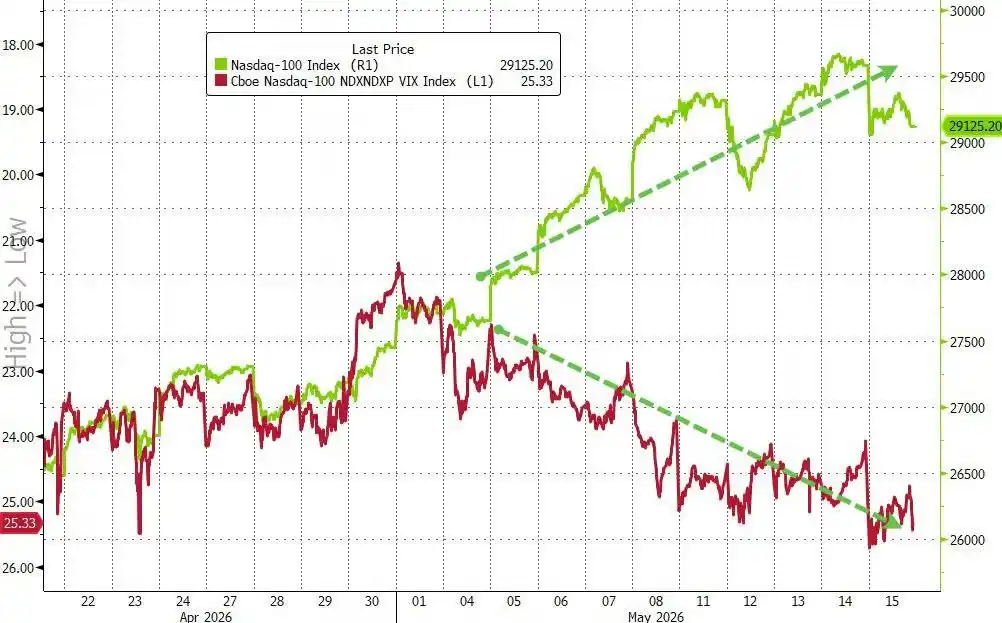
Options analysis firm SpotGamma noted in a recent report that the market is displaying a rare concurrent pattern of "rising stock prices with simultaneously climbing volatility"—typically, the two should have an inverse relationship. This signal indicates that traders are chasing the rally while also paying a premium for protection against significant volatility.
Nvidia's earnings report currently implies a volatility move of around 6%, with market attention highly concentrated on this timing.
The earnings results and forward guidance will directly test the market's conviction in the AI computing super-cycle thesis. Given Nvidia's high correlation with the semiconductor and broader technology sectors, its earnings performance, whether positive or negative, is expected to trigger widespread ripple effects across the market.

1. Technical Indicators Flash Most Extreme Warning Since 1999/2000
The magnitude and speed of the recent semiconductor rally have pushed technical indicators to historically overbought levels.
Goldman Sachs data shows that the SOX index has surged approximately 70% from its late March low, adding over $5 trillion in market value along the way.
Driving factors include a temporary easing of geopolitical tensions, better-than-expected corporate earnings—such as AMAT raising its full-year guidance more than expected, CSCO reporting a 35% year-over-year growth in product orders—and investors' growing confidence in AI computing demand; earnings expectations for the semiconductor industry have been revised upwards by over 25% year-to-date.
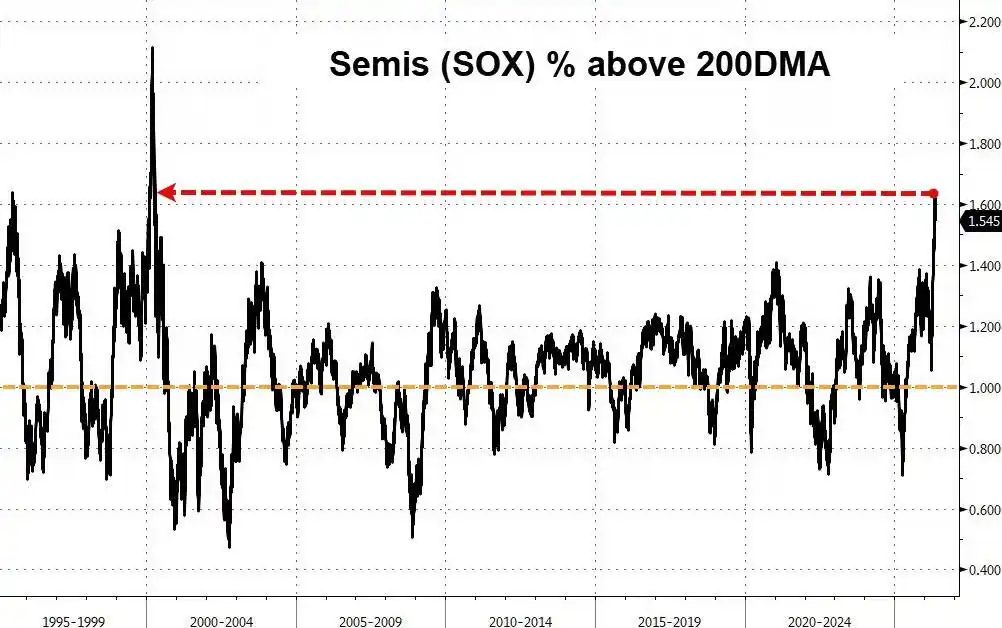
However, Peter Callahan specifically pointed out that the SOX index is currently about 60% above its 200-day moving average, a deviation magnitude not seen since the peak of the dot-com bubble in 1999/2000.
He also noted that Goldman Sachs' high-momentum factor portfolio has experienced 12 trading days with intraday swings exceeding ±5% year-to-date, accounting for nearly 15% of the year's trading sessions; the rapid expansion of leveraged ETFs and options products has further amplified this two-way elasticity.
"It's worth keeping these tactical dynamics in mind heading into summer trading as this week's earnings season (Nvidia, May 20th) concludes," Callahan wrote. While Goldman's trading desk maintains a constructive medium-term stance on the AI and semiconductor theme, it advises investors to remain tactically cautious about technical challenges.
2. Nvidia Earnings: Forward Guidance May Be More Critical Than Current Quarter Results
The market remains optimistic about Nvidia's fundamental outlook, but recent stock price movements have already priced in some of these expectations to an extent.
According to Goldman Sachs' Nvidia earnings preview report, analysts generally expect Nvidia's revenue this quarter to exceed market estimates by about $2 billion—historically, the company's beat margin has typically been between 2% and 3%.
The market is more focused on the forward guidance for the next quarter, with the current analyst consensus estimate around $86 billion, representing a sequential increase of about 9%.
Other areas of focus include: whether there is further upside to Nvidia's cumulative data center revenue guidance of approximately $1 trillion, and the narrative of accelerating Agentic AI inference demand—especially its pure CPU rack products expected to begin shipping in the second half of 2026.
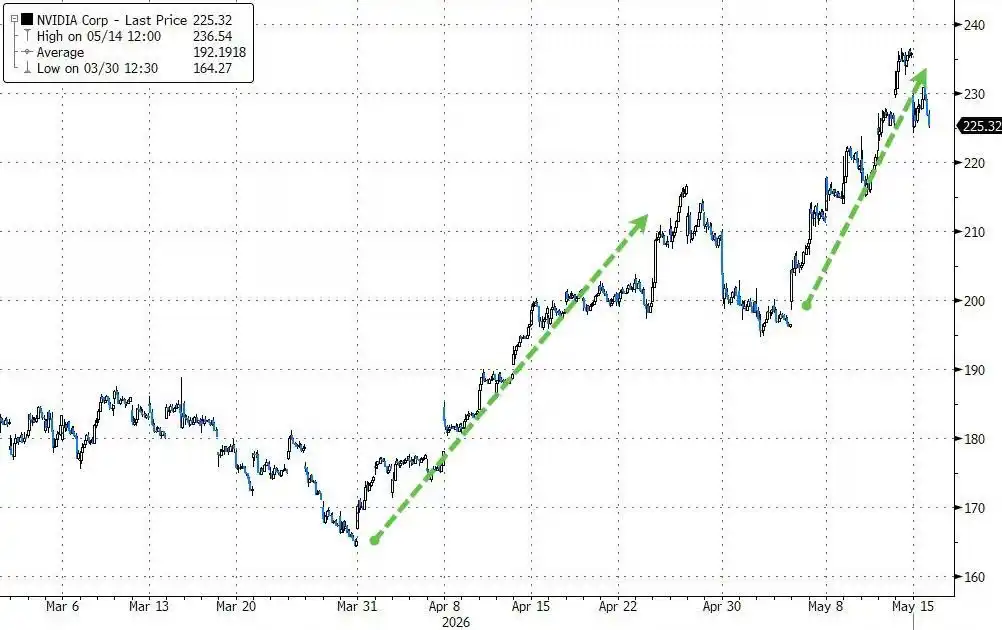
Looking at recent price action, Nvidia has risen for seven consecutive trading days, gaining 20% over that period, marking its longest winning streak in nearly two years; the stock has added about $1.7 trillion in market value since its late March low.
However, Goldman Sachs data also shows that in the trading session (T+1) following Nvidia's past five earnings releases, the stock declined four times. In fact, significant single-day rallies triggered by earnings reports have not occurred since May 2022.
3. Options Market: Extreme Bullish Bets and Tail Hedging Simultaneously in Place
The options positioning structure presents a set of inherently contradictory signals.
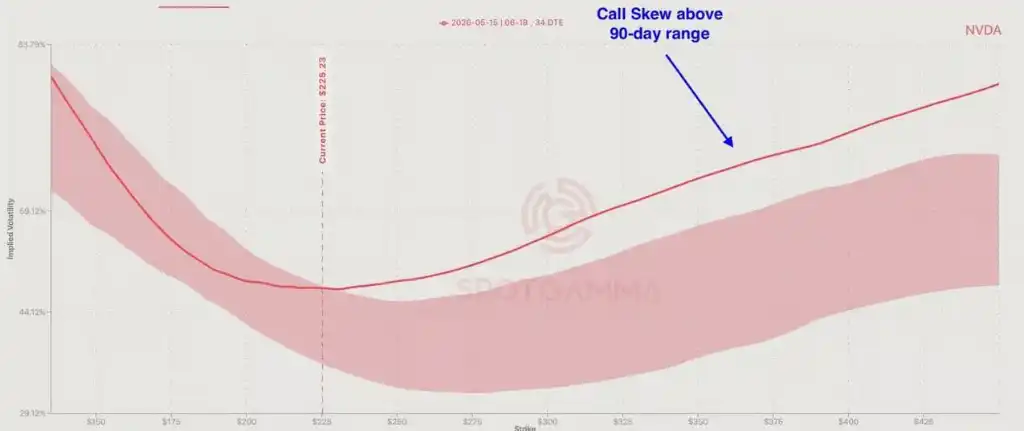
According to SpotGamma data, the overall positioning direction remains extremely skewed towards bullish bets, with traders continuously rolling Nvidia call options to higher strike prices. Call skew remains at the high end of its 90-day historical range, while demand for downside protection is extremely limited.
Citing data, 22V Research reported that last Friday saw a record $2.6 trillion in notional call option volume for the S&P 500, with call options making up a high 60% of total options volume; the Philadelphia Semiconductor Index's RSI also rose to its highest level since March 2000.
At the same time, hedging against downside risks is also quietly underway.
SpotGamma points out that significant put option structures and buying activity have noticeably increased around the S&P 500 (SPY), semiconductor ETF (SMH), and DRAM-related assets, concentrated in deep out-of-the-money strike price ranges, indicating their function is closer to tail risk hedging rather than purely directional bets. "Market participants are not bearish on Nvidia, but preparation for downside scenarios is not trivial," SpotGamma wrote in its report. "Any directional shift will almost immediately ripple through the broader market."
SpotGamma added, Nvidia has risen over 35% since its March low, and the size of current call option positioning implies that if earnings disappoint the market or trigger large-scale profit-taking, it could potentially trigger a significant directional reversal.
4. Market Breadth Concerns: Rally Supported by a Handful of Stocks
Beneath the strong performance of semiconductors and large-cap tech stocks, a lack of broad market participation is creating structural concerns.
Peter Callahan noted in his report that while the S&P 500 is up about 8% year-to-date, only about 52% of its constituents have posted positive returns. Sectors that have significantly lagged year-to-date span residential real estate, medical devices, engineering & construction without government exposure, federal IT services, software & services, independent power producers, restaurant chains, commercial real estate brokers, and insurance brokers, among others.
Callahan admits that when reviewing the charts of these sectors, it makes him question whether the current market performance reflects overall "health" or is merely a "funding source" effect where investors are forced to concentrate capital in a few large-cap AI stocks.
Oppenheimer's equity derivatives team also pointed out that only about one-fifth of S&P 500 constituents outperformed the index over the past month, the dispersion index rose to its highest level in over a year, while implied correlation hovered near year-to-date lows.
Latest data from Goldman Sachs' Prime Brokerage (PB) department also shows clear signs of "risk-off" activity in the technology sector recently.