Dogecoin Whales Add 400 Million To Their Stash, Here’s How Much They Hold

bitcoinistОпубліковано о 2024-09-13Востаннє оновлено о 2024-09-14

Анотація

Dogecoin whales are starting to increase their holdings in what is a general uptick in activity on the Dogecoin blockchain....

Dogecoin whales are starting to increase their holdings in what is a general uptick in activity on the Dogecoin blockchain. According to the latest on-chain data, addresses with large Dogecoin balances saw a remarkable surge in their holdings, with an approximate 960% increase occurring within just 24 hours. This accumulation by large holders coincides with a critical moment for the meme-based cryptocurrency, as it recently managed to break through a persistent downward-sloping trendline. 

Dogecoin Whales Add Millions To Their Stash

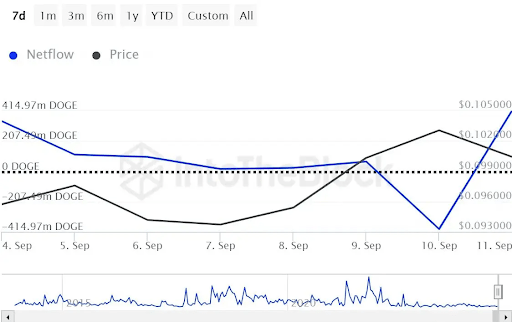
According to data from the IntoTheBlock dashboard, Dogecoin large holders (also known as whales) recently saw their holdings increase by a massive 446.9 million DOGE tokens on September 11. This data was revealed through the ‘Large Holders Inflow,’ a metric that tracks the number of DOGE tokens entering addresses holding at least 0.1% of the total circulation supply of Dogecoin. Particularly, this data shows that the large holders increased their inflow from 46.25 million to 493.15 million DOGE on Sept. 11.  

Related Reading: Bitcoin Vs. Ethereum: Legendary Analyst Says He’s ‘Pretty Confident’ ETH Will Outperform

Furthermore, the netflow data shows a corresponding increase from -395.88 million DOGE on the previous day to 414.97 million DOGE on September 11. Netflow is determined by subtracting the outflows (tokens leaving addresses) from inflows (tokens entering addresses) over a given period. A positive netflow indicates that whales are accumulating more Dogecoin, while negative values typically signal a selloff.
Dogecoin
Source: IntoTheBlock

On the exchange front, IntoTheBlock data also shows a notable decline in the amount of DOGE held by wallet addresses linked to cryptocurrency exchanges. The ‘Aggregated Exchanges Netflow’ metric highlights a net outflow of -104.31 million DOGE over the past 24 hours and a total of -108.89 million DOGE across the last seven days. These negative figures suggest that more Dogecoin is being withdrawn from exchanges than is being deposited. This shift is significant because it marks a change in market sentiment, given that previous data pointed to heightened selling pressure from whale addresses.

DOGE Price Movement

At the time of writing, DOGE is trading at $0.1031 and is up by 0.69% in the past 24 hours. A recent rally means DOGE is now trading 15% above a low of $0.08969 which it traded at earlier in the week. According to an analysis by crypto analyst Javon Marks, this rally puts DOGE on a little breakout above the upper trendline in a multi-month falling wedge price formation. 

However, the breakout is yet to be complete because DOGE bulls have found it hard to break above $0.104 for over three days now. In his analysis, he predicts that a successful breakout would likely result in a substantial 100% price increase that will drive DOGE up to around $0.22. From there, the stage could be set for an even larger bullish move for a major target of $0.6533.

Dogecoin price chart from Tradingview.com
DOGE price continues to recover | Source: DOGEUSDT on Tradingview.com
Featured image created with Dall.E, chart from Tradingview.com
Scott Matherson

Scott Matherson

Scott Matherson is a leading crypto writer at Bitcoinist, who possesses a sharp analytical mind and a deep understanding of the digital currency landscape. Scott has earned a reputation for delivering thought-provoking and well-researched articles that resonate with both newcomers and seasoned crypto enthusiasts. Outside of his writing, Scott is passionate about promoting crypto literacy and often works to educate the public on the potential of blockchain.

Пов'язані матеріали

The Next Generation of Payments Lies Not in the Payment Layer

The Next-Generation of Payment is Not in the Payment Layer This is the second piece in a series analyzing Stripe's AI strategy. The series stems from Stripe's vision of becoming the economic infrastructure for the AI Agent era, announced at Stripe Sessions 2026. A key debate centers on whether Know Your Agent (KYA) is merely an upgrade to existing payment systems. The author argues the opposite: payment will become a subsystem of KYA, not the other way around. Historically, major payment innovations (online banking, mobile wallets, QR codes) emerged from new transaction scenarios that broke the underlying assumptions of old systems, not from optimization within the payment layer itself. Agent economy is that new scenario, and KYA is the foundational infrastructure growing to support it. KYA's proposed five layers—Agent Identity, Authorization Scope, Intent Signing, Liability Chain Auditing, and Credit Rating—extend far beyond payments. Only authorization and auditing directly touch the payment链路. Identity, intent, and credit layers serve broader needs like cross-platform calls, AI alignment, and permission management. Stripe's strategic moves validate this view. Its focus on "economic infrastructure for AI," investments in protocols like Agentic Commerce Protocol (an identity/session protocol), Shared Payment Tokens, stablecoin infrastructure, embedded wallets, and its own Tempo blockchain for settlement, all point to building the KYA layer, not just optimizing payments. Data shows the core challenge in AI commerce has shifted upstream: determining "who this is, what they intend to do, and if they deserve resources" happens long before checkout. This is why Stripe is moving its Radar fraud prevention from the transaction moment to the entire user lifecycle—a KYA-layer concern. Legally, ultimate responsibility will still fall on a human, as laws like AB 316 dictate. However, in a distributed,网状 liability chain involving users, Agent platforms, model providers, and payment protocols, KYA's role is to use cryptography to make every entity's actions and roles verifiable and traceable. This enables accountability where it was previously impossible to pinpoint evidence, fundamentally changing责任追溯, not just payment efficiency. The next-generation payment形态 will not be designed within the payment layer. It will emerge from the Agent economy scenario after the KYA infrastructure is established.

marsbit1 год тому

The Next Generation of Payments Lies Not in the Payment Layer

marsbit1 год тому

The Next Generation of Payments Is Not in the Payment Layer

The next generation of payments won't be designed within the payment layer itself. This article argues that historical payment innovations (e.g., online banking, mobile wallets) emerged from new transactional scenarios, not from optimizing existing payment systems. The new scenario is the Agent economy. Know Your Agent (KYA) is not merely a payment-layer upgrade for efficiency. It is the foundational infrastructure layer for the Agent economy. KYA’s five layers—Agent identity, authorization scope, intent signature, accountability chain audit, and credit rating—primarily serve broader needs like cross-platform identification, AI alignment, and permission management. Payment is just one application built on top of this KYA foundation. Stripe’s strategy exemplifies this shift. Its focus on "economic infrastructure for AI," investments in protocols like the Agentic Commerce Protocol (identity/session layer), stablecoin infrastructure, embedded wallets, and moving risk management (Radar) to the user lifecycle all indicate it is building the KYA layer, not just optimizing payments. While ultimate legal liability remains with a human (as laws like AB 316 stipulate), KYA enables traceability in a distributed,网状 responsibility chain involving multiple entities (user, Agent platform, model provider, etc.). It makes accountability verifiable where previously it was opaque. The conclusion: A new class of economic actors (Agents) forces a new infrastructure layer (KYA) to emerge. This layer redefines identity, authorization, and accountability. On top of it, the next generation of payment will reorganize and emerge from the demands of the scenario, not from within the traditional payment system.

链捕手1 год тому

The Next Generation of Payments Is Not in the Payment Layer

链捕手1 год тому

The "Big Short" Prototype Makes a Major Bet: Shorting Nvidia, Going Long on Software Stocks 'Scared Away' by AI

'The Big Short' Legend Michael Burry Doubles Down on AI Bet: Shorts Nvidia, Buys Beaten-Down Software Stocks As the Nasdaq hits record highs and Nvidia's market cap nears $5.3 trillion, Michael Burry—famed for his 2008 subprime mortgage bet—is making a major contrarian move. He is significantly expanding his bearish wagers against the AI frenzy while buying traditional software stocks he believes have been unfairly punished. Burry's latest portfolio adjustments, revealed in his Substack column, include maintaining and increasing put options on Nvidia and Palantir. He has also initiated new short positions on Palantir and expanded bearish bets on the semiconductor ETF (SOXX), the Nasdaq 100 ETF (QQQ), and Oracle. Simultaneously, he is buying shares of software companies like Adobe, Autodesk, Salesforce, and Veeva Systems. He argues these stocks have been sold off due to "AI disruption" fears and technical selling pressure from private credit funds, not deteriorating fundamentals. Their valuations have fallen to multi-year lows. This creates a complete hedge: short the perceived "AI winners" and long the oversold "AI losers." Burry believes the current AI infrastructure spending boom mirrors the late-1990s internet bubble, with inflated demand projections and questionable accounting practices by large cloud customers extending GPU depreciation schedules. While his Palantir short is currently profitable, his Nvidia put options are deeply underwater as the stock trades near all-time highs. Burry remains steadfast, comparing Nvidia to Cisco during the dot-com era. He anticipates a broad repricing of the AI bubble, where overvalued beneficiaries fall and unfairly battered companies rebound.

marsbit1 год тому

The "Big Short" Prototype Makes a Major Bet: Shorting Nvidia, Going Long on Software Stocks 'Scared Away' by AI

marsbit1 год тому

Торгівля

Спот
Ф'ючерси
活动图片