Инвесторы из США и Канады получат полную компенсацию в рамках урегулирования GSB Group

cryptonews.ruОпубліковано о 2024-05-10Востаннє оновлено о 2024-09-10

Регуляторы ценных бумаг в 12 штатах США добились возмещения инвесторам, которые потеряли деньги в инвестиционной схеме, включающей метавселенную Lydian.World, криптовалюту и токенизированное частичное владение небоскребом метавселенной.

По данным Североамериканской ассоциации администраторов ценных бумаг (NASAA), регуляторы достигли соглашения с группой немецких компаний, связанных с Йосипом Хайтом и известных под общим названием GSB Group, о возврате всех денег и криптовалюты, депонированных в GSB Group для любых целей.

Штаты и провинции работают вместе против схемы MLM

Согласно заявлению, опубликованному законными представителями Хайта и GSB Group, американские инвесторы в штатах, участвующих в урегулировании, получат компенсацию, и эти штаты «отзовут все предыдущие обвинения в мошенничестве или нечестной практике».

Хайт и его компании не будут платить никаких штрафов в рамках урегулирования. В этом заявлении участниками урегулирования были названы штаты Алабама, Аризона, Арканзас, Джорджия и Техас.

NASAA заявило, что в урегулировании приняли участие регулирующие органы из Алабамы, Аризоны, Арканзаса, Калифорнии, Джорджии, Кентукки, Миссисипи, Нью-Гемпшира, Техаса, Юты, Вашингтона и Висконсина.

Эти регулирующие органы, а также Комиссия по ценным бумагам Британской Колумбии в Канаде, начали подавать иски о принудительном исполнении против немецкой группы в ноябре. Регуляторы описали предложение GSB Group как схему многоуровневого маркетинга (MLM).
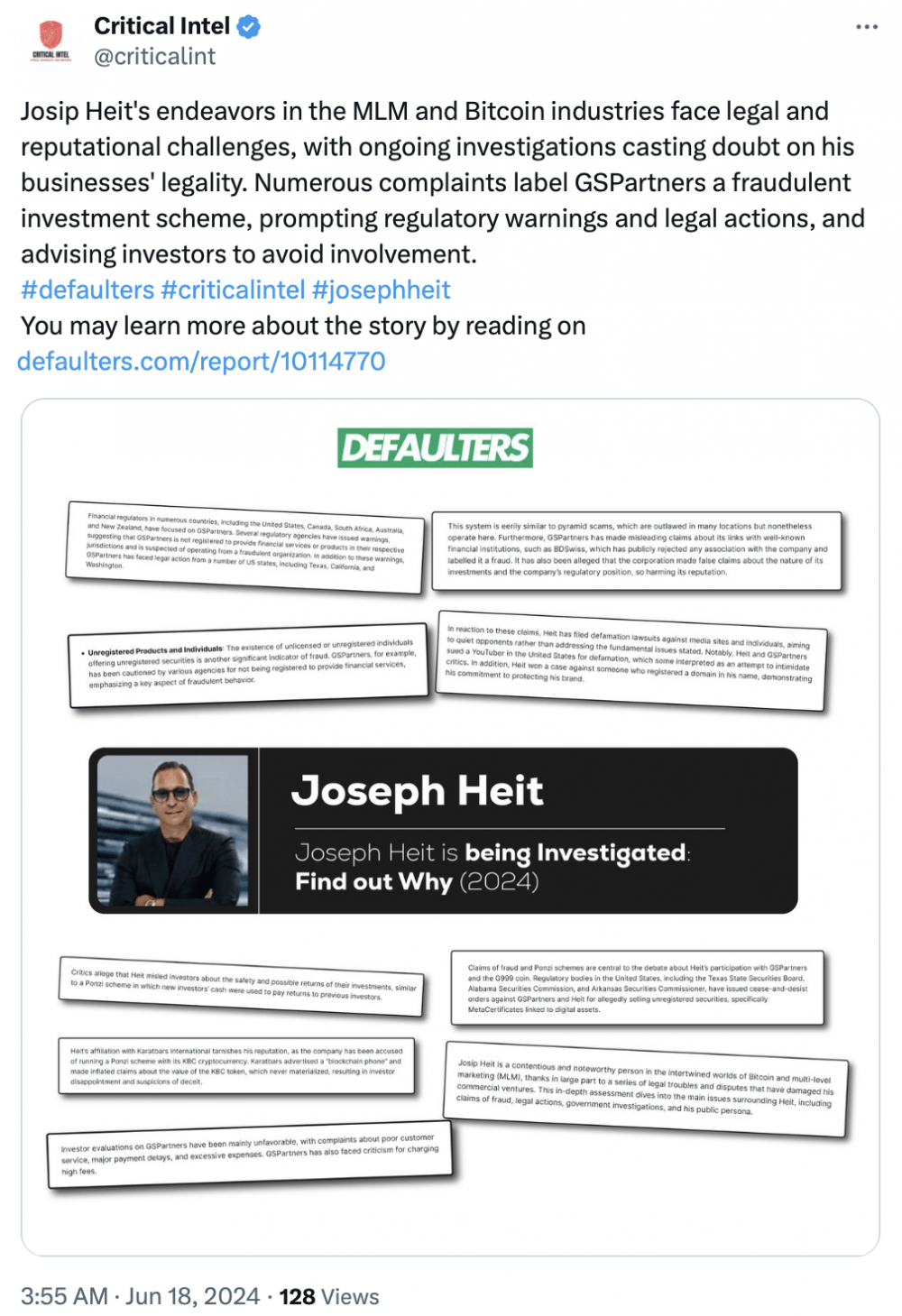

Источник: Critical Intel.

Североамериканское урегулирование

Bloomberg сообщает, что GSB Group начала замораживать снятие средств в октябре. Bloomberg процитировал Джо Ротунду, директора по принудительному исполнению Совета по ценным бумагам штата Техас и вице-председателя NASAA, который сказал:

«Мы договорились об урегулировании, которое гарантирует, что все клиенты в любом штате или провинции, которые присоединятся к урегулированию, получат 100% своих депозитов, за вычетом любых снятий. Это действительно североамериканское урегулирование».

По данным Bloomberg, инвесторам будут возвращены «сотни миллионов долларов». Также сообщается, что «сотни тысяч инвесторов в США и Канаде» пострадали от этой схемы.

У инвесторов будет 90 дней, чтобы подать иск против группы. Немецкая группа утверждает, что насчитывает более 800 000 инвесторов из более чем 170 стран и транзакции на сумму около 1 миллиарда долларов.

Пов'язані матеріали

Li Fei-Fei's Latest Long-Form Article: When Video Generation, Robotics, and NVIDIA All Call Themselves World Models, We Need a Taxonomy

In a new article, Dr. Fei-Fei Li addresses the widespread and often inconsistent use of the term "world model" in AI. She proposes a clear, functional taxonomy rooted in the classic Partially Observable Markov Decision Process (POMDP) loop (agent → action → state → observation → agent). According to this framework, current systems called "world models" are different projections of this loop, categorized by their primary output: 1. **Renderers**: Output observations (pixels). Their goal is visual fidelity for human consumption (e.g., video generation models like Sora). They are the most commercially mature but are limited by a focus on appearance over physical accuracy. 2. **Simulators**: Output states (geometric, physical, dynamic representations). They provide a structurally accurate world for both human professionals (e.g., architects) and computational agents (e.g., robots for training). Li argues simulators are the crucial, underappreciated bridge, as they can underpin both rendering and planning. 3. **Planners**: Output actions. Given an observation and a goal, they decide what an agent should do next (e.g., robotic action models). This area is highly promising but remains the least mature for real-world deployment. Li highlights a key trend: the boundaries between these three categories are beginning to blur, as they all rely on a shared underlying understanding of geometry, physics, and dynamics. The logical endpoint is a unified world foundation model capable of switching between rendering, simulation, and planning based on downstream needs. This convergence, she concludes, is central to advancing spatial intelligence—enabling machines not just to talk about the world, but to truly understand, imagine, and interact with it.

marsbit3 год тому

Li Fei-Fei's Latest Long-Form Article: When Video Generation, Robotics, and NVIDIA All Call Themselves World Models, We Need a Taxonomy

marsbit3 год тому

Forbes Feature: Stablecoin Cross-Border Payments Are Faster, But Not Yet Cheaper

A Forbes feature delves into the state of stablecoin-based cross-border payments, noting rapid growth but a key shortfall: while faster and more accessible, they are not yet cheaper. At a recent industry conference in Mexico City, optimism about technology, regulation, and volume was tempered by discussions with practitioners. The core issue is liquidity. Traditional FX brokers charge 60-70 basis points, and stablecoins promise to slash this to 2-5 basis points. However, this theoretical cost advantage cannot be realized until deep liquidity pools are established at scale, requiring significant institutional capital inflow. A major adoption barrier is trust. Businesses often rely on long-standing relationships with traditional brokers, valuing reliability over marginal cost savings. This shift will be gradual. Furthermore, successful companies in the space are not positioning themselves as replacements for legacy systems like SWIFT, but as complements. They leverage stablecoins for speed while using traditional rails for their standardization and reliability in ensuring accurate payment details—a critical factor for supplier payments to avoid customs issues. Companies like Caliza, experiencing high monthly growth, exemplify this hybrid approach. The industry anticipates consolidation, as long-term viability will depend on securing the essential trifecta: proper licensing, robust fiat on/off-ramps, and deep liquidity. Without these, firms risk being mere intermediaries rather than building sustainable businesses.

marsbit3 год тому

Forbes Feature: Stablecoin Cross-Border Payments Are Faster, But Not Yet Cheaper

marsbit3 год тому

Торгівля

Спот
活动图片