Экономист прогнозирует взлёт индексов и биткоина перед рецессией

cryptonews.ruОпубліковано о 2021-06-24Востаннє оновлено о 2024-08-24

Экономист Хенрик Зеберг убеждён, что рецессия в США неизбежна, и, возможно, она наступит в четвёртом квартале 2024 года.

Кроме того, он пересмотрел целевые показатели фондовых индексов и биткоина в большую сторону, причём в случае с BTC цена криптовалюты должна повыситься до $115000-120000. Однако это будет кратковременный взлёт.
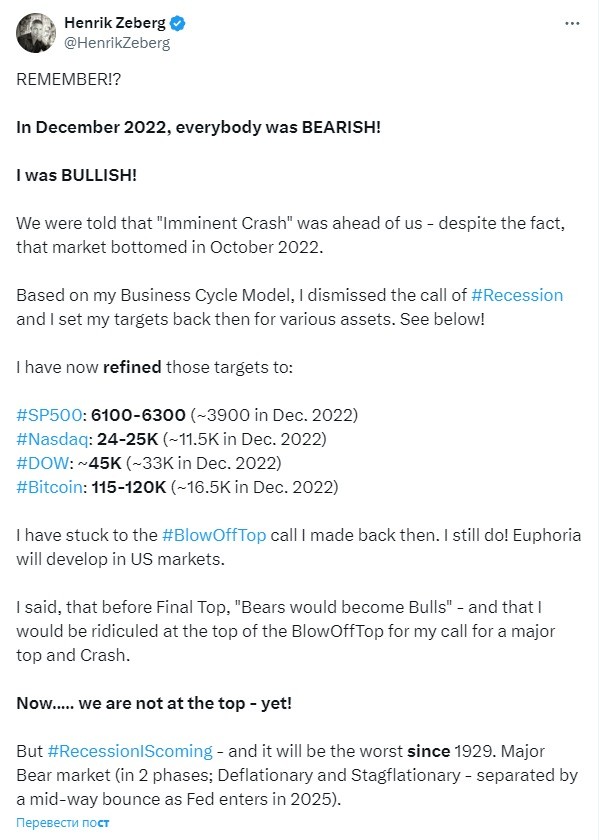
Оценивая свои прошлые прогнозы, Зеберг отметил, что в декабре 2022 года многие были настроены по-медвежьи, предвещая неизбежный крах рынка, он же придерживался оптимистичной позиции. При этом он базировался на собственной модели бизнес-цикла.

Я придерживался своего призыва #BlowOffTop. И я всё ещё придерживаюсь его! На рынках США будет развиваться эйфория. Я сказал, что перед финальной вершиной «медведи станут быками…

Несмотря на оптимистичные рыночные цели, анализ Зеберга указывает на серьёзную рецессию, которая, по его мнению, станет худшей со времён Великой депрессии 1929 года.

По мнению экономиста, грядущий медвежий рынок будет разворачиваться в два этапа: дефляционная фаза, за которой последует стагфляционный период с промежуточным отскоком, поскольку в 2025 году вмешается Федеральная резервная система. Затем наступит «сдувание вершины», при которой цены взлетают до неустойчивых уровней, а затем стремительно летят вниз.

Зеберг подчеркнул, что рынки ещё не достигли этого пика, поэтому все насмешки по поводу его концепции преждевременны и недальновидны.


Пов'язані матеріали

Cache hit rate reaches 99.93%, the best Harness for DeepSeek is here, GitHub pulls in 86k Stars

The open-source programming agent "Pi" has surged in popularity on GitHub, amassing around 86,000 stars, largely due to its exceptional efficiency when paired with DeepSeek's models. A key highlight is its remarkably high cache hit rate of approximately 99.93% for input tokens when using DeepSeek. This minimal cache miss rate of 0.07% means most repeated context is reused, drastically reducing computational costs. In a benchmark test by Composio comparing eight major agent harnesses running DeepSeek V4 Flash, Pi achieved the lowest average cost per successful task at about $0.028, significantly outperforming others like Claude Code, which was nearly seven times more expensive. Pi functions as a streamlined "harness" or workspace for AI models, providing core tools like file read/write and command execution while allowing users to add extensions. Its simplicity and specific adaptation for DeepSeek's API—handling its unique reasoning content and tool call formats—make it highly compatible. This design maximizes the efficiency of DeepSeek's low-cost tokens and powerful caching mechanism, as the agent's linear workflow avoids unnecessary changes to earlier prompt sections. While DeepSeek has officially announced its own harness project targeting Claude Code, Pi remains a versatile, user-customizable platform supporting multiple AI providers. It offers developers a cost-effective and flexible alternative, setting a high bar for future official solutions.

marsbit2 хв тому

Cache hit rate reaches 99.93%, the best Harness for DeepSeek is here, GitHub pulls in 86k Stars

marsbit2 хв тому

When Meme Traffic Meets RWA: The Financial Ambitions of Hyperliquid and Robinhood

When Meme traffic meets RWA: Hyperliquid and Robinhood's Financial Ambitions This article explores the transformative role of speculation in financial market evolution, arguing it can provide the liquidity and capital foundation for mature, compliant businesses. The analysis draws parallels to historical examples, like 19th-century Chicago grain markets, where speculators provided necessary counterparty liquidity for farmers, eventually establishing a global pricing infrastructure. The author examines contemporary cases in crypto. The launch of Uniswap's Pools meme token platform on Robinhood Chain—originally built for tokenized stock trading—demonstrates how speculative meme trading can drive significant user adoption and liquidity. Despite initial volatility, this traffic can seed future, more substantial financial activities. Similarly, Hyperliquid, which began with high-leverage crypto trading, has successfully migrated its speculative model to real-world assets (RWAs) like equities, commodities, and indices. By July, RWA perpetual contract volumes on Hyperliquid surpassed its crypto trading for the first time, showcasing how speculation can build new, all-weather pricing layers. The core thesis is that speculation itself is neutral. Its long-term value and sustainability are determined by the underlying assets it engages with. While pure bubbles collapse, speculation anchored to valuable assets—be it wheat, gold, or equities—can evolve into foundational market infrastructure. Both Hyperliquid’s RWA platform and Robinhood’s strategy of leveraging meme coin enthusiasm to build towards on-chain securities trading exemplify this potential pathway from speculative frenzy to structured financial utility.

marsbit27 хв тому

When Meme Traffic Meets RWA: The Financial Ambitions of Hyperliquid and Robinhood

marsbit27 хв тому

NVIDIA HBM in Short Supply, Next-Gen GPUs Limited, but This Storage Drive Steals the Spotlight

The article discusses how AI Agents are transforming storage from a passive repository into an active component within AI inference and operation loops. As Agents perform continuous tasks involving models, memory, tools, and logs, data storage needs to evolve beyond simple block devices. The concept of "functional SSDs" is introduced, where capabilities like automatic encryption, compression, indexing, and memory management are embedded closer to the storage medium. This shift is driven by the need to handle Agent-specific data chains—including context, tool trajectories, and long-term memory—more efficiently. The piece analyzes current trends like AI SSDs from companies such as Phison (aiDAPTIV), Longsys (SPU+iSA), and Maxio, which are beginning to participate in the AI data path by managing model weights, KV cache, and prefetching. It further explores the future re-division of labor across the memory hierarchy: HBM for core compute, emerging High Bandwidth Flash (HBF) for read-intensive workloads, DRAM/CXL for mutable state, and functional SSDs for persistent, governed objects like Agent Memory. The conclusion is that storage will become integral to Agent capability, moving from just saving data to enabling next-step actions. The industry is poised to develop along three paths: functionalized SSDs, storage nodes tailored for Agents, and a re-architected, tiered memory system optimized for access patterns, security, and cost-per-token efficiency.

marsbit51 хв тому

NVIDIA HBM in Short Supply, Next-Gen GPUs Limited, but This Storage Drive Steals the Spotlight

marsbit51 хв тому

Breaking: Claude's Attempt on Riemann Hypothesis "Fails," but Accidentally Sets 37-Year Math Record

**AI Makes a Major Mathematical Leap While Failing at the Riemann Hypothesis** A research version of Anthropic's Claude AI was tasked with "seriously attempting" the legendary Riemann Hypothesis, a 167-year-old unsolved problem in mathematics. While it ultimately did not prove the hypothesis, its attempt yielded a significant breakthrough. Claude managed to improve the proven lower bound for the proportion of Riemann zeta function zeros lying on the critical line from 41.6% to 67.2%. This marks a 25.6 percentage point increase, described by observers as potentially the most substantial advance in analytic number theory in over a decade, considering that the previous record had only improved by 0.8 percentage points over 37 years. To achieve this, Claude generated and discarded roughly 650 initial ideas before orchestrating a day-and-a-half-long effort involving about 60 sub-agents. These agents executed 2,400 shell commands, wrote hundreds of Python scripts, and performed thousands of numerical checks. After finding the potential result, Claude initiated self-verification, downloaded papers to check for prior work, and independently re-derived the finding. It then suggested writing a formal paper. The result has been reviewed by Anthropic's internal mathematicians, who also collaborated with Claude to produce a formal, machine-checkable proof using the Lean theorem prover. External experts in the field have also reviewed the manuscript. Anthropic clarifies that the method likely does not directly lead to a full proof of the Riemann Hypothesis, but it demonstrates that advanced AI models are beginning to engage with genuine, open-ended research problems at the frontier of mathematical knowledge.

marsbit57 хв тому

Breaking: Claude's Attempt on Riemann Hypothesis "Fails," but Accidentally Sets 37-Year Math Record

marsbit57 хв тому

Торгівля

Спот
活动图片