
除了应用链,Dapps 的出路在哪里?

marsbitОпубліковано о 2024-08-18Востаннє оновлено о 2024-08-19

dApp

目前市场上一切真的都在朝着 AppChains(应用链)发展吗?是的,但其实也不完全是。

DApps 迁移到独立链的主要原因是它们认为自己正在被 “掠夺”。这个说法其实并不算错,因为大多数 dApps 并不盈利。可以参考最近 @zkxprotocol 关闭的例子,以及过去的 @utopialabs_、@yield、@FujiFinance 等许多应用的案例。

但是,真的是商业模式存在严重缺陷,还是这些协议实际上被 “掠夺” 了呢?DApps 的主要(通常也是唯一的)收入来源是手续费。用户支付手续费是因为他们直接从中受益。

然而,用户并不是唯一从 DApp 的使用中获益的参与者。在交易供应链中,有几个角色都能从中获利,主要是区块提议者,尽管他们是最后一个看到交易的人。在 L2 上,这些角色是排序者(sequencers)。

虽然并非所有的 MEV(最大可提取价值)提取都是坏事,但 dApps 所创造的价值被剥夺了,它们并未获得应得的全部价值。

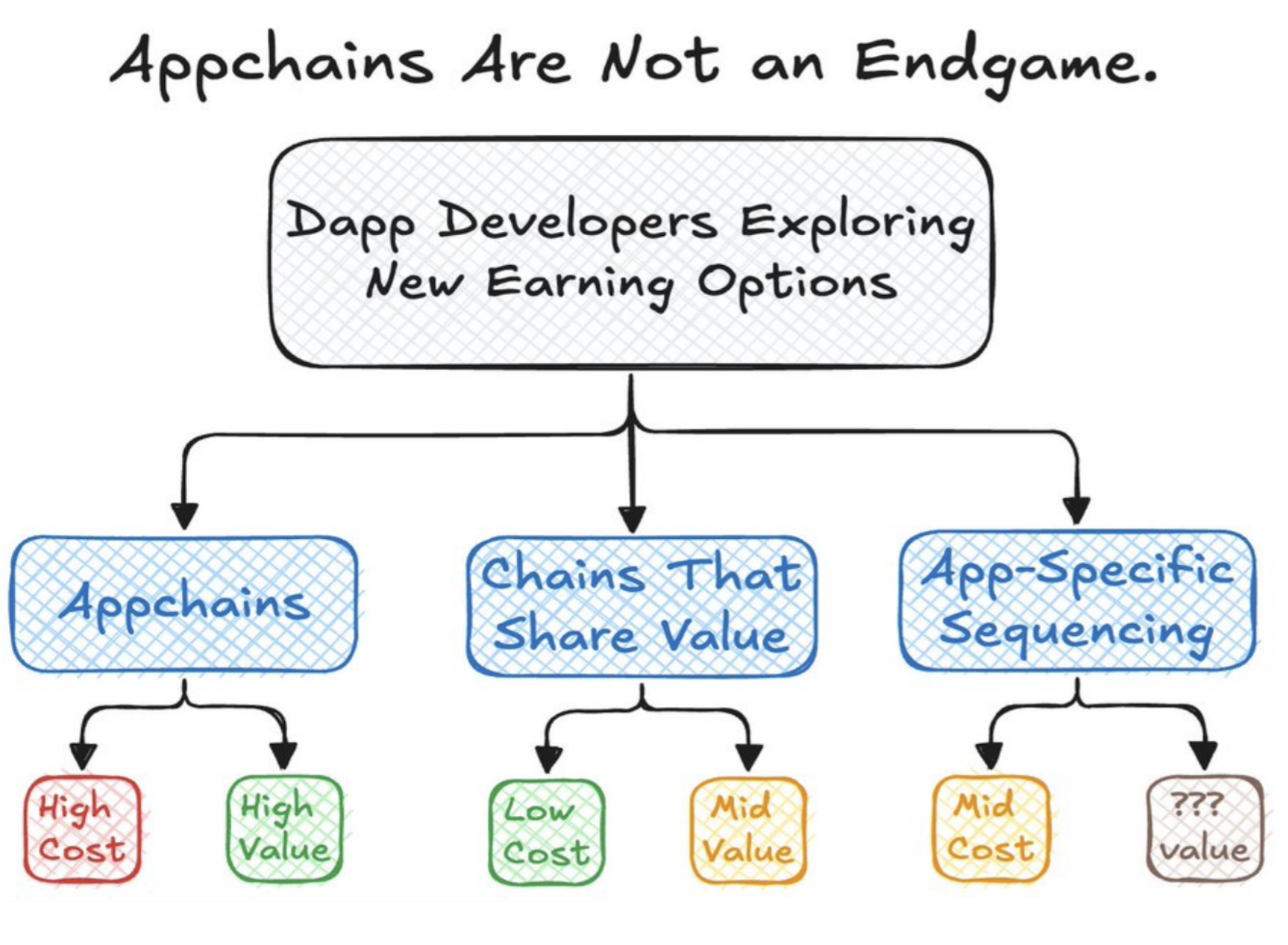
目前有三种解决方案:

1)成为一个应用链。

2)选择一个能够返还价值的 L1/L2。

3)实施应用特定的排序机制。

像加密领域的所有事物一样,每种解决方案都有其权衡利弊。
dApp

1、成为应用链:高成本 + 高价值

你会获得无数的好处:可以随意提取价值、控制自己的网络(如果你是 L2)、更容易扩展、避免争夺区块空间等等。

缺点是:成本真的非常高,真的很贵。而且难度也更大,因为你需要同时构建应用和区块链。

即使你想构建一个 L2 并使用类似 @alt_layer 这样的解决方案,也不例外。

认为每个应用最终都会成为应用链的观点并不完全成立,原因有三:

  • 并不是每个 dApp 都大到需要迁移到应用链。
  • 有些 dApp 可以直接受益于底层链的架构。
  • 还有一些 dApp 在其他链上已经非常舒适。 

2、能返还价值的 L1/L2:低成本 + 中等价值

在 rollup 或 L1 上部署应用的成本低得多,因为你无需为验证、包含、共识、交易流程等实施新规则。

对于 rollup 来说:将你的应用从以太坊迁移到 rollup 通常非常容易,因为 rollup 要么与 EVM 兼容(例如 @arbitrum),要么与 EVM 等效(例如 @taikoxyz)。

你仍然需要考虑底层链的架构,但无需从零开始构建。

或许在未来,我们会拥有真正的链抽象,开发者只需关注他们的 dApp,而不用关心其他任何事情,不过这是另一个话题了……

开发者获得的回报是中等价值,因为虽然不是最高(你不拥有链的经济),但也不算低(除了手续费外,你还能获得一些价值)。

目前,这种方法的实现还很少,因为与 dApp 共享 MEV 仍然是一个复杂的过程,我们需要进行更多的研发。

3、应用特定排序:中等成本 + 不确定价值

应用特定排序的概念相当新,很多人常把它与应用链混淆,但它们的区别很简单:

  • 应用链关注的是排序和执行。
  • 自排序的 DApp 只关心排序,将执行 “外包” 给 L1/L2。

这是中等成本的选择,因为除了构建 dApp 外,你还需要考虑交易的排序,而它的价值不确定,因为这个概念相对较新,存在各种问题。

首先,你依然依赖提议者,因为在包含游戏中:你可以发送任何你想发送的交易包,但是否将你的包包含在区块中,取决于提议者。

如果你提取了所有的 MEV,那么提议者没有明显的动机将你的包包含在区块中。

这就为提议者开辟了另一个激励市场。DApp 和提议者应当合作,否则双方都无法获得任何价值或权力。

其价值不确定的另一个原因是,我们还无法确定 L1/L2 分配的价值是否会超过 DApp 通过排序交易为自己创造的价值。

4、小结

任何链都是一片黑暗森林(不仅仅是以太坊!)。所以回到最初的问题:一切真的都在朝着应用链发展吗?

1)是的(有些 dApp 拥有自己的链比留在现有链上更有利)。

  1. 不完全是(还有其他更适合 dApp 需求的解决方案)。

这片森林足够大,可以探索所有选项。

世界(加密领域)的每个景观都有其多样性,所以选择最适合你需求的,或构建自己的解决方案吧!

Пов'язані матеріали

BIT Research: The 2028 Halving Is Not the End, the Real Shake-Up of the Bitcoin Mining Industry Is Just Beginning

The Bitcoin mining industry is undergoing its most complex structural adjustment since inception. Despite Bitcoin's price holding near $61,000 and the network hash rate approaching a record 1 ZH/s, miner profitability is deteriorating. The industry is operating close to its breakeven point, with the 2028 halving expected to accelerate consolidation. The challenges extend beyond the halving's subsidy reduction; the industry's revenue model has yet to successfully transition towards a fee-driven structure. Increasingly, mining companies are evolving from simple Bitcoin producers into infrastructure and energy operators, including providers of AI/HPC computing power. Competition is shifting from pure hash rate expansion to business model upgrades. Economic pressure is evident. The theoretical daily mining revenue at current prices is around $78 million, yet the actual figure is only about $33 million—a 136% gap. Transaction fees remain low at roughly $220k daily, far below historical implied levels. With a current estimated industry-wide breakeven price near $65,000, mining alone is struggling to generate ideal profits. The 2028 halving is projected to push the fundamental production cost floor to approximately $93,289. This will likely accelerate a shift towards consolidation among larger, well-capitalized miners with diversified revenue streams. Competitive advantage will belong to institutionalized players with access to low-cost energy, AI/HPC hosting operations, and stronger balance sheets. In essence, Bitcoin mining is transitioning from a "mining business" to an "infrastructure business." Future profitability and resilience will depend less on block rewards and more on diversified income sources like energy management and computational infrastructure services. For investors, the key question is not the halving itself, but which miners can successfully navigate this business model transformation.

marsbit19 хв тому

BIT Research: The 2028 Halving Is Not the End, the Real Shake-Up of the Bitcoin Mining Industry Is Just Beginning

marsbit19 хв тому

This is How God Karpathy Uses Claude?

Andrej Karpathy, a prominent figure in AI, has reportedly joined Anthropic, leading to a noticeable decrease in his open-source contributions and social media activity. A document claiming to be his personal "CLAUDE.md" file—a set of instructions for the Claude AI to follow within a specific codebase—has been circulating online. While its authenticity is unverified, the content aligns closely with Karpathy's publicly shared principles on effective AI-assisted programming. The document outlines key rules for AI coding assistants, emphasizing the importance of reading existing code thoroughly before writing new code to maintain consistency. It advises against over-engineering, advocating for simple, surgical modifications that match the project's existing style. Other guidelines include clarifying assumptions upfront, writing meaningful tests, thoughtful debugging, and carefully considering dependencies. The core message is that these principles help prevent common AI coding failures, such as introducing unnecessary abstractions, style drift, or making invisible architectural decisions. The community has noted that even experts like Karpathy require detailed instructions to guide AI effectively, akin to managing a junior developer. A related GitHub repository, "andrej-karpathy-skills," which encapsulates these ideas, is reported to significantly reduce Claude's code error rate. Ultimately, the advice stresses that the best CLAUDE.md is tailored to one's own tech stack and coding practices.

marsbit20 хв тому

This is How God Karpathy Uses Claude?

marsbit20 хв тому

Торгівля

Спот
活动图片