Парадокс дня: биткоин растет на фоне новых переводов Mt. Gox

cryptonews.ruОпубліковано о 2021-06-13Востаннє оновлено о 2024-08-13

Кто бы мог подумать, что призрак давно почившей биржи может вызвать парадоксальный рост курса криптовалют? Но именно это и произошло, когда более $2 млрд в биткоинах от печально известной Mt. Gox внезапно пришли в движение.

Что за чертовщина творится?

Компания Arkham Intelligence, специализирующаяся на отслеживании блокчейн-данных, во вторник забила тревогу. Они заметили подозрительную активность с криптоадреса, на который ранее поступило свыше $2 млрд в биткоинах от рухнувшей биржи.

Сначала с адреса были отправлены тестовые транзакции — явный признак подготовки к чему-то масштабному. А затем — бабах! — весь баланс в 33 000 BTC (это, на минуточку, $2 млрд по текущему курсу) перекочевал на другой кошелек.

Кто за этим стоит?

По мнению Arkham, этот адрес, скорее всего, связан с компанией BitGo. Если вы не в курсе, это одна из фирм, которой поручили нелегкую задачу — вернуть деньги клиентам, потерявшим свои биткоины в результате взлома более десяти лет назад.

Кстати, BitGo — не единственный игрок на этом поле. Еще четыре криптобиржи — Bitbank, Bitstamp, Kraken и SBI VC Trade — уже начали процесс выплат пострадавшим клиентам.

А что с ценой биткоина?

Вот тут-то и начинается самое интересное! Обычно, когда огромные суммы в криптовалюте начинают двигаться, цена биткоина падает. Трейдеры и аналитики рынка ожидают, что владельцы этих средств начнут их продавать, что приводит к снижению курса.

Но в этот раз все пошло не по сценарию. После того как эти $2 млрд пришли в движение, цена биткоина… взлетела! Сейчас он торгуется выше $61 000, подскочив примерно на 3% всего за час (с $59 500 до текущей цены).
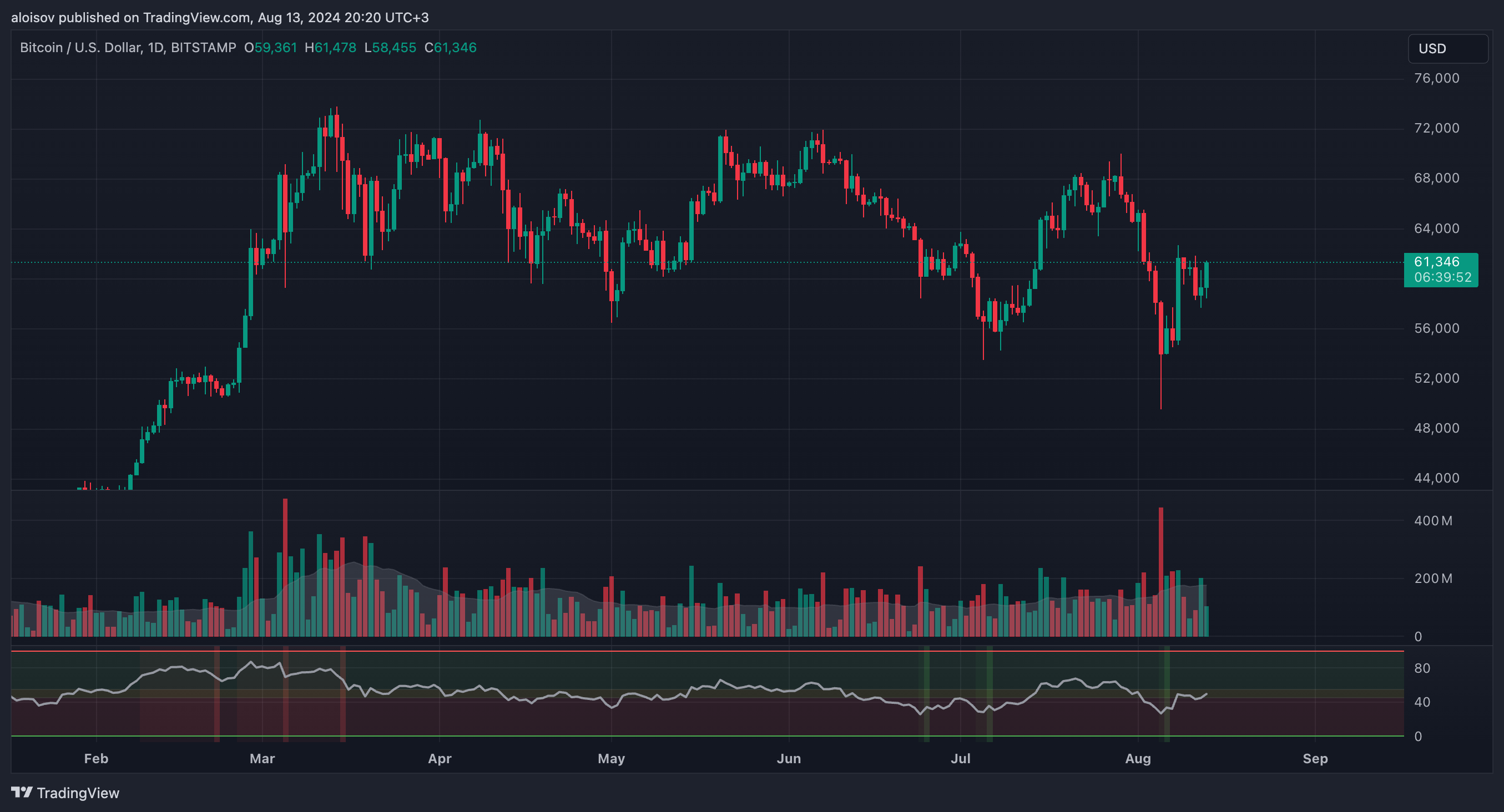
1-дневный график BTC/USD. Источник: Bitstamp/TradingView

Правда, не стоит слишком обольщаться. Биткоин все еще не дотягивает до своего исторического максимума в почти $74 000, который был достигнут в марте. Да и совсем недавно, чуть больше недели назад, цена падала ниже $50 000.

Краткая история Mt. Gox для тех, кто пропустил этот эпизод

Mt. Gox когда-то была популярной биржей биткоинов, базировавшейся в Японии. Но в 2014 году она с треском обанкротилась после того, как хакеры умыкнули 850 000 биткоинов через долгоиграющую уязвимость.

Спустя годы правоохранительным органам удалось найти и вернуть 140 000 биткоинов. И только сейчас, спустя целое десятилетие, бывшие клиенты начинают получать назад свои средства согласно плану реабилитации, утвержденному в 2021 году.

Самое интересное в этой истории то, что клиенты, потерявшие деньги при взломе Mt. Gox, могли бы получить просто астрономическую прибыль. Ведь когда биржа рухнула более 10 лет назад, цена биткоина была меньше $500. Представляете, какой это рост?

А вот что действительно забавно: похоже, крипторынок наконец-то перестал трястись при виде призрака Mt. Gox. Видимо, все уже поверили, что эти криптодинозавры не побегут сломя голову продавать свои биткоины. Кто бы мог подумать, что ветераны Mt. Gox, пережившие все взлеты и падения, научат нас не паниковать? Страх, который раньше заставлял всех сбрасывать монеты при малейшем шорохе, куда-то испарился. Может, в этом и есть секрет? Сидеть спокойно и наблюдать, как биткоин пишет свою непредсказуемую историю.


Пов'язані матеріали

When Meme Traffic Meets RWA: The Financial Ambitions of Hyperliquid and Robinhood

When Meme traffic meets RWA: Hyperliquid and Robinhood's Financial Ambitions This article explores the transformative role of speculation in financial market evolution, arguing it can provide the liquidity and capital foundation for mature, compliant businesses. The analysis draws parallels to historical examples, like 19th-century Chicago grain markets, where speculators provided necessary counterparty liquidity for farmers, eventually establishing a global pricing infrastructure. The author examines contemporary cases in crypto. The launch of Uniswap's Pools meme token platform on Robinhood Chain—originally built for tokenized stock trading—demonstrates how speculative meme trading can drive significant user adoption and liquidity. Despite initial volatility, this traffic can seed future, more substantial financial activities. Similarly, Hyperliquid, which began with high-leverage crypto trading, has successfully migrated its speculative model to real-world assets (RWAs) like equities, commodities, and indices. By July, RWA perpetual contract volumes on Hyperliquid surpassed its crypto trading for the first time, showcasing how speculation can build new, all-weather pricing layers. The core thesis is that speculation itself is neutral. Its long-term value and sustainability are determined by the underlying assets it engages with. While pure bubbles collapse, speculation anchored to valuable assets—be it wheat, gold, or equities—can evolve into foundational market infrastructure. Both Hyperliquid’s RWA platform and Robinhood’s strategy of leveraging meme coin enthusiasm to build towards on-chain securities trading exemplify this potential pathway from speculative frenzy to structured financial utility.

marsbit18 хв тому

When Meme Traffic Meets RWA: The Financial Ambitions of Hyperliquid and Robinhood

marsbit18 хв тому

NVIDIA HBM in Short Supply, Next-Gen GPUs Limited, but This Storage Drive Steals the Spotlight

The article discusses how AI Agents are transforming storage from a passive repository into an active component within AI inference and operation loops. As Agents perform continuous tasks involving models, memory, tools, and logs, data storage needs to evolve beyond simple block devices. The concept of "functional SSDs" is introduced, where capabilities like automatic encryption, compression, indexing, and memory management are embedded closer to the storage medium. This shift is driven by the need to handle Agent-specific data chains—including context, tool trajectories, and long-term memory—more efficiently. The piece analyzes current trends like AI SSDs from companies such as Phison (aiDAPTIV), Longsys (SPU+iSA), and Maxio, which are beginning to participate in the AI data path by managing model weights, KV cache, and prefetching. It further explores the future re-division of labor across the memory hierarchy: HBM for core compute, emerging High Bandwidth Flash (HBF) for read-intensive workloads, DRAM/CXL for mutable state, and functional SSDs for persistent, governed objects like Agent Memory. The conclusion is that storage will become integral to Agent capability, moving from just saving data to enabling next-step actions. The industry is poised to develop along three paths: functionalized SSDs, storage nodes tailored for Agents, and a re-architected, tiered memory system optimized for access patterns, security, and cost-per-token efficiency.

marsbit42 хв тому

NVIDIA HBM in Short Supply, Next-Gen GPUs Limited, but This Storage Drive Steals the Spotlight

marsbit42 хв тому

Breaking: Claude's Attempt on Riemann Hypothesis "Fails," but Accidentally Sets 37-Year Math Record

**AI Makes a Major Mathematical Leap While Failing at the Riemann Hypothesis** A research version of Anthropic's Claude AI was tasked with "seriously attempting" the legendary Riemann Hypothesis, a 167-year-old unsolved problem in mathematics. While it ultimately did not prove the hypothesis, its attempt yielded a significant breakthrough. Claude managed to improve the proven lower bound for the proportion of Riemann zeta function zeros lying on the critical line from 41.6% to 67.2%. This marks a 25.6 percentage point increase, described by observers as potentially the most substantial advance in analytic number theory in over a decade, considering that the previous record had only improved by 0.8 percentage points over 37 years. To achieve this, Claude generated and discarded roughly 650 initial ideas before orchestrating a day-and-a-half-long effort involving about 60 sub-agents. These agents executed 2,400 shell commands, wrote hundreds of Python scripts, and performed thousands of numerical checks. After finding the potential result, Claude initiated self-verification, downloaded papers to check for prior work, and independently re-derived the finding. It then suggested writing a formal paper. The result has been reviewed by Anthropic's internal mathematicians, who also collaborated with Claude to produce a formal, machine-checkable proof using the Lean theorem prover. External experts in the field have also reviewed the manuscript. Anthropic clarifies that the method likely does not directly lead to a full proof of the Riemann Hypothesis, but it demonstrates that advanced AI models are beginning to engage with genuine, open-ended research problems at the frontier of mathematical knowledge.

marsbit48 хв тому

Breaking: Claude's Attempt on Riemann Hypothesis "Fails," but Accidentally Sets 37-Year Math Record

marsbit48 хв тому

The Unaffordable Failure of Yushu's IPO

Yushu Robotics' IPO is not just a typical public offering; it represents a pivotal moment for China's humanoid robot industry. With a staggering 219x P/E ratio at issuance and immense market enthusiasm, the company's listing is seen as a critical test case for the entire sector. The IPO reveals Yushu's rapid transition from quadruped consumer robots to humanoid robots, which now account for over 50% of its revenue, alongside a shift to profitability. The offering was massively oversubscribed, with retail investors scrambling for scarce shares, while the majority of the stock is held by locked-up strategic investors like DeepSeek. The core tension lies in the market's valuation. Investors are not buying Yushu's current profits but its future potential as a leader in general-purpose humanoid hardware. However, challenges are evident: revenue heavily depends on research/education clients rather than industrial applications, selling prices are falling faster than costs, and the company is still developing its own AI "brain" for true autonomous decision-making. As the first major humanoid robot company on China's A-share market, Yushu's post-listing performance will set a valuation benchmark for the industry. A wide range of stakeholders, from venture capitalists to strategic partners, have a vested interest in its success. The real test, however, will be Yushu's ability to transition its sales to core industrial clients, maintain margins amid price competition, and successfully integrate advanced AI, thereby justifying its premium valuation.

marsbit1 год тому

The Unaffordable Failure of Yushu's IPO

marsbit1 год тому

Торгівля

Спот
活动图片