DEF покупает патент, чтобы остановить судебные иски против MakerDAO и Compound

cryptonews.ruОпубліковано о 2024-03-13Востаннє оновлено о 2024-08-13

Образовательный фонд DeFi (DEF) приобрел патент, принадлежащий True Return Systems (TRS), который лежал в основе судебных исков против децентрализованных автономных организаций MakerDAO и Compound Protocol за нарушение авторских прав.

Патент касается системы, подобной оракулу, для «разделения и связывания стекированного модульного хранения и обработки данных». DEF «посвятит» патент общественности, предотвратив использование патента в подобных исках в будущем.

Патент на технологию хранения данных

DEF охарактеризовал TRS как «патентного тролля», то есть фирму, которая предъявляет патентные иски, которые могут быть необоснованными. В сентябрьской петиции в Патентное и товарное ведомство США (USPTO) DEF утверждал, что технология, запатентованная TRS в 2018 году, уже широко используется. DEF перечислил четыре технологии, которые служили той же цели и были созданы в 2014 и 2016 годах.
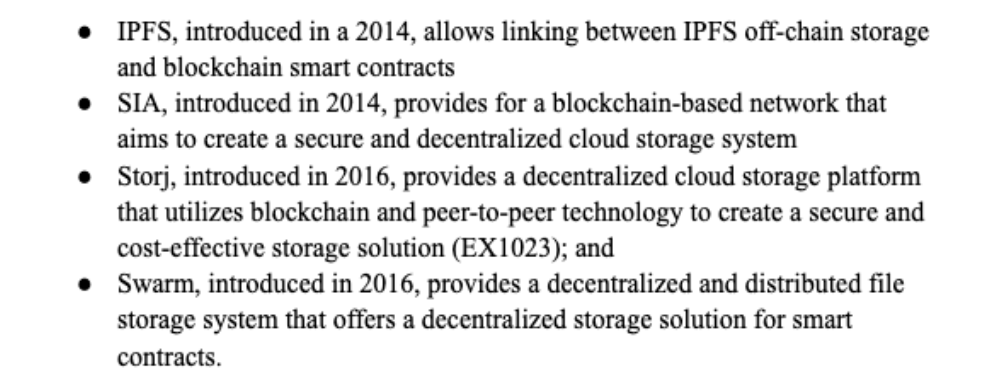

Технология, похожая на патент TRS. Источник: DeFi Education Fund.

USPTO должен был ответить в течение шести месяцев, будет ли он рассматривать патент, и вынести решение о том, следует ли аннулировать патент в течение 12 месяцев. Главный юридический директор DEF Аманда Туминелли заявила:

«В результате урегулирования, TRS прекратит судебное разбирательство против MakerDAO и Compound Protocol. […] Как мы заявили, когда впервые подали нашу петицию о признании патента недействительным, оскорбительное патентование противоречит духу разработки программного обеспечения с открытым исходным кодом».

TRS подала жалобы на MakerDAO и Compound Protocol в октябре 2022 года, требуя возмещения ущерба от нарушения патентных прав и запретив DAO использовать в будущем предмет претензий TRS. Покупка патента урегулирует иски.

Попытка извлечь выгоду из патента

В сентябре Туминелли написал в посте на X, что «целью TRS было назвать ответчиков, которые не могли ответить на жалобу, чтобы TRS могла получить заочное решение, а затем попытаться применить это решение против держателей токенов. […] Патентные тролли выбирают цели, которые либо не могут оспорить их в суде, либо не имеют ресурсов для этого».
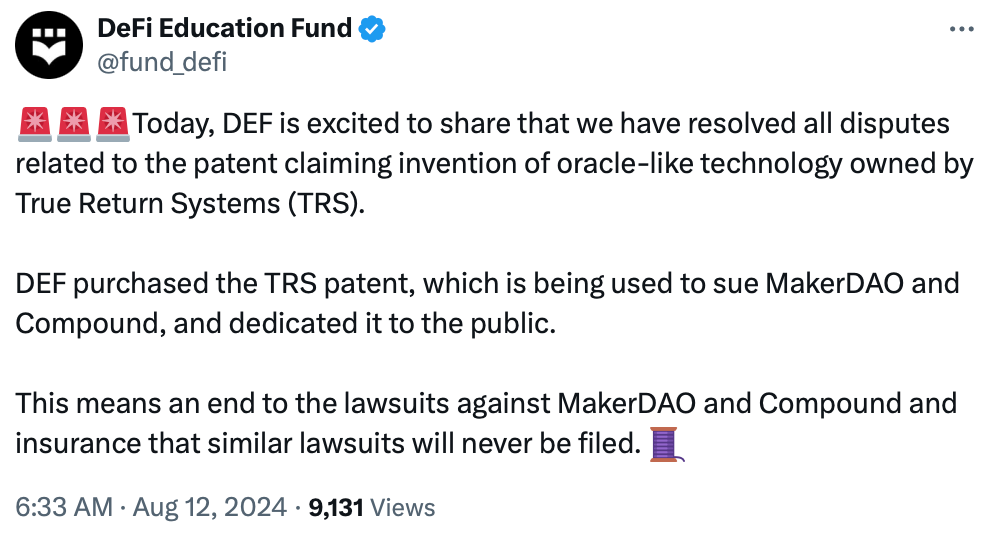

Источник: DeFi Education Fund.

TRS попыталась продать патент как невзаимозаменяемый токен (NFT) на OpenSea в ноябре 2021 года. Считалось, что это был первый случай токенизации патента. Однако покупателя он не нашел. TRS запросила 2250 ETH за NFT и отклонила единственное полученное предложение за 0,69 ETH.

На момент написания статьи веб-сайт TRS был отключен. Основатель TRS Джек Фонсс умер в марте.

Пов'язані матеріали

BIS Report Compliance Observations: The True Risks of Stablecoins Go Beyond 'De-pegging'

The BIS report, "Anchoring trust in money: innovation beyond stablecoins," highlights that the primary risks of stablecoins extend beyond potential de-pegging. It argues that the core challenge is whether stablecoins can be integrated into a financial system that is identifiable, monitorable, accountable, and regulatable. While acknowledging efficiency gains like faster payments and programmability, BIS emphasizes that money requires an institutional framework—including legal certainty, liquidity support, and financial integrity controls—which many stablecoins currently lack. The report details compliance risks, noting that while blockchain transactions are transparent, address visibility does not equate to identity or purpose clarity. This creates a systemic risk as pseudonymity, non-custodial wallets, and cross-chain bridges can undermine AML/CFT controls. Furthermore, these risks can spill over into the traditional financial system through on- and off-ramps. The future direction, per BIS, is not to prohibit innovation but to embed regulatory rules—such as identity verification and transaction screening—directly into the technological infrastructure of tokenized finance. The key takeaway for compliance is that any new financial instrument must clearly address questions of customer identification, transaction monitoring, accountability, and cross-border rule consistency to be viable as a mainstream payment tool.

marsbit55 хв тому

BIS Report Compliance Observations: The True Risks of Stablecoins Go Beyond 'De-pegging'

marsbit55 хв тому

When US Giants Collectively "Defect" to Chinese AI Models

When Silicon Valley Giants Turn to Chinese AI Models to Cut Costs A surprising trend is emerging: major U.S. tech companies are significantly reducing AI costs by switching to Chinese models. Coinbase, the largest U.S. cryptocurrency exchange, reportedly halved its AI spending after migrating to China's GLM-5.2 and Kimi 2.7 models, despite increasing usage. They achieved this through a sophisticated three-part strategy: implementing an automatic routing system to select the most cost-effective model per task, boosting cache hit rates from 5% to 60% to reuse computations, and employing "context engineering" to provide AI with more precise, less cluttered information. They are not alone. AI startup Lindy switched from Claude to DeepSeek, saving millions, while Snowflake's tests found GLM-5.2 solved 66% of coding tasks compared to Claude Opus's 67%—but at a fraction of the cost (output pricing is 5-7 times lower). While the top Western models may offer slightly better stability, the massive price differential is leading many businesses to reconsider their value proposition. This shift signals a deeper change in the AI industry, moving beyond pure performance benchmarks to a fierce cost competition. As pressure mounts, even OpenAI and Anthropic have begun slashing prices. For users, this means more choices, lower costs, and a crucial lesson: using multiple models based on task complexity, optimizing with caching, and keeping contexts lean are now key to leveraging AI efficiently and affordably.

marsbit1 год тому

When US Giants Collectively "Defect" to Chinese AI Models

marsbit1 год тому

BIS Report Compliance Watch: The Real Risks of Stablecoins Are Not Just 'De-pegging'

BIS Report Compliance Observations: The real risks of stablecoins go beyond "depegging" The BIS report "Anchoring trust in money: innovation beyond stablecoins" argues that while stablecoins and tokenization offer efficiency gains, their primary risk lies in fitting into an identifiable, monitorable, accountable, and regulatable financial system. Money's trust stems not just from technology but from institutional arrangements: a common unit of account, guaranteed redemption at par, liquidity support, regulatory frameworks, and financial integrity requirements. Stablecoins, operating on permissionless blockchains with pseudo-anonymity and non-custodial wallets, create systemic compliance gaps: unclear customer identity, incomplete fund origins, unexplained transaction purposes, fragmented cross-chain paths, and ambiguous liability. On-chain transparency does not equal compliance transparency. Public addresses don't reveal identity or intent. While blockchain analytics aid law enforcement, they cannot replace routine, large-scale AML/CFT controls. Effective compliance requires a closed-loop process encompassing customer onboarding, transaction monitoring, investigation, reporting, and audit. Stablecoin risks are not confined to the blockchain; they re-enter the traditional financial system via on/off-ramps, exchanges, and payment institutions. This forces banks to monitor client accounts for activity linked to virtual assets. The future direction is not to prohibit innovation but to embed rules into the technology. Tokenized finance should integrate with the existing two-tier monetary system, embedding compliance—like customer identification, pre-transaction screening, and auditable data trails—directly into the transaction flow. For compliance professionals, the key takeaway is that any new financial instrument must answer core questions: Who identifies the customer? Who monitors transactions? Who handles exceptions? Who is liable? Compliance is not the antithesis of innovation but the essential infrastructure for its sustainable growth.

链捕手1 год тому

BIS Report Compliance Watch: The Real Risks of Stablecoins Are Not Just 'De-pegging'

链捕手1 год тому

When American Giants 'Defect' to Chinese AI Models

Summary: The trend of major U.S. technology firms adopting more cost-effective Chinese AI models is gaining momentum. A prime example is Coinbase, the largest U.S. cryptocurrency exchange, which reportedly halved its AI expenditure by switching to Chinese models GLM-5.2 and Kimi 2.7, while its usage volume increased. This was achieved through a sophisticated cost-saving system featuring intelligent model routing (selecting the most suitable model per task), dramatically improving cache hit rates from 5% to 60%, and implementing "Context Engineering" to streamline prompts. This shift is not isolated. Other companies like the AI startup Lindy and data cloud firm Snowflake are making similar moves, drawn by the significant price disparity. For instance, GLM-5.2 costs $1.40/$4.40 per million tokens (input/output), compared to $5/$25 for Claude Opus 4.7. While top Western models may offer slightly higher stability or speed in complex tasks, the performance gap is narrowing, making the price difference harder to justify for many enterprise use cases. The implications are significant for both businesses and individual users. It highlights the importance of a multi-model strategy based on task requirements, the value of caching and reusing outputs, and the effectiveness of providing concise context. Ultimately, this migration signals a potential reshaping of the AI industry's pricing model, moving competition from pure performance benchmarks to practical cost-effectiveness, with increased choice and downward price pressure benefiting end-users.

链捕手1 год тому

When American Giants 'Defect' to Chinese AI Models

链捕手1 год тому

Торгівля

Спот
活动图片