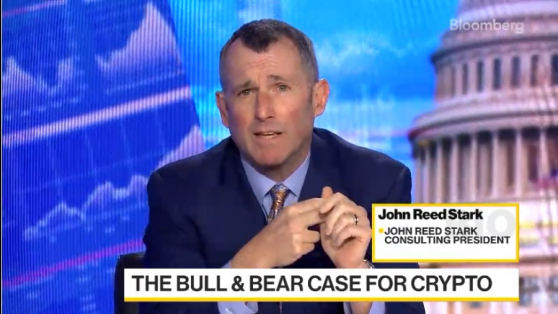
Джон Рид Старк: Решение Morgan Stanley продвигать спотовые биткоин-ETF уничтожит корпорацию

investing.ruОпубліковано о 2024-08-12Востаннє оновлено о 2024-08-12

Джон Рид Старк (John Reed Stark) считает, что контролирующие ведомства получат полный доступ ко всем внутренним документам корпорации, имеющим отношение к продажам паев спотовых биткоин-ETF розничным инвесторам. Найти нарушения в таких условиях будет чрезвычайно просто, подчеркнул бывший глава SEC:

«Дав “зеленый свет” своей армии из 15 000 брокеров на продвижение спотовых биткоин-ETF, Morgan Stanley (NYSE:MS) самостоятельно положил начало тому, что может стать крупнейшей в истории проверкой, проводимой SEC и Службой регулирования отрасли финансовых услуг (FINRA). Кто бы не занимал пост директора по соответствию законодательным нормам, желаю ему успеха».

С 7 августа финансовые консультанты Morgan Stanley получили право предлагать своим клиентам биржевые фонды (ETF) на основе биткоинов от компаний Fidelity Investments и BlackRock. Эти продукты доступны клиентам, чей капитал под управлением (AUM) превышает сумму $1,5 млн. В Morgan Stanley заявили, что такое решение приведет к притоку дополнительных инвестиций.

Ранее ETF-эксперт Bloomberg Intelligence Джеймс Сейффарт (James Seyffart) заявил, что SEC может зарегистрировать опционы на спотовые биткоин-ETF в четвертом квартале 2024 года.

Читайте оригинальную статью на сайте Bits.media
Пов'язані матеріали

Embodied Intelligence 'Gaokao' is Insanely Hard, Humans Score 100, Best Model Only 12.8

Embodied AI Faces a Daunting "Everest": New Benchmark Reveals Huge Gap Between Models and Humans A comprehensive new benchmark for robotic manipulation, RoboDojo, has been released, painting a stark picture of the current state of embodied AI. It serves as a unified evaluation platform covering both simulation and real-world robot tasks. The benchmark assesses five core capabilities: Generalization (adapting to new scenes/objects), Memory, Precision manipulation, Long-Horizon multi-step tasks, and Open semantic understanding. It includes 42 simulation tasks and 18 standardized real-world tasks across three dual-arm robot platforms. The results are sobering. In simulation, the best-performing generalist robot policy achieved an average success rate of only 8.80%. Performance in the real world was slightly higher but still low, with the top model succeeding 12.8% of the time on average. In stark contrast, human experts scored 76.03% in simulation and 100% in real-world tests. The benchmark highlights significant, uneven gaps in current models' abilities. While some excel in specific areas like visual recognition or simple actions, they struggle with reliability, especially in long-horizon tasks where errors accumulate and in open-ended semantic instructions. The low scores, particularly in real-world deployment with physical uncertainties like camera noise and contact dynamics, underscore that today's models are far from being robust, general-purpose operational robots. RoboDojo is more than just a ranking; it's an infrastructure designed for fair, reproducible comparison. Its companion system, XPolicyLab, standardizes the interface for different models to be evaluated. Maintained by an academic consortium without commercial ties, it aims to provide a community-wide "altitude meter" to track genuine progress toward reliable and generalizable robot manipulation.

marsbit1 год тому

Embodied Intelligence 'Gaokao' is Insanely Hard, Humans Score 100, Best Model Only 12.8

marsbit1 год тому

Zuckerberg's 'Mango' Image Generation Model Trails Only GPT Image 2, It Learned to Revise Prompts on Its Own

Meta's MSL has launched Muse Image, an advanced image generation model nicknamed "Mango," which ranks second globally in text-to-image benchmarks, closely trailing OpenAI's GPT Image 2. Its key innovation is agent-like behavior: it searches for factual information, writes code for charts, and, most notably, has developed self-correction abilities through reinforcement learning, allowing it to revise its own outputs without explicit programming. This shift emphasizes reasoning over immediate generation. Integrated with Meta's ecosystem, Mango connects with the Muse Spark language model for complex tasks and features a unique "@" function that can incorporate public Instagram photos into generated images—raising privacy concerns as it's enabled by default. The model is directly accessible in Meta AI, Instagram, and WhatsApp, leveraging Meta's vast user base for distribution rather than competing solely on image quality. Accompanying Mango is the preview of Muse Video, a video generation model with integrated audio, currently ranked third in its category. All Mango-generated images include an invisible, persistent watermark (Content Seal) for AI identification, alongside a public detection tool. While Mango advances "thinking" image models, its use of social data poses new ethical questions about consent and digital boundaries.

marsbit2 год тому

Zuckerberg's 'Mango' Image Generation Model Trails Only GPT Image 2, It Learned to Revise Prompts on Its Own

marsbit2 год тому

Торгівля

Спот
活动图片