Author: ARK Invest
Compiled by: Felix, PANews (This article has been abridged)
ARK Invest releases its flagship research report, "Big Ideas," annually. This report filters out short-term noise, aiming to identify and interpret the technologies reshaping the global economy. In this year's report, ARK explores 13 significant ideas spanning AI, robotics, energy, blockchain, space, and biology, which are creating compound effects and redefining productivity, capital allocation, and competitive advantages across industries. This excerpt covers areas like AI and blockchain. Details are as follows.
In the Era of Great Acceleration, AI acts as the core engine, accelerating the development of five major innovation platforms and triggering an inflection point in macroeconomic growth.
Technological convergence is accelerating. Five innovative technologies (AI, public blockchains, robotics, energy storage, and multi-omics) are becoming increasingly interdependent, as performance improvements in one technology unlock new capabilities for another.
Reusable rockets delivering autonomous Mobility AI chips into orbit could be key to scaling next-generation cloud services. Multi-omics data authorized in digital wallets could power neural networks, advancing precision therapies to cure rare diseases.
The world is entering an unprecedented cycle of technological investment. Each disruptive technology has the potential for profound macroeconomic impact.
AI Infrastructure
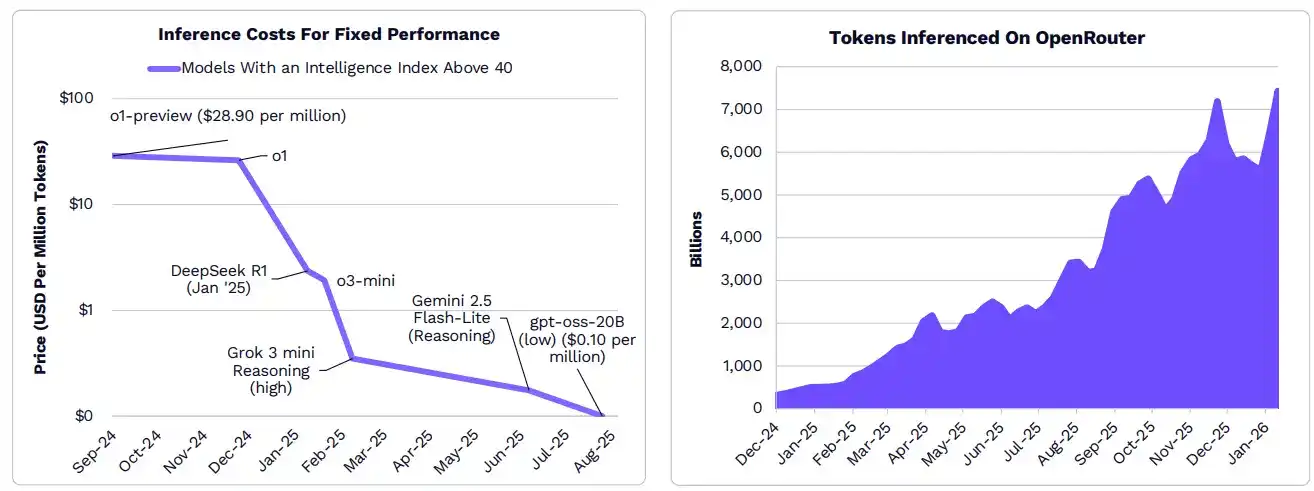
As inference costs decline, demand for AI is growing rapidly.
By some metrics, inference costs have fallen by over 99% in the past year. The decline in costs is driving an explosion in the number of tokens for developer, enterprise, and consumer inference as AI-native applications proliferate. Since December 2024, computational demand on OpenRouter (a unified API for accessing large language models) has grown 25-fold.
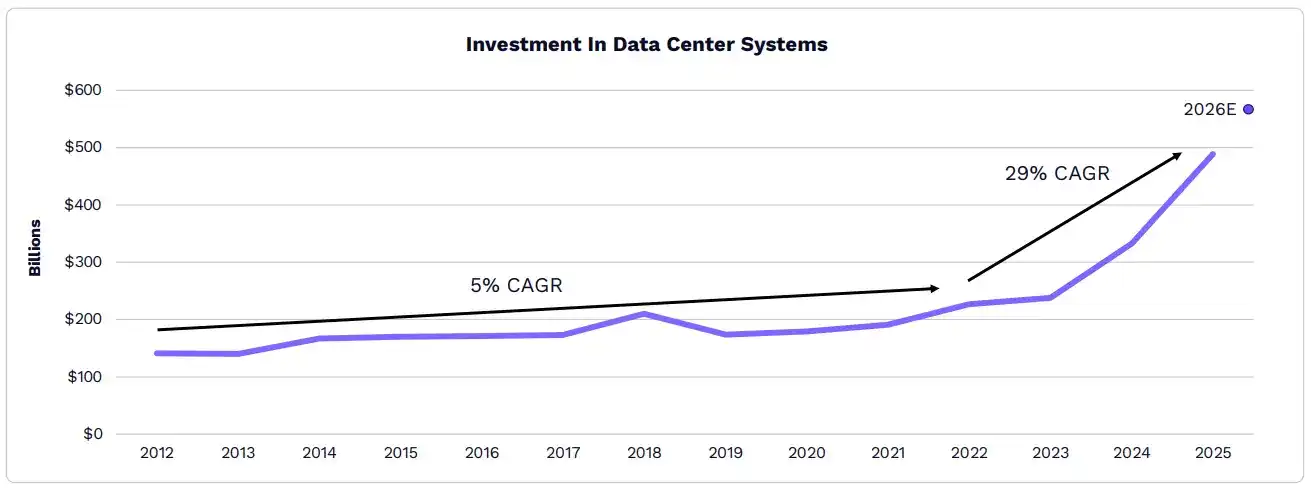
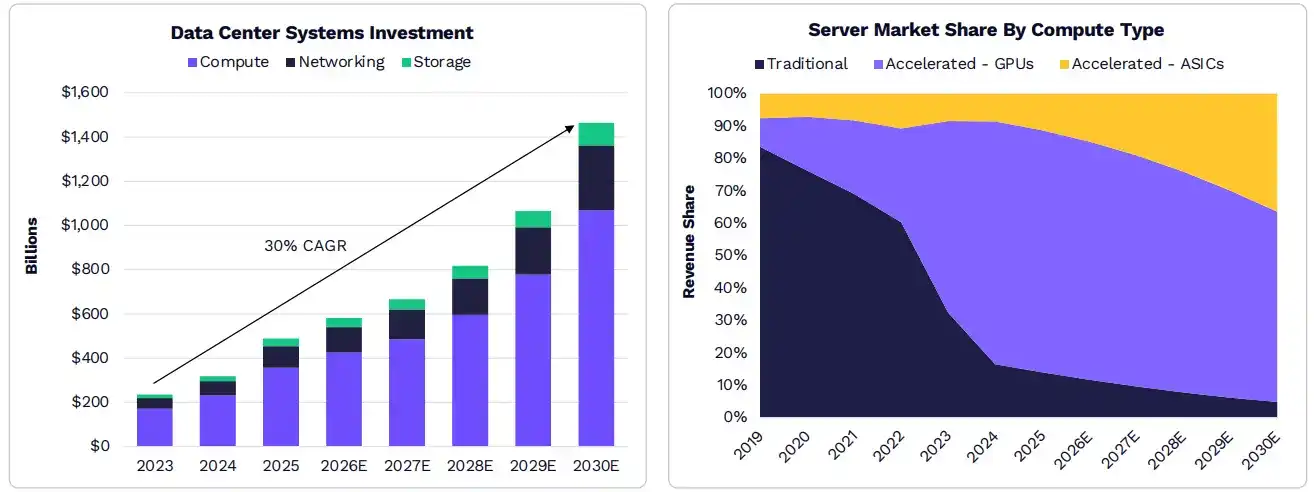
Since the "ChatGPT moment", the growth rate of data center systems has accelerated from 5% to 29%, with the annual growth rate continuing to climb.
By 2025, annual investment in data center systems was approximately $500 billion, nearly 2.5 times the average from 2012 to 2023. According to ARK research, such investment will continue to grow, potentially tripling to approximately $1.4 trillion by 2030.
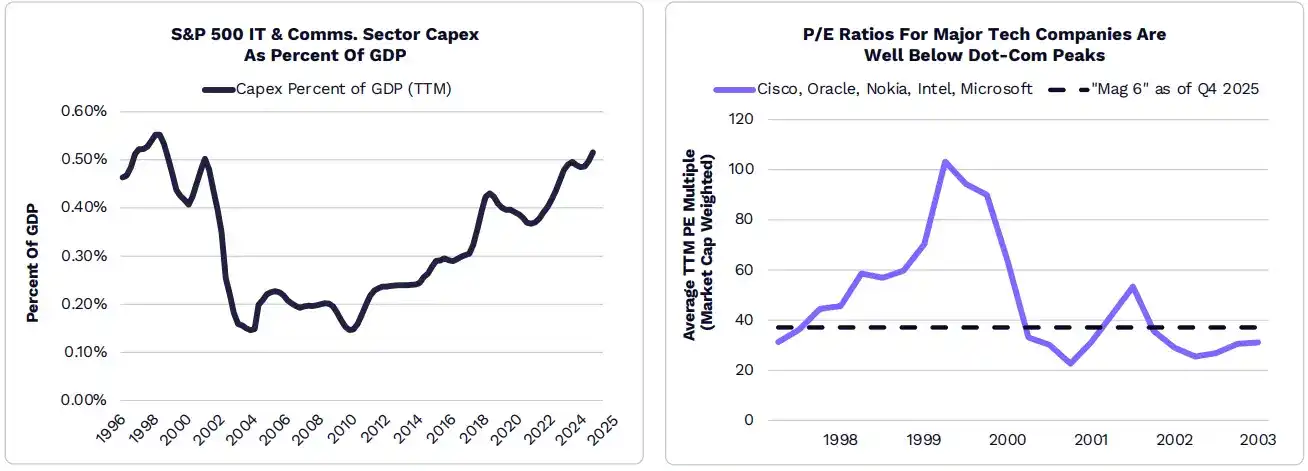
Tech capital expenditure has reached levels seen during the tech and telecom boom, but tech company valuations are far lower than during that period.
According to ARK research, hyperscale data center operators' capital expenditure in 2026 will exceed $500 billion, nearly triple the $135 billion in 2021 (pre-ChatGPT boom in 2022). Although the capital expenditure of the Information Technology and Communication Services sectors as a percentage of GDP has reached its highest level since 1998, the price-to-earnings (P/E) ratio of the tech sector is far below the peak of the tech and telecom bubble era.
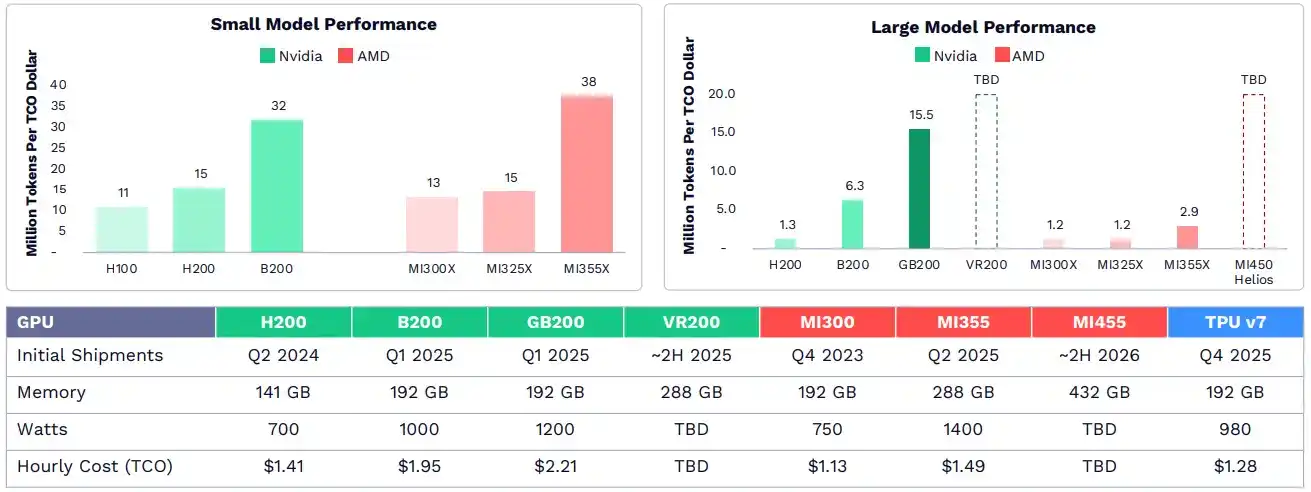
Nvidia faces increasing competition.
Nvidia's early investments in AI chip design, software, and networking gave its graphics processing units (GPUs) an 85% market share and 75% gross margins. Today, competitors like AMD and Google have caught up in certain areas, such as small language model inference. Nvidia's Grace Blackwell rack-scale systems lead in large model inference, supporting the most advanced foundational models.
AI demand will drive sustainable growth in infrastructure.
As AI workloads proliferate in enterprise and consumer environments, AI infrastructure investment could exceed $1.4 trillion by 2030, with the majority going towards accelerated servers. ARK research indicates that ASICs designed by companies like Broadcom and Amazon's Annapurna Labs will continue to gain market share as AI labs and hyperscalers seek cost-effective computing power.
Bitcoin
Bitcoin is gradually becoming the leader of a new institutional asset class.
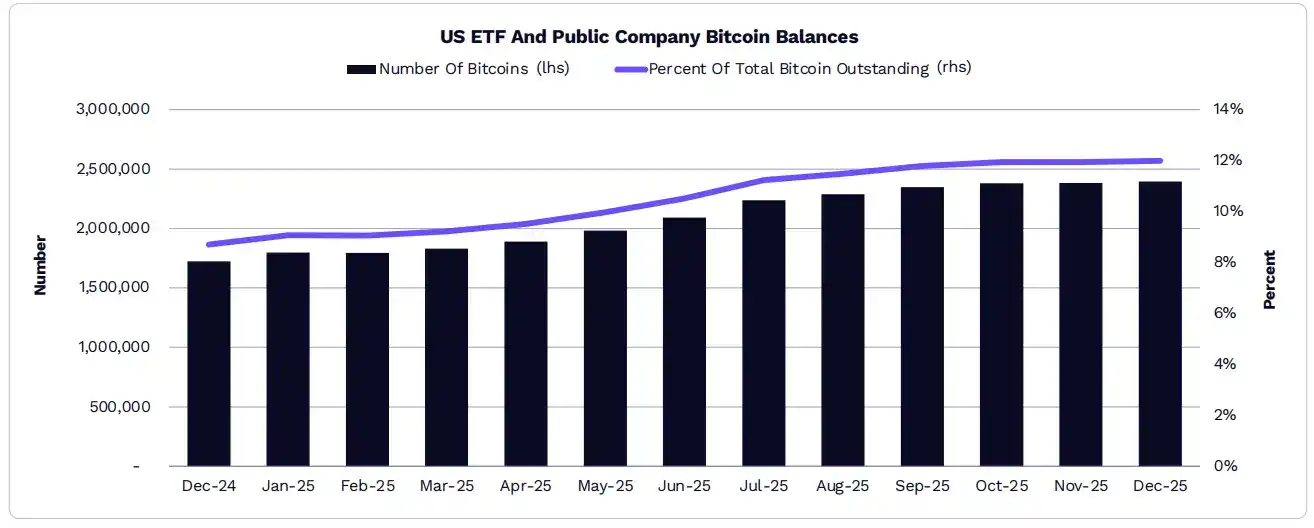
US ETFs and publicly traded companies hold 12% of the total Bitcoin supply.
In 2025, Bitcoin ETF holdings grew 19.7%, from approximately 1.12 million to about 1.29 million BTC; holdings by publicly traded companies grew 73%, from approximately 598,000 to about 1.09 million BTC. Consequently, the total Bitcoin held by ETFs and public companies increased from 8.7% to 12% of the supply.
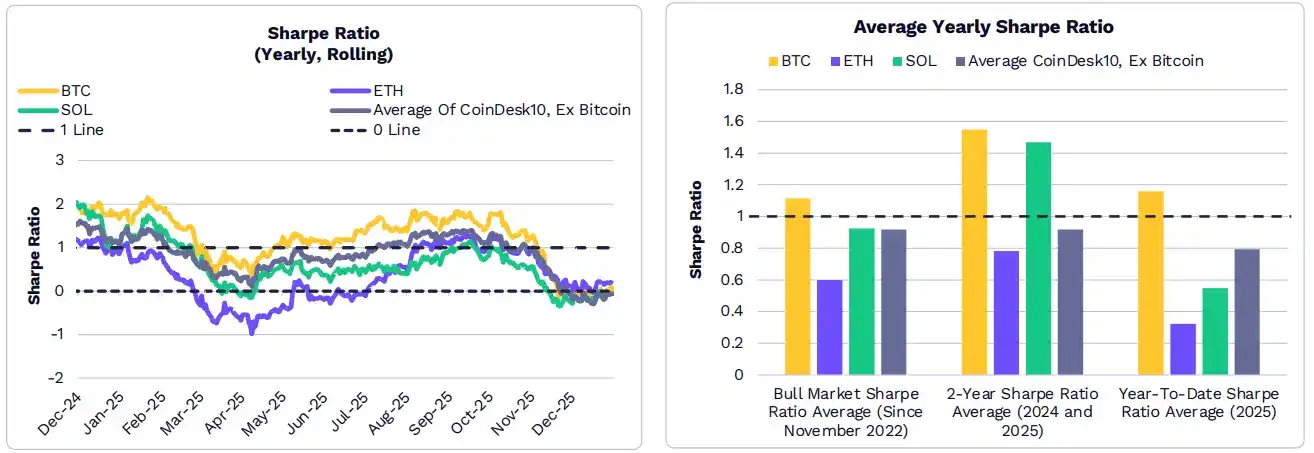
Bitcoin's annual risk-adjusted returns (Sharpe Ratio) have long been higher than those of the broader crypto market.
For most of 2025, Bitcoin's risk-adjusted returns exceeded those of most other large-cap cryptocurrencies and indices. Bitcoin's average annualized Sharpe Ratio also surpassed the averages of Ethereum, SOL, and the other nine constituents of the CoinDesk 10 Index since the recent cycle low (November 2022), the beginning of 2024, and the beginning of 2025.
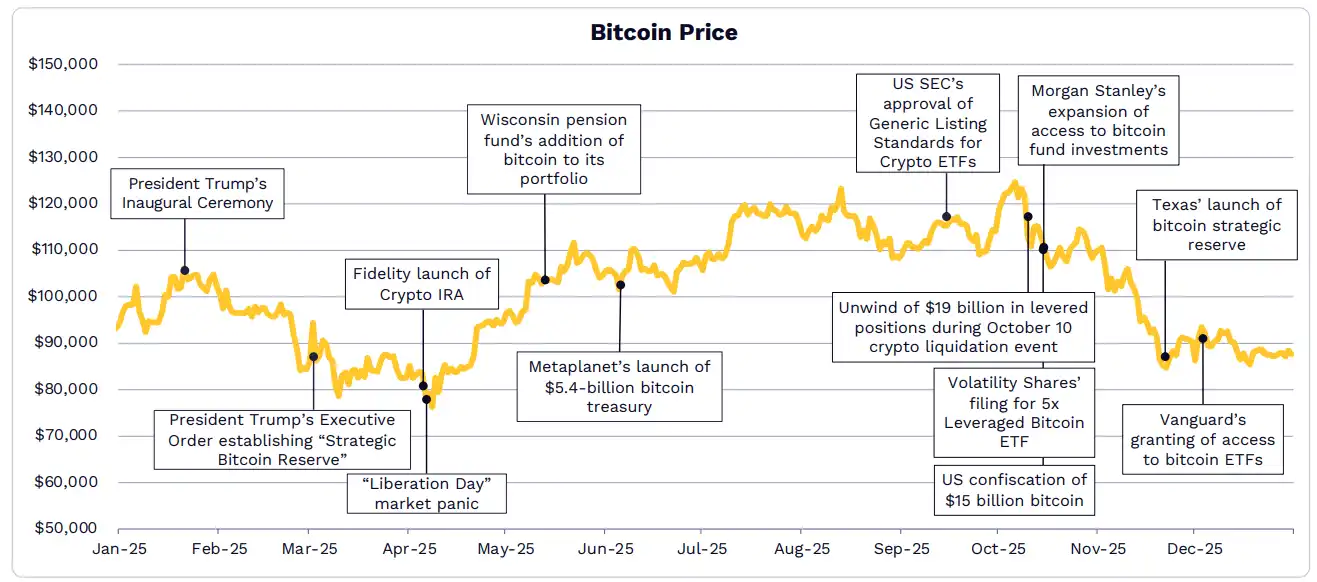
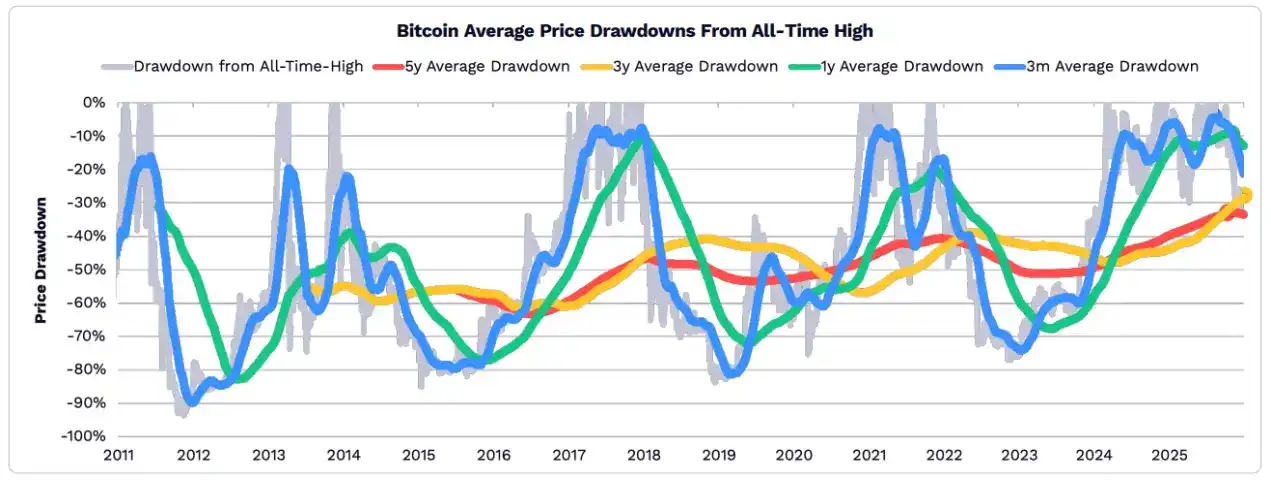
In 2025, the average drawdown of Bitcoin's price from its all-time high has moderated.
As Bitcoin's role as a safe-haven asset strengthens, its volatility has decreased. Looking at 5-year, 3-year, 1-year, and 3-month timeframes, Bitcoin's drawdowns in 2025 were more moderate relative to historical levels.
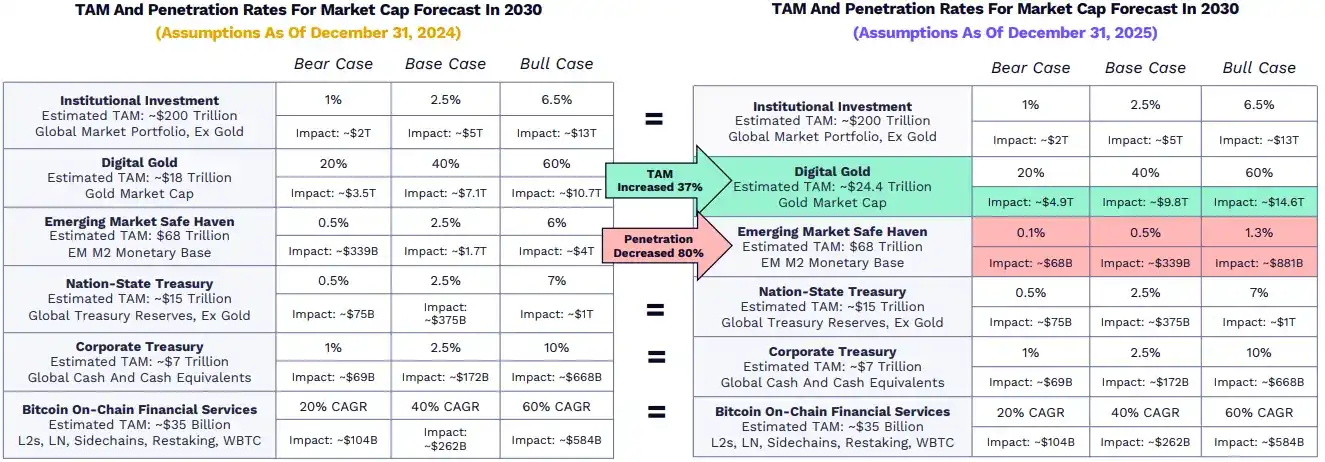
ARK's assumptions for Bitcoin's growth have changed, but the forecast remains largely unchanged.
ARK's forecast for Bitcoin in 2030 has been quite stable, with only two assumption changes: as digital gold, its total addressable market (TAM) grew 37% after gold's market cap surged 64.5% in 2025; as an emerging market safe-haven asset, its projected penetration rate decreased by 80% to reflect the rapid adoption of stablecoins in developing countries.
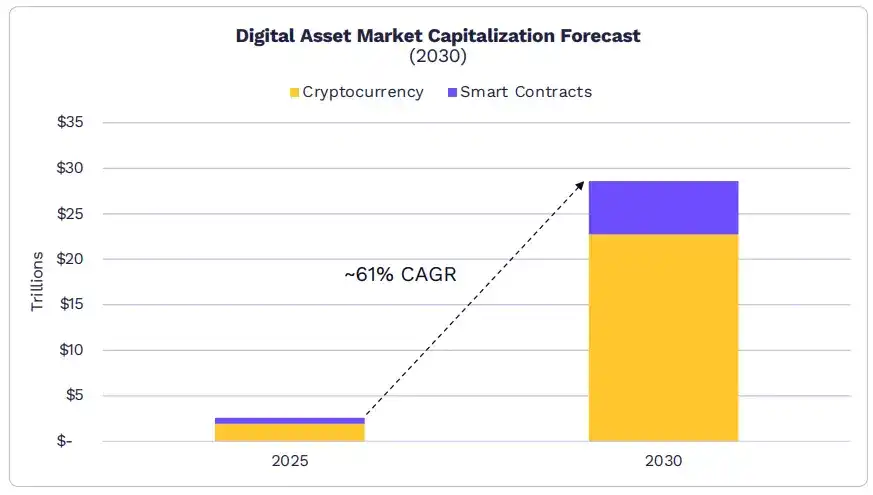
The digital asset market cap could reach $28 trillion by 2030.
The market size for smart contracts and pure digital money (the latter serving as a store of value, medium of exchange, and unit of account on public blockchains) could grow at an annual rate of approximately 61%, reaching $28 trillion by 2030. ARK believes Bitcoin could capture a 70% market share, with the remainder dominated by smart contract networks like Ethereum and Solana.
- According to ARK's projections, Bitcoin is likely to dominate the cryptocurrency market over the next five years with a compound annual growth rate (CAGR) of approximately 63%, growing from nearly $2 trillion to approximately $16 trillion by 2030.
- The market cap of smart contracts could grow at an annual rate of 54% to approximately $6 trillion by 2030, with annualized revenue of about $192 billion and an average fee rate of 0.75%.
- Two to three L1 platforms will capture the majority of the market share, but the市值 they gain will come more from their monetary premium (store of value and reserve asset characteristics) than discounted cash flows.
Tokenized Assets
Thanks to the GENIUS Act, financial institutions are reassessing their stablecoin and tokenization strategies.
Benefiting from the regulatory clarity brought by the GENIUS Act, stablecoin activity has surged to record highs. Multiple companies and institutions have announced their own stablecoins, while BlackRock revealed it is preparing an internal tokenization platform. Major stablecoin issuers and fintech companies like Tether, Circle, and Stripe have launched/supported L1 blockchains optimized for stablecoins.
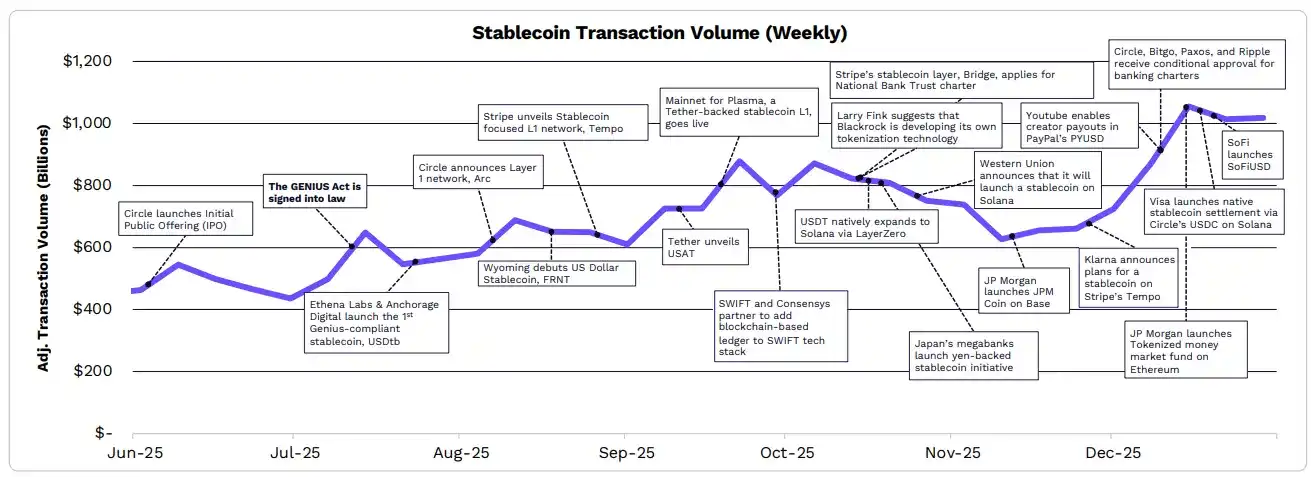
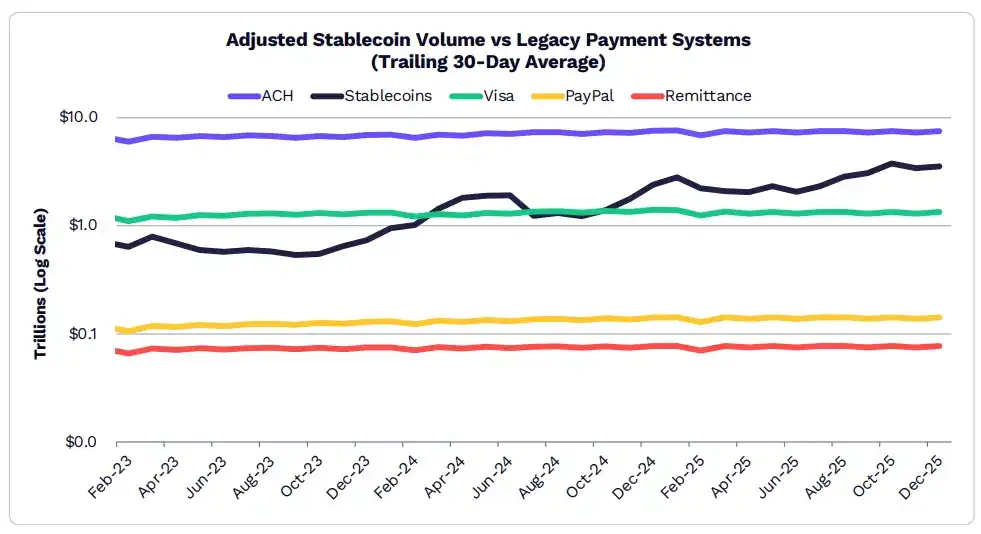
Stablecoin transaction volume reached $3.5 trillion in December, far exceeding most traditional payment systems.
In December 2025, the 30-day moving average of stablecoin transaction volume was $3.5 trillion, 2.3 times the combined value of Visa, PayPal, and Remittances.
Circle's stablecoin USDC dominated transaction volume with a share of approximately 60%, followed by Tether's USDT at approximately 35%.
In 2025, stablecoin supply grew approximately 50%, from $210 billion to $307 billion, with USDT and USDC accounting for 61% and 25%, respectively.
Sky Protocol was the only stablecoin issuer other than the major ones to reach a market cap exceeding $10 billion by the end of 2025.
Notably, PayPal's PYUSD market cap grew more than sixfold to $3.4 billion.
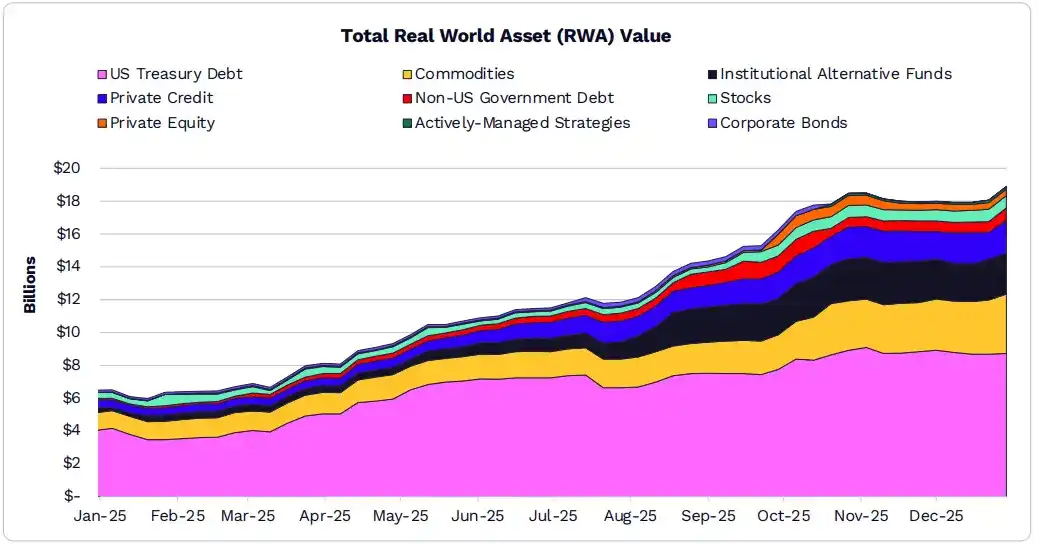
Driven primarily by US Treasuries and commodities, the tokenized asset market tripled in 2025, reaching $18.9 billion.
The market cap of RWAs grew 208% in 2025 to $18.9 billion.
BlackRock's $1.7 billion BUIDL money market fund was one of the largest products, accounting for 20% of the $9 billion in US Treasuries.
Tokenized gold products from Tether (XAUT) and Paxos (PAXG) led the tokenized commodities market, with market caps reaching $1.8 billion and $1.6 billion, respectively, combining for 83%.
Tokenization of public equities approached $750 million.
Ethereum remains the blockchain of choice for on-chain assets.
The total value of assets on Ethereum now exceeds $400 billion. On seven of the eight most popular blockchains, 90% of the market cap is supported by stablecoins and the top 50 tokens.
On blockchains other than Solana, meme coins account for approximately 3% or less of the market cap. On Solana, meme coins account for approximately 21% of assets.
Tokenization of RWAs is expected to be one of the fastest-growing categories. As most global value exists off-chain, off-chain assets remain the largest growth opportunity for on-chain adoption.

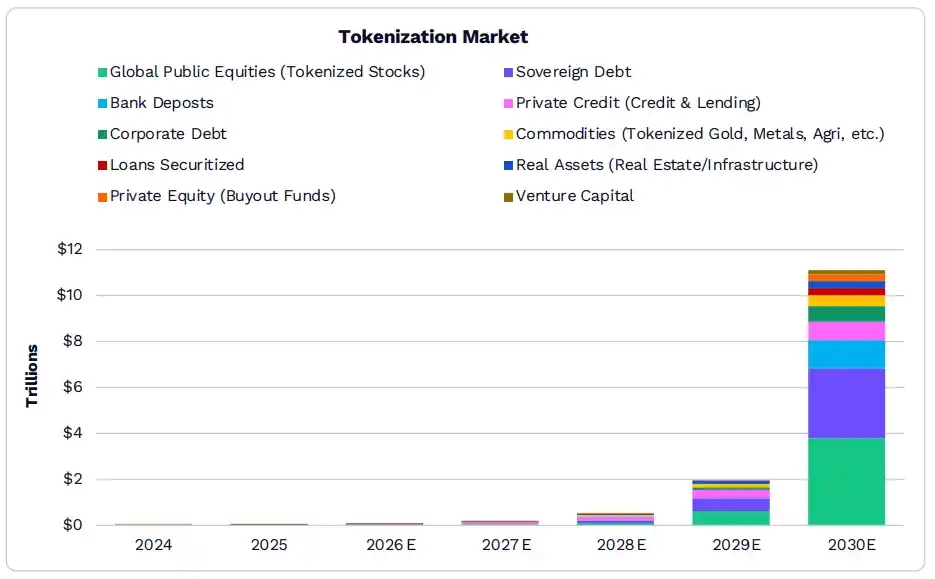
By 2030, the global tokenized asset market size could exceed $11 trillion.
According to our research, the scale of tokenized assets could grow from $189 billion to $11 trillion,届时 accounting for approximately 1.38% of all financial assets.
Although sovereign debt currently dominates tokenization, within the next 5 years, the on-chain value of bank deposits and globally listed equities could see higher penetration rates than current levels.
ARK believes widespread tokenization will depend on clearer regulatory policies and the maturation of institutional-grade infrastructure.
Traditional enterprises are expanding their on-chain presence by building their own infrastructure.
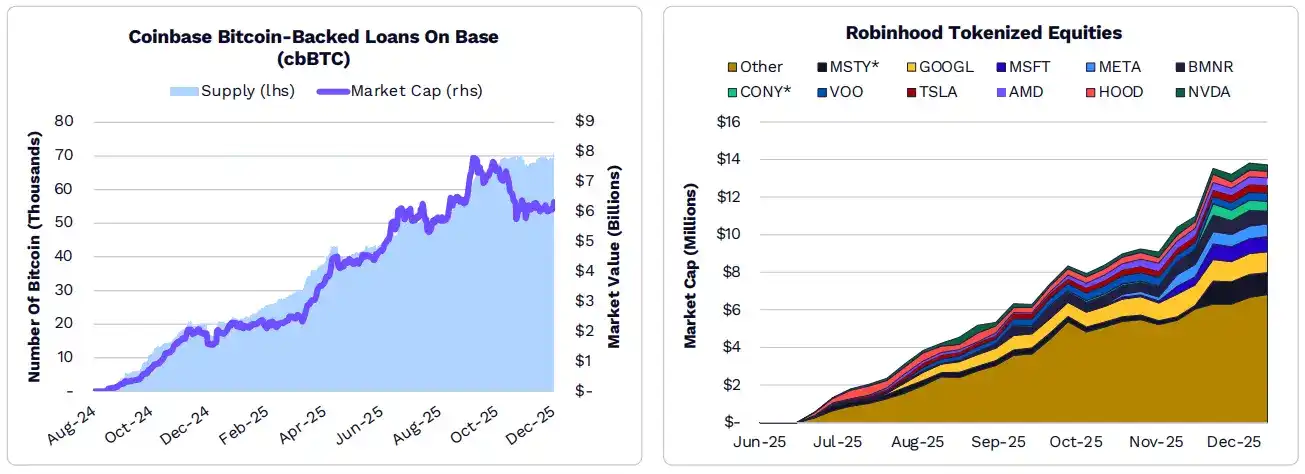
Traditional enterprises are building their own on-chain infrastructure. Circle (Arc), Coinbase (Base, cbBTC), Kraken (Ink), OKX (X Layer), Robinhood (Robinhood Chain), and Stripe (Tempo) are launching company-branded L1/L2 networks to support their own products, such as Bitcoin-collateralized loans, tokenized stocks and ETFs, and stablecoin-based payment channels.
DeFi Applications
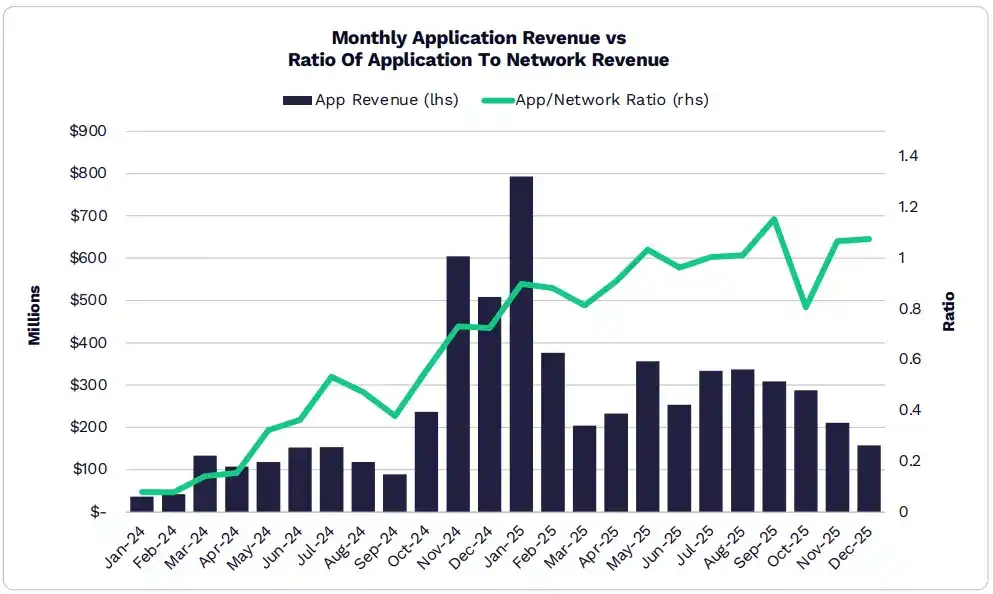
Digital asset value capture is shifting from networks to applications.
Networks are increasingly becoming utilities, transferring user economic benefits and profit margins to the application layer.
Led by Hyperliquid, Pump.fun, and Pancakeswap, application total revenue reached a record high of approximately $3.8 billion in 2025.
One-fifth of all application revenue in 2025 came from January, the highest monthly revenue ever.
Today, 70 applications and protocols have monthly recurring revenue (MRR) exceeding $1 million.
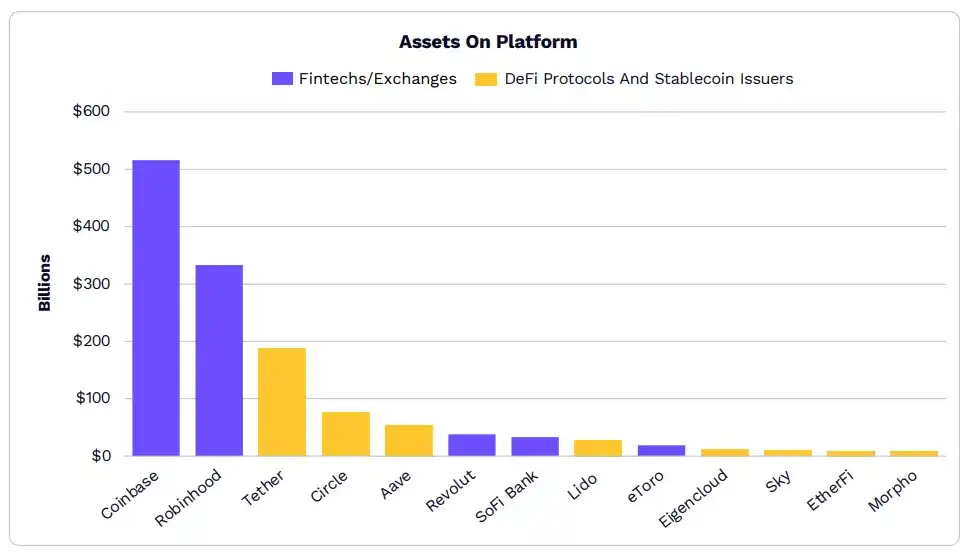
DeFi and stablecoin issuers' asset sizes are catching up to many fintech companies.
The gap in asset size between traditional fintech platforms and crypto-native platforms is narrowing, indicating a convergence of traditional and on-chain infrastructure.
DeFi protocols like liquid staking or lending platforms are attracting institutional capital and expanding rapidly.
The TVL of the top 50 DeFi platforms has entered the billion-dollar club, with the top 12 protocols each exceeding $5 billion.
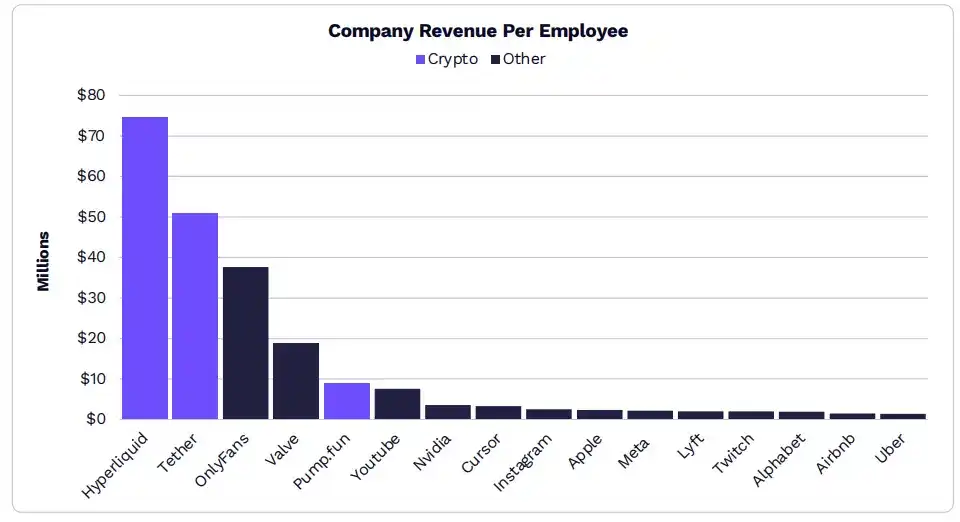
The world's most revenue-efficient companies include Hyperliquid,Tether and Pump.fun.
In 2025, Hyperliquid generated over $800 million in annual revenue with just 15 employees.
Through its focus on on-chain verticals like perpetual contracts, stablecoins, and meme coins, Hyperliquid is attracting users and capital at an astonishing scale with clear product-market fit.
On-chain businesses and protocols are redefining productivity, as a handful of people can create revenue and profitability rivaling world-class enterprises.
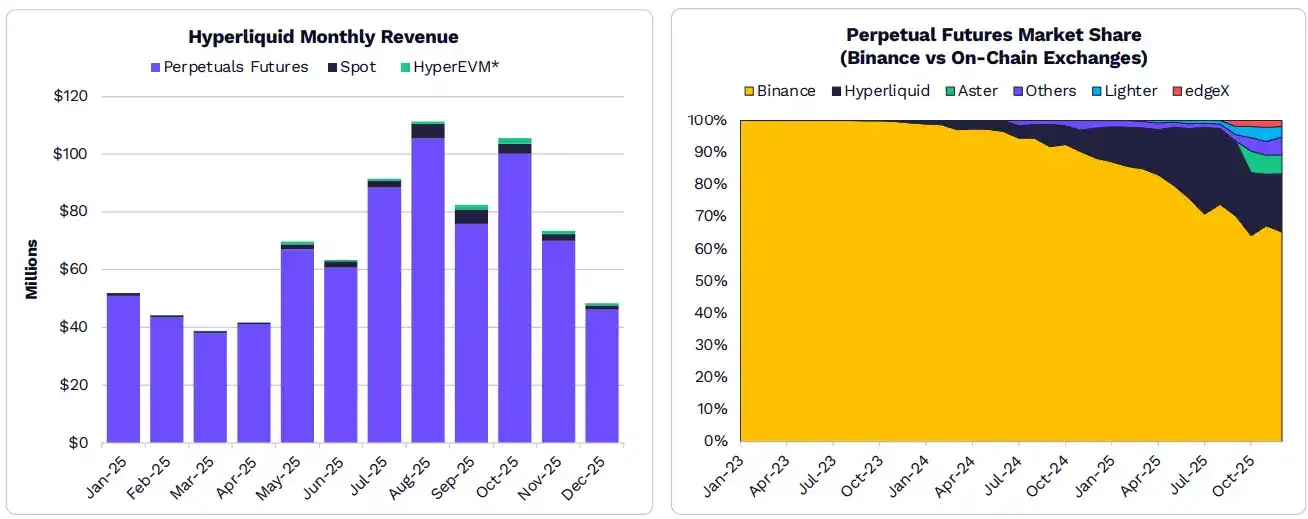
Led by Hyperliquid,DeFi derivatives are taking perpetual swap market share from Binance.
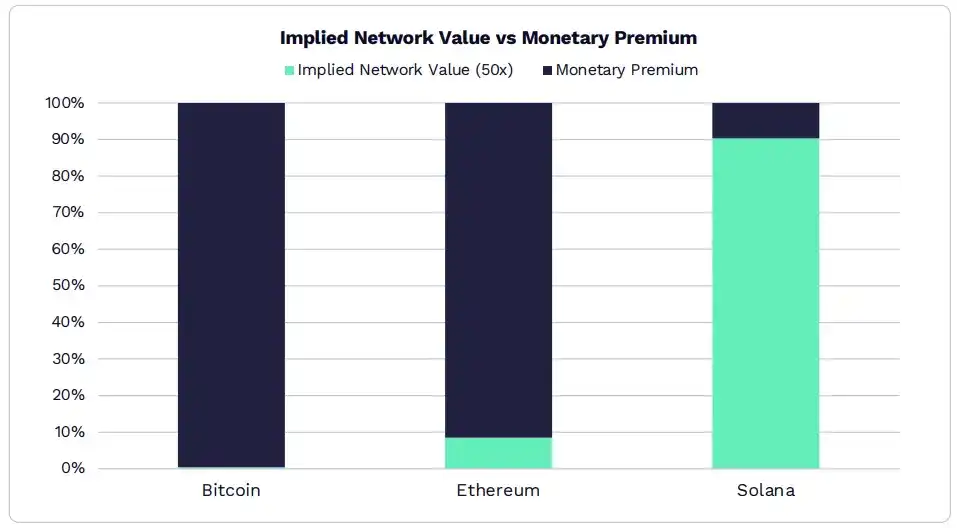
L1 networks are evolving from revenue-generating networks to monetary assets.
If valued based on a 50x revenue multiple, over 90% of Ethereum's market cap is attributable to its role as a monetary asset.
Solana generated $1.4 billion in revenue, proving that 90% of its valuation comes from network utility.
According to ARK research, only a few digital assets will retain monetary properties to become liquid stores of value.
Related reading: Cathie Wood's 2026 Macro and Tech Investment Roadmap
Трендові криптовалюти












Пов'язані питання
QAccording to ARK's 2026 Big Ideas report, what is the projected market capitalization for digital assets by 2030?
AAccording to ARK's research, the digital asset market capitalization is projected to reach $28 trillion by 2030.
QWhat major factor is driving the surge in stablecoin activity to all-time highs, as mentioned in the report?
AThe surge in stablecoin activity is primarily driven by the regulatory clarity provided by the GENIUS Act.
QWhich company's GPU currently holds an 85% market share in AI chips but is facing increasing competition?
ANvidia's GPU currently holds an 85% market share in AI chips but is facing increasing competition from companies like AMD and Google.
QWhat percentage of Bitcoin's total supply is now held by US ETFs and public companies combined?
AUS ETFs and public companies combined now hold 12% of Bitcoin's total supply.
QWhich blockchain does the report identify as the preferred choice for on-chain assets?
AThe report identifies Ethereum as the preferred blockchain for on-chain assets.
Пов'язані матеріали





Торгівля
Популярні статті
Що таке BITCOIN
Розуміння HarryPotterObamaSonic10Inu (ERC-20) та його позиції у крипто-просторі Останніми роками ринок криптовалют спостерігав за зростанням популярності мем-коінів, які привертають інтерес не тільки трейдерів, але й тих, хто шукає спілкування та розважальну цінність. Серед цих унікальних токенів є HarryPotterObamaSonic10Inu (ERC-20), інтригуючий проект, що поєднує культурні посилання з тканинами криптовалюти. Ця стаття досліджує ключові аспекти HarryPotterObamaSonic10Inu, вивчаючи його механізми, спільноту та його взаємодію з ширшим крипто-ландшафтом. Що таке HarryPotterObamaSonic10Inu (ERC-20)? Як випливає з його назви, HarryPotterObamaSonic10Inu є мем-коіном, побудованим на блокчейні Ethereum, класифікованим за стандартом ERC-20. На відміну від традиційних криптовалют, які можуть підкреслювати практичну корисність або інвестиційний потенціал, цей токен процвітає завдяки розважальній цінності та силі своєї спільноти. Проект спрямований на створення середовища, де зацікавлені користувачі можуть об'єднуватися, ділитися ідеями та брати участь у заходах, натхненних різноманітними культурними явищами. Однією з примітних особливостей HarryPotterObamaSonic10Inu є нульовий податок на транзакції. Цей привабливий елемент має на меті заохочувати торгівлю та участь у спільноті, позбавлену додаткових витрат, які можуть відлякувати дрібних трейдерів. Загальна пропозиція монет становить один мільярд токенів, що позначає намір підтримувати суттєву циркуляцію в межах спільноти. Творець HarryPotterObamaSonic10Inu (ERC-20) Походження HarryPotterObamaSonic10Inu дещо окутане таємницею; деталі про творця залишаються невідомими. Розвиток цього токена позбавлений впізнаваної команди або чіткої стратегії, що не є рідкістю в секторі мем-коінів. Натомість проект виник органічно, а його розвиток значною мірою залежить від ентузіазму та участі його спільноти. Інвестори HarryPotterObamaSonic10Inu (ERC-20) Щодо зовнішніх інвестицій та підтримки, HarryPotterObamaSonic10Inu також залишається невизначеним. Токен не зазначає жодних відомих інвестиційних фондів або значної організаційної підтримки. Натомість життєва сила проекту полягає в його базовій спільноті, яка інформує про його зростання та стійкість через колективні дії та залученість у крипто-просторі. Як працює HarryPotterObamaSonic10Inu (ERC-20)? Як мем-коін, HarryPotterObamaSonic10Inu функціонує передусім поза традиційними рамками, що часто регулюють вартість активів. Є кілька відмінних аспектів, що визначають, як працює проект: Транзакції без податку: Завдяки відсутності податкових зборів на транзакції, користувачі можуть вільно купувати та продавати токен, не турбуючись про приховані витрати. Залучення спільноти: Проект процвітає завдяки взаємодії спільноти, використовуючи соціальні медіа для створення шуму та сприяння залученню. Обговорення, обмін контентом та залученість є ключовими елементами, що допомагають розширити його охоплення та зміцнити лояльність серед прихильників. Відсутність практичної корисності: Слід зазначити, що HarryPotterObamaSonic10Inu не пропонує конкретної корисності в рамках фінансової екосистеми. Натомість він класифікується як токен, що призначений в основному для розваги та спільнотних активностей. Культурне посилання: Токен кмітливо вплітає елементи популярної культури, щоб привернути інтерес, зв'язуючи з ентузіастами мемів та крипто-стежками. HarryPotterObamaSonic10Inu ілюструє, як мем-коіни функціонують інакше, ніж традиційні криптовалютні проекти, увійшовши на ринок як інноваційні соціальні конструкти, а не утилітарні активи. Хронологія HarryPotterObamaSonic10Inu (ERC-20) Історія HarryPotterObamaSonic10Inu відзначена кількома значними етапами: Створення: Токен виник з вірусного мему, захопивши уяву багатьох крипто-ентузіастів. Конкретні дати створення недоступні, що підкреслює його органічний розвиток. Лістинг на біржах: HarryPotterObamaSonic10Inu з'явився на різних біржах, дозволяючи зручніший доступ і торгівлю спільноти. Ініціативи залучення спільноти: Ведення діяльності, спрямованої на покращення взаємодії спільноти, включаючи конкурси, кампанії в соціальних мережах та створення контенту від фанатів та прихильників. Плани на майбутнє: Дорожня карта проекту включає запуск колекції NFT, мерчандайзинг та електронну комерцію, пов'язану з його культурними темами, що далі залучає спільноту та намагається додати більше вимірів до його екосистеми. Ключові моменти про HarryPotterObamaSonic10Inu (ERC-20) Спільнотний підхід: Проект надає пріоритет колективному внеску та креативності, забезпечуючи, щоб участь користувачів була в центрі його розвитку. Класифікація як мем-коін: Це є його епігенез розважальної криптовалюти, що відрізняється від традиційних інвестиційних інструментів. Жодного прямого відношення до Bitcoin: Незважаючи на схожість у назві, HarryPotterObamaSonic10Inu є відмінним і не має жодного зв’язку з Bitcoin або іншими усталеними криптовалютами. Зосередженість на співпраці: HarryPotterObamaSonic10Inu створено для того, щоб надати простір для співпраці та обміну історіями серед його власників, забезпечуючи шлях для творчості та спільного зв'язку. Перспективи на майбутнє: Амбіція розширитися за межі початкової концепції в NFT та мерчандайз відкриває шлях для проекту потенційно потрапити в більш мейнстрімні сфери цифрової культури. Оскільки мем-коіни продовжують захоплювати уяву спільноти криптовалют, HarryPotterObamaSonic10Inu (ERC-20) вирізняється своїми культурними зв'язками та орієнтованим на спільноту підходом. Хоча він може не відповідати типовій моделі утилітарного токена, його суть полягає в радощах і товариськості, що підтримуються серед його прихильників, підкреслюючи еволюційну природу криптовалют в усе більш цифрову епоху. Оскільки проект продовжує розвиватися, важливо спостерігати за тим, як динаміка спільноти вплине на його траєкторію в постійно змінюваному ландшафті технології блокчейн.
2.2k переглядів усьогоОпубліковано 2024.04.01Оновлено 2024.12.03

Як купити BTC
Ласкаво просимо до HTX.com! Ми зробили покупку Bitcoin (BTC) простою та зручною. Дотримуйтесь нашої покрокової інструкції, щоб розпочати свою криптовалютну подорож.Крок 1: Створіть обліковий запис на HTXВикористовуйте свою електронну пошту або номер телефону, щоб зареєструвати обліковий запис на HTX безплатно. Пройдіть безпроблемну реєстрацію й отримайте доступ до всіх функцій.ЗареєструватисьКрок 2: Перейдіть до розділу Купити крипту і виберіть спосіб оплатиКредитна/дебетова картка: використовуйте вашу картку Visa або Mastercard, щоб миттєво купити Bitcoin (BTC).Баланс: використовуйте кошти з балансу вашого рахунку HTX для безперешкодної торгівлі.Треті особи: ми додали популярні способи оплати, такі як Google Pay та Apple Pay, щоб підвищити зручність.P2P: Торгуйте безпосередньо з іншими користувачами на HTX.Позабіржова торгівля (OTC): ми пропонуємо індивідуальні послуги та конкурентні обмінні курси для трейдерів.Крок 3: Зберігайте свої Bitcoin (BTC)Після придбання Bitcoin (BTC) збережіть його у своєму обліковому записі на HTX. Крім того, ви можете відправити його в інше місце за допомогою блокчейн-переказу або використовувати його для торгівлі іншими криптовалютами.Крок 4: Торгівля Bitcoin (BTC)Легко торгуйте Bitcoin (BTC) на спотовому ринку HTX. Просто увійдіть до свого облікового запису, виберіть торгову пару, укладайте угоди та спостерігайте за ними в режимі реального часу. Ми пропонуємо зручний досвід як для початківців, так і для досвідчених трейдерів.
5.0k переглядів усьогоОпубліковано 2024.12.12Оновлено 2026.06.02

Що таке $BITCOIN
ЦИФРОВЕ ЗОЛОТО ($BITCOIN): Комплексний аналіз Вступ до ЦИФРОВОГО ЗОЛОТА ($BITCOIN) ЦИФРОВЕ ЗОЛОТО ($BITCOIN) — це проект на основі блокчейну, що працює в мережі Solana, який має на меті поєднати характеристики традиційних дорогоцінних металів з інноваціями децентралізованих технологій. Хоча він має таку ж назву, як і Bitcoin, який часто називають “цифровим золотом” через його сприйняття як засобу збереження вартості, ЦИФРОВЕ ЗОЛОТО є окремим токеном, розробленим для створення унікальної екосистеми в ландшафті Web3. Його мета — позиціонувати себе як життєздатний альтернативний цифровий актив, хоча деталі щодо його застосувань і функціональностей все ще розробляються. Що таке ЦИФРОВЕ ЗОЛОТО ($BITCOIN)? ЦИФРОВЕ ЗОЛОТО ($BITCOIN) — це токен криптовалюти, спеціально розроблений для використання в блокчейні Solana. На відміну від Bitcoin, який виконує широко визнану роль зберігання вартості, цей токен, здається, зосереджується на більш широких застосуваннях і характеристиках. Помітні аспекти включають: Інфраструктура блокчейну: Токен побудований на блокчейні Solana, відомому своєю здатністю обробляти швидкі та низьковартісні транзакції. Динаміка постачання: ЦИФРОВЕ ЗОЛОТО має максимальне постачання, обмежене 100 квадрильйонами токенів (100P $BITCOIN), хоча деталі щодо його обігового постачання наразі не розголошуються. Утиліта: Хоча точні функціональності не викладені, є вказівки на те, що токен може бути використаний для різних застосувань, потенційно пов'язаних з децентралізованими додатками (dApps) або стратегіями токенізації активів. Хто є творцем ЦИФРОВОГО ЗОЛОТА ($BITCOIN)? На даний момент особа творців і команди розробників, що стоять за ЦИФРОВИМ ЗОЛОТОМ ($BITCOIN), залишається невідомою. Ця ситуація є типовою для багатьох інноваційних проектів у сфері блокчейну, особливо тих, що пов'язані з децентралізованими фінансами та феноменом мем-коінів. Хоча така анонімність може сприяти культурі, орієнтованій на спільноту, вона посилює занепокоєння щодо управління та підзвітності. Хто є інвесторами ЦИФРОВОГО ЗОЛОТА ($BITCOIN)? Доступна інформація вказує на те, що ЦИФРОВЕ ЗОЛОТО ($BITCOIN) не має жодних відомих інституційних спонсорів або помітних венчурних капіталовкладень. Проект, здається, працює за моделлю “рівний до рівного”, зосереджуючись на підтримці та прийнятті спільноти, а не на традиційних шляхах фінансування. Його активність і ліквідність переважно розташовані на децентралізованих біржах (DEX), таких як PumpSwap, а не на встановлених централізованих торгових платформах, що ще більше підкреслює його підхід знизу вгору. Як працює ЦИФРОВЕ ЗОЛОТО ($BITCOIN) Операційні механізми ЦИФРОВОГО ЗОЛОТА ($BITCOIN) можна детальніше розглянути на основі його дизайну блокчейну та характеристик мережі: Механізм консенсусу: Використовуючи унікальний proof-of-history (PoH) Solana в поєднанні з моделлю proof-of-stake (PoS), проект забезпечує ефективну валідацію транзакцій, що сприяє високій продуктивності мережі. Токеноміка: Хоча конкретні дефляційні механізми не були детально описані, велике максимальне постачання токенів вказує на те, що воно може задовольняти мікротранзакції або нішеві випадки використання, які ще потрібно визначити. Інтероперабельність: Існує потенціал для інтеграції з більш широкою екосистемою Solana, включаючи різні платформи децентралізованих фінансів (DeFi). Однак деталі щодо конкретних інтеграцій залишаються невизначеними. Хронологія ключових подій Ось хронологія, яка підкреслює значні віхи, пов'язані з ЦИФРОВИМ ЗОЛОТОМ ($BITCOIN): 2023: Початкове розгортання токена відбувається на блокчейні Solana, позначене його адресою контракту. 2024: ЦИФРОВЕ ЗОЛОТО набуває видимості, оскільки стає доступним для торгівлі на децентралізованих біржах, таких як PumpSwap, що дозволяє користувачам торгувати ним проти SOL. 2025: Проект спостерігає спорадичну торгову активність і потенційний інтерес до ініціатив, очолюваних спільнотою, хоча на даний момент не зафіксовано жодних значних партнерств або технічних досягнень. Критичний аналіз Сильні сторони Масштабованість: Основна інфраструктура Solana підтримує високі обсяги транзакцій, що може підвищити утиліту $BITCOIN у різних сценаріях транзакцій. Доступність: Потенційно низька торгова ціна за токен може привабити роздрібних інвесторів, сприяючи більш широкій участі завдяки можливостям дробового володіння. Ризики Відсутність прозорості: Відсутність публічно відомих спонсорів, розробників або процесу аудиту може викликати скептицизм щодо стійкості та надійності проекту. Волатильність ринку: Торгова активність сильно залежить від спекулятивної поведінки, що може призвести до значної волатильності цін і невизначеності для інвесторів. Висновок ЦИФРОВЕ ЗОЛОТО ($BITCOIN) постає як цікавій, але неоднозначний проект у швидко розвиваючійся екосистемі Solana. Хоча він намагається використати наратив “цифрового золота”, його відхід від встановленої ролі Bitcoin як засобу збереження вартості підкреслює необхідність чіткішого розмежування його передбачуваної утиліти та структури управління. Майбутнє прийняття та адаптація, ймовірно, залежатиме від вирішення поточної непрозорості та більш чіткого визначення його операційних та економічних стратегій. Примітка: Цей звіт охоплює синтезовану інформацію, доступну станом на жовтень 2023 року, і можуть відбутися події, що виходять за межі дослідницького періоду.
160 переглядів усьогоОпубліковано 2025.05.13Оновлено 2025.05.13
