2026 Altcoin Season Guide: Is It Time to Welcome the Altcoin Season?

marsbitОпубліковано о 2026-07-19Востаннє оновлено о 2026-07-19

Анотація

The Altcoin Season Guide for 2026 examines the phenomenon where alternative cryptocurrencies outperform Bitcoin. Defined by the Altseason Index, an altcoin season occurs when over 75% of the top 50 altcoins beat Bitcoin's returns over a rolling 90-day period, typically lasting 2-6 months. This cycle differs due to the "ETF wall," where institutional capital in Bitcoin ETFs may limit immediate flows into altcoins. A genuine season requires Bitcoin's dominance to fall below 50-55%, coupled with strength in key pairs like ETH/BTC. Historical patterns show capital rotation through distinct phases: accumulation, early narrative-driven breakouts (e.g., AI, RWA, DePIN), and a peak phase marked by high volatility and retail frenzy. Successful strategies involve portfolio diversification, sector rotation, and strict risk management. The next major altcoin season is anticipated 18-30 months post the 2024 Bitcoin halving, potentially in 2026-2027, driven by macroeconomic conditions, institutional adoption, and strong narratives in emerging sectors. Preparation involves building a watchlist of projects with solid fundamentals and active ecosystems.

Written by: Maciej Zerelik

Compiled by: AididiaoJP, Foresight News

The altcoin season kicks off when alternative cryptocurrencies start outperforming Bitcoin. However, accurately pinpointing its exact start is not easy. This guide will provide a detailed explanation of the cyclical patterns of altcoin seasons, the impact of the ETF Wall, narrative-driven sector rotations, and potential cross-chain strategies for 2026.

Understanding Altcoin Season

Definition of Altcoin Season

Many newcomers wonder, what exactly is an altcoin season, and why does it attract so much attention from crypto investors.

Altcoin season refers to a phase where at least 75% of the top 50 cryptocurrencies outperform Bitcoin over a rolling 90-day period. Analysts use this benchmark to gauge whether capital is flowing from BTC into other digital assets.

This concept became widely known during the 2017-2018 bull market. At that time, countless investors shifted Bitcoin profits into Ethereum and other smaller tokens, resulting in many altcoins delivering returns far exceeding BTC within months.

Historically, a complete altcoin season typically lasts 2 to 6 months, though the rhythm varies each cycle.

"Outperform" means that an altcoin has a higher return than Bitcoin over the same period. For example, if Bitcoin rises 25% over 90 days, and Solana rises 80%, then Solana has significantly outperformed BTC. When most leading cryptocurrencies exhibit similar performance, the market is usually considered to be in an altcoin season.

Bitcoin vs. Altcoin Dynamics: The ETF Wall

Bitcoin Dominance represents Bitcoin's share of the total cryptocurrency market capitalization. When this indicator begins to decline, investors often interpret it as a signal that capital is flowing into altcoins.

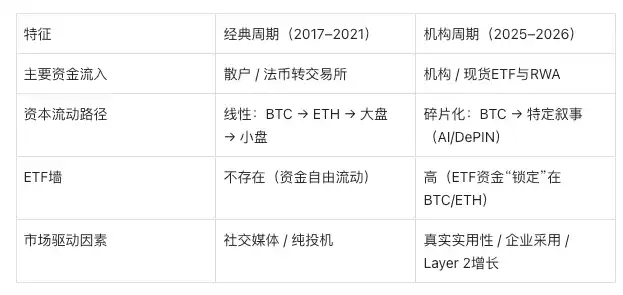
However, this market cycle is different from previous ones due to the existence of the so-called "ETF Wall."

Spot Bitcoin ETFs launched by asset managers like BlackRock and Fidelity have attracted tens of billions of dollars from institutional investors. These investors typically only gain Bitcoin exposure through regulated financial products, effectively locking this portion of capital within the BTC ecosystem.

In the 2017 bull market, retail capital could flow more freely into thousands of altcoins. In 2026, for a broad altcoin season to occur, it may require Bitcoin profit-taking alongside a new wave of retail and on-chain liquidity injection before capital can diffuse into the broader market.

Comparison between classic cycles (2017–2021) and institutional cycles (2025–2026):
How to Identify Altcoin Season

Identifying an altcoin season early can make a huge difference, as entering after the biggest gains often carries higher risks and less upside potential.

Altcoin Season Index and New 2026 Indicators

The Altcoin Season Index is one of the most popular tools for tracking market rotation. Developed by Blockchaincenter, it measures the performance of major cryptocurrencies against Bitcoin over the past 90 days on a scale of 0-100.

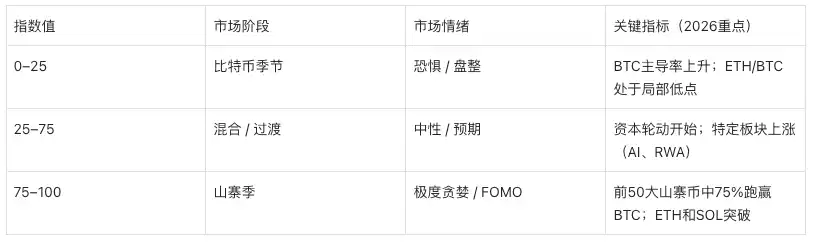
An index below 25 indicates Bitcoin season, 25-75 indicates a mixed market, and when the index rises above 75, the market is usually considered to be in an altcoin season, as most leading altcoins are outperforming BTC.
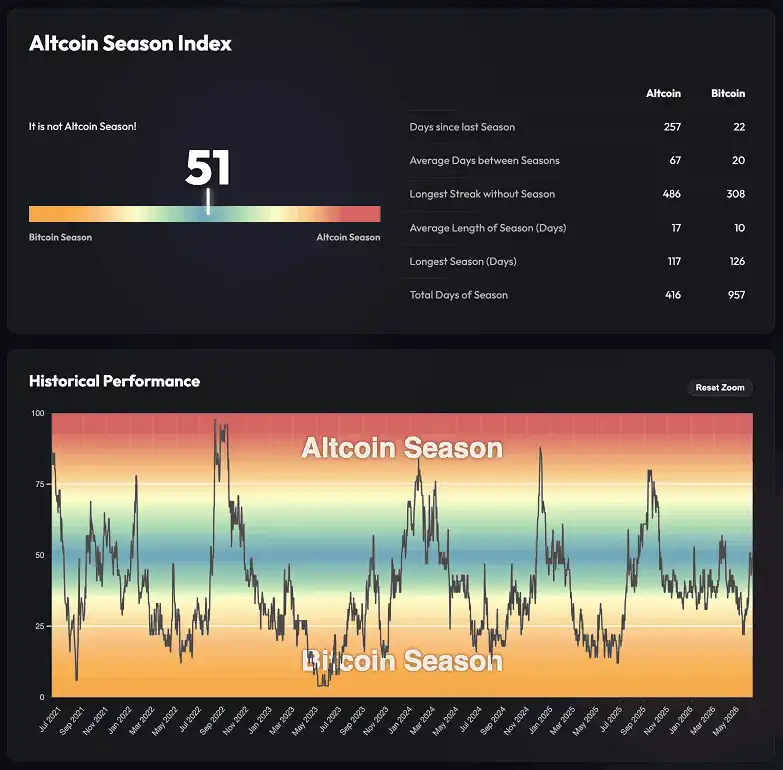
(Chart: Altcoin Season Index, BlockchainCenter, June 10, 2026)

However, the 2026 market requires additional confirmation. Many analysts now also observe the ETH/BTC and SOL/BTC trading pairs. If Ethereum and Solana fail to strengthen against Bitcoin, even if the index exceeds 75, it might only be short-term speculation rather than a sustainable rotation. Strong performance in benchmark pairs often confirms that capital has flowed from Bitcoin into the broader ecosystem.

Table of index values corresponding to market phases:
Key Metrics and Indicators

No single metric can perfectly predict the market. Experienced investors combine multiple signals to judge whether a new rotation is genuinely starting.

One of the strongest indicators is Bitcoin Dominance. When it retreats from above 50% to 40% or lower, it typically means capital is moving away from BTC into altcoins. Simultaneously, the total altcoin market cap growth rate should significantly outpace Bitcoin's, ideally by 2-3 times.

Trading activity also provides important clues. A week-over-week increase in altcoin/BTC trading volume exceeding 50% often indicates growing investor interest. Social media engagement and Google Trends can corroborate this, especially when search terms like "best altcoins" or "altcoin season" grow 30-50% within a few weeks.

When multiple indicators align, the probability of a genuine altcoin season is much higher than relying on the Altcoin Season Index alone.

Historical Altcoin Bull Run Patterns

Each major altcoin rally leaves valuable lessons, helping investors identify recurring trends and avoid emotional decisions in future cycles.

2017-2018 and 2020-2021 Bull Markets

Although both cycles produced astonishing returns, the driving forces behind them were entirely different.

The 2017-2018 altcoin season was driven by the ICO frenzy. Hundreds of new blockchain projects raised funds directly from retail investors, with speculation often outweighing fundamentals. As Bitcoin hit new highs and slowed down, capital quickly shifted to smaller tokens, with many coins surging hundreds of percent within months.

The 2020-2021 cycle followed a different path. Market focus shifted to DeFi protocols, NFT platforms, Layer 1 blockchains, and later, meme coins. Meanwhile, institutional investors entered the crypto space through companies, funds, and regulated products, bringing in capital far exceeding previous levels.

Retail investors still played a significant role in the NFT and meme coin mania, but institutional participation made the market larger and more mature. This shift also changed the way capital rotated, making the leadership role of Ethereum and key sectors more important than broad speculation. Therefore, future altcoin seasons may become increasingly selective rather than lifting all projects simultaneously.

Phases of an Altcoin Season: From BTC to Narrative-Driven

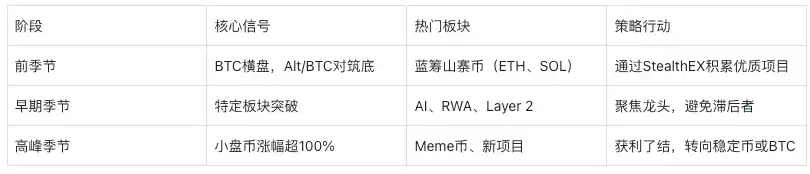
Modern altcoin cycles are no longer about all tokens rising in sync. Capital now rotates among different narratives, rewarding those sectors with the strongest adoption and momentum. Understanding these phases helps investors see where money is flowing, rather than chasing projects that have already peaked.

Phase comparison table:
Pre-Season (Accumulation Phase)

The accumulation phase typically begins when Bitcoin is range-bound or corrects by 10-20%. During this time, many altcoins may fall another 20-40% from their local highs, leading to disappearing retail interest.

Trading volume remains low, social media activity declines, and discussions are filled with negative sentiment. Behind the scenes, experienced investors are gradually accumulating fundamentally strong projects at discounted prices.

This phase often ends when Bitcoin stabilizes, Ethereum starts outperforming BTC, and trading volume slowly recovers. For long-term investors, this is the best time to research projects, build watchlists, and establish positions before widespread market attention returns.

Early Season: Narrative-Led Breakouts

Many investors ask, when does the altcoin season start? In today's market, the answer is often linked to narratives rather than market cap.

Not all top-ten cryptocurrencies will rise simultaneously; capital first flows into the most talked-about sectors. AI agents, Real-World Assets (RWA), and DePIN projects have recently become typical examples of this trend.

The traditional strategy of buying the largest altcoins simply because they are in the top ten is much less effective. Early winners are increasingly those projects with clear use cases, growing ecosystems, and the ability to attract fresh liquidity.

Peak Season (Maximum Activity)

When mid- and small-cap coins achieve 100-500% gains within weeks, does that mean we are in the common altcoin season? In this phase, optimism reaches extremes, and the Fear & Greed Index often exceeds 80.

Retail investors aggressively buy every dip, while experienced traders begin gradually reducing positions and locking in profits. New token launches surge, leverage amplifies, and social media is flooded with unrealistic price predictions.

These conditions are often warning signs rather than buying opportunities. Rising volatility, excessive leverage, and parabolic moves typically indicate the market is approaching exhaustion. Historically, this peak phase lasts 2 to 6 weeks, followed by significant corrections or broader market rotations.

Trading Strategies for Altcoin Season

Successful altcoin investing depends on a clear plan. A structured strategy helps investors manage risk, protect profits, and avoid emotional decisions during extreme volatility.

Portfolio Allocation and Sector Rotation

A balanced portfolio should match your risk tolerance and market environment. Conservative investors allocate more capital to Bitcoin, Ethereum, and stablecoins, while aggressive traders increase exposure to high-growth sectors during strong trends.

Sector rotation is equally important. Capital rarely stays in one narrative for the entire cycle. For example, profits taken from AI-related projects may later rotate into RWA, DePIN, gaming, or other emerging sectors. Following liquidity rather than chasing past winners often yields better long-term results.

Risk Management and Stop-Loss Discipline

Even the strongest altcoin seasons eventually end, so risk management is one of the most crucial parts of any strategy.

Many experienced investors limit single positions to 5-10% of their portfolio to minimize the impact of any one trade failing. Diversifying across 8-12 carefully selected projects further reduces overall risk while maintaining exposure to multiple narratives.

Keeping a portion of the portfolio in stablecoins also provides flexibility. A stablecoin reserve allows you to buy quality assets during pullbacks and protect profits when the market overheats. Combined with preset stop-losses and profit targets, this disciplined approach often leads to more consistent outcomes than trying to maximize gains on every trade.

Altcoin Season vs. Bitcoin Season

Understanding the transition between Bitcoin season and altcoin season helps investors identify market rotations and adjust strategies before capital shifts.

Key Differences and Rotation Signals

The difference between altcoin season and Bitcoin season lies in capital flow. During Bitcoin season, BTC dominance typically rises above 50-60%, showing investor preference for the market's largest, most mature asset. Simultaneously, many altcoins underperform or decline against BTC even if their USD price is stable.

Altcoin season is the opposite story. Bitcoin dominance tends to fall back to 40% or lower, and Ethereum and other major cryptocurrencies begin to attract more liquidity. This rotation eventually spreads to mid-cap and small-cap projects, creating the cycle's strongest gains.

Investor profiles also change. Bitcoin season attracts more conservative investors and institutions seeking lower volatility and long-term exposure. Altcoin season brings more speculative capital, with traders accepting higher risk in pursuit of significantly higher returns.

Historically, Bitcoin dominant phases can last for months, while intense altcoin seasons may only last 2-6 weeks before momentum fades. Therefore, watching BTC dominance is critical. If dominance begins rising again, stablecoin inflows increase, and leading altcoins start weakening against Bitcoin, these are often early signals that capital is flowing back to BTC or defensive positions, signaling the altcoin season is about to end.

Expert Predictions and Future Outlook for Altcoin Season

While all predictions involve uncertainty, understanding altcoin season forecasts and their key catalysts can help investors build smarter long-term strategies.

When Will the Next Altcoin Season Start

Many investors ask when the altcoin season will start, but no indicator can give an exact date. Successful prediction relies on a combination of macroeconomic conditions, Bitcoin market cycles, and capital rotation.

Historically, the strongest altcoin rallies have occurred 18 to 30 months after a Bitcoin market bottom, often following a halving event. Given the most recent Bitcoin halving occurred in April 2024, many analysts believe 2026-2027 could still offer favorable conditions if liquidity continues to improve.

Macroeconomic factors will play a significant role. Lower interest rates, global liquidity expansion, and stronger investor risk appetite may encourage capital flow into high-risk digital assets. Institutional adoption will also support the market, though much investment remains concentrated in Bitcoin ETFs rather than altcoins.

Technological progress will likely shape the next cycle alongside macroeconomics. Narratives like AI infrastructure, real-world asset tokenization, DePIN, next-gen DeFi, and blockchain gaming may become the primary destinations for fresh capital. Investors should not expect all cryptocurrencies to rise in unison but should focus on sectors attracting real users, active developer engagement, and institutional attention.

When Will the 2026 Altcoin Season Start

The official confirmation of a 2026 altcoin season has not yet begun, as Bitcoin currently represents about 56-60% of the total market cap. Analysts predict that a sustained shift to altcoins will only occur when Bitcoin dominance falls below 50-55% and the Altcoin Season Index reaches the 75 threshold.

How to Prepare for the Next Altcoin Season

Preparing during calm market periods often creates better opportunities than reacting after prices have already skyrocketed. A solid plan allows you to act confidently when momentum returns.

Building a Watchlist

The best watchlists focus on quality over quantity. Before adding a project, investors should confirm it has a real product, active users, an experienced and public development team, reasonable valuation, and a strong community supporting long-term growth.

A practical research checklist should include: token utility, ecosystem activity, developer updates, partnerships, liquidity, tokenomics, and competitive advantages. Regularly reviewing these factors makes it easier to distinguish lasting projects from short-term hype.

Frequently Asked Questions

What is the current Altcoin Season Index value?

You can view the Altcoin Season Index in real-time on Blockchaincenter. A score of 0-25 indicates Bitcoin season, 25-75 indicates a mixed market, and 75-100 suggests an altcoin season. Although the index updates daily, checking weekly often provides clearer signals and avoids overtrading due to short-term noise.

When is the altcoin season coming?

Many investors ask when the altcoin season is coming, but there is no fixed date. Historically, major altcoin rallies have often occurred 12-18 months after a Bitcoin halving. While the most recent halving was in April 2024, market conditions, Bitcoin dominance, liquidity, and ETH/BTC strength are more important than the calendar.

If Bitcoin crashes, can an altcoin season still happen?

No. A broad altcoin season requires Bitcoin to remain stable or rise moderately. When Bitcoin drops more than 20% in a short period, capital typically leaves the entire crypto market rather than rotating into altcoins. Historically, significant altcoin rallies have occurred during Bitcoin consolidation or moderate uptrends, with only a few exceptions during minor BTC pullbacks.

When will altcoins surge?

The answer to when altcoins will surge usually depends on market rotation. Altcoins tend to accelerate after Bitcoin dominance peaks above 50-55% and begins to decline, while the ETH/BTC ratio strengthens. A 15-30% rise in ETH/BTC often heralds a broader rally, with capital gradually flowing from Ethereum to large-cap, then mid-cap, and finally small-cap altcoins.

Трендові криптовалюти

Пов'язані питання

QWhat is the key metric used by analysts to define an 'alt season', and what does it measure?

AThe key metric used to define an 'alt season' is the Altseason Index, which measures the percentage of the top 50 cryptocurrencies that have outperformed Bitcoin over a rolling 90-day period. An index value above 75 typically indicates an alt season is underway, signaling a capital rotation from BTC into other digital assets.

QWhat is the 'ETF wall' mentioned in the article, and how does it differ from previous market cycles?

AThe 'ETF wall' refers to the massive capital inflows into spot Bitcoin ETFs from institutional investors via firms like BlackRock and Fidelity. Unlike the 2017 cycle where retail capital flowed freely into altcoins, a significant portion of institutional capital in the current cycle is locked into regulated BTC products. This creates a structural difference, potentially making a broad alt season reliant on bitcoin profit-taking and a new wave of retail or on-chain liquidity to spread to the wider market.

QAccording to the article, what additional confirmation is needed in 2026 beyond the Altseason Index to signal a sustainable alt season?

AIn 2026, analysts look for additional confirmation beyond the Altseason Index reaching above 75. Specifically, they monitor the strength of key trading pairs like ETH/BTC and SOL/BTC. If major cryptocurrencies like Ethereum and Solana are not strengthening against Bitcoin, a high index score might indicate short-term speculation rather than a sustained, broad-based capital rotation.

QWhat are the typical stages of a modern altcoin cycle as described in the guide, and what characterizes the 'Early Season'?

AThe typical stages of a modern altcoin cycle are: Accumulation Phase (Pre-Season), Early Season, and Peak Season (Maximum Activity). The 'Early Season' is characterized by narrative-led breakouts, where capital flows first into the most compelling thematic sectors (like AI agents, RWA, or DePIN projects) rather than all top altcoins rising simultaneously. Winners are increasingly projects with clear use cases and growing ecosystems.

QUnder what market condition is a broad alt season unlikely to occur, and why?

AA broad alt season is unlikely to occur if Bitcoin experiences a sharp crash. Historically, when Bitcoin drops more than 20% in a short period, capital tends to exit the entire crypto market rather than rotate into altcoins. Significant altcoin rallies usually happen during periods of Bitcoin consolidation or moderate uptrends, with only minor exceptions during slight BTC pullbacks.

Пов'язані матеріали

Should Developers Build on Corporate Chains Like Base and Robinhood? Five Key Risks to Consider

Should developers build on enterprise chains like Base and Robinhood? While offering enticing initial benefits like user access, these chains pose significant risks due to the inherent conflict of interest when the operator controls both the platform and a leading on-chain application. The primary lure is the promise of traffic and user distribution (e.g., through a parent company's app). However, five key risks emerge: 1. **Direct Competition**: The platform can use its exclusive data and positioning to launch competing products against third-party developers, mirroring cases like Amazon and Microsoft. 2. **Wallet Multi-Chain Reality**: Associated wallets (like Coinbase Wallet) must support multiple chains to remain competitive, diluting the promised exclusive traffic advantage for the enterprise chain. 3. **Exclusion by Platform Rivals**: Competing platforms (e.g., Coinbase vs. Robinhood) have no incentive to promote applications built on each other's chains, limiting growth avenues. 4. **Profit Squeeze**: The party controlling the end-user interface holds superior bargaining power and can capture a disproportionate share of value, squeezing developer profits. 5. **Unfulfilled Promises**: Promised traffic support can fail to materialize due to shifting platform priorities or strategic changes. In contrast, neutral blockchains like Ethereum and Solana avoid these platform risks. To mitigate risks on enterprise chains, developers should consider strategies like securing substantial onboarding grants, obtaining formal commitments (though these have weak historical enforceability), or, most effectively, pursuing a multi-chain deployment strategy while building independent user acquisition channels. Enterprise chains may be useful for initial cold-start user acquisition, but the core goal should be cultivating an independent user base rather than long-term dependence.

Foresight News10 хв тому

Should Developers Build on Corporate Chains Like Base and Robinhood? Five Key Risks to Consider

Foresight News10 хв тому

Crypto Watch This Week: Uniswap Fee Switch Vote Starts Today, CLARITY Act Could Face Senate Vote This Week

**Weekly Crypto Watch: Key Events & Catalysts** This week’s crypto focus is on pivotal governance votes, potential regulatory progress, and major protocol upgrades. **Uniswap** takes center stage with two crucial on-chain proposals going to vote from July 19-26. The first aims to activate protocol fees for Uniswap V2/V3 on the new Robinhood Chain and direct them to a UNI token burn mechanism. The second seeks to activate V4 fees across seven major chains, including Ethereum and Base. Robinhood Chain has already seen over $60B in Uniswap volume since its launch 18 days ago. The proposals build on last year's UNIfication plan, which transformed UNI into a fee-generating asset. On the **U.S. regulatory front**, the **CLARITY Act** could face a Senate floor vote this week. While some lawmakers are optimistic, the bill faces hurdles, needing at least 60 votes to overcome a filibuster. Prediction market Polymarket currently gives it only a 34% chance of being signed into law this year. Other notable catalysts include: * **Morpho's** fixed-rate lending protocol, **Morpho Midnight**, is set for its public launch, starting with a single market (cbBTC/USDC) on Base. * **Derive** (formerly Lyra) is preparing for its largest-ever upgrade, **V3**, which will reportedly introduce 0DTE options and a more retail-friendly UX. * **Pendle** will hold a community call on July 22 to share its roadmap, with a focus on expanding its RWA (Real World Assets) capabilities. * An undisclosed privacy-focused application for **Polymarket**, built on **Starknet**, is reportedly launching on July 20.

marsbit1 год тому

Crypto Watch This Week: Uniswap Fee Switch Vote Starts Today, CLARITY Act Could Face Senate Vote This Week

marsbit1 год тому

Citi's Interpretation: Upgrading China, Downgrading South Korea, Is the Emerging Markets Rally Beginning to Broaden?

In its latest emerging markets strategy report, Citi has upgraded China to overweight from neutral, while downgrading South Korea to neutral from overweight. It maintains an overweight rating for China-Taiwan markets. The report sets MSCI EM index targets of 1870 by end-2026 and 2050 by mid-2027, implying further upside of approximately 12% and over 20% respectively from current levels. Citi's move reflects a search for "broadening" opportunities beyond the concentrated rally in AI hardware and tech, which has driven EM gains year-to-date, led by South Korea and China-Taiwan markets. The upgrade for China is based on factors including light investor positioning, potential benefits from lower oil prices, and relative attractiveness in a recovering global growth cycle. While maintaining a strong long-term view on South Korea, Citi notes its recent outperformance and elevated volatility prompted a tactical downgrade. The report highlights that EM earnings revisions remain narrow, with the IT sector contributing about 85% of 2026 EPS estimate upgrades. For a sustained rally, Citi argues that market gains need to broaden to other sectors and regions. China, South Africa, and Mexico rank highly as potential "broadening candidates" based on factors like sensitivity to a weaker dollar, lower bond yields, and oil prices. Key uncertainties include the sustainability of AI capital expenditure returns, geopolitical risks, and Federal Reserve policy. Citi's stance is cautiously optimistic, suggesting the rally has room to broaden rather than signaling a confirmed broad-based EM bull market. The path to higher index targets depends on whether non-tech earnings revisions improve and if capital rotates from concentrated winners into a wider set of markets.

marsbit1 год тому

Citi's Interpretation: Upgrading China, Downgrading South Korea, Is the Emerging Markets Rally Beginning to Broaden?

marsbit1 год тому

Торгівля

Спот

Популярні статті

Що таке $S$

Розуміння SPERO: Комплексний огляд Вступ до SPERO Оскільки ландшафт інновацій продовжує еволюціонувати, виникнення технологій web3 та криптовалютних проектів відіграє ключову роль у формуванні цифрового майбутнього. Один з проектів, який привернув увагу в цій динамічній сфері, — це SPERO, позначений як SPERO,$$s$. Ця стаття має на меті зібрати та представити детальну інформацію про SPERO, щоб допомогти ентузіастам та інвесторам зрозуміти його основи, цілі та інновації в рамках web3 та крипто-сектору. Що таке SPERO,$$s$? SPERO,$$s$ — це унікальний проект у криптопросторі, який прагне використати принципи децентралізації та технології блокчейн для створення екосистеми, що сприяє залученню, корисності та фінансовій інклюзії. Проект розроблений для полегшення взаємодії між користувачами новими способами, надаючи їм інноваційні фінансові рішення та послуги. У своїй основі SPERO,$$s$ прагне надати можливості індивідам, забезпечуючи інструменти та платформи, які покращують користувацький досвід у криптовалютному просторі. Це включає в себе можливість більш гнучких методів транзакцій, сприяння ініціативам, що підтримуються спільнотою, та створення шляхів для фінансових можливостей через децентралізовані додатки (dApps). Основна концепція SPERO,$$s$ обертається навколо інклюзивності, прагнучи зменшити розриви в традиційній фінансовій системі, використовуючи переваги технології блокчейн. Хто є творцем SPERO,$$s$? Особистість творця SPERO,$$s$ залишається дещо невідомою, оскільки є обмежені публічно доступні ресурси, що надають детальну інформацію про його засновників. Ця відсутність прозорості може бути наслідком зобов'язання проекту до децентралізації — етики, яку багато проектів web3 поділяють, ставлячи колективні внески вище за індивідуальне визнання. Зосереджуючи обговорення навколо спільноти та її колективних цілей, SPERO,$$s$ втілює суть наділення без виділення конкретних осіб. Таким чином, розуміння етики та місії SPERO є більш важливим, ніж ідентифікація єдиного творця. Хто є інвесторами SPERO,$$s$? SPERO,$$s$ підтримується різноманітними інвесторами, починаючи від венчурних капіталістів до ангельських інвесторів, які прагнуть сприяти інноваціям у крипто-секторі. Зосередження цих інвесторів зазвичай узгоджується з місією SPERO — пріоритет надається проектам, які обіцяють технологічний прогрес у суспільстві, фінансову інклюзію та децентралізоване управління. Ці інвесторські фонди зазвичай зацікавлені в проектах, які не лише пропонують інноваційні продукти, але й позитивно впливають на спільноту блокчейн та її екосистеми. Підтримка з боку цих інвесторів підкріплює SPERO,$$s$ як значного конкурента в швидко змінюваній сфері крипто-проектів. Як працює SPERO,$$s$? SPERO,$$s$ використовує багатогранну структуру, яка відрізняє його від традиційних криптовалютних проектів. Ось деякі ключові особливості, які підкреслюють його унікальність та інноваційність: Децентралізоване управління: SPERO,$$s$ інтегрує моделі децентралізованого управління, надаючи користувачам можливість активно брати участь у процесах прийняття рішень щодо майбутнього проекту. Цей підхід сприяє відчуттю власності та відповідальності серед членів спільноти. Корисність токена: SPERO,$$s$ використовує свій власний криптовалютний токен, розроблений для виконання різних функцій в екосистемі. Ці токени дозволяють здійснювати транзакції, отримувати винагороди та полегшувати послуги, що пропонуються на платформі, підвищуючи загальну залученість та корисність. Шарова архітектура: Технічна архітектура SPERO,$$s$ підтримує модульність та масштабованість, що дозволяє безперешкодно інтегрувати додаткові функції та додатки в міру розвитку проекту. Ця адаптивність є надзвичайно важливою для збереження актуальності в постійно змінюваному крипто-ландшафті. Залучення спільноти: Проект підкреслює ініціативи, що підтримуються спільнотою, використовуючи механізми, які стимулюють співпрацю та зворотний зв'язок. Підтримуючи сильну спільноту, SPERO,$$s$ може краще задовольняти потреби користувачів та адаптуватися до ринкових тенденцій. Фокус на інклюзію: Пропонуючи низькі комісії за транзакції та зручні інтерфейси, SPERO,$$s$ прагне залучити різноманітну базу користувачів, включаючи осіб, які раніше не брали участі в крипто-просторі. Це зобов'язання до інклюзії узгоджується з його загальною місією наділення через доступність. Хронологія SPERO,$$s$ Розуміння історії проекту надає важливі уявлення про його розвиток та етапи. Нижче наведено пропоновану хронологію, що відображає значні події в еволюції SPERO,$$s$: Етап концептуалізації та ідеації: Початкові ідеї, що стали основою SPERO,$$s$, були сформовані, тісно пов'язані з принципами децентралізації та фокусом на спільноті в індустрії блокчейн. Запуск білого паперу проекту: Після концептуального етапу був випущений комплексний білий папір, що детально описує бачення, цілі та технологічну інфраструктуру SPERO,$$s$, щоб залучити інтерес та зворотний зв'язок від спільноти. Створення спільноти та ранні залучення: Активні зусилля були спрямовані на створення спільноти ранніх прихильників та потенційних інвесторів, що полегшило обговорення цілей проекту та отримання підтримки. Подія генерації токенів: SPERO,$$s$ провів подію генерації токенів (TGE) для розподілу своїх рідних токенів серед ранніх прихильників та встановлення початкової ліквідності в екосистемі. Запуск початкового dApp: Перший децентралізований додаток (dApp), пов'язаний з SPERO,$$s$, став доступним, дозволяючи користувачам взаємодіяти з основними функціями платформи. Постійний розвиток та партнерства: Безперервні оновлення та вдосконалення пропозицій проекту, включаючи стратегічні партнерства з іншими учасниками блокчейн-простору, сформували SPERO,$$s$ у конкурентоспроможного та еволюціонуючого гравця на крипто-ринку. Висновок SPERO,$$s$ є свідченням потенціалу web3 та криптовалют для революціонізації фінансових систем та наділення індивідів. Завдяки зобов'язанню до децентралізованого управління, залучення спільноти та інноваційно спроектованих функцій, він прокладає шлях до більш інклюзивного фінансового ландшафту. Як і з будь-якими інвестиціями в швидко змінюваному крипто-просторі, потенційним інвесторам та користувачам рекомендується ретельно досліджувати та обдумано взаємодіяти з поточними подіями в SPERO,$$s$. Проект демонструє інноваційний дух крипто-індустрії, запрошуючи до подальшого дослідження його численних можливостей. Хоча подорож SPERO,$$s$ ще триває, його основні принципи можуть справді вплинути на майбутнє того, як ми взаємодіємо з технологією, фінансами та один з одним у взаємопов'язаних цифрових екосистемах.

134 переглядів усьогоОпубліковано 2024.12.17Оновлено 2024.12.17

Що таке $S$

Що таке AGENT S

Агент S: Майбутнє автономної взаємодії в Web3 Вступ У постійно змінюваному ландшафті Web3 та криптовалюти інновації постійно переосмислюють, як люди взаємодіють з цифровими платформами. Один з таких новаторських проектів, Агент S, обіцяє революціонізувати взаємодію людини з комп'ютером через свою відкриту агентну структуру. Прокладаючи шлях для автономних взаємодій, Агент S прагне спростити складні завдання, пропонуючи трансформаційні застосування в штучному інтелекті (ШІ). Це детальне дослідження заглиблюється в складності проекту, його унікальні особливості та наслідки для сфери криптовалюти. Що таке Агент S? Агент S є революційною відкритою агентною структурою, спеціально розробленою для вирішення трьох основних викликів в автоматизації комп'ютерних завдань: Набуття специфічних знань у галузі: Структура інтелектуально навчається з різних зовнішніх джерел знань та внутрішнього досвіду. Цей подвійний підхід дозволяє їй створити багатий репозиторій специфічних знань у галузі, покращуючи її продуктивність у виконанні завдань. Планування на довгих горизонтах завдань: Агент S використовує планування з підкріпленням досвіду, стратегічний підхід, який полегшує ефективний розподіл та виконання складних завдань. Ця функція значно підвищує її здатність ефективно та результативно управляти кількома підзавданнями. Обробка динамічних, неоднорідних інтерфейсів: Проект представляє Інтерфейс Агент-Комп'ютер (ACI), інноваційне рішення, яке покращує взаємодію між агентами та користувачами. Використовуючи багатомодальні великі мовні моделі (MLLMs), Агент S може безперешкодно орієнтуватися та маніпулювати різноманітними графічними інтерфейсами користувача. Завдяки цим новаторським функціям Агент S надає надійну структуру, яка вирішує складнощі, пов'язані з автоматизацією людської взаємодії з машинами, прокладаючи шлях для численних застосувань у ШІ та за його межами. Хто є творцем Агент S? Хоча концепція Агент S є фундаментально новаторською, конкретна інформація про його творця залишається невідомою. Творець наразі невідомий, що підкреслює або початкову стадію проекту, або стратегічний вибір зберегти засновників у таємниці. Незважаючи на анонімність, акцент залишається на можливостях та потенціалі структури. Хто є інвесторами Агент S? Оскільки Агент S є відносно новим у криптографічній екосистемі, детальна інформація про його інвесторів та фінансових спонсорів не задокументована. Відсутність публічно доступних відомостей про інвестиційні фонди або організації, що підтримують проект, викликає питання щодо його фінансової структури та дорожньої карти розвитку. Розуміння підтримки є критично важливим для оцінки стійкості проекту та потенційного впливу на ринок. Як працює Агент S? В основі Агент S лежить передова технологія, яка дозволяє йому ефективно функціонувати в різних умовах. Його операційна модель побудована навколо кількох ключових функцій: Взаємодія з комп'ютером, подібна до людської: Структура пропонує розширене планування ШІ, прагнучи зробити взаємодії з комп'ютерами більш інтуїтивними. Імітуючи людську поведінку при виконанні завдань, вона обіцяє підвищити досвід користувачів. Наративна пам'ять: Використовується для використання високорівневого досвіду, Агент S використовує наративну пам'ять для відстеження історій завдань, тим самим покращуючи свої процеси прийняття рішень. Епізодична пам'ять: Ця функція надає користувачам покрокові інструкції, дозволяючи структурі пропонувати контекстуальну підтримку в міру виконання завдань. Підтримка OpenACI: Завдяки можливості працювати локально, Агент S дозволяє користувачам зберігати контроль над своїми взаємодіями та робочими процесами, узгоджуючи з децентралізованою етикою Web3. Легка інтеграція з зовнішніми API: Його універсальність і сумісність з різними платформами ШІ забезпечують те, що Агент S може безперешкодно вписатися в існуючі технологічні екосистеми, роблячи його привабливим вибором для розробників та організацій. Ці функціональні можливості колективно сприяють унікальному положенню Агент S у крипто-просторі, оскільки він автоматизує складні, багатоступеневі завдання з мінімальним втручанням людини. У міру розвитку проекту його потенційні застосування в Web3 можуть переосмислити, як відбуваються цифрові взаємодії. Хронологія Агент S Розробка та етапи Агент S можуть бути узагальнені в хронології, яка підкреслює його значні події: 27 вересня 2024 року: Концепція Агент S була представлена в комплексній науковій статті під назвою “Відкрита агентна структура, яка використовує комп'ютери як людина”, що демонструє основи проекту. 10 жовтня 2024 року: Наукова стаття була опублікована на arXiv, пропонуючи детальне дослідження структури та її оцінки продуктивності на основі бенчмарку OSWorld. 12 жовтня 2024 року: Було випущено відеопрезентацію, що надає візуальне уявлення про можливості та особливості Агент S, ще більше залучаючи потенційних користувачів та інвесторів. Ці маркери в хронології не лише ілюструють прогрес Агент S, але й вказують на його прихильність до прозорості та залучення громади. Ключові моменти про Агент S У міру розвитку структури Агент S кілька ключових характеристик виділяються, підкреслюючи її новаторський характер та потенціал: Інноваційна структура: Розроблена для забезпечення інтуїтивного використання комп'ютерів, подібного до людської взаємодії, Агент S пропонує новий підхід до автоматизації завдань. Автономна взаємодія: Здатність автономно взаємодіяти з комп'ютерами через GUI означає стрибок до більш інтелектуальних та ефективних обчислювальних рішень. Автоматизація складних завдань: Завдяки своїй надійній методології він може автоматизувати складні, багатоступеневі завдання, роблячи процеси швидшими та менш схильними до помилок. Безперервне вдосконалення: Механізми навчання дозволяють Агенту S покращуватися на основі минулого досвіду, постійно підвищуючи свою продуктивність та ефективність. Універсальність: Його адаптивність до різних операційних середовищ, таких як OSWorld та WindowsAgentArena, забезпечує його здатність служити широкому спектру застосувань. Оскільки Агент S займає своє місце в ландшафті Web3 та криптовалюти, його потенціал покращити можливості взаємодії та автоматизувати процеси означає значний прогрес у технологіях ШІ. Завдяки своїй інноваційній структурі Агент S є прикладом майбутнього цифрових взаємодій, обіцяючи більш безперешкодний та ефективний досвід для користувачів у різних галузях. Висновок Агент S представляє собою сміливий крок вперед у поєднанні ШІ та Web3, з можливістю переосмислити, як ми взаємодіємо з технологією. Хоча проект все ще на ранніх стадіях, можливості для його застосування є величезними та переконливими. Завдяки своїй комплексній структурі, що вирішує критичні виклики, Агент S прагне вивести автономні взаємодії на передній план цифрового досвіду. У міру того, як ми заглиблюємося в сфери криптовалюти та децентралізації, проекти, подібні до Агент S, безсумнівно, відіграватимуть ключову роль у формуванні майбутнього технологій та співпраці людини з комп'ютером.

757 переглядів усьогоОпубліковано 2025.01.14Оновлено 2025.01.14

Що таке AGENT S

Як купити S

Ласкаво просимо до HTX.com! Ми зробили покупку Sonic (S) простою та зручною. Дотримуйтесь нашої покрокової інструкції, щоб розпочати свою криптовалютну подорож.Крок 1: Створіть обліковий запис на HTXВикористовуйте свою електронну пошту або номер телефону, щоб зареєструвати обліковий запис на HTX безплатно. Пройдіть безпроблемну реєстрацію й отримайте доступ до всіх функцій.ЗареєструватисьКрок 2: Перейдіть до розділу Купити крипту і виберіть спосіб оплатиКредитна/дебетова картка: використовуйте вашу картку Visa або Mastercard, щоб миттєво купити Sonic (S).Баланс: використовуйте кошти з балансу вашого рахунку HTX для безперешкодної торгівлі.Треті особи: ми додали популярні способи оплати, такі як Google Pay та Apple Pay, щоб підвищити зручність.P2P: Торгуйте безпосередньо з іншими користувачами на HTX.Позабіржова торгівля (OTC): ми пропонуємо індивідуальні послуги та конкурентні обмінні курси для трейдерів.Крок 3: Зберігайте свої Sonic (S)Після придбання Sonic (S) збережіть його у своєму обліковому записі на HTX. Крім того, ви можете відправити його в інше місце за допомогою блокчейн-переказу або використовувати його для торгівлі іншими криптовалютами.Крок 4: Торгівля Sonic (S)Легко торгуйте Sonic (S) на спотовому ринку HTX. Просто увійдіть до свого облікового запису, виберіть торгову пару, укладайте угоди та спостерігайте за ними в режимі реального часу. Ми пропонуємо зручний досвід як для початківців, так і для досвідчених трейдерів.

1.7k переглядів усьогоОпубліковано 2025.01.15Оновлено 2026.06.02

Як купити S

Обговорення

Ласкаво просимо до спільноти HTX. Тут ви можете бути в курсі останніх подій розвитку платформи та отримати доступ до професійної ринкової інформації. Нижче представлені думки користувачів щодо ціни S (S).

活动图片